EN — English
 TR — Türkçe
 DE — Deutsch
 RU — Русский
 FR — Français
 ES — Español
 AR — العربية
 SR — Српски

Hard Rock Stone Crushing Plant 150-250 TPH: Basalt, Granite, Quartzite
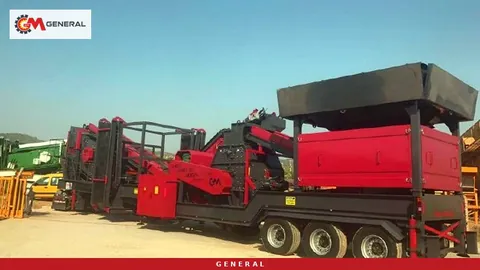
In a hard rock quarry, the cost of choosing the wrong crusher does not show up in the first month. The plant starts, tonnage looks fine and everyone is satisfied. By the third month blow bar changes come more often, the flakiness of the screened chippings creeps towards the specification limit and the operator starts slowing the feeder down. Basalt, granite and quartzite all carry the same "hard rock" label, yet the load each one puts on a crusher is different. This guide explains how an investor targeting 150-250 TPH should tell the three rocks apart, which crushing stages to combine and which General models to look at.
All model figures below are catalogue values from our product pages. A firm verdict on the stone in your own quarry needs a laboratory sample; treat the recommendations here as starting points to be confirmed by those tests.
Basalt, granite and quartzite load a crusher differently
Wear is governed by free silica and the related Bond abrasion index (Ai), not by Mohs hardness. Our jaw crusher page gives the threshold: once silica exceeds 10% or Bond Ai exceeds 0.15, the material is abrasive and compression crushers take the lead. All three rocks sit above that line, but at different distances.
Basalt: high strength, moderate abrasiveness
Our cone crusher page puts basalt at Ai≈0.20. What makes basalt hard work is not that it scrapes metal away, but the load its high compressive strength places on the crusher frame and bearings. Massive, fine-grained flow basalt and vesicular basalt can occur in the same quarry; the vesicular type breaks more easily but raises the share of fines and dust. A cubical particle shape is relatively easy to achieve in basalt, which is why rotor-type cubicizers are common in basalt lines.
Granite: abrasive and coarse-grained
The same source gives granite Ai≈0.55, more than two and a half times the basalt figure. Large quartz and feldspar crystals break into sharp edges that scour the liners. Weathered upper benches often contain granite that has decayed to a sandy consistency (grus); unless it is removed before the crusher, it eats capacity and contaminates the product with fines.
Quartzite: the highest silica of the three
Quartzite is a metamorphic rock made almost entirely of tightly bonded quartz grains. Our product pages do not give a separate Ai value for quartzite, so we do not quote one. In practice it consumes liners fastest of the three and is the material that pushes an impact crusher out of economic range soonest. For quartzite, the compression principle should come first at every crushing stage.
Where an impact crusher reaches its limit in hard rock
A horizontal shaft impactor (HSI) throws material from blow bars on the rotor against breaker plates. In limestone and dolomite this gives high reduction and a cubical product in a single pass; our M-PDK primary impact unit page quotes ratios of up to 20:1 in limestone. The same unit can crush basalt and granite, but in rock with high free quartz the blow bars wear noticeably faster.
On site the difference looks like this: a blow bar set that lasts for weeks in limestone has to be turned and replaced much sooner in granite. Every change means downtime, and downtime means the 150-250 TPH target is missed by the end of the shift. That is why our recommended layout for hard rock is a jaw primary followed by a cone or cubicizer secondary. An impact secondary is still an option for moderately abrasive stone such as basalt when particle shape comes first; for quartzite it is not the first choice.
Matching models to the 150-250 TPH range
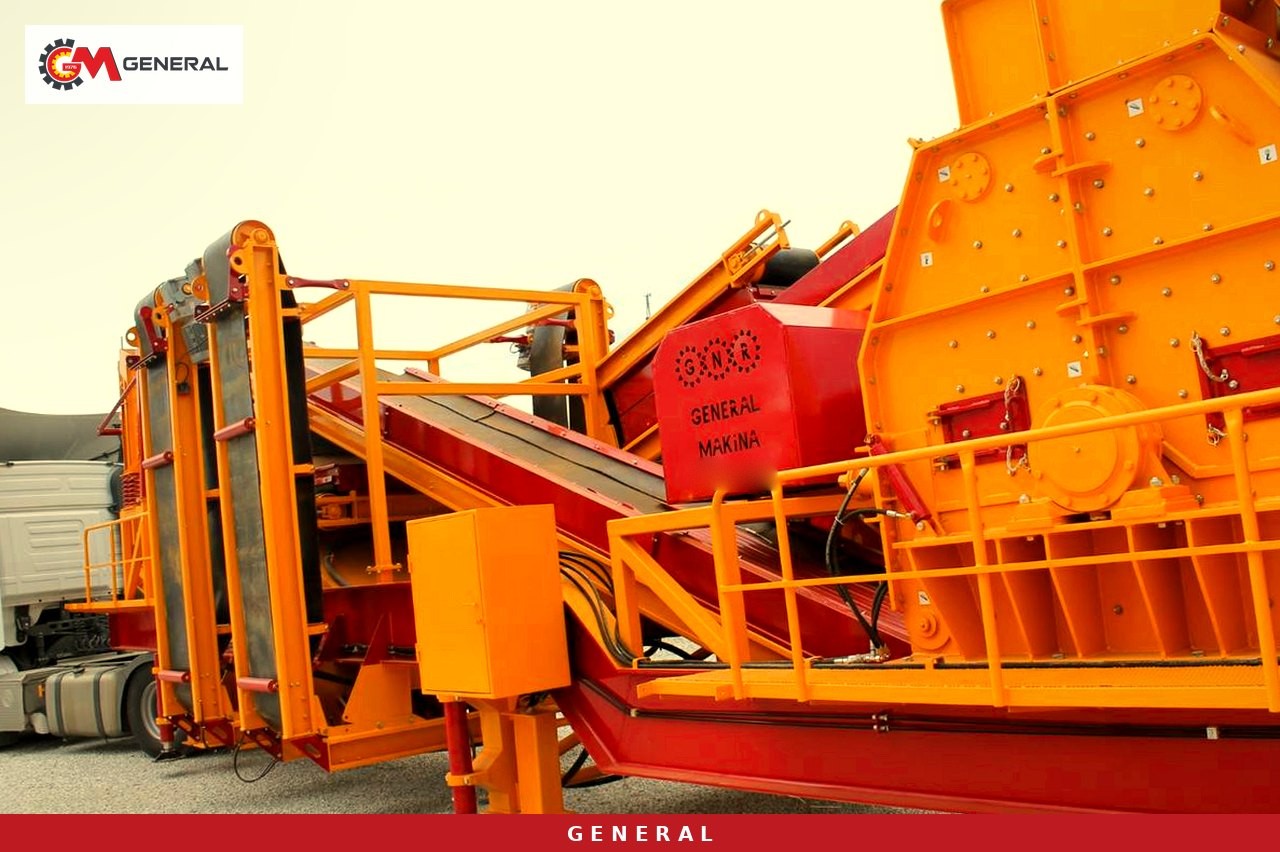
Our catalogue has no single hard-rock unit that covers the whole range on its own. The table shows four real ways to reach the target, each row written with the values from the corresponding product page.
| Configuration | Primary | Secondary | Capacity (t/h) | Feed (mm) | Generator / motor |
|---|---|---|---|---|---|
| General 944 (single chassis) | GPJ 90 jaw | GM430 cone | 120-180 | 800 | 550 kVA |
| GNR-MC110 (twin chassis) | GPJ 110 jaw | DMK03 impact | 200-300 | 900 | 750 kVA |
| Mobile primary GNR 110 + GNR MK110 | GNRK 110 jaw | MK110 cubicizer | 180-300 / 160-250 | 0-1100 / 350 | 200 kW (MK110) |
| Stationary line: GNRK 110 + cone | GNRK 110 jaw | General cone | 200-350 (primary) | 1100×850 mouth | 110/132 kW (primary) |
For buyers who want a single-chassis plant
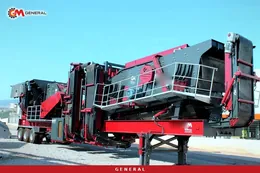
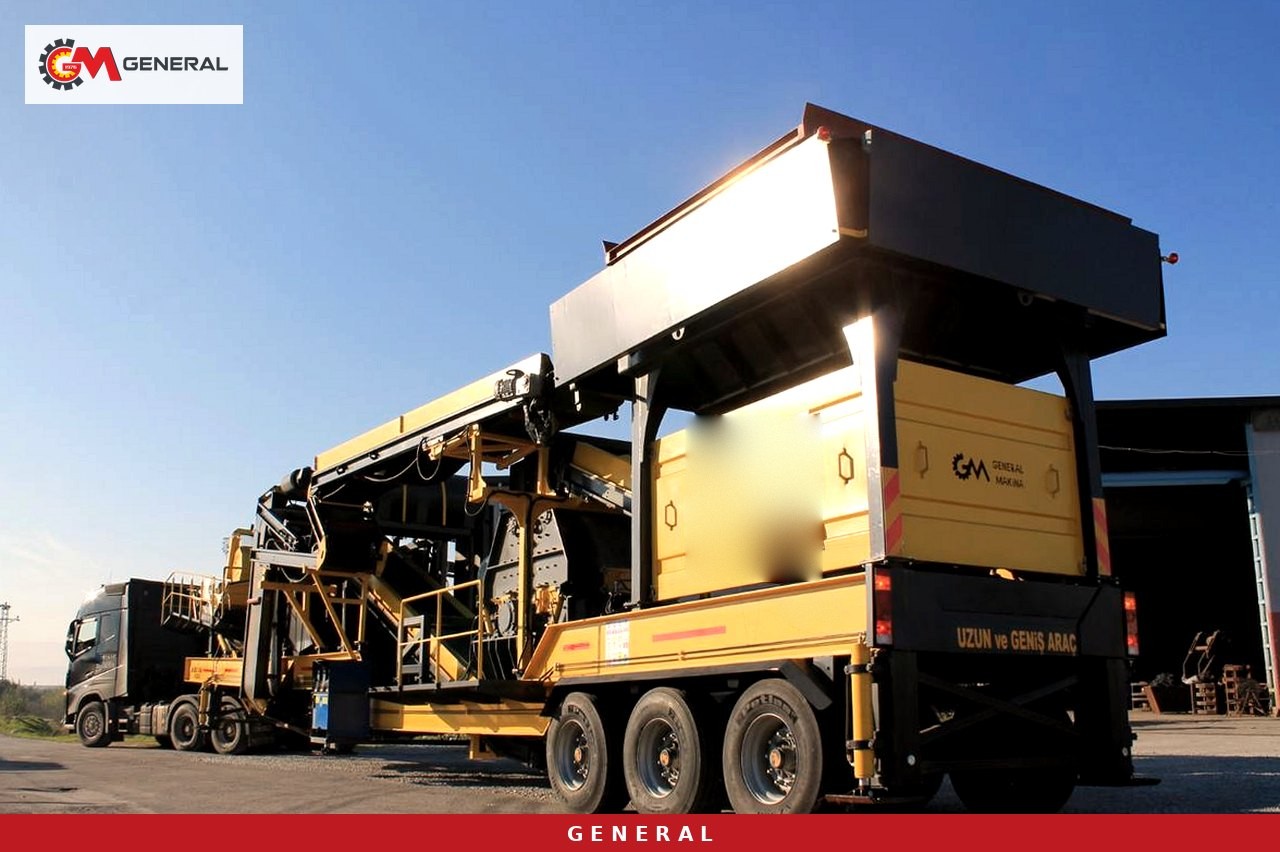
General 944 is a wheeled plant designed for hard rock: the GPJ 90 jaw primary is followed by the GM430 cone, and a 1600×5000 mm three-deck horizontal screen delivers 0-5 / 5-12 / 12-19 mm fractions. One unit sits in the lower part of the range. An operation that wants to get close to 250 TPH can add a second 944 for a combined catalogue figure of 240-360 t/h; the benefit of two units is that one keeps producing while the other is in maintenance. The cone secondary is what makes this model stand out in granite and quartzite.
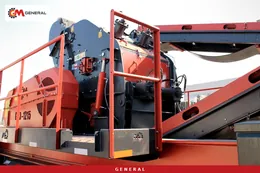
GNR-MC110 reaches the upper half of the range in one step: 200-300 t/h, 900 mm feed and a 2000×6000 mm four-deck screen producing four products, 0-5 / 5-12 / 12-19 / 19-40 mm. The primary and secondary chassis can run independently. Its secondary is the DMK03 impactor, which gives a good particle shape in basalt and granite; in a quarry dominated by quartzite, blow bar consumption has to be assessed with a sample at the quotation stage.
A line built from modular units
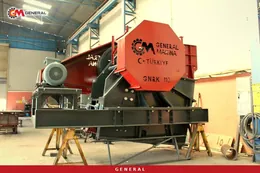
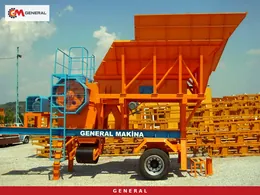
The GNR 110 mobile primary jaw unit combines an armoured feeder hopper and a GNRK 110 jaw on one chassis, runs at 180-300 t/h and accepts 0-1100 mm feed. Coupled behind it, the GNR MK110 cubicizer with 160-250 t/h, 350 mm maximum feed and a 200 kW motor forms the typical pair for a basalt line. The cubicizer's inner liners are Hardox 500 steel; in high-quartz work liner life must be monitored and a cone alternative considered where needed. For a single long-life quarry, stationary crushing lines cover the same range on a concrete foundation with a GNRK 110 primary and a cone secondary.
The secondary stage is chosen by the rock
The primary crusher choice leads to the same answer for all three rocks: a jaw. The real split happens at the secondary stage, and that decision is driven by the abrasiveness of the stone together with the particle shape the product needs.
In basalt, a cubicizer or an impact secondary improves particle shape easily; if the job calls for low-flakiness chippings for an asphalt wearing course, these two options are practical. In granite the cone crusher moves ahead: as our page states, it gives 6:1-8:1 reduction as a secondary and about 10:1 as a tertiary, accepts 50-250 mm feed, and its wear part consumption is clearly lower than an impactor's. In quartzite, options other than a cone should only be discussed after a sample test.
A cone can also improve particle shape. The way to do it is to run the cone choke-fed and keep the CSS close to the target product. A cone running half empty produces flaky stone, so setting the feeder and hopper level to keep the cone mouth full at all times is one of the first jobs during commissioning.
Wear part metallurgy and screen layout
Jaw plates are cast in austenitic manganese steel. The standard grade is Mn13/Mn18; our jaw crusher page recommends Mn18/Mn22 for high-silica stone. Manganese steel work-hardens on the surface under impact, so a correctly fed jaw plate gets harder as it works. Cone liners (mantle and concave) are generally manganese steel, with a high-chrome liner option for high-silica duty.
The cheapest way to extend plate life is to keep material that does not need crushing out of the crusher. If weathered granite and soil are not removed on the grizzly feeder, the jaw works for nothing. On the screen side, the sharp grains of hard rock shorten wire cloth life; mesh apertures and wire thickness are set at order stage according to the product grading. Bear in mind that the 944 has three decks and the MC110 four, and that the number of decks directly sets how many products go to stockpile.
Dust is a separate issue in hard rock. The fine dust from crushing granite and quartzite contains silica. Water-spray dust suppression at transfer points and enclosed belt covers are measures that can be selected per project; if your specification sets a dust limit, state it at the quotation stage.
Sampling and pre-quotation checklist
To define the right configuration, we ask you to prepare the following information:
- Compressive strength, Bond Ai and silica content from samples taken at different levels of the quarry.
- The largest lump size in the run-of-mine rock and its typical distribution after blasting.
- The share of weathered zone, soil and clay, and how moisture changes in the wet period.
- Target products, the daily tonnage of each and the particle shape limit in the specification.
- Daily operating hours, and whether grid power is available or the plant will run on a generator.
- Quarry life: a job of a few years or many years on the same site.
The last item decides between mobile and stationary. For an operation that will change sites, wheeled mobile crushing and screening plants are the right fit; an operation staying on one quarry for many years gains a larger feed opening and more screen decks from a stationary line.
Frequently asked questions
Why is an impact secondary not recommended for quartzite?
An impactor will crush quartzite, but blow bar consumption is high and stoppages become frequent. For quartzite we recommend a jaw primary and a cone secondary; an impact option is only considered after a sample test and when particle shape is mandatory.
Can basalt and granite be processed on the same line?
Yes, the General 944 and the stationary jaw-cone line handle both. Since granite is more abrasive, liner stock and the change schedule should be planned around granite.
What does the warranty cover?
Our machines carry a 1-year warranty; wear parts are excluded. Production is certified to ISO 9001 and CE.
What determines the price?
The number of crushing stages, mobile or stationary design, the number of screen decks, generator requirements and the shipping method. We prepare a project-specific quotation based on your sample results and target products.
Conclusion
Particle shape is the main concern in basalt, wear in granite and silica management in quartzite; in all three the primary should be a jaw. For 150-250 TPH, the General 944, the GNR-MC110, the GNR 110 with MK110 pair and the stationary jaw-cone line are the real options. Contact us with your sample data and we will define the right configuration for your stone together.
Definitions of technical terms: Glossary