EN — English
 TR — Türkçe
 DE — Deutsch
 RU — Русский
 FR — Français
 ES — Español
 AR — العربية
 SR — Српски

Tanzania Granite Quarry Stone Crushing Plant 120-180 TPH
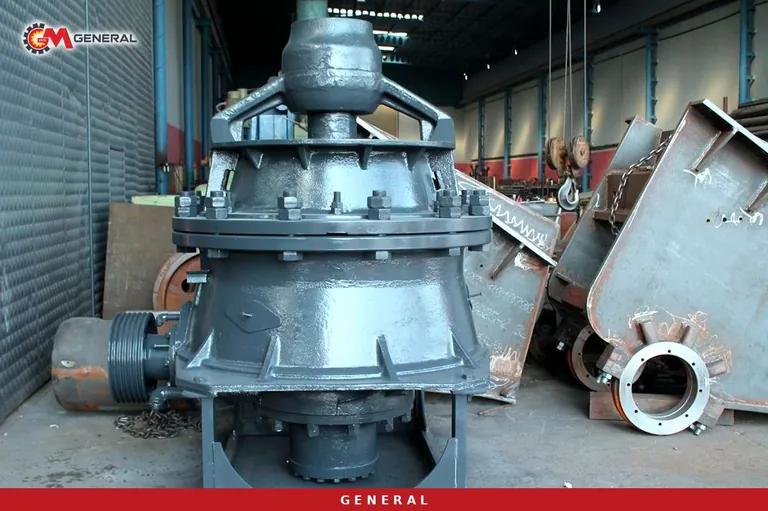
An investor opening a granite quarry in Tanzania, or expanding an existing one, usually has two files on the desk: a handful of rock samples from the face, and the haul route from the port of Dar es Salaam to the pit. Choosing the right granite line for 120-180 tonnes per hour depends on reading those two files together. This article looks at the decision from the buyer's side: which real models cover this band, why the cone secondary decides the economics in granite, how logistics and seasons shape the choice, and what information should be ready before you ask for a quote.
From Mwanza to Dodoma: the load Tanzanian granite puts on a line
Much of Tanzania's bedrock is old crystalline rock. The massive granite outcrops around Mwanza on the shore of Lake Victoria are among the country's best-known landscapes, and granite and gneiss quarries are common along the Dodoma-Morogoro corridor as well. Stone from these pits goes into roads, bridges, housing and ready-mix concrete as crushed aggregate. Yet no two quarries produce the same granite: quartz content, grain size and degree of weathering vary from one seam to the next. What follows is a general framework; an abrasion (Bond Ai) and crushability test on your own rock moves the choice from guesswork to measurement.
Granite loads a crushing plant at three points. In the primary stage, large angular blocks demand high compressive force. In the secondary stage, free silica wears metal surfaces, and the wrong crusher type multiplies the parts cost per tonne. On the screening side, the share of flaky and elongated particles in crushed granite can cause trouble with concrete and asphalt specifications. Before looking at a capacity figure for a 120-180 TPH line, look at these three points.
Three configurations on the table for this tonnage
The target range is one our wheeled family can cover with a single unit. For an investor who wants a fixed installation, the same tonnage can also be built from separate machines. The table below sets the product-page data side by side; cells with a dash are defined per project.
| Item | General 944 | General 950 | Fixed line: GNRK 90 + cone crusher |
|---|---|---|---|
| Capacity | 120-180 t/h | 120-180 t/h | GNRK 90: 60-225 t/h |
| Primary crusher | GPJ 90 jaw | GPJ 90 jaw | GNRK 90, opening 900×650 mm |
| Secondary crusher | GM430 cone | DMK01 impact | General cone crusher (model per project) |
| Max. feed size | 800 mm | 800 mm | — |
| Screen | 1600×5000 mm, three-deck | 1600×5000 mm, three-deck | Example: GNR 1650, 1600×5000 mm, 15 kW |
| Product fractions | 0-5 / 5-12 / 12-19 mm | 0-5 / 5-12 / 12-19 mm | Set by deck count and apertures |
| Generator | 550 kVA | 600 kVA | — |
| Weight | 70,000 kg | 70,000 kg | GNRK 90 alone: 11,400 kg |
General 944: the first candidate for granite
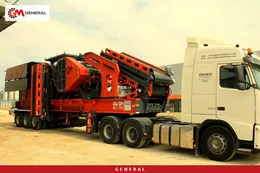
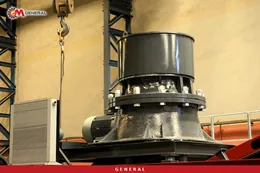
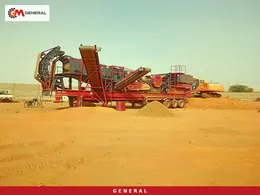
The General 944 combines a GPJ 90 primary jaw with a GM430 cone secondary on one wheeled chassis. It accepts run-of-mine rock up to 800 mm and splits it into 0-5, 5-12 and 12-19 mm on a 1600×5000 mm three-deck horizontal screen. In granite the real gain sits in the secondary: because the cone breaks rock by compression, the mantle and concave wear far more slowly than the blow bars of an impact rotor. A hard-rock application of the same family appears on our site as the GNR 944 project in Africa rated at 120-150 t/h.
General 950: when does an impact secondary make sense?
The General 950 is the 944's twin in size and weight; the difference is the DMK01 impact crusher in the secondary. An impactor gives high reduction and cubical grains, but in quartz-rich granite blow-bar consumption rises quickly. If the test shows your rock has low abrasivity, or if cubical shape dominates the product programme, the 950 deserves a look; otherwise a cone secondary stays cheaper to run on Tanzanian granite.
Fixed line: GNRK 90 followed by a cone crusher
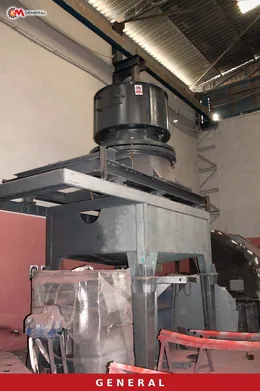
When the quarry has a long life and the reserve sits in one place, fixed crushing plants should be considered. In this layout a GNR 90 grizzly feeder (1000×3750 mm, 140-210 t/h) feeds the GNRK 90 jaw crusher; with its 900×650 mm opening and 75/90 kW motor it works in the 60-225 t/h range. For the General cone crusher behind it, the model, capacity and power table is prepared per project; the site gives only class values: secondary reduction 6:1-8:1, feed 50-250 mm, power in the 90-500 kW range. A fixed line needs a concrete foundation and either a grid connection or a separate power unit; in return, fraction count and stockpile layout become more flexible.
How cone crusher settings drive the cost per tonne
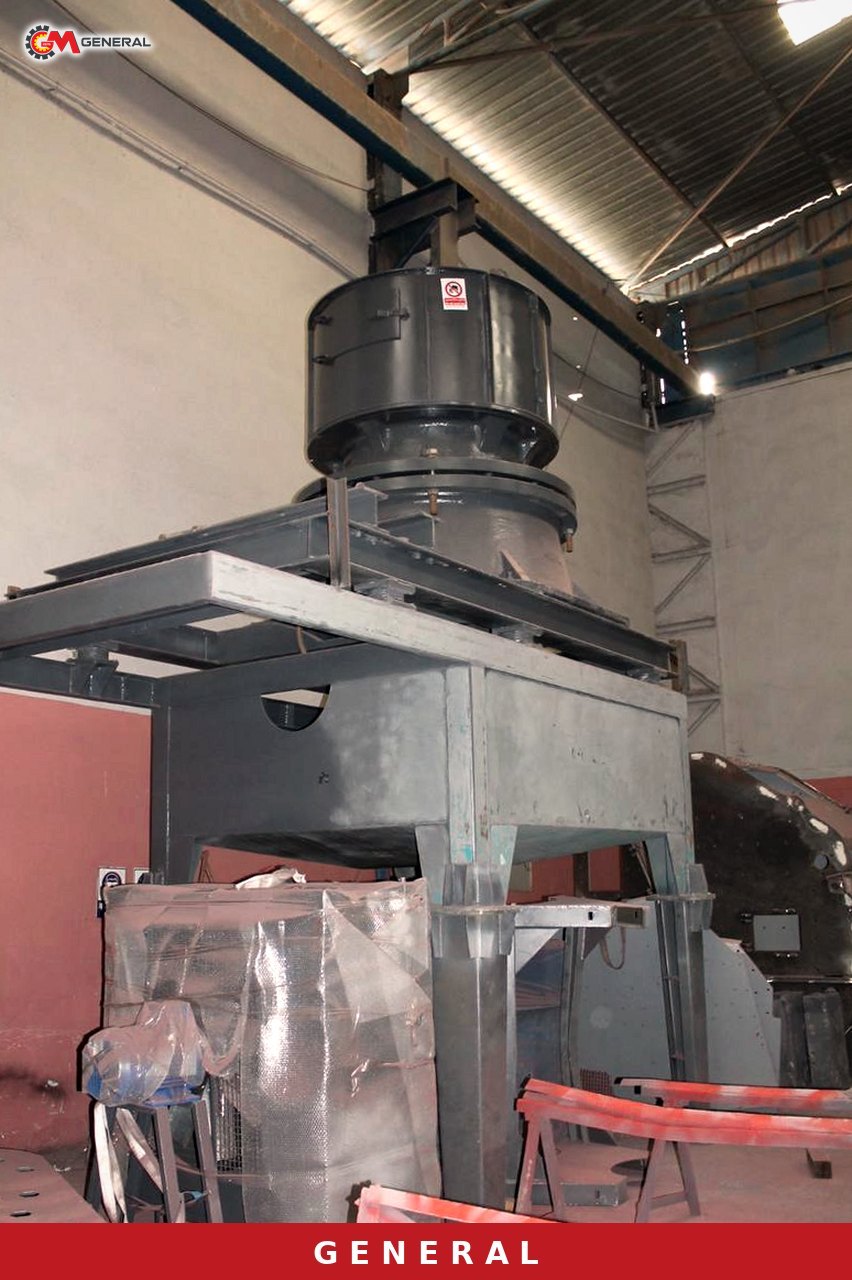
In a granite line the purchasing decision does not end with the nameplate; most of the operating cost is shaped by how the cone crusher is fed and set. Three settings stand out.
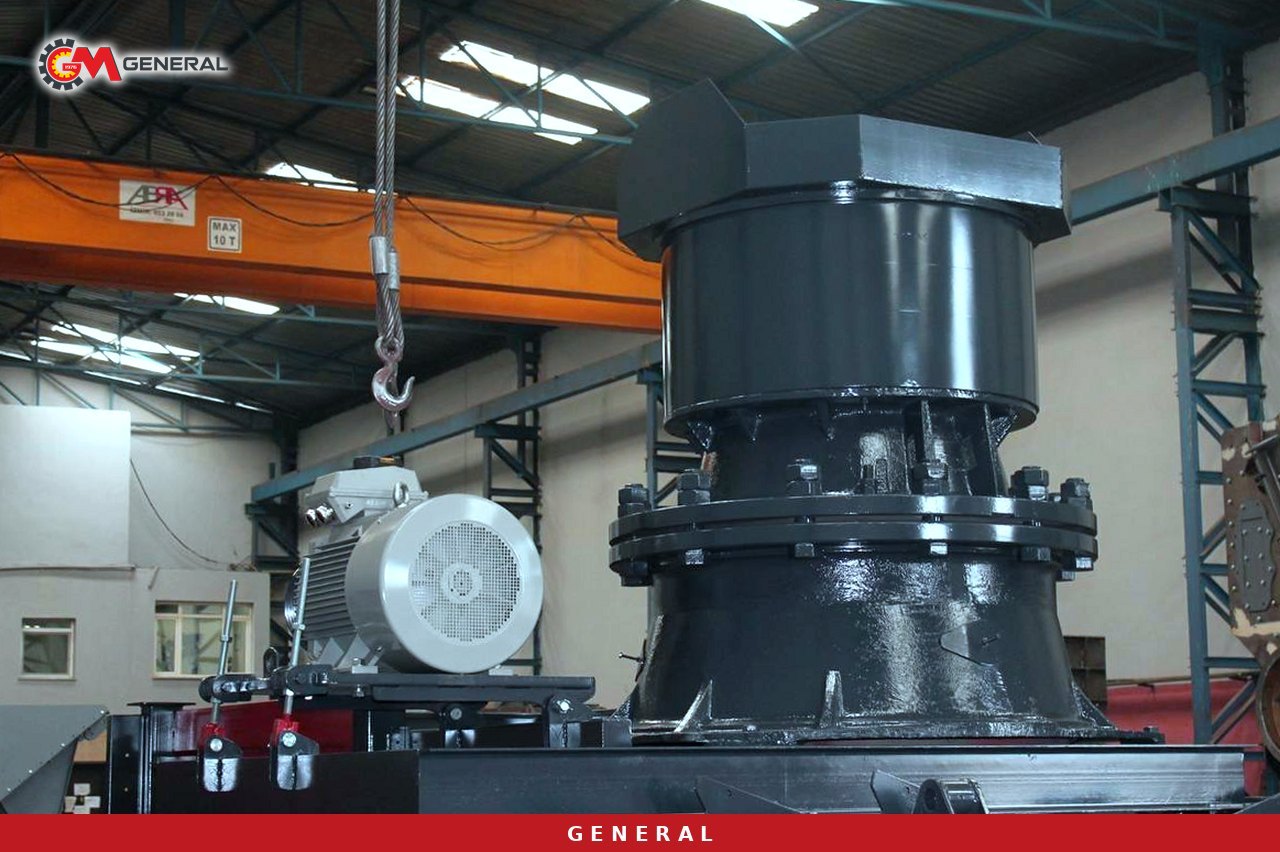
Choke feeding. With the crushing chamber kept full, the cone also breaks rock against rock and particle shape improves. A half-fed cone lowers the share of cubical product and leaves uneven wear on the mantle. A surge bin or a regulated feeder between the primary discharge and the cone therefore usually pays for itself.
Hydraulic CSS setting. Product size is set by the hydraulic adjustment mechanism, and a hydraulic cylinder protects the crusher against sudden packing. As wear progresses the closed-side setting opens; measuring and logging the CSS every week keeps the 12-19 mm fraction inside the specification limit.
Liner choice. A standard liner suits the secondary stage, a short-head liner the tertiary stage. Mantle and concave are usually cast in manganese steel; for high-silica rock a high-chrome option can be discussed. The abrasion test on the sample decides which one fits.
A simple formula shows the wear cost per tonne: (liner set cost + production lost during change-out hours) ÷ tonnes crushed over the liner life. As a hypothetical example, if the same set yields twice the tonnage on one line as on another, the parts cost per tonne halves. That ratio matters more than the list price when choosing a crusher type.
From Dar es Salaam port to the quarry: shipping and power plan
A crushing line leaving Türkiye usually enters Tanzania through the port of Dar es Salaam; for quarries in the north-east, Tanga port is another option. The road leg after the port has a direct bearing on machine choice.
The wheeled 944 has transport dimensions of 4130×20350×4500 mm and weighs 70,000 kg. On the long routes towards Mwanza or Arusha these figures should be checked in advance for bridges, crossings and abnormal-load permits; confirming permit conditions with the relevant road authority is one of the buyer's first tasks. In a fixed line the machines are packed separately, so loads are lighter, but foundations, steelwork and assembly labour are added on site.
Power is part of the shipping plan too. If the quarry is far from the grid, a 550 kVA power unit is budgeted for the 944 and 600 kVA for the 950. Close to the grid, a fixed line can run on electric motors; the quarry's energy infrastructure makes that call. The Titan 100 mobile concrete batching plant (100 m³/h) we delivered to the country is a concrete reference from Tanzania on how granite aggregate is used on the concrete side; for an investor who may later add concrete production to the crushing line, sourcing both from one supplier simplifies parts and contact persons.
Two rainy seasons and a dry spell: running the site
Across most of Tanzania the year divides into the long and short rains with dry periods between them. That cycle stresses a granite line in two different ways.
In the wet months, soil and clay arriving with the run-of-mine can blind the feeder grizzly and push wet fines into the cone. The grizzly feeder's by-pass section separates fines and soil before they reach the crusher; if the overburden is clayey, planning a separate scalping step and stockpile area helps. In the dry season the issue is dust: water-spray suppression at transfer points and over the screen, covered belts and frequent checks of engine air filters are measures that can be added per project. On a generator-powered site filter care matters even more, because a clogged filter in dusty air means lost power and overheating.
In hot weather, cooling of the hydraulic and lubrication systems belongs on the checklist as well. Keeping the fins of the cone crusher's oil cooler clean directly affects bearing life.
The quote file: what the buyer should prepare
Whether a quote arrives with the right configuration depends on what the buyer sends in the first message. The list below is the skeleton of the file for a granite quarry in Tanzania.
- A representative granite sample from the quarry and its abrasion/crushability test result; if no test has been done, a test plan.
- Target hourly tonnage and daily operating hours; where between 120 and 180 t/h the plant will run.
- Product programme: which fractions and in what proportions (concrete aggregate, asphalt chippings, sub-base).
- Largest block size after blasting; whether it exceeds the 800 mm limit.
- Power situation: distance to the grid or a generator preference.
- Route from port to quarry, road condition over the last kilometres and site gradient.
- Whether the plant stays on one site or moves between quarries.
A quote prepared from this information covers the configuration, screen apertures and an initial spare-parts package together. The main price drivers are the secondary crusher type, number of screen decks, power unit, conveyor lengths and freight terms. General Makina has been manufacturing in İzmir since 1976; its machines carry ISO 9001 and CE certification and are delivered with a 1-year warranty, wear parts excluded.
Frequently asked questions
Cone or impact secondary for Tanzanian granite?
For granite whose test shows high abrasivity, a cone secondary is recommended: the General 944, or a cone crusher in a fixed line. If the rock is low in abrasion and cubical grains come first, the DMK01 impactor on the General 950 can be considered.
Can a 120-180 TPH line run on a generator?
Yes. A 550 kVA power unit is specified for the General 944 and 600 kVA for the General 950. At quarries near the grid, a fixed line can run on electric motors.
When is a fixed line better than a wheeled plant?
A fixed line pays off when the reserve is in one place with a long life, and when more fractions and a large stockpile area are needed. If the plant must move between quarries or start up quickly, the wheeled plant comes first.
How are price and delivery time settled?
Both depend on the chosen configuration, the power unit and the shipping terms. Send your request with the file above and a project-specific quote will be prepared.
Conclusion: test the rock first, then choose the line
For a 120-180 TPH granite target in Tanzania, the strongest candidate is the General 944 with its GPJ 90 jaw and GM430 cone; the General 950 is the alternative for low-abrasion rock, and a fixed line built around the GNRK 90 and a cone crusher suits a long-life single site. Other wheeled options are listed on our mobile crushing and screening plants page. Send your sample test result, target product list and quarry location through our contact page and we will prepare a configured quote based on delivery to Dar es Salaam.
Definitions of technical terms: Glossary