EN — English
 TR — Türkçe
 DE — Deutsch
 RU — Русский
 FR — Français
 ES — Español
 AR — العربية
 SR — Српски

West Africa Gold Fields: Best Crushing and Screening Plant 100-200 TPH
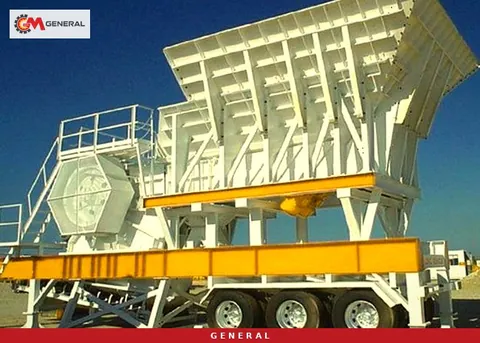
For an operator opening a gold field in West Africa, choosing a crusher starts with understanding how the material from a single pit changes with depth. In the Birimian greenstone belts, a laterite cap and clay-rich saprolite sit on top, while hard, abrasive fresh rock cut by quartz veins lies below. A crushing and screening plant targeting 100-200 TPH will meet both extremes within the same year, sometimes within the same shift. This article looks at how jaw, cone, impact and wobbler-scalped jaw crushers behave against that profile, which General Makina models genuinely cover the band, and how the differences between the Sahel and the coastal belt translate into the equipment list.
The regolith profile: depth decides the crusher type
Most deposits along the gold belts that run from Ghana to Mali and from Burkina Faso to Guinea and eastern Senegal sit in rocks exposed to long tropical weathering. That weathering splits the pit into layers, and each layer asks something different of the crusher:
- Laterite and ferruginous crust: lumpy, partly gravelly material that turns sticky when it rains. The difficulty lies in feeding rather than crushing; grizzly gaps can blind with clay.
- Saprolite (oxide zone): soft, fines-rich ore that breaks easily. Here screen area and pre-scalping capacity matter more than crusher power.
- Transition zone: a mix of partly weathered rock blocks and clayey matrix, with the widest swings in lump size and moisture.
- Fresh rock and quartz veins: high in silica, hard and abrasive. This zone drives wear part consumption and therefore the operating cost per tonne crushed.
Many operations start on oxide ore and reach fresh rock within a few years. An operator who sizes the crusher only for today's soft material later faces either a heavy wear bill or the need to rebuild the line. Taking representative samples of every zone from drill cores and running abrasion and crushability tests before ordering is the first and cheapest step in model selection.
Four crusher types against gold ore
Jaw crusher: the natural owner of the primary stage
Working on compression, the jaw crusher is the primary choice that keeps metal consumption low in quartz-veined fresh rock. In the GNRK series the GNRK 90 runs at 60-225 TPH with a 900×650 mm opening and a 75/90 kW motor, and the GNRK 110 at 200-350 TPH with a 1100×850 mm opening and a 110/132 kW motor. The jaw plates are austenitic manganese steel that work-hardens under impact. Because a clay-laden feed can pack the cavity, placing grizzly or wobbler scalping ahead of the jaw is how the laterite period is run without stoppages.
Cone crusher: the second stage for quartz-rich fresh rock
The cone crusher squeezes material from several directions inside the bowl liner; in high-silica ore its mantle and concave wear far more slowly than an impact rotor. For a gold mine that has reached or will reach fresh rock, it is the preferred type for the second stage. Run choke-fed, it improves both liner life and particle shape, and hydraulic CSS adjustment makes it easier to hold the product size that the milling or leach circuit expects.
Impact crusher: strong in oxide, costly in quartz
An impact secondary delivers a high reduction ratio and stays economical in soft, low-abrasion ore such as saprolite. Once the same machine moves into quartz-rich fresh rock, blow bar change intervals shorten noticeably. Primary impact (HSI) crushers are designed for materials like soft limestone and are not recommended as the first stage on quartz-bearing gold ore.
Wobbler-scalped jaw unit: insurance for the rainy season
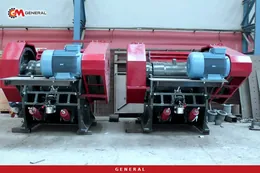
In a wobbler feeder, material tumbles forward over rotating shafts, and clay and fines separate before reaching the jaw. On sites with a high share of laterite and saprolite it keeps feeding even when a grizzly would blind. Its capacity of 250-450 TPH sits above the 100-200 TPH band; it is still worth considering when the mine plans to grow or when the clay share is very high.
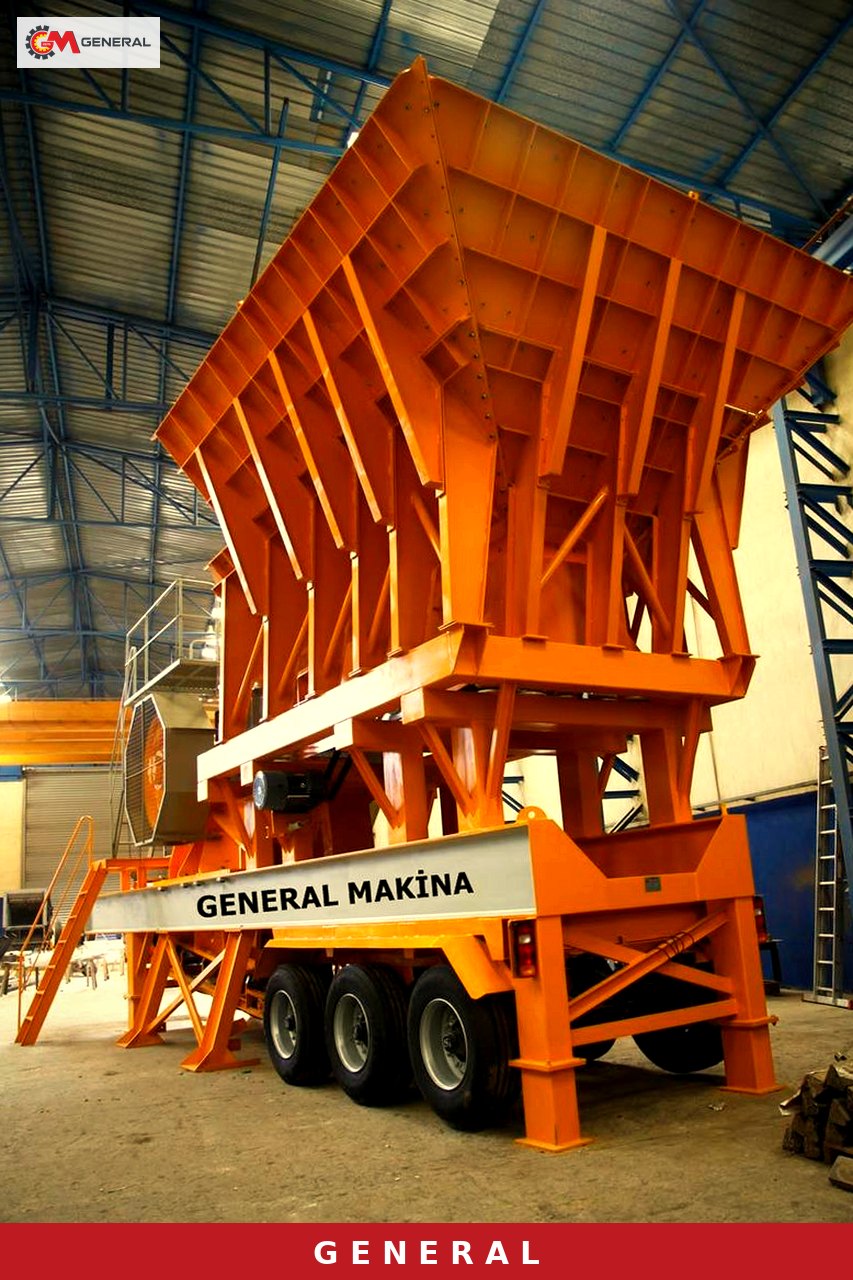
Real models and combinations for the 100-200 TPH band
The table below contains only values published on the product pages. Unknown cells are marked "—"; screen apertures and product split are agreed at order stage based on ore samples.
| Configuration | Crushing stages | Capacity (t/h) | Max. feed (mm) | Screen | Generator (kVA) | Weight |
|---|---|---|---|---|---|---|
| General 944 | GPJ 90 jaw + GM430 cone | 120-180 | 800 | 1600×5000 mm, 3-deck | 550 | 70,000 kg |
| General 950 | GPJ 90 jaw + DMK01 impact | 120-180 | 800 | 1600×5000 mm, 3-deck | 600 | 70,000 kg |
| GNR-MC110 | GPJ 110 jaw + GS1215/DMK03 impact | 200-300 | 900 | 2000×6000 mm, 4-deck | 750 | 2 × 55,000 kg |
| GNR 110 mobile primary unit | GNRK 110 jaw | 180-300 | 1100 | — | — | 55,000 kg |
| Wobbler-scalped mobile jaw | Jaw + wobbler feeder | 250-450 | — | — | — | — |
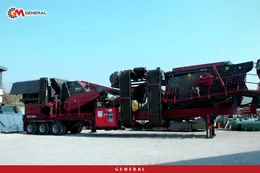
Two sister models stand out in the lower and middle part of the band. The General 944 pairs a GPJ 90 jaw primary with a GM430 cone secondary; for a mine heading into fresh quartz-rich rock it is the most consistent mobile option. The General 950 has the same dimensions and weight but carries a DMK01 impact secondary; it makes sense when the mine will crush mainly oxide ore over its life. Both deliver 120-180 TPH; the decision between them comes down to how well the secondary suits the ore.
At the top end of the band sits the GNR-MC110: a GPJ 110 jaw primary and an impact secondary on two separate chassis, 200-300 TPH. Because the primary chassis can run on its own, it is possible to do only primary crushing in the first year and bring the secondary chassis in later. Where a cone stage is wanted above 200 TPH on quartz-rich ore, a cone crushing stage is added after the GNR 110 mobile primary unit, or the line is designed as a stationary plant; model-specific cone capacity is provided per project.
Sahel belt versus coastal forest: two climates, two equipment lists
West Africa's gold fields do not share a single climate. Northern sites near the Sahel see a long dry season and fine dust carried by the harmattan wind, while southern sites closer to the Gulf of Guinea face a long, heavy rainy season. The same model should be ordered with different auxiliary equipment in each region.
On a dry, dusty site air is the priority: easily replaced air filters with pre-cleaners on generator and engine intakes, water-spray dust suppression at transfer points, covers on belt conveyors and dust seals on electrical panels. These are measures that can be chosen per project and should be listed separately at quotation stage.
On a wet site material flow is the priority: wobbler or wide-gap grizzly scalping, a sloped and drained plant pad, regular checks for clay build-up inside hoppers, and blinding-resistant screen media on each deck. Keeping a covered buffer pile on the stockyard for the wet saprolite season stops the crusher from running empty.
Energy is common to both regions. On mine sites far from the grid, mobile plants run on their own generator: the product tables list 550 kVA for the General 944, 600 kVA for the General 950 and 750 kVA for the GNR-MC110. The fuel supply routine and spare filter stock affect production continuity as much as the crusher type does.
From port to mine site: coastal versus landlocked countries
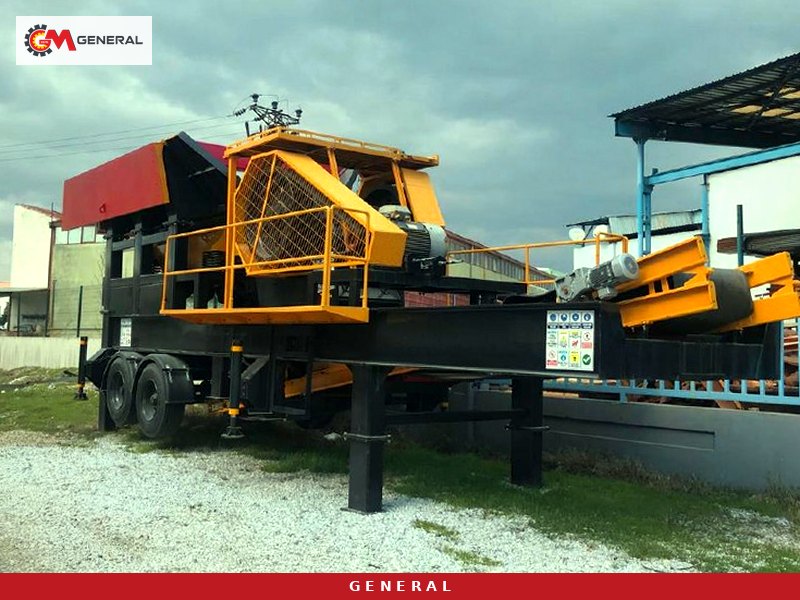
In countries with a coastline, equipment reaches the site on a relatively short road leg after landing at the port. In landlocked countries such as Mali, Burkina Faso and Niger, cargo moves by transit road from a neighbouring country's port, so chassis dimensions, axle loads and bridge limits become selection criteria. The General 944 and 950 have a transport size of 4130×20350×4500 mm and weigh 70,000 kg. On the GNR-MC110 the load is split over two chassis measuring 3000×13500 mm and 4200×18300 mm, each weighing 55,000 kg. The route survey should be done with the haulier, and transit permits confirmed with the relevant authorities.
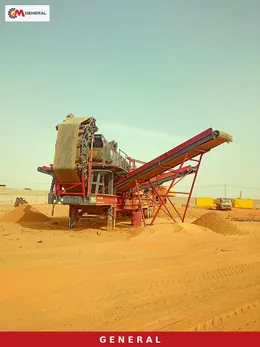
As a regional reference, the General 950 shipped to Niger is listed on the site at 240 TPH. Details are on the project page; the ore and capacity data of your own site are assessed separately.
Site data checklist before ordering
- A representative sample and abrasion/crushability test result from each regolith zone (laterite, saprolite, transition, fresh rock).
- The oxide-to-fresh ore ratio by year in the mine plan.
- The largest particle size accepted by the milling or heap leach circuit.
- The largest lump size coming from blasting or excavator loading.
- Daily operating hours and annual target tonnage; these two place you within the 100-200 TPH band.
- Power source: generator, site power plant or grid.
- Port and road route, chassis size and weight limits.
- Dust and water management conditions in the environmental permit.
Frequently asked questions
Is there a single "best" crusher type for gold ore?
No. A jaw crusher is right for the primary stage in almost every case; the second stage is chosen to suit the ore. A cone stands out in quartz-veined fresh rock, an impact secondary in mainly oxide ore. Wherever the feed is clayey, wobbler scalping is assessed as well.
Does the plant have to be replaced when the mine moves from oxide to fresh rock?
If the cone-secondary General 944 is chosen at the start, the same line handles fresh rock too. Starting with an impact-secondary line means wear part consumption rises in fresh rock; that transition should be built into the mine plan from day one.
What warranty and certificates apply?
General Makina has been manufacturing in Izmir since 1976; the machines carry ISO 9001 and CE certification. The warranty runs for one year, excluding wear parts.
What determines the price?
The model and crusher combination, auxiliary equipment such as generator and dust suppression, the number of screen decks, the spare wear part package and the shipping method set the price. The figure is finalised in a quotation prepared with your site data.
Conclusion: ore behaviour with depth first, model second
For 100-200 TPH on West African gold fields, the right crusher combination is the one that covers the whole profile from laterite and saprolite down to quartz-rich fresh rock from the outset. On most sites the jaw-plus-cone General 944 is a safe starting point; the General 950 suits oxide-dominated, short-life sites, and the GNR-MC110 is assessed for operations heading above 200 TPH. All mobile options are on the wheeled mobile crushing plants page. Contact us with your sample results and mine plan, and we will prepare a quotation for the configuration that suits your site.
Definitions of technical terms: Glossary