EN — English
 TR — Türkçe
 DE — Deutsch
 RU — Русский
 FR — Français
 ES — Español
 AR — العربية
 SR — Српски

Georgia Kura & Rioni Gravel Crushing and Screening Plant 100-200 TPH
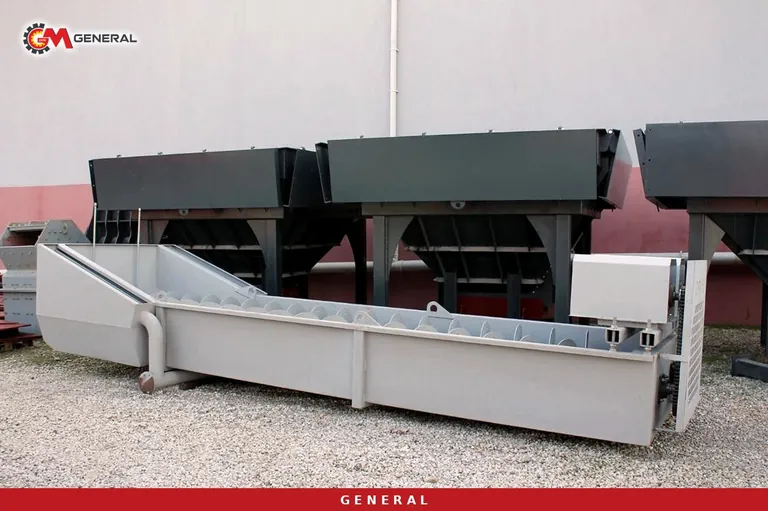
For an investor in Georgia looking for aggregate for ready-mix concrete, precast and road work, the most accessible raw material is often river gravel. In the east, the Kura (Mtkvari in Georgian) flows through Tbilisi and on into Azerbaijan; in the west, the Rioni comes down from the Caucasus slopes, passes Kutaisi and reaches the Black Sea at Poti. The beds and old terraces of both rivers hold sand, gravel and large rounded cobbles. This article looks at which crushing, washing and screening equipment a Georgian gravel pit targeting 100-200 TPH should install, and in what order, using General Makina catalogue values. The aim is to help you ask the right questions before you get to a machine list.
Kura versus Rioni: two different deposits in one country
A river's gravel is a summary of the ground it has crossed. Rivers fed from the Caucasus carry a mix of volcanic and sedimentary stones; a single bucket can hold hard andesite or basalt pebbles next to softer sandstone and limestone gravel. That mix decides both the crusher type and the consumption of wear parts. Rather than guessing the proportions, ask for a petrographic examination and an abrasiveness test on a representative sample from the pit.
Flow regime also changes the material. Where a river leaves the mountains and enters the plain, large, partly rounded stone dominates; closer to the sea the grain gets finer and the share of sand and silt rises. In the lower Rioni, fines and organic debris are the more frequent problem, while on the valley terraces of the Kura clay bands and coarse gravel tend to appear. This is a generalisation; the real picture at your site only emerges from screen analyses of samples taken at different depths.
Extracting material from a riverbed or bank terrace requires a permit. Permit conditions, excavation depth and working season are set by the relevant Georgian authorities. Confirm these limits from official sources before drawing the plant layout, because how close to the bed you may set up directly changes the length of the water circuit and of the conveyor line.
Designing backwards from the product list
At a gravel plant the first question is not "how many tonnes?" but "which products will I sell, and in what proportion?" A ready-mix plant wants washed 0-5 mm sand plus 5-12 and 12-22 mm chippings; a road contractor wants crushed-face base material; a precast producer is very sensitive to clay in the sand. A plant built without knowing the sales mix either crushes too much or washes needlessly.
The share that needs crushing
Because river gravel is rounded, many concrete and asphalt specifications require a minimum share of crushed-face particles in the coarse aggregate. If there is no such requirement and most of the material is already a saleable size, the crusher only works to reduce oversize stone. If there is, part of the fine gravel also goes through the crusher and the crushing capacity grows.
The share that needs washing
Clay and silt are the main contaminants in sand: they lower concrete strength and raise water demand. Have the clay content measured with the Methylene Blue (MBV) or Sand Equivalent (SE) test. With a light clay load, a washing screen and a screw washer are enough; if there are sticky clay balls that will not crumble by hand, a log washer ahead of the screw is considered.
Take a hypothetical example: pit output of 200 t/h, about one third of it larger than the target size. The flow to the crusher then stays around 70 t/h, and the rest goes straight to washing and screening. Once a crushed-face requirement applies, the crusher share can double. The proportions vary from site to site; the logic stays the same: split the total flow into the share to be crushed and the share to be washed, and size each unit for its own share.
Models and configurations for 100-200 TPH
The table below compares General Makina units that may suit Georgian river gravel, using catalogue values. Capacities are ranges that vary with the material and the required grading curve.
| Unit | Capacity | Max. feed | Main equipment | Power supply | Weight |
|---|---|---|---|---|---|
| GNR YM1650 | 120-180 t/h | 0-100 mm | Sand hopper, washing screen, screw washer | Grid or generator | 21,000 kg |
| Mobil 90 | 90-150 t/h | 800 mm | GPJ 90 jaw, 1600×5000 mm 3/4-deck washing screen, 600×6000 mm twin screw washer | 350 kVA generator | 45,000 kg |
| General 944 | 120-180 t/h | 800 mm | GPJ 90 jaw, GM430 cone, 1600×5000 mm 3-deck screen | 550 kVA generator | 70,000 kg |
| Log washer | 50-250 t/h | 0-200 mm | 2 counter-rotating log shafts | — | — |
When the material is already saleable size: GNR YM1650
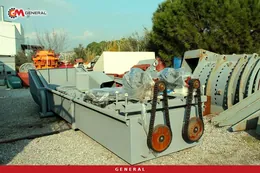
In a deposit like the lower Rioni, with little oversize and plenty of sand, the main job is cleaning. The GNR YM1650 washes and screens 0-100 mm feed at 120-180 t/h; the washing screen strips clay from the surface and the screw scrubs the fine sand and overflows the silty water. Stone above 100 mm is separated on the grizzly and stockpiled, or fed to a crusher later.
When crushed faces and oversize matter: General 944 plus YM1650
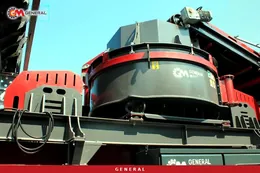
Where oversize and a crushed-face requirement are decisive, as on the Kura terraces, the General 944 is paired with the GNR YM1650. On the 944 the GPJ 90 jaw takes stone up to 800 mm, and the GM430 cone secondary, working by compression, consumes less metal than an impact rotor on hard, siliceous gravel. Crushed fines and natural sand are washed in the YM1650. Both units sit in the 120-180 t/h range, so once the crushing and washing shares are balanced, a line approaching 200 t/h can be built.
When a single-chassis set-up is preferred: Mobil 90
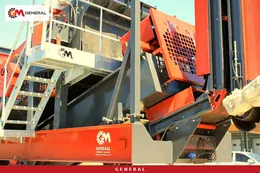
For an operation in the lower half of the target band that moves often or works a single plot, the Mobil 90 crushing, washing and screening plant carries a jaw crusher, washing screen and twin screw washer together, producing sand and chippings at 90-150 t/h without a second wash plant. If you need to reach 200 t/h, adding a second washing and screening unit alongside can be planned. For a wider choice, see the mobile crushing plants and washing and screening plants pages.
The screw washer: the unit that decides sand losses
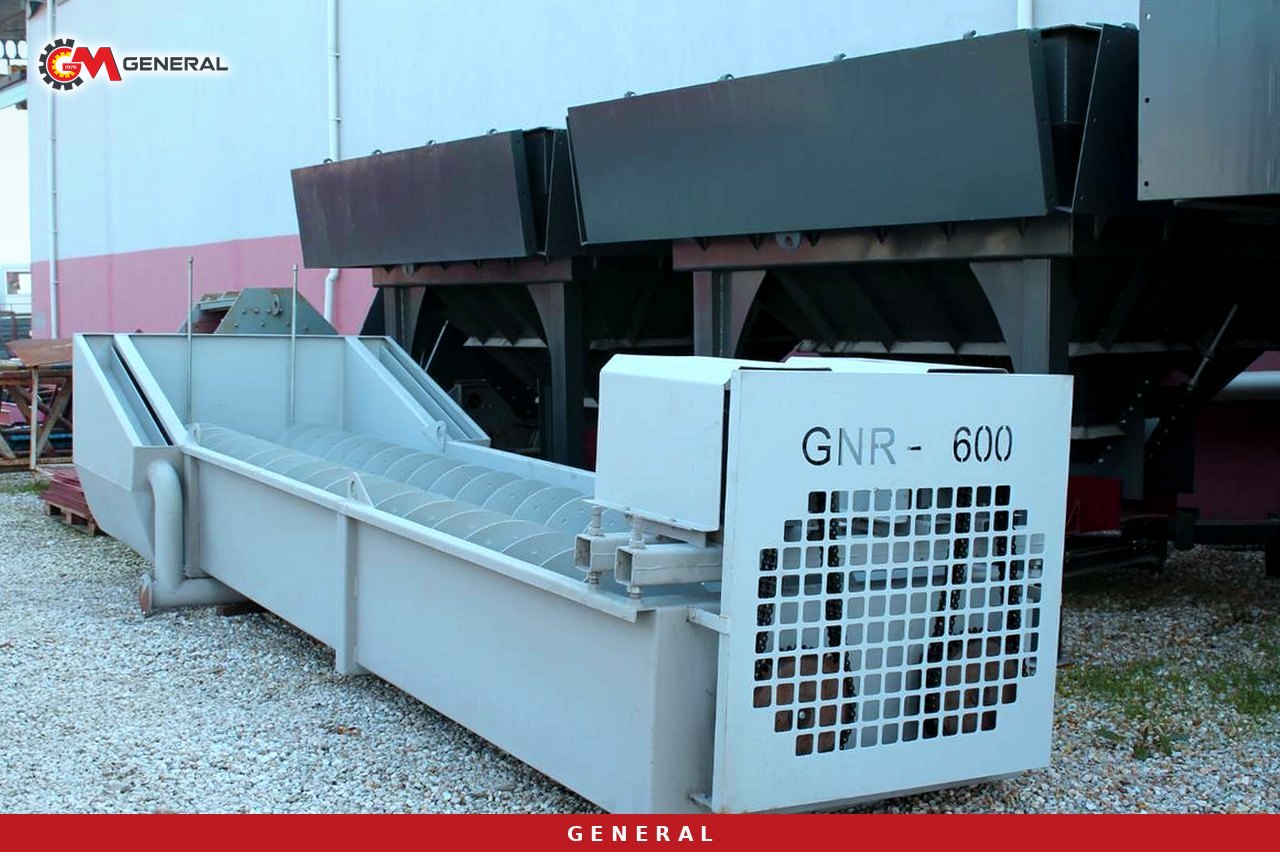
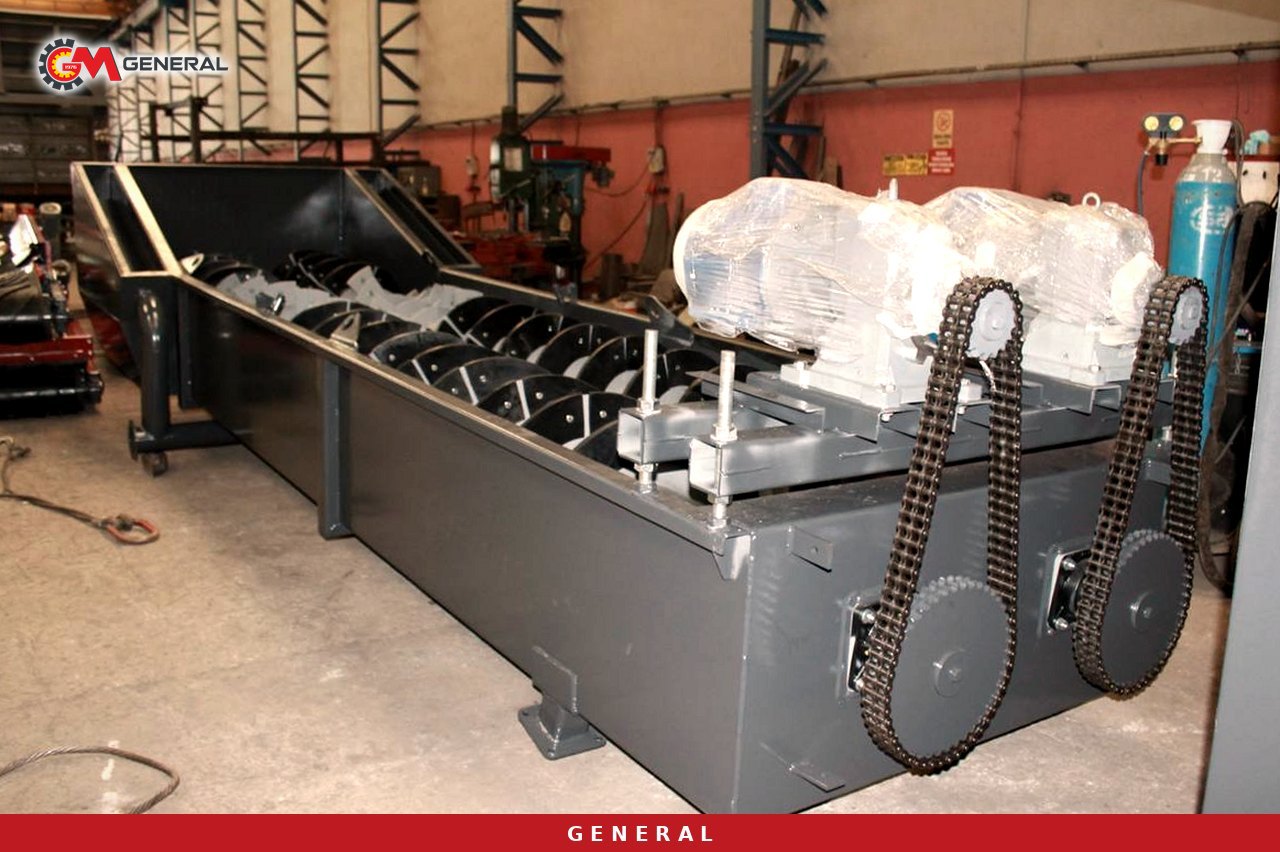
At a river gravel plant the product that earns money is usually washed sand, and the screw washer decides how much of it escapes with the water. The fine material screw washer takes 0-50 mm feed and works at 50-250 t/h; single models are more economical, twin models give higher capacity and longer scrubbing.
- Single: GNR 500 (500×5000 mm, 4 kW), GNR 600 (600×6000 mm, 5.5 kW), GNR 800 (800×8000 mm, 11 kW)
- Twin: GNR 400 (400×4000 mm, 2×5.5 kW), GNR 500 (500×5000 mm, 2×7.5 kW), GNR 600 (600×6000 mm, 2×7.5 kW), GNR 800 (800×8000 mm, 2×11 kW)
Sand moisture at the screw discharge is typically 15-30%. If you want to load trucks straight away or stockpile close to a batching plant, a hydrocyclone and a dewatering screen are added to the chain; moisture drops to 8-20%, and the hydrocyclone recovers fine sand the screw would lose. Water demand is proportional to the silt in the material; the catalogue gives an order of magnitude of about 190 L/min per t/h of silt. So the water source and settling pond capacity must be discussed together with the screw size.
Riverside operation, winter conditions and shipping
A plant close to the river must keep its equipment at a safe level during flood season. Mobile chassis units help here: pulling the plant back when the water rises is far easier than with a line on fixed concrete foundations. Place settling ponds outside the bed so that fine mud cannot enter the river; environmental conditions are part of the permit process.
In inland and higher parts of Georgia, winter frost targets the weakest point of a washing line. On a wet plant, pumps, pipes and nozzles must be fully drained at the end of the season, and no water should be left in the screw trough. If production is planned through winter, pipe insulation and drain points should be specified at the quotation stage.
On power: at bank sites far from the grid, units run on generators. Catalogue values are 350 kVA for the Mobil 90 and 550 kVA for the General 944; the YM1650 can be connected to the grid or a generator. For shipping, transport dimensions matter: YM1650 4200×13600×4500 mm, Mobil 90 3600×15700×4500 mm, General 944 4130×20350×4500 mm. From Izmir to Georgia, shipment can go by sea via the Black Sea ports of Poti or Batumi, or by road across the Turkey-Georgia land border; chassis length and the condition of the last kilometres decide the route.
The file to prepare before requesting a quote
To work out the right configuration for your Georgian project, the following is enough:
- Target capacity and daily operating hours, for the first year and later years separately.
- Screen analyses of samples taken at different depths, and the largest stone size.
- Clay load: MBV or SE result, and a photo of clay balls if possible.
- Products to be sold, size fractions, and whether a crushed-face requirement applies.
- Water source, area available for ponds, and permitted excavation limits.
- Grid access or generator preference.
- Preferred shipping route: Poti, Batumi or road.
Frequently asked questions
Can I sell Kura or Rioni gravel just by washing it?
Yes, if the material is at target size and your buyer does not set a crushed-face requirement; in that case a washing and screening unit such as the GNR YM1650 may be enough on its own. If oversize is high, a jaw and cone crusher is needed to crush and sell it rather than leave it in stock.
Is an impact crusher suitable for siliceous river gravel?
In soft, limestone-rich gravel an impact crusher gives a good cubical product. Where hard, siliceous particles dominate, a cone crusher uses its wear parts longer thanks to the compression principle. An abrasiveness test on the sample is needed to decide.
Will clay balls break down in the screw washer?
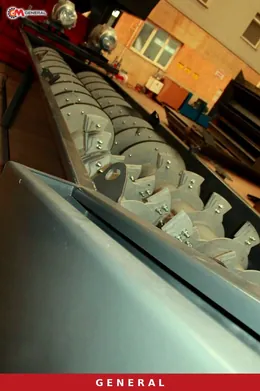
With a light clay load, a washing screen and screw washer are enough. For sticky, plastic clay balls a log washer is placed ahead of the screw; it accepts 0-200 mm feed and breaks the clay mechanically with two counter-rotating shafts.
What determines the cost of the plant?
The size of the crushing and washing shares, the number of units, single or twin screws, the need for a hydrocyclone and dewatering, conveyor length, generators and the shipping route. A project-specific quotation is prepared from this information.
Conclusion
Kura and Rioni gravel can deliver both washed sand and crushed-face chippings on a line built in the right order. With little oversize the GNR YM1650, with a crushed-face requirement the General 944 together with the YM1650, and for a single-chassis solution the Mobil 90 are sensible starting points. General Makina has manufactured in Izmir since 1976; its machines carry CE and ISO 9001 and a 1-year warranty excluding wear parts. Send us your sample data through our contact page and we will work out the configuration that suits your Georgian site.
Definitions of technical terms: Glossary