EN — English
 TR — Türkçe
 DE — Deutsch
 RU — Русский
 FR — Français
 ES — Español
 AR — العربية
 SR — Српски

Jordan Basalt & Limestone Mobile Stone Crusher Plant 120-180 TPH
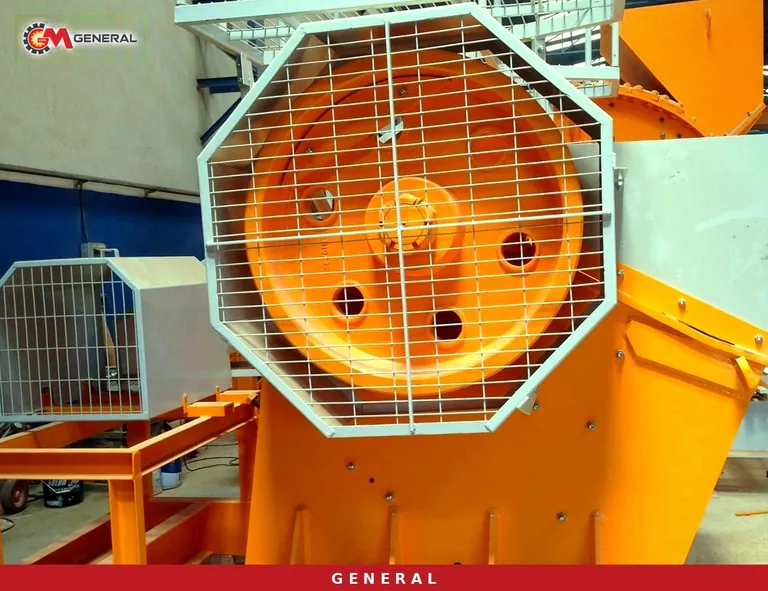
A contractor entering the aggregate business in Jordan rarely plans around a single rock. The dark basalt that covers a wide area of the country's north-east is sought after for asphalt and high-strength concrete, while limestone quarries on the central plateaus and around the Amman–Zarqa belt supply most of the fill, sub-base and concrete aggregate. The two rocks behave very differently inside a crusher. Basalt wears metal and prefers compression; limestone breaks easily under impact but tends to produce excess fines. When choosing a mobile crusher for 120-180 TPH, the first question is therefore not "which model is strongest" but "which rock will the quarry run, and for how many months". Below we match our real models to that question, with their published figures.
Why basalt and limestone give different results from the same crusher
Basalt is a fine-grained, dense volcanic rock with high silica content. In an impact rotor it consumes blow bars and aprons quickly; crushed by compression in a jaw or cone crusher, wear part life is noticeably longer. Limestone is softer and less abrasive: an impact crusher gives it a high reduction ratio and good cubical shape, whereas a cone crusher spends more energy than necessary and efficiency can drop.
Even between Jordanian quarries, the quality of both rocks varies. Some limestone seams carry chert bands or dolomitic transitions; some basalt flows contain porous, lighter layers. Samples of both rocks should therefore be tested in a laboratory for abrasiveness (Bond Ai), compressive strength and Los Angeles abrasion. If the machine is chosen without these values, the first-year wear part bill or the product shape will bring surprises.
Three scenarios based on the quarry plan
Most investors in Jordan either work mainly one rock or move the plant between two permit areas in campaigns. That operating plan decides the configuration.
Basalt-dominated quarry
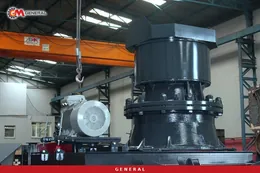
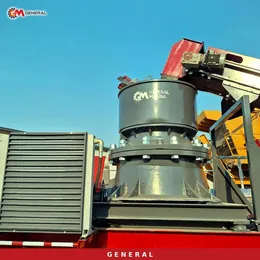
If north-eastern basalt will be processed for most of the year, a jaw and cone combination is the logical layout. General 944 places a GM430 cone secondary behind a GPJ 90 jaw primary, accepts 800 mm feed and works in the 120-180 TPH range. The compression principle of the cone stage extends wear part intervals on basalt and delivers the cubical chippings asphalt requires.
Limestone-dominated quarry
If the main products are limestone concrete aggregate and sub-base, a plant with an impact crusher is more efficient. General 01 performs primary and secondary work in one machine with its GPS 1210 impact crusher, accepts 700 mm feed and produces four products, 0-5, 5-12, 12-19 and 19-40 mm, from a 1600×5000 mm four-deck screen. Occasional small batches of basalt are possible, but rotor parts will wear faster during those periods.
Alternating between the two rocks
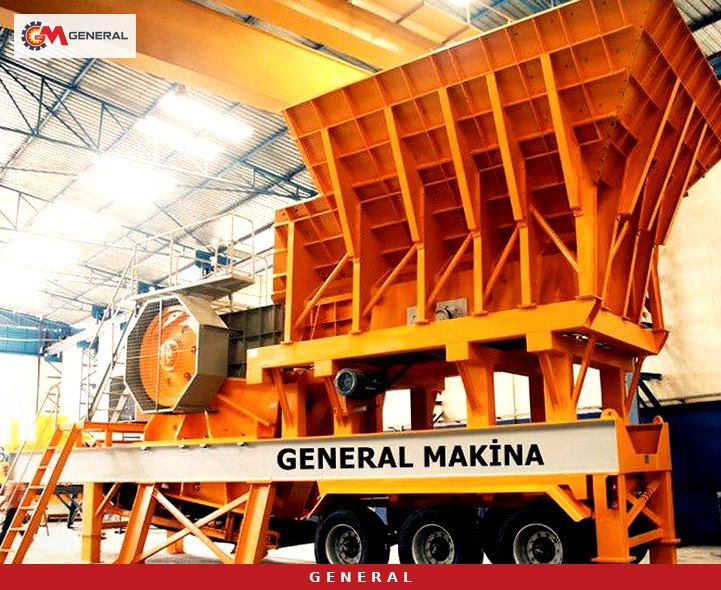
If the same plant will spend one period on a basalt site towards Mafraq and another in a limestone quarry on the central plateau, the balanced choice is General 950. The GPJ 90 jaw primary takes the first break of basalt by compression, while the DMK01 impact secondary gives high reduction and cubical grains on limestone. During basalt campaigns the secondary wear parts are monitored more closely; on limestone the plant approaches its full output.
Real configurations within 120-180 TPH
The table below uses the values published on our product pages. The fourth row is a modular alternative built from two separate units instead of a single-chassis plant.
| Configuration | Crushing chain | Capacity (t/h) | Max. feed (mm) | Screen | Generator (kVA) | Weight (kg) | Best rock |
|---|---|---|---|---|---|---|---|
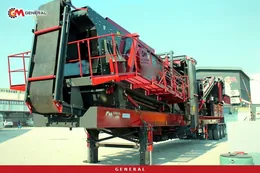
| General 944 | GPJ 90 jaw + GM430 cone | 120-180 | 800 | 1600×5000 mm, 3 decks | 550 | 70,000 | Mainly basalt |
| General 950 | GPJ 90 jaw + DMK01 impact | 120-180 | 800 | 1600×5000 mm, 3 decks | 600 | 70,000 | Basalt and limestone alternating |
| General 01 | GPS 1210 impact (primary + secondary) | 120-180 | 700 | 1600×5000 mm, 4 decks | 550 | 55,000 | Mainly limestone |
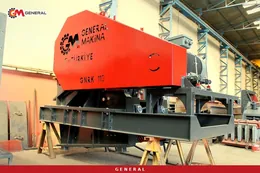
| GNR 90 + GNR MK110 | GNRK 90 jaw unit + rotor cubicizer | 70-180 (primary limit) | — | Separate screen needed | — | 25,000 + | Cubical basalt chippings |
The fourth option combines the GNR 90 wheeled primary jaw unit with feeder hopper and the GNR MK110 mobile cubicizer. The GNR 90 unit has a 1000×3800 mm feeder and 70-180 TPH capacity; the MK110 accepts feed up to 350 mm, runs at 160-250 TPH with a 200 kW motor and has a Hardox 500 inner lining. The primary sets the line capacity, so working near the 180 TPH upper limit requires a steady quarry feed. A separate vibrating screen is added in this layout to split the products. To compare all crusher types side by side, see our crushers page; for the full wheeled plant family, visit wheeled mobile crushing plants.
What to adjust when the plant switches rock
In an alternating plant, output depends as much on the changeover-day settings as on the machine itself. This checklist helps when moving from basalt to limestone or back:
- Jaw setting (CSS): on basalt the primary discharge can be kept tighter to protect the secondary; on limestone it is opened slightly to reduce fines.
- Secondary setting: rotor speed and apron gap on the 950, or the cone CSS on the 944, are reset to suit the product list.
- Screen media: the 0-5 mm share rises on limestone; mesh opening and wire type on the fine deck are reviewed accordingly.
- Wear part log: jaw plates, cone liners or blow bars are measured at every changeover, so the quarry's own data shows how much metal each rock consumes per tonne.
- Grizzly pre-screening: where limestone faces carry a lot of soil and clay, the feeder grizzly gap is opened so this material is removed before it reaches the crusher.
- Dust suppression: limestone crushing generates more dust; water spray nozzles and covers at conveyor transfer points can be added per project.
Manganese cast jaw plates work-harden under compression; on high-silica basalt a higher-manganese alloy may be preferred. Which alloy suits your basalt becomes clear once we receive the sample results.
From Aqaba port to the quarry: transport, power and climate
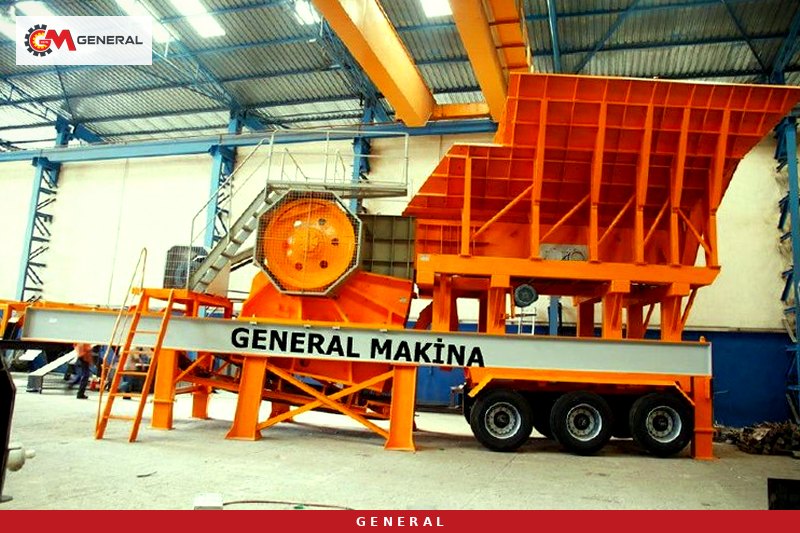
Aqaba is Jordan's only seaport; a plant leaving Izmir arrives there by sea and is towed by road to quarries in the north. The route north from the port is long, so chassis dimensions and weight must be considered in route planning from the start. The General 944 and 950 have a loading size of 4130×20350×4500 mm and weigh 70,000 kg; the General 01 measures 4300×18500×4500 mm and weighs 55,000 kg. Required transport permits and route restrictions should be confirmed with the relevant Jordanian road authority and the haulage company.
Basalt sites in the north-east are mostly far from the grid. Our plants are sized to run on generators: the product pages list 550 kVA for the 944 and 01, and 600 kVA for the 950. Hot, dusty desert summers call for extra measures for the generator and electrical panel. Options that can be selected per project include heavy-duty air filters, an enlarged radiator, a dust-tight panel enclosure and filtered ventilation. These should not be assumed standard and are discussed separately at the quotation stage.
Site data the quotation file needs
Working out the right configuration for a Jordanian quarry depends on how complete the following information is:
- Basalt-to-limestone ratio: how many months each rock will be processed in the annual plan.
- Laboratory results for both rocks: Bond Ai, compressive strength, Los Angeles value and any chert or clay content.
- Largest run-of-mine block size and blasting method.
- Product list for sale: asphalt chippings, concrete aggregate, sub-base, crushed sand, with target tonnage for each.
- Whether grid power is available and, if so, the connection capacity.
- Aggregate specification of the road or infrastructure project you supply; shape and abrasion limits should be confirmed with the relevant authority.
In a quotation prepared from this data, the main cost drivers are the selected crushing chain, generator scope, number of screen decks, dust and climate measures, and transport method. We state the price for your project once these items are defined.
Frequently asked questions
Is one plant enough if I crush both basalt and limestone in Jordan?
Yes. The General 950 is designed for that balance: its jaw primary handles basalt by compression, and its impact secondary gives cubical product on limestone. If basalt fills most of the year, the General 944 offers lower wear cost.
Can north-eastern basalt be used for asphalt chippings?
Basalt is a preferred asphalt rock, but meeting the specification depends on grain shape. The cone-secondary 944 or the modular line with a cubicizer suits cubical product. A definite answer comes from tests on a sample from your quarry.
How does the plant run on a site without grid power?
The plants are configured to run on generators; the product pages give 550 kVA for the 944 and 01, and 600 kVA for the 950. Filtration and cooling measures for desert conditions are added per project.
How do I get price and delivery information?
Send us the rock type, capacity target, product list and power situation, and we prepare a project-specific quotation; the delivery schedule is stated in the offer according to the order scope.
Conclusion
Crushing basalt and limestone with one investment in Jordan is feasible; the right model follows each rock's annual share and the target product list. For mainly basalt, the 944 is the first candidate; for mainly limestone, the 01; for alternating work, the 950. Built in Izmir since 1976 at our ISO 9001 and CE certified factory, our plants are delivered with a 1-year warranty excluding wear parts. Send your sample results and quarry plan through our contact page and we will define the configuration and quotation for your Jordanian quarry together.
Definitions of technical terms: Glossary