EN — English
 TR — Türkçe
 DE — Deutsch
 RU — Русский
 FR — Français
 ES — Español
 AR — العربية
 SR — Српски

Dubai Demolition Concrete Recycling Crusher and Screener Plant 100-200 TPH
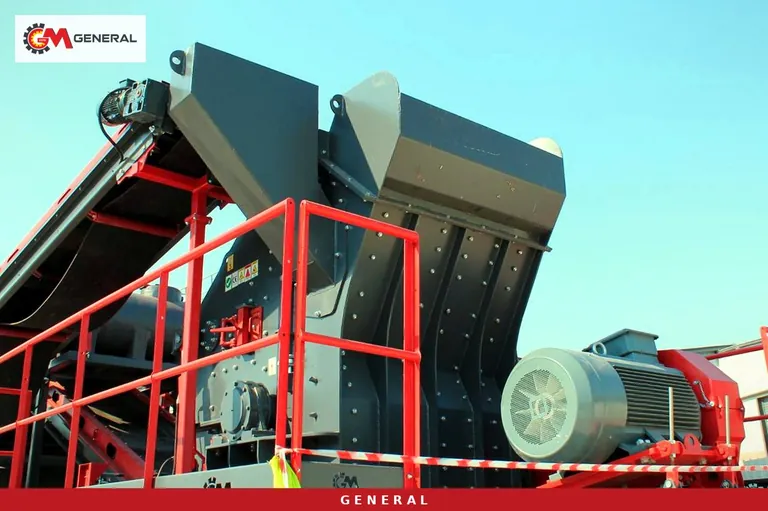
When a tower or a low-rise block comes down in Dubai, what leaves the plot by truck is mostly reinforced concrete slabs, broken blockwork, plaster and formwork debris. Crushing and screening that pile on the same site, or at a staging yard on the edge of the city, cuts truck trips to a distant landfill and produces aggregate that can go into fill, sub-base and block manufacturing. A crushing and screening plant sized for 100-200 TPH on demolition waste, however, raises questions a normal quarry line never meets: how is the rebar separated, how does the crusher survive tramp steel, and how are the generator and control panel protected through long, hot summer afternoons? Below we answer these with the catalogue values of real models from our range.
Note: recycling requirements, permitted aggregate classes and site permits for individual demolition and redevelopment projects in Dubai belong to the project owner and the relevant authority. Confirm the project specification and the authority's current conditions before you start selecting machines.
Why demolition concrete behaves differently from quarry rock
Quarry rock is homogeneous; the crusher sees roughly the same material hour after hour. Demolition concrete changes with every truck. One load brings clean column sections, the next a floor slab with ribbed bar hanging out, then plaster mixed with block rubble. That variability has three consequences:
- Wide size distribution. A slab piece not pre-broken with an excavator breaker can exceed a metre, while the same load contains powdery plaster.
- High contaminant share. Timber, plastic pipe, cable, gypsum board and insulation lower product quality.
- Metal content. Rebar and anchor bolts that reach the crusher stress the blow bars and belts.
For that reason plant capacity on demolition concrete is not set by the crusher rating alone; the combined pace of feed preparation, pre-screening and hand picking decides it. A line whose crusher can take 200 tonnes an hour may not reach even half of that if the feed pile is not prepared.
Before the crusher: sorting and rebar removal
Most demolition work in Dubai runs on a tight plot close to neighbouring buildings, so much of the sorting starts during demolition itself. A site sequence that works in practice:
- Selective strip-out: timber, gypsum, glass, cable and building services go into separate skips before the structure is brought down.
- Pre-sizing: an excavator-mounted hydraulic breaker or shear reduces pieces to fit the chosen crusher's feed opening and cuts protruding bars.
- Grizzly pre-screening: soil, plaster dust and fine mix are removed before the crusher; this fine fraction is often a separate fill product.
- Post-crusher metal separation: an overband magnet can be added above the crusher discharge belt as a project option, collecting the bar freed during crushing.
- Hand-picking point: a short picking platform before the screen catches remaining timber and plastic.
The magnet and picking platform are not standard equipment on our models; they are project-specific additions chosen according to the material. Share the type of structure and the expected rebar density at quotation stage and these items are built into the line.
What a primary impact crusher delivers on demolition concrete
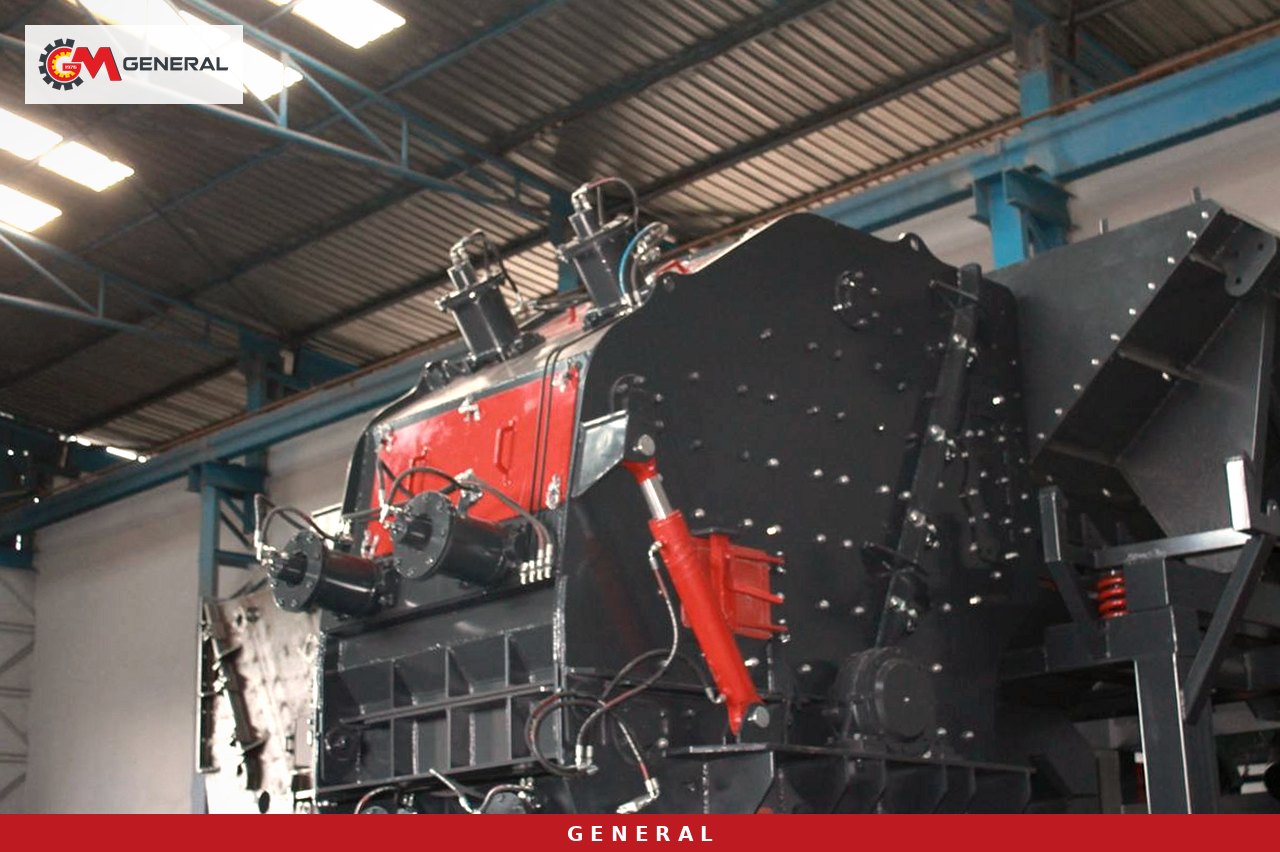
Concrete is less abrasive than granite and basalt. That is the main reason for choosing an impact crusher (HSI): blow bars on the rotor throw pieces against the breaker plates, cement mortar breaks away from the aggregate particles and the product comes out cubical. The GNR PDK series primary impact crusher page also lists C&D concrete recycling among the applications this crusher suits.
Blow bar alloy
High-chrome white iron gives long life on clean, abrasive rock, but with demolition concrete there is always a risk of steel reaching the crusher. For that risk the catalogue recommends tough manganese or martensitic blow bars. An impact-resistant alloy may wear faster than a brittle one, yet it will not crack on a piece of steel and stop the rotor. A trial run on your own feed mix is the soundest way to see which alloy gives the lower cost per tonne.
Jaw or impact?
If heavily reinforced bridge piers or very thick foundation beams are to be processed, a jaw crusher first and an impact crusher second can be considered; the jaw tolerates steel more easily. For mixed but moderately reinforced feed such as residential and commercial demolition, a single impactor does both primary and secondary reduction and shortens the line.
Matching models to 100-200 TPH
The table brings together catalogue values for our impact-crusher models covering this band. Wheeled plants are listed in detail under wheeled mobile crushing and screening plants self-propelled units under track-mounted mobile crushers.
| Model | Chassis | Capacity (t/h) | Max. feed (mm) | Crusher | Screen | Power | Weight (kg) |
|---|---|---|---|---|---|---|---|
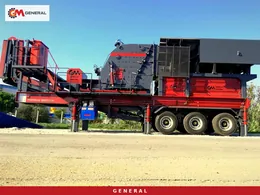
| General 800 | Wheeled, single chassis | 80-150 | 600 | PDK 1280 primary impact | 1300×4000 mm, 3-deck | 450 kVA | 35,000 |
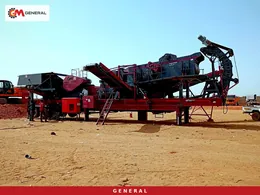
| GM 100 | Tracked | 100-180 | 600 | GNR-01 impact, 160 kW | 1500×5500 mm, 3-deck | 450 kVA | 42,000 |
| General 01 | Wheeled, single chassis | 120-180 | 700 | GPS 1210 impact | 1600×5000 mm, 4-deck | 550 kVA | 55,000 |
| GM 125 | Tracked | 150-250 | 700 | GNR PDK02 impact, 200 kW | (bypass conveyor 600×5000 mm) | 550 kVA | 48,000 |
| M-PDK02 | Portable, single chassis | 200-300 | 0-1200 | Primary impact, 250 kW | — | — | 45,000 |
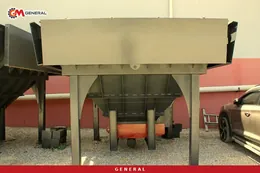
Practical conclusions from the table: if daily tonnage sits at the low end and the product is fill only, General 800 is enough; its 600 mm feed limit demands disciplined pre-sizing with the excavator. For continuous output above 150 tonnes and four fractions, the 4-deck screen of General 01 stands out. For a target approaching 200 tonnes, GM 125 covers the band on its own in crushing terms, with a separate screen unit added for fractions; its 6 m³ hopper and 1360×2160 mm grizzly pre-screen suit mixed demolition feed. Operators who prefer to crush larger pieces with less pre-breaking can use the M-PDK02 portable primary impact crusher which accepts feed up to 1200 mm; it needs a separate screening unit.
Wheeled or tracked chassis?
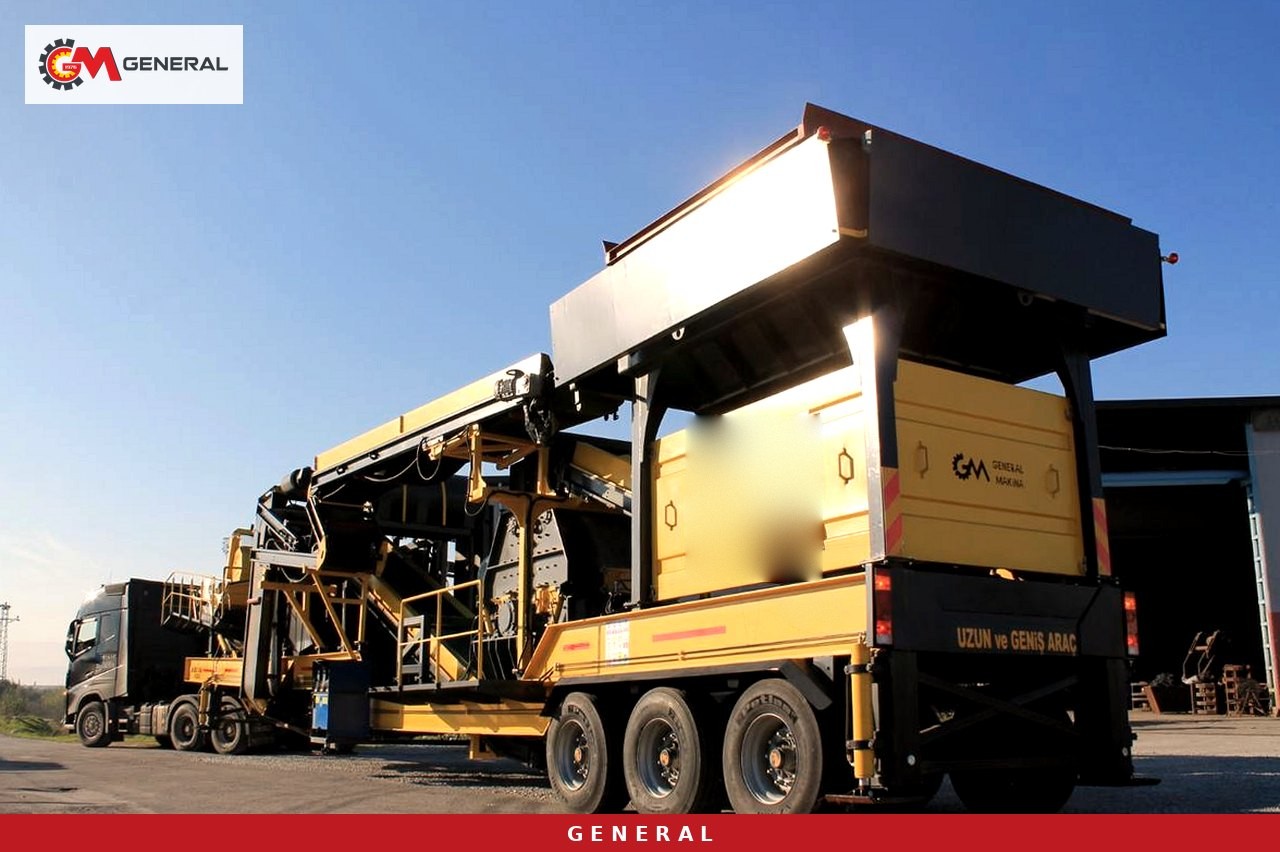
If the demolition work moves from plot to plot, tracked units (GM 100, GM 125) walk themselves into position and can sit right next to the pile on a cramped site. If the operation will run for months at a single staging yard, wheeled General 800 or General 01 offer more screen area and set up without a concrete foundation thanks to folding conveyors.
Running two units
Processing clean column-and-beam concrete together with plastered, mixed block rubble on one line lowers product quality. Two units can be set up instead, for example General 01 (120-180 t/h) for clean concrete and GM 100 (100-180 t/h) for mixed material. If one stops, the site does not come to a standstill, and each product stockpile stays separate.
Where recycled aggregate can go
The typical fractions given in the General 800 and General 01 catalogues are 0-5, 5-12, 12-19 and 19-40 mm. Which uses these products from demolition concrete can serve depends on their cleanliness and on the class the local specification allows. Common matches on site:
- 19-40 mm and coarser: road sub-base, temporary site roads, drainage fill.
- 5-12 and 12-19 mm: concrete blocks, kerbs and pavers; non-structural concrete.
- 0-5 mm: backfill and pipe bedding; keep it separate if plaster dust content is high.
Water absorption and fines content of recycled aggregate differ from natural rock. Before supplying the product to a customer or a batching plant, have gradation, water absorption and contaminant tests done at an independent laboratory; the project specification decides which class it can meet. For complete machine sets, see the concrete (C&D) recycling plant page.
Gulf heat, dust and urban operation
Summers in Dubai are long, hot and humid; on coastal sites humidity and fine dust combine and build up in panels and bearings. Demolition sites are often close to residential areas as well. Measures that can be chosen per project for these two conditions:
- Dust suppression: water spray nozzles at the feed hopper, crusher discharge and stockpile conveyor heads; dust covers on belts.
- Electrical panel: dust-tight cabinet with cooling; heavy-duty air filter on the generator and more frequent filter checks.
- Belt rubber: the belt under an impact crusher uses EP 125 – 4-ply rubber; impact idlers protect it from tearing by steel pieces.
- Shift plan: maintenance and picking in the hottest hours, full-capacity production in cooler hours.
- Noise and visual screening: using stockpiles as a screen on the side facing neighbouring buildings and keeping truck traffic one-way.
On the logistics side, a unit shipped by sea from Türkiye to a port such as Jebel Ali is then towed to site by road. Trailer-chassis wheeled plants and tracked units are prepared for this journey in one piece or a small number of pieces; dimensions and weights are finalised against the transport plan at quotation stage.
Frequently asked questions
Does reinforced concrete damage the crusher?
With protruding bars cut off and tough manganese or martensitic blow bars selected, an impact crusher handles reinforced concrete. Steel freed after crushing is collected by an overband magnet added to the project.
Can a single plant reach 200 tonnes an hour?
On the crushing side, the models covering this target on their own are the tracked GM 125 (150-250 t/h) and the portable M-PDK02 (200-300 t/h); neither has an integrated multi-deck screen in the catalogue, so a separate screen unit is added for fractions. If an integrated-screen solution is preferred, two units such as General 01 and GM 100 can run together. Real tonnage depends on feed preparation and picking speed.
Can asphalt planings go through the same line?
Asphalt and concrete recycling are among the applications of the impact models. Mixing the two materials, however, narrows where the product can be used; separate stockpiles and separate shifts are recommended. For a general overview, read mobile crusher use for construction and demolition waste.
What about warranty and certification?
Our plants carry CE and ISO 9001 certification, with a 1-year warranty excluding wear parts. We have been manufacturing in İzmir since 1976, and the Middle East is one of the regular export regions for this production.
Information to prepare before a quote
To propose the right configuration for a demolition or recycling job in Dubai we need: the type of structures to be demolished and estimated rebar density, daily operating hours and target tonnage, required product sizes, whether grid power is available on site, and whether the plant will move between plots or stay at one yard. The price is shaped by chassis type, crusher and screen choice, add-ons such as the magnet and dust suppression, and the shipping plan. Send these details via our contact page and we will prepare a line proposal and quotation for your site.
Definitions of technical terms: Glossary