EN — English
 TR — Türkçe
 DE — Deutsch
 RU — Русский
 FR — Français
 ES — Español
 AR — العربية
 SR — Српски

DR Congo Copper Mine Crushing and Screening Plant 250-450 TPH
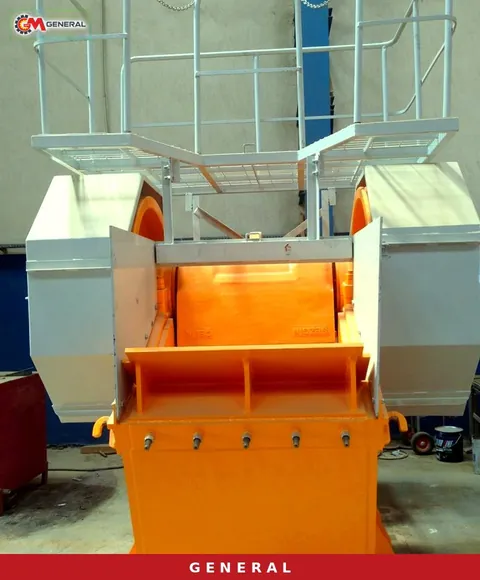
In the southern copper belt of the Democratic Republic of the Congo, across Lualaba and Haut-Katanga provinces, anyone planning a crushing plant serves two customers at once: the mine itself and the concentrator waiting for crushed ore. For a crushing and screening plant rated at 250-450 TPH, the size of block its jaw can swallow matters, and so does whether the screen undersize suits the milling or leach circuit downstream. This article matches feeding, primary crushing, secondary crushing and screening, stage by stage, to equipment with verified catalogue values, for open pits similar to those around Kolwezi.
Every model figure in this text comes from our product pages. We give no information about any specific licence, tender or contractor; please confirm the project specification with the relevant mining authority or the owner's technical documents.
Oxide and sulphide: two different feeds from one pit
In copper belt deposits, the zones close to surface are usually oxidised, weathered and clay-rich; with depth come sounder sulphide ore and hard host rock. In practice you will run on sticky, fines-rich feed in the early years of the pit and on blocky, abrasive feed later. Sizing the line only for today's blasted material ends a few years later in either a choked feeder or crusher liners that wear out much faster than planned.
That is why we ask for two sample sets to be tested at quotation stage: one from the oxide zone and one from fresh rock. Without compressive strength, Bond abrasion index, moisture and clay content, model selection is guesswork. Also allow for the fact that material from the pit floor in the rainy season is far wetter than in the dry months; the same feeder behaves like two different machines across the two seasons.
The concentrator, not the crusher, sets the target product
In an aggregate quarry the product sizes follow the sales list; at a copper mine the limit is set by the process engineer. If crushed ore goes to a grinding circuit, the feed size the mill accepts determines how many crushing stages you need. If it goes to heap leaching, both the top size and the fines content affect how the solution percolates through the heap. The crushing line is not designed until that decision is clear, and the first thing our enquiry form asks for is the target top size and the acceptable fines content.
A typical copper line in the 250-450 TPH range has three steps.
Primary stage: feeder and jaw crusher
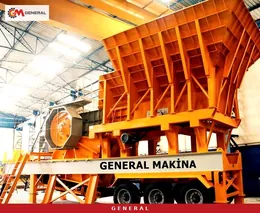
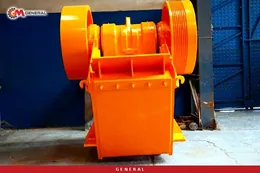
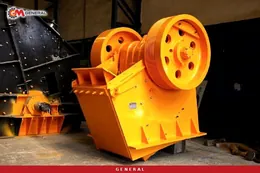
Blasted ore is tipped from the truck into the hopper; the feeder delivers it to the jaw in a steady flow, while the grizzly section removes fines before they enter the crusher. The GNRK series jaw crusher works by compression, so metal consumption stays low in siliceous, abrasive material; typical reduction is 4:1-9:1. The largest acceptable block is about 0.8-0.9 of the opening width, which means the blast design in the pit must also be matched to the crusher.
Secondary stage: cone crusher
For the second stage on abrasive ore we recommend a cone crusher. The General cone crusher gives 6:1-8:1 reduction in secondary duty and about 10:1 in tertiary duty, with feed of 50-250 mm and product in the 0-60 mm order. Hydraulic CSS adjustment lets the product size follow what the concentrator asks for, and a hydraulic cylinder protects the machine against sudden packing. An impact crusher would give higher reduction here, but on siliceous feed its blow bar and liner consumption strains operating cost.
Screening and closed circuit
Cone discharge goes to the screen; material above the target size returns to the cone by conveyor. This closed circuit is what actually guarantees the product top size. Because the recirculating load is added on top of the primary tonnage, screen area must be chosen for the total circulating flow, not for the nominal crusher output.
Stage-by-stage equipment table for a 250-450 TPH line
The table below brings together real models for each stage with their catalogue values. Unknown values are shown as "—"; the model-specific capacity table for the cone crusher is provided per project.
| Stage | Model | Main dimension | Power (kW) | Capacity (t/h) |
|---|---|---|---|---|
| Feeding, dry ore | GNR 110 grizzly feeder | 1100×4750 mm | 2×7.5 | 200-300 |
| Feeding, dry ore | GNR 140 grizzly feeder | 1400×5000 mm | 2×9.2 | 350-600 |
| Feeding, clayey oxide | GWB1136 wobbler feeder | 1100×3600 mm | 18.5 | 75-600 |
| Primary crushing | GNRK 110 jaw crusher | 1100×850 mm opening | 110/132 | 200-350 |
| Primary crushing | GNRK 130 jaw crusher | 1300×1000 mm opening | 160 | 400-500 |
| Secondary crushing | General cone crusher | Feed 50-250 mm | 90-500 | — |
| Screening | GNR 2470 circular-motion screen | 2400×7000 mm | 30 | 100-400 |
| Screening | ELKK-2580 banana screen, 3 decks | 2500×8000 mm | 2×22 | 100-400 |
| Screening | Twin vibrating screen | — | — | 100-500 |
Three conclusions follow from the table. First, a 250-300 TPH target sits where the GNR 110 feeder and the GNRK 110 jaw overlap; if the feeder's 300 TPH ceiling is to be exceeded, move up to the GNR 140. Second, for 400-450 TPH the GNRK 130 is the right primary, paired with a GNR 140 or a GWB1136 feeder. Targets between 350 and 400 TPH fall between the catalogue bands of the two jaws; in that case the GNRK 130 is chosen and capacity is confirmed with sample results. Third, on the screening side a single 100-400 TPH screen may not carry a 450 TPH line once recirculating load is added; plan a twin vibrating screen or two screens in parallel. Conveyors between stages are selected from the 50-1000 TPH range in widths of 500-1200 mm.
Clay in oxide ore: the feeder and washing decision
In weathered ore from the upper benches of Lualaba pits, clay can fill the bar gaps of a grizzly feeder within a short time. That blinding leaves the crusher running half empty while fines slip into the jaw and wear the liners for nothing. The GWB1136 wobbler feeder works like a self-cleaning moving grate with synchronised rotating elliptical disc shafts: it screens muddy fines downward and carries coarse rock on to the crusher. Because it uses rotation instead of vibration, noise and vibration stay low; it runs on a motor-gearbox-chain drive.
Whether oxide ore must be washed is the concentrator's decision. If the process engineer asks for it, a log washer with two counter-rotating manganese-paddle shafts handles 0-200 mm coarse feed at 50-250 TPH and breaks plastic clay by attrition. On a 450 TPH line one log washer is not enough; the tonnage of the fraction to be washed has to be calculated separately.
The practical rule for the seasonal difference is to choose the feeder for the worst material the site will see. If the mine plan starts in the oxide zone, a wobbler feeder; if it starts with dry, hard sulphide ore, a grizzly feeder is the simpler and more economical starting point.
Stationary line or mobile unit, and the power and transport plan
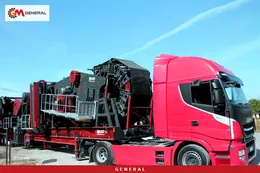
If the mine life is long and the crushing point stays in one place for years, a stationary crushing and screening plant with steel structure, wide maintenance platforms and high-capacity screen groups is the most orderly solution. If the crusher must move between pits or first production must start quickly, a mobile unit comes forward. The highest-capacity mobile primary solution in our range, the mobile jaw plant with wobbler feeder combines pre-screening and the jaw on one chassis and runs at 250-450 TPH. It covers the primary stage only; the cone secondary and screen group are planned separately.
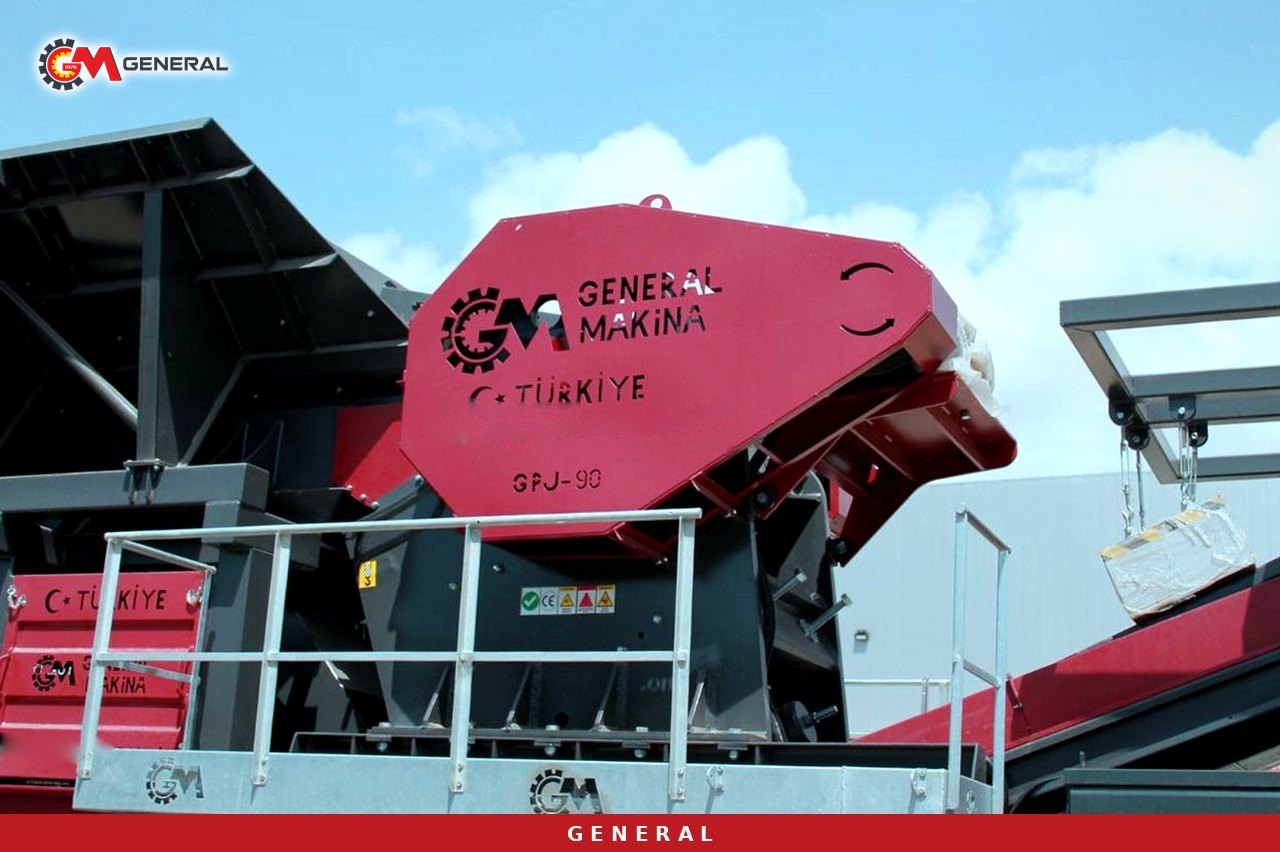
The copper region of DR Congo lies deep inland; equipment reaches a port by sea and then travels long road routes to site. The dimensions and weights of large items such as the crusher body, feeder and screens must therefore be fixed at the start of the shipping plan. The GNRK 130 weighs about 42,500 kg and the GNRK 110 33,000 kg; these figures directly determine truck and crane selection for the road leg.
For power there are two scenarios: a line fed from the mine grid or a stand-alone line on generators. Calculate installed power as the sum of crusher, screen, feeder and conveyor motors; for example, catalogue values are 160 kW for the GNRK 130, 2×9.2 kW for the GNR 140 feeder and 2×22 kW for the ELKK-2580 screen. Cone crusher and conveyor powers are added per project. PLC-based automation starts machines in sequence against the direction of material flow and stops upstream stages when one machine trips, a safeguard that limits operator error at a remote site. For dry-season dust, enclosed conveyor transfers and water-spray dust suppression at transfer points should be written into the specification as measures selectable per project.
Wear planning and a pre-quotation checklist
Free silica in the host rock of copper ore drives wear more than Mohs hardness does. Austenitic manganese steel (Mn13/Mn18/Mn22) is the standard choice for jaw plates and cone liners; its surface work-hardens under impact. High-chrome cast iron is used for impact crusher blow bars, but being brittle it can crack on coarse feed with tramp iron. At a remote site the most expensive stoppage is the one where the spare liner is still on the road, so we recommend adding at least one set of jaw plates and cone liners to the first order. Wear and spare parts are outside the 1-year warranty; plan accordingly.
When you request a quotation, send the following together; matching crusher models is done with this data:
- Compressive strength, Bond abrasion index, moisture and clay content for oxide and sulphide samples
- Largest block size after blasting and how trucks discharge into the hopper
- Top size and fines limit required by the concentrator
- Hourly and annual target tonnage, shift pattern
- Grid or generator; available voltage and frequency
- Whether the crushing point stays fixed or moves between pits
- Weight and dimension limits on the port and road route
Frequently asked questions
Why should the primary crusher for copper ore be a jaw?
A jaw crusher breaks material by compression, which keeps metal consumption low in siliceous, abrasive ore. The GNRK 110 and GNRK 130 openings accept large blast blocks and, at 4:1-9:1 reduction, prepare a size suitable for the cone crusher.
Is one jaw crusher enough for 450 TPH?
In the catalogue the GNRK 130 covers 400-500 TPH, so the primary stage can be handled by one machine. The feeder (GNR 140 or GWB1136) and the screen group must, however, also carry this tonnage together with the recirculating load.
Can an impact crusher be used instead of a cone?
On soft, low-silica material an impact crusher gives higher reduction. On abrasive copper ore, blow bar and liner consumption rises, which is why we recommend a cone for the secondary stage. The final decision follows sample testing.
What determines the price?
Number of stages, cone crusher and screen models, feeder type, stationary steel structure or mobile chassis, automation scope, generator requirement and spare parts package. A quotation prepared with this information is project-specific.
Conclusion
A 250-450 TPH crushing and screening plant for a DR Congo copper mine should be built around ore that changes from oxide to sulphide: a wobbler feeder for clayey feed and a grizzly feeder for dry, hard ore; a GNRK 110 or GNRK 130 depending on tonnage; a cone crusher for the abrasive secondary stage and a screen group that carries the recirculating load. As a team manufacturing in Izmir since 1976 with ISO 9001 and CE certified equipment, we can prepare a flow sheet for your site; send your sample results and process targets through our contact page.
Definitions of technical terms: Glossary