EN — English
 TR — Türkçe
 DE — Deutsch
 RU — Русский
 FR — Français
 ES — Español
 AR — العربية
 SR — Српски

Botswana Diamond & Copper Mobile Crushing and Screening Plant 150-250 TPH
A mining team preparing a crushing line in Botswana may face two jobs inside one country with almost opposite goals. On the kimberlite sites around Orapa, Letlhakane and Jwaneng, the crusher has to open the rock and hand it to the recovery circuit without damaging the diamonds inside. In the Kalahari Copper Belt, stretching from the Ghanzi area in the west, the task is to reduce siliceous, hard and abrasive ore to a size the grinding mill can take while keeping metal wear under control. This article explains which mobile layout makes sense for which ore on a Botswana project targeting 150-250 TPH, using models with published catalogue data. It also covers Kalahari sand, dust and water limits, shipping to a landlocked country and the site data you should collect before ordering.
One caveat up front: the mining districts named in the title are a geographic frame only. We give no information about the ore body, production plan or technical specification of any particular licence; confirm these with the licence holder and the relevant authority.
The crusher's job in kimberlite: open the rock, protect the stone
In diamond mining, crushing does not make the product; it liberates it. Valuable stones scattered inside a kimberlite block can crack if they see excessive compression or a hard impact during crushing. The real yardstick on a kimberlite line is therefore a low fines ratio and no needless breakage of coarse particles.
Weathered upper zones and fresh kimberlite behave differently
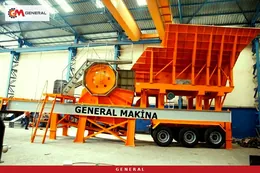
The near-surface part of a kimberlite pipe is usually weathered, clayey and moist; deeper down the rock becomes harder and more competent. In the first months of a pit the crusher receives sticky, soil-laden feed, and a few years later the same machine works on hard blocks. With clayey feed, the bars of a conventional grizzly feeder can blind. Here a mobile jaw plant with wobbler feeder uses its rotating elliptical discs to strip out fine mud and send cleaner material to the jaw. Its catalogue capacity is 250-450 t/h, so it runs at or above the top of the 150-250 TPH target and leaves headroom for future tonnage.
A wide jaw setting and stopping at one stage
On most kimberlite projects the primary jaw crusher runs with a wide closed-side setting close to the top size the recovery plant accepts. A jaw breaks by compression and loads the particle in a more controlled way than impact. Whether a second stage is needed, and of which type, should be decided by the process engineer who knows the diamond size distribution of the ore. We recommend that assessment before any impact secondary is put to work on kimberlite.
Siliceous ore in the Kalahari Copper Belt and the wear equation
On a copper site the priorities flip. The crusher must deliver a small, consistent product to feed the grinding circuit, at a low wear cost per tonne. Ores in the Kalahari Copper Belt generally sit in sedimentary host rocks with a high silica content, and that kind of ore strips metal quickly from impact rotors and blow bars.
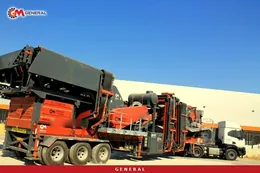
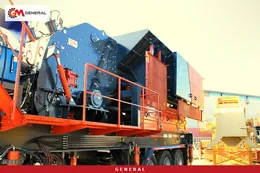
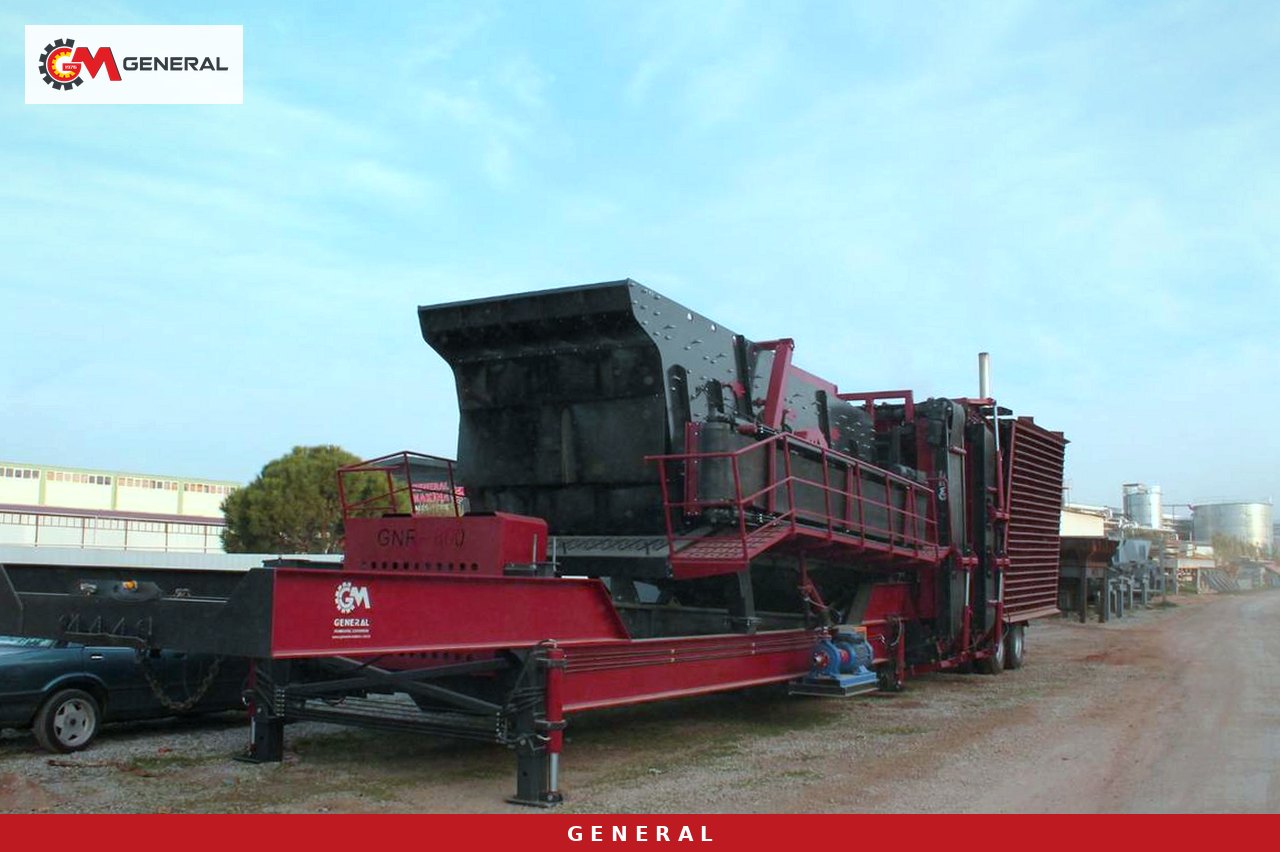
A sensible layout for copper ore is therefore a jaw primary combined with a cone secondary that also crushes by compression. The General 944 is built exactly this way: GPJ 90 jaw primary, GM430 cone secondary, 800 mm feed, a 1600×5000 mm three-deck horizontal screen and 120-180 t/h capacity. If more tonnage is needed, the GNR-MC110 comes in: GPJ 110 jaw primary, GS1215/DMK03 impact secondary, 900 mm feed, a 2000×6000 mm four-deck screen and 200-300 t/h. The MC110 secondary is an impactor, so blow bar consumption on siliceous copper ore must be budgeted, and no decision should be made without an abrasion test on a sample.
Screen layout matters on a copper line too. A single undersize fraction may be enough for material going to the mill; in that case some decks act as a control screen and oversize returns to the crusher in closed circuit.
Real models that fit the 150-250 TPH band
The table compares models that cover the target range, or reach it with two units, using catalogue values only. Unknown cells are marked with a dash.
| Model | Crusher layout | Capacity | Feed / jaw opening | Generator | Weight | Suggested role |
|---|---|---|---|---|---|---|
| GNR-MC110 | GPJ 110 jaw + GS1215/DMK03 impact, twin chassis | 200-300 t/h | 900 mm | 750 kVA | 2 × 55,000 kg | Full line on copper; primary chassis only on kimberlite |
| General 944 | GPJ 90 jaw + GM430 cone | 120-180 t/h | 800 mm | 550 kVA | 70,000 kg | Siliceous copper ore |
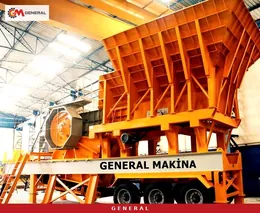
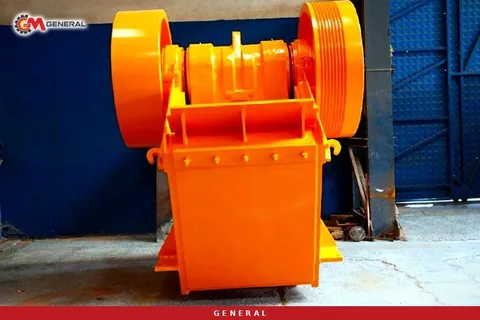
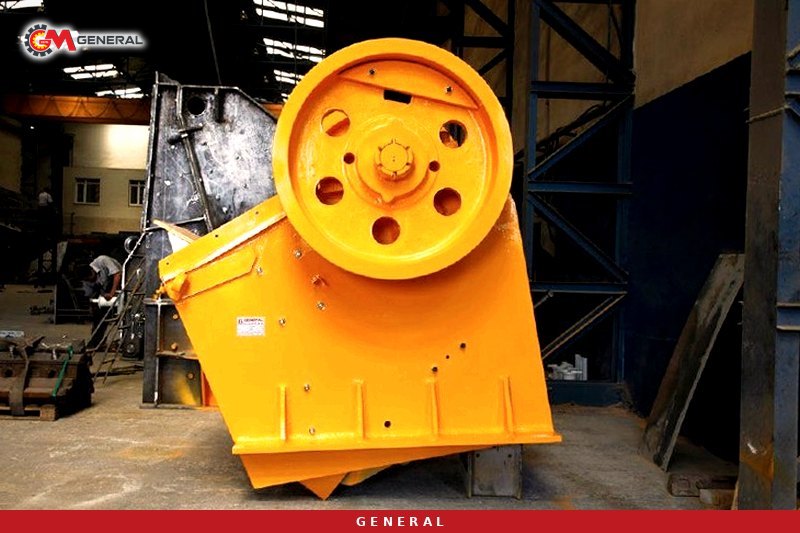
| Mobile primary jaw GNR 110 | Feeder hopper + GNRK 110 jaw | 180-300 t/h | Opening 1100×850 mm | — | 55,000 kg | Kimberlite primary crushing |
| Mobile jaw plant with wobbler feeder | Wobbler feeder + primary jaw | 250-450 t/h | — | — | — | Clayey, weathered kimberlite |
| General 640 | GPJ 60 jaw + GNR 50 impact | 60-100 t/h | 500 mm | 300 kVA (optional) | 38,000 kg | Too small for this band; sampling and trial scale |
Two set-ups for a copper project
For a 150-180 TPH target, a single General 944 covers the range at catalogue value. For 200-250 TPH there are two routes: one GNR-MC110 or two 944 units. Two 944s give 240-360 t/h nominal in total and let one unit keep producing while the other is in maintenance; in exchange you manage two generators, two operator crews and two screen set-ups. The MC110 offers a simpler site plan with one feed point and a four-deck screen.
Two set-ups for a diamond project
On kimberlite, primary crushing alone is often enough. With dry, hard feed the mobile primary jaw crusher GNR 110 covers the whole band at 180-300 t/h. If an MC110 is chosen, its primary chassis can run independently on kimberlite, while the secondary chassis is brought in later for another material. In weathered, clayey upper zones the wobbler-fed unit is the safer choice. All mobile crusher options are on the portable rock crushers page and complete wheeled lines on the mobile stone crushers page.
Sand, dust and scarce water: details that protect the plant in the Kalahari
The Kalahari, which covers most of Botswana, means fine sand and dust. Under these conditions the most sensitive points of the plant are the generator air intake, radiator cores, screen drive and electrical panel. Measures that can be specified per project include a heavy-duty filter with pre-cyclone on the generator intake, easy-access cleaning hatches on the radiator, a sunshade over the panel, belt covers at transfer points and low-water fine-mist dust suppression nozzles.
Water is the scarcest resource on most Kalahari sites. Where dust suppression water will come from, and at what flow, must be settled before the plant layout. Choosing dry screening cuts water demand, but check separately whether the recovery side wants moist material. On off-grid sites, size the generator from the catalogue rating plus the power loss at high ambient temperature; the catalogue values of 550 kVA for the 944 and 750 kVA for the MC110 are the starting point of that calculation.
Shipping to a landlocked country: from port to pit
Botswana has no coastline; equipment leaving Türkiye arrives at a seaport in the region and crosses the border by road or rail. Choose the port and route with your freight forwarder and import adviser, and confirm current transit documents and heavy-load permits with the relevant road authority.
A wheeled chassis helps on this journey. The General 944 has a transport size of 4130×20350×4500 mm, weighs 70,000 kg and is towed on its own axles. On the MC110 the load is split over two chassis: primary 3000×13500 mm, secondary 4200×18300 mm, 55,000 kg each. Moving in two pieces along long, narrow mine roads is easier to plan than one large chassis. On arrival the hydraulic legs are lowered and no concrete foundation is needed, which matters for short-lived or relocating pit faces.
Site information to prepare before ordering
A sound quotation starts with sound data. The more complete the list below, the fewer assumptions go into model selection:
- Ore type: kimberlite, copper ore, or both in different campaigns?
- Lab data: compressive strength, abrasion index, silica content and moisture; separate samples for weathered and fresh kimberlite.
- Feed size: the largest block after blasting and the loading method (shovel or truck).
- Target product: the top size accepted by the recovery or grinding circuit and the fractions required.
- Hourly and per-shift tonnage, annual operating days and how often the plant will relocate.
- Power: grid available or generator only; fuel supply distance.
- Water source and the amount available for dust suppression.
- Preferred port of arrival and the width, gradient and bridge limits of the final access road.
Frequently asked questions
Can kimberlite and copper ore be crushed with the same plant?
Mechanically yes, but the two ores have different goals. Diamonds call for a wide setting that keeps fines low; copper calls for a small, consistent product. The twin-chassis GNR-MC110 adds flexibility here: primary only on kimberlite, full line on copper. Settings and wear part changes should be planned between campaigns.
Is an impact crusher risky on a diamond site?
Impact transfers energy to the particle at high speed and can raise the risk of diamond breakage. On kimberlite a compression-type jaw primary is usually preferred. The secondary stage and its type should be chosen with the approval of a process engineer who knows the diamond size distribution.
What about warranty and certification?
General Makina has manufactured in Izmir since 1976; the equipment carries ISO 9001 and CE certification. The warranty is 1 year, and wear parts such as jaw plates, liners and blow bars are excluded. After-sales spare parts support is provided.
What determines the quoted cost?
The model and crusher layout, generator rating, number of screen decks, project-specific equipment such as dust suppression and filters, and the packing and shipping method are the main cost drivers. Send your site data and a project-specific quotation will be prepared.
The short route to a decision
In Botswana, separate the ore first: for kimberlite, a single-stage jaw primary with a wide setting; for Kalahari copper, the jaw-and-cone 944 or, for higher tonnage, the GNR-MC110. Put the wobbler feeder on the plan for clayey upper zones, and filters, shading and water-saving dust suppression for hot, sandy sites. Send your sample results and target tonnage through our contact page and our engineers will prepare the configuration and quotation for your ore.
Definitions of technical terms: Glossary