EN — English
 TR — Türkçe
 DE — Deutsch
 RU — Русский
 FR — Français
 ES — Español
 AR — العربية
 SR — Српски

Dar es Salaam Wheeled Mobile Crushing & Screening Plant 150-250 TPH
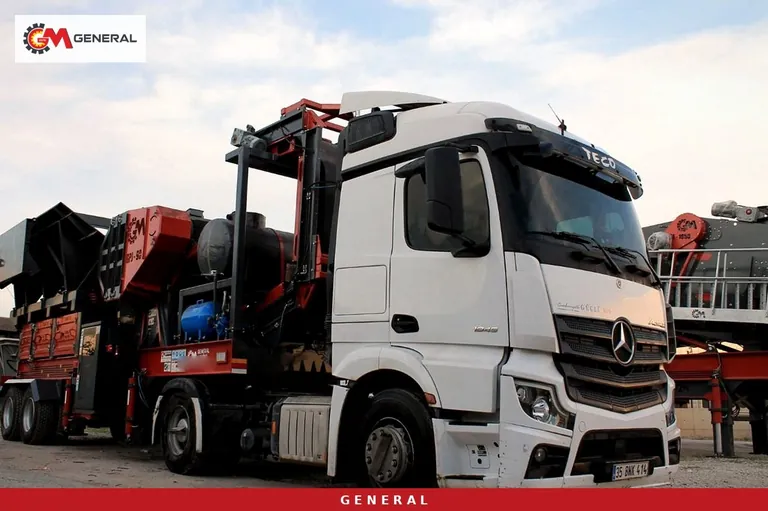
Dar es Salaam is Tanzania's largest city and its main seaport, so a large share of the country's building activity concentrates here: high-rise housing, office blocks, warehousing around the port, urban roads and the ready-mix plants that supply all of them. Every one of these jobs depends on the same raw material: correctly sized, clean aggregate arriving without interruption. This article looks at which wheeled crushing and screening plant makes sense for a contractor or quarry operator who wants to supply 150-250 TPH of chippings and crushed sand to the Dar es Salaam market, on which rock, and in what layout, from the point of view of an engineer who has commissioned plants in the field.
The rock in your quarry decides the machine more than the capacity target does. The same 200 t/h goal is met by an impact plant on coastal limestone and by a line that starts with a jaw crusher on hard inland rock.
Who buys aggregate in Dar es Salaam?
Before sizing a plant, be clear about who will buy the product, because the screen arrangement and the choice of secondary crusher follow from it. Three buyer groups stand out in Dar es Salaam.
The first is ready-mix and precast producers. They want 5-12 and 12-19 mm chippings with consistent grading, cubical particle shape and a low dust content. In the high-strength concrete used for multi-storey buildings, flaky and elongated particles spoil workability, so particle shape is negotiated as hard as price. The second group is road contractors, who take 19-40 mm and 0-5 mm together in large volumes for sub-base and base courses. The third is fill, platform and ground-improvement work at port and industrial sites, where shape matters less and tonnage and continuity of supply decide the deal.
If you aim at ready-mix plants, a four-deck screen and a crusher arrangement that delivers cubical product come first. If you will mostly sell road material, a simpler line can be enough.
Coastal limestone or hard inland rock: the rock picks the primary crusher
Coral-derived and sedimentary limestones are common along the Tanzanian coast, while quarries further inland work harder, crystalline rock. That general picture says nothing about the rock in your own quarry. Having representative samples tested for compressive strength, abrasion (Los Angeles) and silica content before the quotation stage is the step that removes most of the risk from model selection.
Low-abrasive limestone: an impact primary
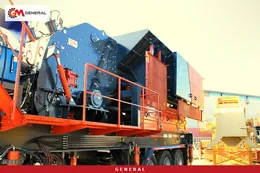
On soft to medium-hard limestone an impact crusher gives a high reduction ratio and cubical particle shape. The General 01 uses its GPS 1210 impact crusher to handle both the primary and the secondary stage in one machine; with 120-180 t/h capacity and a 700 mm feed opening it covers the lower half of the band as a single unit. For a closer look at impact economics on this material, see our article on choosing a mobile crusher for limestone.
Hard, siliceous rock: jaw + cone or jaw + impact
On abrasive rock such as granite, gneiss or quartzite the hammers and plates of an impact primary wear quickly, so the line must start with a jaw crusher. The General 944 places a GM430 cone crusher behind a GPJ 90 jaw; because the cone crushes by compression, metal life is longer in siliceous rock. Capacity is again 120-180 t/h. To account for wear-part consumption from day one, we recommend adding the wear and spare parts options to your tender file.
Four wheeled options for the 150-250 TPH band
Every figure in the table below comes from the product page of the model concerned. No single model covers the whole 150-250 t/h range at the same efficiency, so the choice depends on which side of the band your target sits and on the rock.
| Model | Capacity | Generator | Max. feed | Crusher arrangement | Screen size | Decks |
|---|---|---|---|---|---|---|
| General 01 | 120-180 t/h | 550 kVA | 700 mm | GPS 1210 impact (primary + secondary) | 1600×5000 mm | 4 |
| General 944 | 120-180 t/h | 550 kVA | 800 mm | GPJ 90 jaw + GM430 cone | 1600×5000 mm | 3 |
| GNR-MC110 | 200-300 t/h | 750 kVA | 900 mm | GPJ 110 jaw + DMK03 impact (two chassis) | 2000×6000 mm | 4 |
| General 02 | 250-300 t/h | 660 kVA | 1000 mm | GPS 1413 impact | 2000×5000 mm | 4 |
For a 150-180 t/h target, the General 01 is the natural candidate on limestone and the General 944 on hard rock. If the target rises to 200-250 t/h on hard rock, the GNR-MC110 covers that range with a comfortable margin. The General 02 makes sense at the top of the band, on low-abrasive material such as limestone, where steady demand never falls below 250 t/h. All wheeled models are listed together on the wheeled mobile crushing plants page.
Growing capacity in steps: the GNR-MC110's two chassis
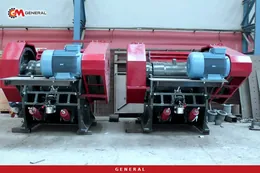
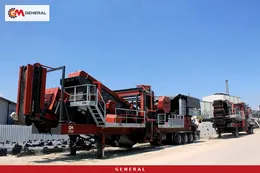
Many investors entering the aggregate business in Dar es Salaam cannot say exactly how many tonnes they will sell in the first year. The layout of the GNR-MC110 answers that uncertainty: chassis one carries the feed hopper and the GPJ 110 jaw crusher, chassis two carries the DMK03 secondary impactor, the 2000×6000 mm four-deck screen and the conveyors. The two groups work independently, and the primary group can produce on its own when required.
That allows a staged plan: buy the primary group first and build cash flow by selling coarse-crushed fill and sub-base, then add the second chassis once ready-mix customers are signed and move to 0-5, 5-12, 12-19 and 19-40 mm fractions. Splitting the weight over two platforms (55,000 kg each) also simplifies axle-load planning for road haulage. There is a cost: two chassis need a wider footprint on site than a single-chassis plant. If your quarry floor is tight, the layout should be drawn together at the quotation stage.
Working on the city fringe: dust, rain and off-grid sites
Some quarries around Dar es Salaam lie close to residential areas, which means the plant has to be planned for its environmental footprint as well as its output. Water-spray dust suppression at conveyor transfer points, covers over the screen and stockpiles placed with the prevailing wind in mind are measures that can be selected per project. Confirming which of them the local environmental permit requires is the contractor's responsibility.
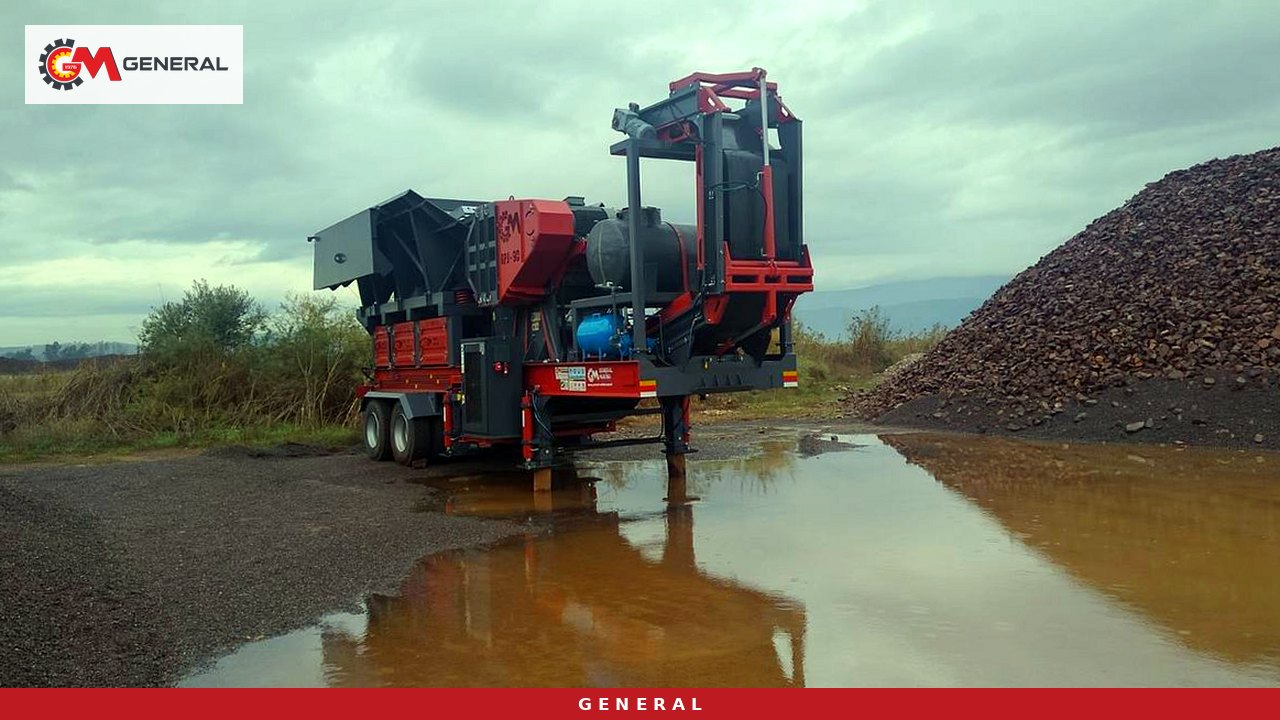
The city's climate is hot and humid, with two rainy seasons a year. During wet weeks the clay and soil content of quarry feed rises. The grizzly by-pass on the vibrating feeder then removes fines before they enter the crusher, which reduces both packing in the crushing chamber and contamination of the product. If a ready-mix customer insists on clean aggregate, heavily clayey feed may also need washing; that should be discussed on the basis of sample results.
On power, quarries outside the urban area do not always have a grid connection ready. The generator ratings in the table (550 kVA for the General 01 and 944, 750 kVA for the GNR-MC110) are therefore a purchase item to discuss separately in the quotation. In heat and dust, shortening air-filter service intervals for the generator and switchgear and placing the electrical panel in shade removes some of the most common causes of breakdowns we see on site.
From the port to the quarry: haulage on a wheeled chassis
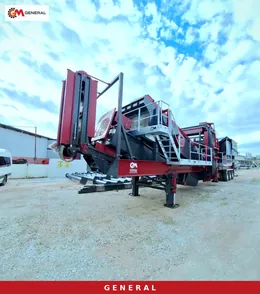
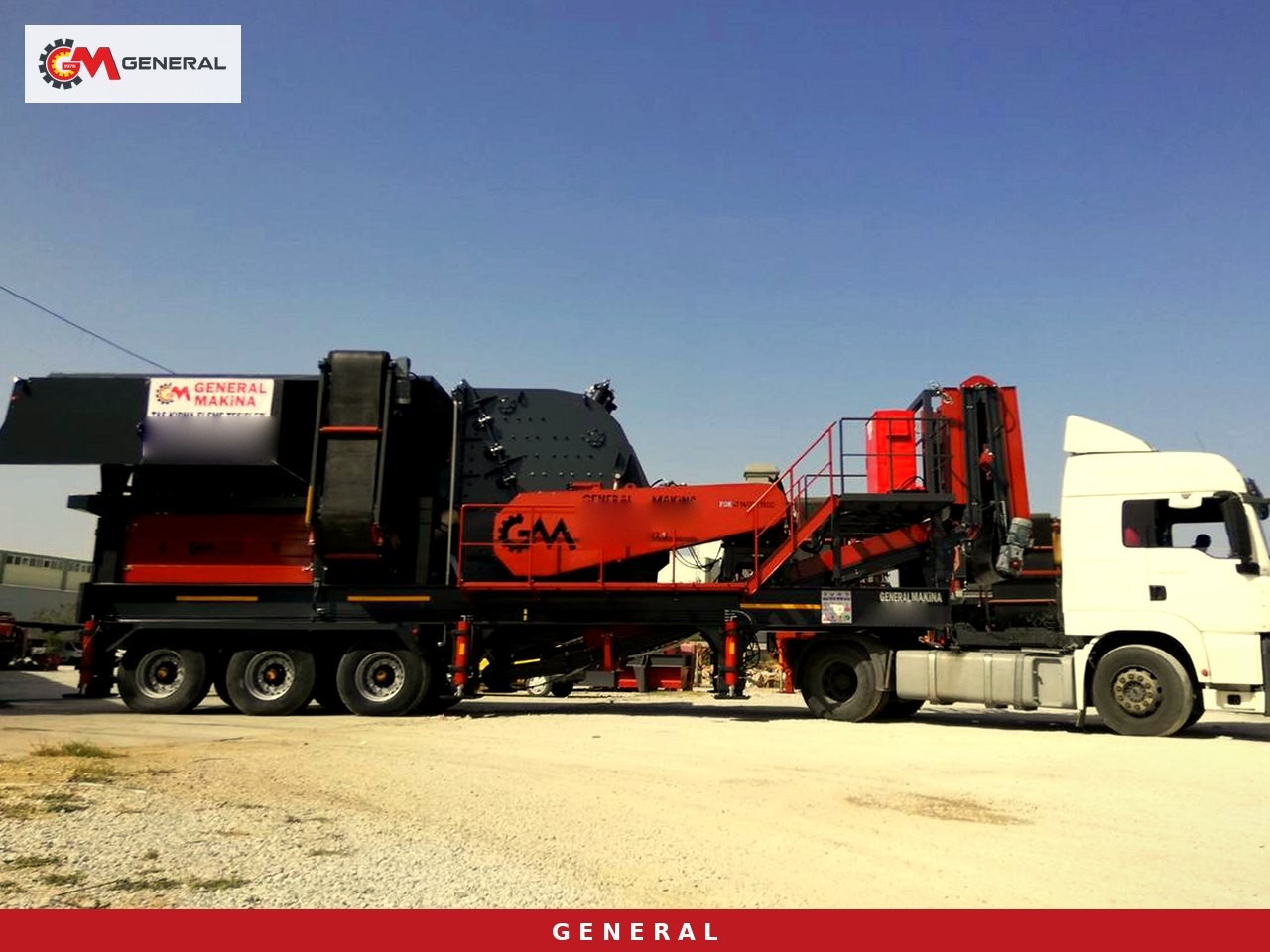
A plant shipped from Türkiye enters the country through the Port of Dar es Salaam. This is where a wheeled plant shows its advantage: the machine is towed on its own chassis from the port to the quarry and set up on hydraulic legs without a concrete foundation. The dimensions to plan around are on the product pages: the General 01 travels at 4300×18500×4500 mm, the General 944 at 4130×20350×4500 mm. Check bridges, flyovers and tight turns on the route from the port gate to the quarry against these figures in advance.
Tanzania is the destination of one of the real deliveries listed on our site: a Titan 100 mobile concrete batching plant rated at 100 m³/h. Sourcing the crushing plant and the batching plant from the same manufacturer makes it easier to match aggregate grading and mix design from the start.
Information to prepare before ordering:
- Name of the quarry rock and laboratory results (compressive strength, abrasion value, silica content).
- Largest block size; the feed opening depends on it (700, 800, 900 or 1000 mm).
- Fractions to be sold and the expected monthly share of each.
- Daily operating hours and target hourly tonnage.
- Whether grid power is available; if not, the generator choice.
- Height and weight limits on the port-to-quarry route.
- Dust and noise measures required under the local environmental permit.
Frequently asked questions
Can a single wheeled plant produce 250 TPH in Dar es Salaam?
On hard rock, the GNR-MC110 meets that target with its 200-300 t/h range. On low-abrasive material such as limestone, the General 02 also delivers 250-300 t/h. Reaching 250 t/h with the 120-180 t/h models requires two separate units.
Which model suits sales to ready-mix plants?
Thanks to a four-deck screen and cubical product, the General 01 stands out on limestone and the GNR-MC110 on hard rock. The General 944 has a three-deck screen producing 0-5, 5-12 and 12-19 mm fractions; keep that in mind if you also need 19-40 mm.
What warranty and certificates apply?
The plants carry ISO 9001 and CE certification. A 1-year warranty covers everything except wear parts. General Makina has built crushing and screening equipment in İzmir since 1976.
What determines the price?
The model and crusher arrangement, the number of screen decks, the generator, options such as dust suppression, the wear-parts package and sea freight are the main drivers. A firm figure is given against an enquiry prepared with the list above.
Conclusion
The right wheeled plant for Dar es Salaam is decided first by the rock in your quarry and then by the product you will sell. For 150-180 t/h, the General 01 suits limestone and the General 944 hard rock; for 200-250 t/h on hard rock, the GNR-MC110 is the most balanced option. Send us your sample results, fraction list and site details and we will settle the model and configuration together: reach us through our contact page.
Definitions of technical terms: Glossary