EN — English
 TR — Türkçe
 DE — Deutsch
 RU — Русский
 FR — Français
 ES — Español
 AR — العربية
 SR — Српски
Crushing plant RFQ technical specification
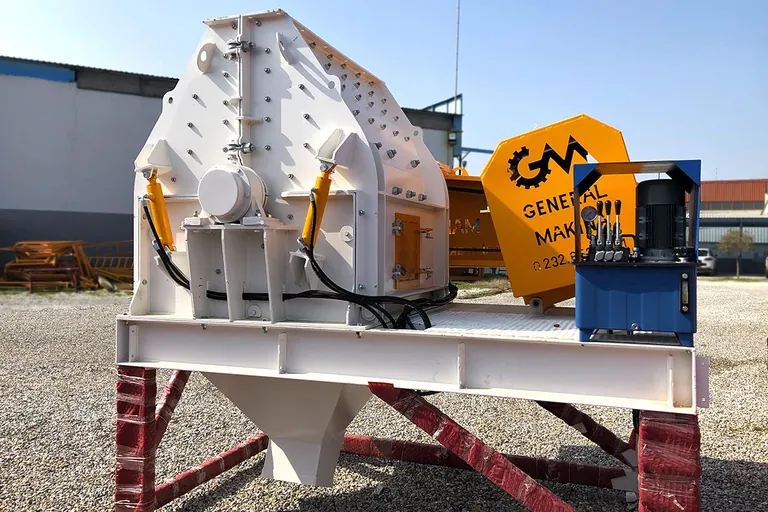
Most quotations for a crushing and screening plant come back impossible to compare, and the cause is rarely the suppliers. It is the document the buyer sent out. A crushing plant RFQ technical specification is not a shopping list of machines: it states what material has to be processed, at what rate, into which fractions, and how all of that will be proven on site. Without those clauses every bidder prices its own assumptions and the comparison collapses.
A specification describes the result, a machine list describes the solution
"One jaw crusher and one three-deck screen" is a solution. "One hundred tonnes per hour of quarried basalt separated into four saleable fractions" is a result. Writing the result and letting each bidder propose the flowsheet is the only way two genuinely different circuits can be placed side by side and judged on cost per tonne rather than on the number of machines listed.
Clause one: describe the rock, not the machine
Liner life and energy consumption are governed by what enters the chamber, so the opening section of the document has to characterise the feed in measurable terms.
Material data every bidder needs
- Rock type and in-situ bulk density.
- Resistance to breakage, expressed as a Bond work index in kWh/t, which is used to estimate the net energy needed to take material from a given feed size to the required product size.
- Abrasiveness, expressed as a Bond abrasion index. This figure predicts liner and wear-part consumption rather than motor power.
- Los Angeles resistance to fragmentation to EN 1097-2 and, where particle shape is contractual, flakiness index to EN 933-3.
- Moisture, clay and topsoil content. Sticky feed will defeat a circuit that was calculated for dry rock.
If those numbers are not available, do not invent them. A clause stating that the supplier shall test a representative sample before the design is frozen costs far less than a wrong figure written with confidence.
Capacity and gradation in a crushing plant RFQ technical specification
Capacity is never a single number. Hourly throughput, daily operating hours and target availability belong in separate lines, because a plant quoted at 100 t/h means something entirely different over ten hours than over twenty. Fractions should carry a required percentage split as well, since the same tonnage can be reached with very different screening arrangements.
Two sizing checks can be written straight into the document. The largest lump in the feed should not exceed roughly eighty per cent of the crusher's feed opening, and a single jaw stage is normally worked around a six-to-one reduction ratio. When the required reduction is far above that, the answer is a secondary and tertiary stage rather than a bigger primary.
| Specification clause | General 640 | General 800 | General 950 |
|---|---|---|---|
| Maximum feed size | 500 mm | 600 mm | 800 mm |
| Capacity | 40-70 t/h | 80-120 t/h | 120-180 t/h |
| Output size setting | 0-100 mm | 0-100 mm | 0-100 mm |
| Standard product fractions | 0-5, 5-12, 12-19 mm | 0-5, 5-12, 12-19, 19-40 mm | 0-5, 5-12, 12-19 mm |
| Optional generator | 300 kVA | 450 kVA | 600 kVA |
The table shows how abstract clauses become numbers on an existing series; a fuller capacity selection comparison is handled in a separate guide.
Mechanical, electrical and control clauses
Everything measurable belongs here: drive motor ratings and protection class, structural steel grade and weld quality level, wear-part material and nominal thickness, lubrication arrangement, dust suppression connection points, panel voltage and supply arrangement. On the control side two clauses are essential — sequenced start and stop interlocking, and an emergency stop chain that covers the entire plant rather than individual machines.
Acceptance criteria, the clause buyers skip
A requirement is only enforceable if the document also says how it will be measured. Three questions must be answered for each guaranteed figure: which test, under what conditions, and within which limit is the result accepted. Duration of the throughput trial, the sampling point for the sieve analysis, the separate no-load and loaded running periods, and the remedy applied when a guarantee is missed all sit in this section.
Scope of supply and documentation
The closing section separates what is inside the price from what is not: loading arrangement, erection and commissioning, operator training, the recommended first-year spare parts kit, warranty period and explicit exclusions. Alongside it goes the document list — assembly drawings, wiring diagrams, wear-part codes, maintenance manual and declaration of conformity.
Frequently asked questions
Will a detailed document scare bidders away?
Not if it is written around results. What reduces the bidder list is a document that copies one manufacturer's model codes and effectively pre-selects the supplier.
Can capacity be guaranteed without material testing?
Only conditionally. With no test data, the acceptance clause has to be tied to a sample taken from the actual deposit.
Should spare-part pricing be requested in the first round?
Yes. Without unit prices and expected service life for wear parts, two offers cannot be compared on operating cost at all.
Once the draft exists, the fastest way to validate it is to test each clause against real machine data; further reading under procurement and supply covers bid evaluation and the contract stage.
Definitions of technical terms: Glossary