EN — English
 TR — Türkçe
 DE — Deutsch
 RU — Русский
 FR — Français
 ES — Español
 AR — العربية
 SR — Српски
Crusher bearing temperature monitoring
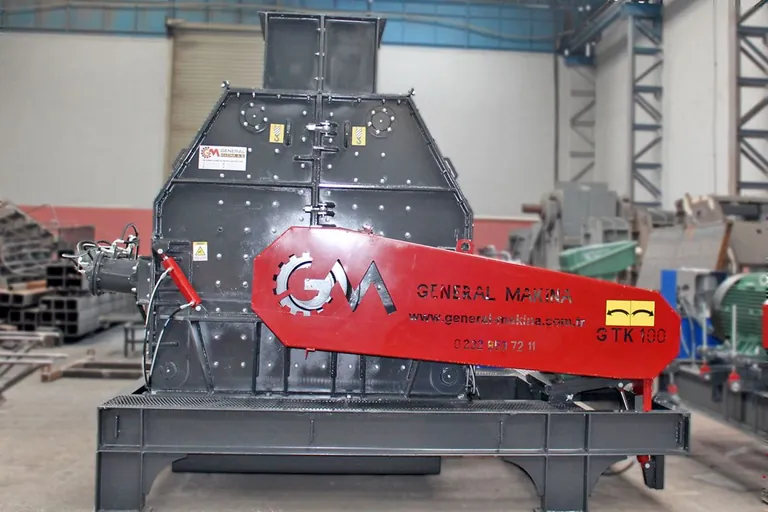
Why crusher bearing temperature monitoring is an early warning
The cheapest usable health signal on a crushing line is the temperature of the bearing housing. Crusher bearing temperature monitoring reports that the oil film is under stress long before the fault becomes audible noise or measurable vibration, because rising friction shows up first as heat. Vibration analysis carries far more detail, but it needs instruments and a trained interpreter. Temperature can be read by hand, every shift, from the same spot. That repeatability matters more than the instrument itself: a single number tells you nothing, while the same point drifting upward across several weeks tells you a bearing is on its way out.
Crushers behave differently from steady rotating machines. The load arrives in impacts, feed is uneven, the air is loaded with dust and the frame absorbs sunlight. Reading an absolute figure in isolation therefore misleads. The quantity worth tracking is the difference between ambient air and the housing, the temperature rise, because that difference removes weather from the picture.
Threshold bands and the decision they trigger
In common industrial practice a reading around 70 °C on the housing is treated as an alarm level and 90 °C as a safe trip level. Bearing steel tolerates far more; the limit is set by the grease and the seal material, not by the rings. Nitrile seals run out of continuous service life just above this band, and the carrier oil in the grease oxidises and separates as the temperature climbs.
| Housing temperature | Interpretation | Action |
|---|---|---|
| Below ambient + 20 °C | Normal duty | Log the reading and move on |
| 60-70 °C | Watch band | Double the reading frequency, confirm the lubrication line |
| 70-90 °C | Alarm | Reduce feed, check grease delivery and seal integrity |
| 90 °C and above | Trip | Empty the chamber, let it cool, inspect bearing and internal clearance |
| 15 °C rise within four hours | Accelerating damage | Intervene without waiting for a threshold |
The last row is the one most plants miss. Even with the absolute value still under 70 °C, a steep climb over a short period can mean the oil film has broken down or the internal clearance has closed up.
Where to measure
Always read the metal surface closest to the loaded zone of the bearing. Three fixed points work well: the centre of the housing cap, the metal next to the grease inlet, and the lower half of the housing flange. Mark them with paint. Two spots a hand's width apart on the same housing can differ by several degrees, and once the point moves the trend loses its meaning. Record whether the machine was loaded or running empty at the moment of the reading, because an unloaded reading sits lower and mixing the two into one list produces a fake improvement.
Contact probe or thermal imaging
| Method | What it reads | Strength | Limit |
|---|---|---|---|
| Contact probe thermometer | Metal surface temperature | Immune to reflection, repeatable | Needs safe physical access |
| Infrared spot thermometer | Radiation leaving the surface | Remote, reads in seconds | Bright metal and oil films pull the reading down |
| Thermal camera | Distribution across the housing | Shows the hot spot and any asymmetry | Needs emissivity setting and a fixed distance |
| Fixed sensor with panel alarm | Continuous temperature | Trips the drive without an operator present | Cabling and sensors need maintenance |
Because a thermal camera is unreliable on shiny, oil-wetted steel, painting a small matt patch on the housing cap makes the distribution reading usable. The comparative approach is the most practical of all: the gap between two symmetrical housings on the same machine diagnoses faster than the absolute value of either one.
The link between temperature and grease life
A lubrication plan cannot be written without a temperature record. The established bearing-industry approach halves the relubrication interval for roughly every 15 °C above about 70 °C. A schedule calculated for a mild day is therefore twice too long in high summer or when feed rate increases. The reverse adjustment exists but is capped and does not suit every bearing type. The practical consequence is plain: without a temperature log, a lubrication interval is only a guess.
Root causes behind a hot housing
Overheating is rarely a defect of the bearing itself. The usual causes, in order of how often they appear, are: too much grease, since a packed cavity stops the lubricant circulating and raises churning friction; too little grease or a blocked line; a bearing fitted with the wrong internal clearance class, because impact duty calls for extra clearance; an interference fit that is too tight on the shaft; dust ingress after a seal has failed; excess belt tension loading the housing radially; and a crust of dust and oil that blocks the cooling path. The order matters, because the reflex on site is usually to add grease, and that reflex feeds the first cause on the list.
Logging and trend
The log needs three columns and nothing more: timestamp, point code, temperature, plus load state. Ambient air belongs in the same sheet. What you review weekly is the difference curve. On heavy impact machines such as a jaw crusher, that curve rises and falls with the wear cycle of the jaw plates; a steady upward shift within one wear period points to something mechanical instead.
A shift routine that survives contact with the plant
A workable routine is no longer than four steps. Take readings once the machine has reached steady state, not while it is warming up. Read the three marked points and write them down. If the difference between symmetrical housings exceeds 10 °C, repeat the measurement inside the same shift. For every housing inside the alarm band, check grease delivery, line pressure and seal condition the same day. This is the lowest-cost tool available for keeping planned downtime genuinely planned, and it belongs on the same schedule as the rest of the plant maintenance and wear programme.
None of this requires an expensive system: three painted marks, one thermometer and a sheet that actually gets filled in will do. If you want the measuring points defined for your own bearing layout, our technical team can walk the machine with you.
Definitions of technical terms: Glossary