EN — English
 TR — Türkçe
 DE — Deutsch
 RU — Русский
 FR — Français
 ES — Español
 AR — العربية
 SR — Српски
Site Ground Preparation for Mobile Crusher
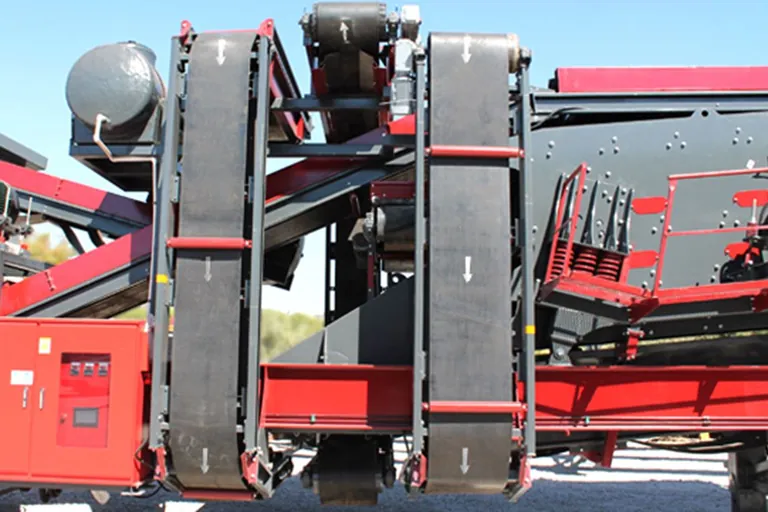
Whether a plant produces on its first day on site is usually decided by the ground beneath it rather than by the machine itself. Proper site ground preparation for mobile crusher installations does not mean pouring a reinforced concrete foundation; it means building a working platform whose settlement is controlled, whose surface sheds water and whose stiffness can be measured. The sections below cover the work to be done before the plant arrives and the test that proves each item.
Is a foundation required?
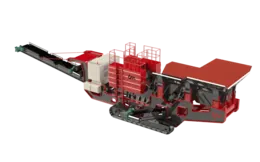
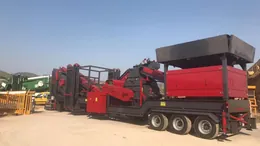
Tracked and trailer-mounted units are designed to spread their load through the chassis over a wide contact area. What installation therefore calls for is not a foundation but a platform that carries the load evenly. On stationary plants the crusher and screen bodies are anchored to the ground, and there a reinforced foundation is unavoidable. The decision follows the plant type, so the plant type must be settled before the layout drawing is produced.
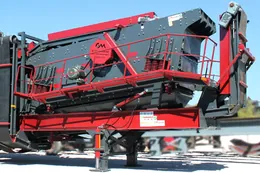
The critical difference in the platform approach is this: the platform must not only carry the load, it must hold its shape under vibration. A screen box and a crusher rotor generate a continuous cyclic load. Insufficiently compacted fill settles under that load over time, and when settlement is one-sided the conveyor axes shift, material spills at transfer points and the chassis is forced into torsion.
Measuring bearing capacity: what each test proves
A visual assessment of the ground is not evidence. Common practice on site platforms is to measure the deformation modulus with a plate load test. The test applies two loading cycles and yields two moduli: Ev1 from the first loading and Ev2 from the second. Ev2 describes the elastic behaviour of the material after seating, while the Ev2/Ev1 ratio indicates whether compaction was sufficient. The lower the ratio, the better compacted the layer.
The Proctor test does not replace this, it complements it. Proctor is a density measure and plate loading is a stiffness measure; there is no single conversion factor valid for every material. Where recycled material or fill with variable grading is used, the stiffness measurement becomes the more reliable acceptance criterion.
| Check | Method | Quantity measured | Unit | Interpretation |
|---|---|---|---|---|
| Stiffness | Plate load test (DIN 18134) | Ev2 deformation modulus | MN/m² | 100-120 is the range commonly required at sub-base level |
| Compaction quality | Plate load test (DIN 18134) | Ev2/Ev1 ratio | dimensionless | 2.3 or below is taken as an indicator of good compaction |
| Degree of compaction | Proctor test | Dry density ratio | % | Defined by specification; not directly convertible to stiffness |
| Levelling | Levelling instrument or laser | Surface gradient | % | Must stay inside the manufacturer's slope tolerance |
| Drainage | Observation after rainfall | Time water stands | hours | No standing water should remain on the pad |
Slope tolerance and levelling
Every crushing and screening unit has a maximum slope it accepts during installation; that figure is given in the machine's own documentation and the site decision follows it. Slope matters for two reasons. The first is the centre of gravity: tall screen and hopper units take side loading on inclined ground. The second is lubrication and sealing, because bearing and gearbox oil levels are designed on the assumption that the machine stands level.
Levelling is planned so that it does not conflict with drainage. If the platform surface is made perfectly horizontal, water sits on it. The practical answer is to keep the footprint of the plant within machine tolerance and give the surrounding area a controlled fall that collects water.
Drainage and surface water management
Water is the item most often skipped in ground preparation. Rainwater mixed with fines turns the top layer of the platform into mud; stiffness drops and tracks or support legs sink. A collection channel is therefore planned around the platform, with a settling section at its outlet. If a washing line is running, water management is sized separately, because continuously circulating process water is a far larger load than rainfall.
The channel route is drawn so that it does not cut across the truck manoeuvring area. The part of a site that degrades first is rarely the platform itself; it is where trucks turn and brake, and spreading coarse crushed stone there noticeably extends the life of the pad.
Layout and access roads
Ground preparation is not limited to the rectangle the plant stands on. The turning radius of the loader on the feed side, the base area of the stockpiles on the product side and the truck approach lane all belong to the same scope. Because track-mounted units can be repositioned within the site, the platform is prepared slightly beyond the first layout; re-filling for a second position costs more than preparing a little extra area at the first attempt.
Stockpile areas are placed so that segregation is reduced. As conveyor discharge height increases, coarse particles roll to the toe of the cone, and this is taken into account when the stockpile base level is set as part of ground preparation. The overall site concept becomes more coherent when read together with the other articles under jobsite and mobile plant.
Frequently asked questions
How is crushed stone platform thickness decided?
Thickness on its own is not meaningful; the target is the stiffness required at the top surface. Weak natural ground calls for a thicker layer compacted in stages, while a thin levelling course may be enough over sound rock. The decision follows the plate load result.
Is a platform built in winter still valid in spring?
Freeze-thaw cycling reduces stiffness in fine-grained soils. Where a platform is built in winter conditions, the measurement should be repeated once the season changes.
Does platform preparation extend installation time?
Preparation runs before and independently of installation; if the platform is ready when the plant arrives, erection proceeds without interruption. The real delay comes from dismantling and repositioning a plant that was landed on an unprepared site.
Treat ground preparation not as a cost line but as insurance on installation time and first-year downtime. Talk to our engineering team about the plant configuration and layout that suit your site conditions.
Definitions of technical terms: Glossary