EN — English
 TR — Türkçe
 DE — Deutsch
 RU — Русский
 FR — Français
 ES — Español
 AR — العربية
 SR — Српски

Asphalt Aggregate Specs with a Mobile Crushing & Screening Plant 150-250 TPH
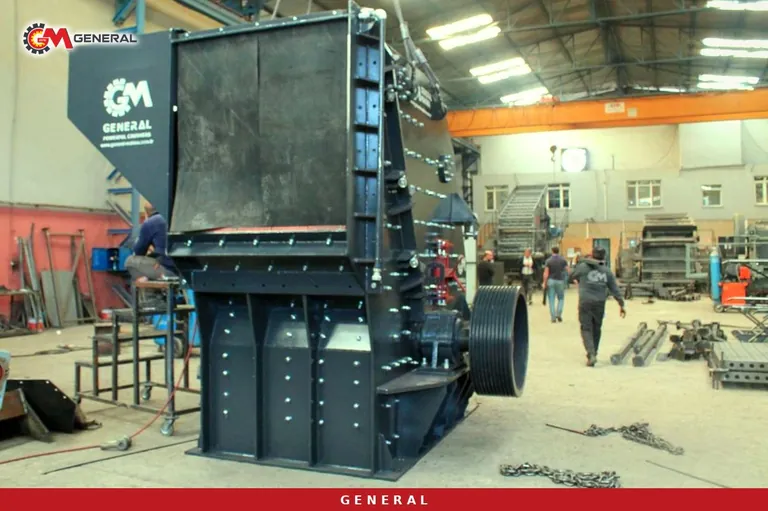
At a quarry that supplies an asphalt plant, the argument usually starts with tonnage and ends in the laboratory. The plant owner wants 200 tonnes per hour; the road authority's resident engineer will not accept a single truckload until he has seen the flakiness sheet, the crushed-face count and the fines result. This article explains how a mobile crushing and screening plant working in the 150-250 TPH range can meet bituminous mix aggregate requirements, which properties the machines can correct, which ones only quarry selection can fix, and which real model combinations we have for this tonnage. Every figure in the table comes from the technical data on our product pages. Limit values differ from project to project, so confirm them in the technical specification of the authority that owns the job.
Aggregate demands change with the road layer
Chippings from the same quarry face a different test depending on which pavement layer they go into. Projects following European norms define asphalt aggregate under EN 13043, while ASTM-based specifications use standards such as ASTM D692. Test names look alike in both systems, but the classes and limits differ. Deciding which layer you are producing for, before the crushing line is designed, shortens the machine list straight away.
Wearing course
In the top layer, where tyres touch the road, particle shape, crushed-face percentage and polishing resistance of the coarse aggregate dominate. Flat and elongated particles break under the roller and spoil the void structure of the mix. Polished stone value (PSV) depends on the rock's mineralogy; no crusher setting gives limestone the polishing resistance of basalt. That is why wearing course aggregate is often required to come from hard igneous rock such as basalt, andesite or granite, which steers the line towards a cone secondary and a separate shaping stage.
Binder and asphalt base courses
Shape requirements in the lower layers are usually one class looser, but the tonnage consumed is far higher. The real worry here is keeping the grading stable all day. If one of the 0-5, 5-12 and 12-19 mm fractions going to the plant's cold bins runs short or piles up, the mix design will not hold. Limestone quarries are often adequate for these layers, and an impact secondary gives good particle shape with high reduction.
Which test results a crushing line can change
A common false expectation in quotation meetings is that the crushing plant will cure every weakness of the rock. In practice the tests fall into two groups, and that split sets the size of the investment.
- Los Angeles abrasion loss and polishing resistance belong to the rock itself. A sample is taken from the quarry; if the result is poor, the answer is a different quarry.
- Flakiness and shape index depend on crusher type, number of stages and feed arrangement, and improve directly with line design.
- Crushed-face percentage depends on the particle entering the crusher being large enough relative to the one leaving it. In gravel pits the grizzly opening at pre-screening sets this value.
- Fines and sand equivalent are controlled by removing soil and clay before the crusher and by keeping the 0-5 mm fraction out of the coarse chippings.
- Grading consistency depends on the number of screen decks, the choice of mesh and the way stockpiles are built.
Everything on that list except the first item is a matter of the line configuration you buy. Having laboratory results from a quarry sample ready before asking for a quotation keeps you from paying for an unnecessary stage, or from arriving on site one stage short.
Real model combinations for 150-250 TPH
No single unit covers this tonnage band in every rock type. The table below brings together catalogue values of the models that can be used together or separately for asphalt aggregate. Capacities vary with the feed rock, moisture and target fraction.
| Unit | Crusher arrangement | Capacity | Max. feed | Screen | Power |
|---|---|---|---|---|---|
| GNR-MC110 | GPJ 110 jaw + GS1215/DMK03 impact | 200-300 t/h | 900 mm | 2000×6000 mm, 4 decks | 750 kVA generator |
| General 944 | GPJ 90 jaw + GM430 cone | 120-180 t/h | 800 mm | 1600×5000 mm, 3 decks horizontal | 550 kVA generator |
| General 950 | GPJ 90 jaw + DMK01 impact | 120-180 t/h | 800 mm | 1600×5000 mm, 3 decks horizontal | 600 kVA generator |
| GNR MK110 | Mobile cubicizer, 1550×1800 mm rotor | 160-250 t/h | 350 mm | — | 200 kW motor |
| M-DMK 02 | Mobile secondary impactor, feeder with by-pass screen | 150-250 t/h | 350 mm | — | 200 kW motor |
In a limestone or dolomite quarry
In low-abrasion rock an impact secondary solves reduction and shape at the same time. For the upper half of the band, GNR-MC110 answers directly: the jaw primary and impact secondary sit on two separate chassis, and the 2000×6000 mm four-deck screen produces four fractions, 0-5, 5-12, 12-19 and 19-40 mm. The fourth fraction can be sold separately for asphalt base or sub-base work. If 150-180 t/h is enough, a single General 950 is a more compact start; its DMK01 impact secondary gives cubical grains and its screen separates three fractions. In a stationary line the same job is done by the GNR DMK series impact crusher: DMK02 runs at 170-250 t/h, DMK03 at 250-300 t/h, and both accept feed up to 800 mm.
In basalt, andesite and granite
In high-silica rock the blow bar life of an impact rotor drops and wear cost per tonne climbs fast. Here the cone-secondary General 944 is the sensible starting point. Because the cone works by compression, its wear parts last long, but on its own it cannot always deliver the low flakiness a wearing course demands. On projects with a tight shape limit, adding a GNR MK110 mobile cubicizer behind the 944 is the safest route. When more than 180 t/h is needed, two General 944 units run in parallel; at 120-180 t/h each they reach a combined nominal 240-360 t/h, and production continues while one is in maintenance. GNR-MC110 also works in hard rock; the choice should follow test results and the wear budget.
Sizing the shaping stage correctly
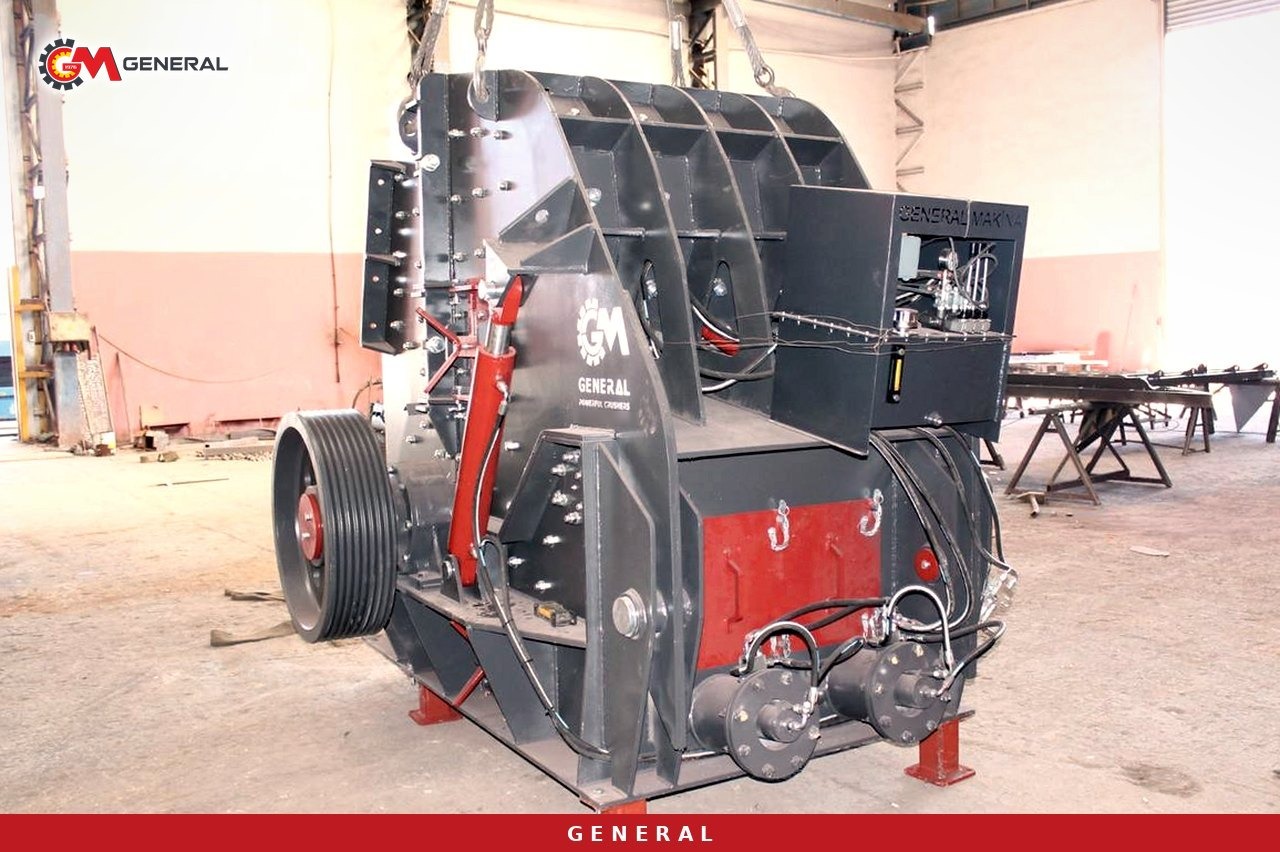
A cubicizer is not a reduction machine. Its job is to break and re-form the flat and elongated particles coming out of the secondary stage, lowering the flakiness index. Two conditions make it work: the feed particle must stay within the size the machine accepts, and the flow must sit within its capacity band.
Within the GNR MK series mobile cubicizer range, the model that fits a 150-250 TPH line is MK110: 160-250 t/h capacity, feed up to 350 mm, a 200 kW motor and a 0-25 mm final product. Its inner liners are Hardox 500 wear-resistant steel. The next model down, MK100, is limited to 90-130 t/h; a single MK100 becomes a bottleneck on a 150 t/h line. If the line is to be stationary, the GNR K110 cubicizer does the same job: 160-250 t/h capacity, 210 mm feed and a 160 kW motor.
The cubicizer does not need the whole flow of the line. For an asphalt layer the shape requirement usually governs the coarse fractions, while 0-5 mm sand can be screened off anyway. Sending only the portion above 5 mm to the shaping stage spends cubicizer capacity on the right fraction and reduces liner wear. The by-pass conveyor and intermediate screen that make this split should be drawn into the line layout from the start; adding them later complicates conveyor angles and site layout.
Holding the grading at the screen and stockpile
The most common reason well-crushed chippings fail the specification is the stockpile area. On a cone pile fed from height, coarse particles roll down to the toe and fines stay at the top. When the loader always works one face of the pile, the grading going to the plant changes hour by hour. A few site habits solve most of this: keep the discharge height of stockpile conveyors low, build the pile in layers, and spread loading along the face of the pile.
On the screen side, the number of decks sets the number of fractions. The four-deck screen of GNR-MC110 makes four products, while the three-deck horizontal screen of General 944 and 950 gives three: 0-5, 5-12 and 12-19 mm. If the specification calls for an extra fine fraction such as 0-2 or 2-5 mm, an additional screen unit is needed; suitable models are on our aggregate vibrating screen decks page. Screen apertures and wire type are defined for each order according to the rock; for asphalt work the choice should follow the sieve series of the specification.
Excess fines are a separate issue. If overburden soil is not removed on the grizzly feeder before the crusher, it passes into the 0-5 mm fraction and lowers the sand equivalent. If dry production is not enough, washing screens come into play, but first make sure the pre-screening is working properly.
A shift-based quality control routine
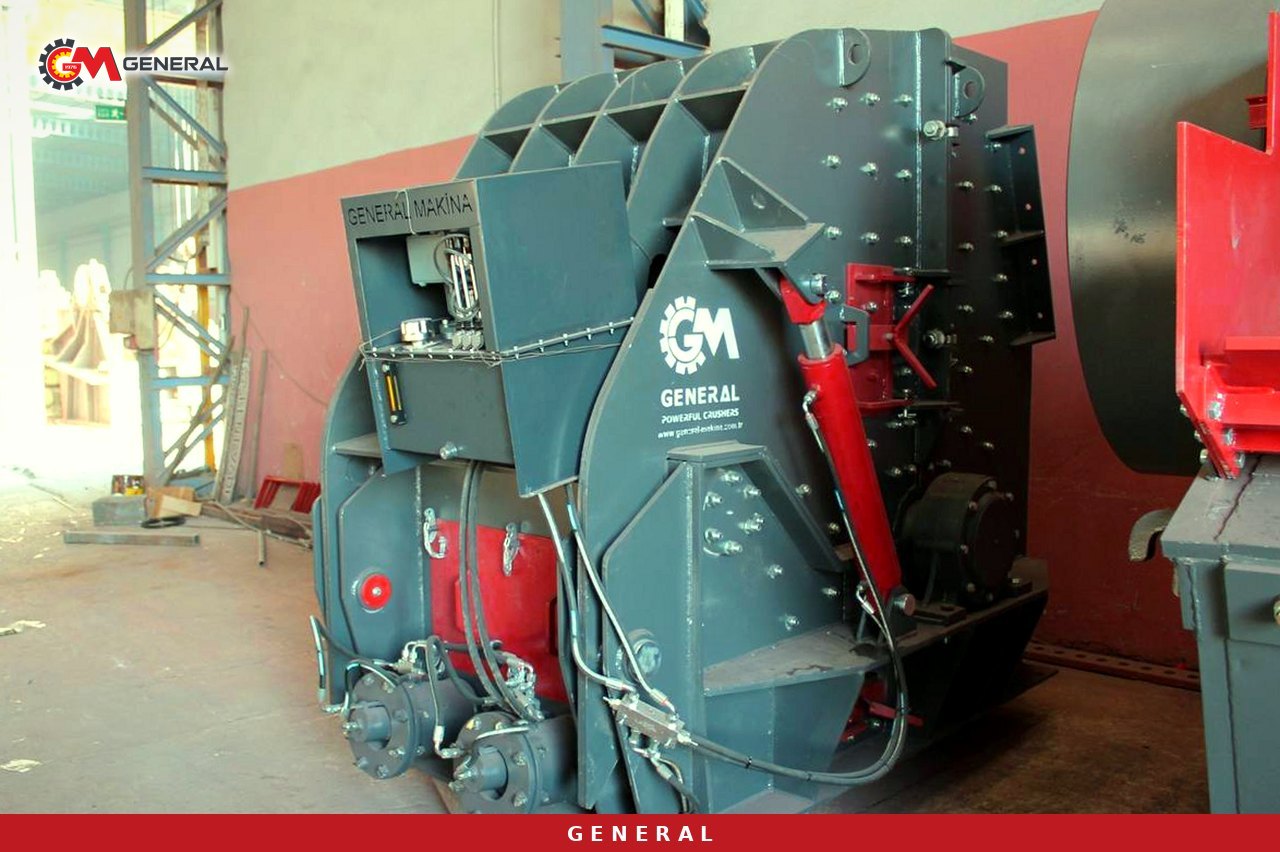
A line that meets the specification is only useful while it keeps meeting it. As wear parts thin out, the discharge gap opens and particle shape drifts. To catch this before the lab report arrives, set up a simple routine on site:
- Measure the secondary stage discharge gap at the start of each shift and log it.
- Sample every fraction from the moving belt; a sample taken from the toe of a pile does not show the truth.
- Repeat the flakiness test on coarse fractions often in the site lab, and reset the gap when results approach the limit.
- Check screen meshes visually for opened apertures and blinding; one torn panel contaminates a whole pile.
- Watch that the cone runs choke-fed and that the cubicizer is not idling far below its capacity band.
- Record blow bar, jaw and cone liner changes with dates; this log shows the link between shape drift and wear.
Frequently asked questions
Does a cone line always need a cubicizer?
No. For binder and base courses, the shape a choke-fed cone produces is often sufficient. A cubicizer is needed when the wearing course flakiness limit is tight or when the quarry rock is laminated. Base the decision on a trial crush of a quarry sample.
Does it make sense to run a single GNR-MC110 at a steady 150 t/h?
The plant will run, but you will sit below its capacity band. If the need is permanently around 150 t/h, a General 950 or General 944 is a better-sized investment. If output is expected to grow, MC110 offers staged growth because its primary group can operate independently.
What certificates and warranty come with the machines?
General Makina has been manufacturing in Izmir since 1976. Our machines carry ISO 9001 and CE certification; the warranty period is one year and does not cover wear parts.
What determines the quoted price?
The price depends on the number of units, whether a shaping stage is included, extra screens and conveyors, the generator arrangement, the spare wear parts package and the shipping method. Once we have this information we prepare a written quotation.
Let us plan the line around your quarry sample
Meeting an asphalt aggregate specification is the sum of the right quarry, the right number of stages and the discipline kept on site. In limestone, GNR-MC110 or General 950, and in hard rock, General 944 combined with GNR MK110, are realistic answers for the 150-250 TPH band. You can compare the other models on our wheeled mobile crushing plants page. Send us your quarry sample test results, the target layer and your daily tonnage, and we will prepare a suitable line layout and quotation: contact us.
Definitions of technical terms: Glossary