EN — English
 TR — Türkçe
 DE — Deutsch
 RU — Русский
 FR — Français
 ES — Español
 AR — العربية
 SR — Српски

Concrete Batching Plant Prices: Mobile vs Stationary Plant Cost Comparison
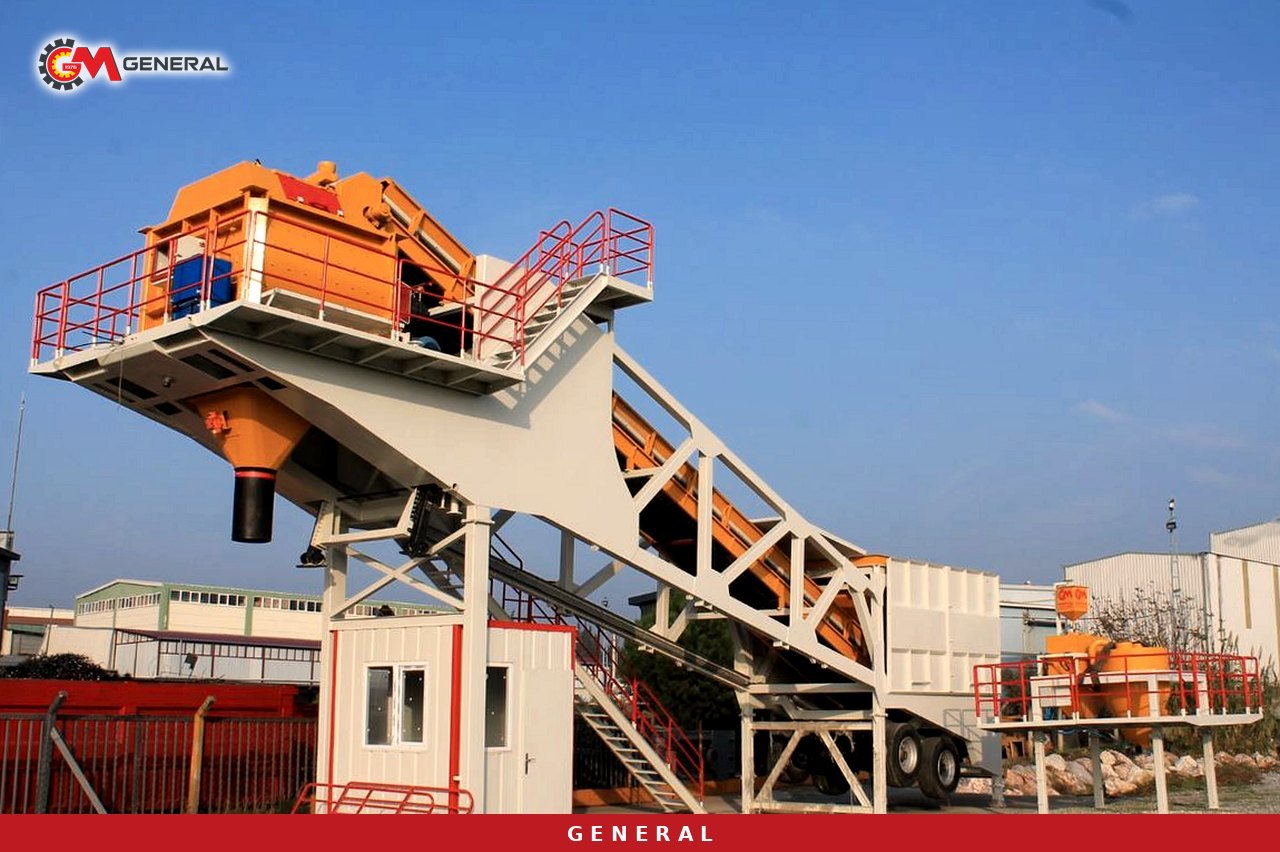
Buyers looking at a concrete batching plant for sale usually start with one question: which is cheaper, mobile or stationary? The real difference, however, shows up less in the invoice for the machine and more in where the money goes on site. With a mobile plant, the budget goes into the chassis, repeatable assembly and portability; with a stationary plant, it goes into foundations, long conveyors and large stock volume. In this article we line up General Makina's mobile series (M-Diamond 60, M-Titan 100, M-Magnum 120, M-Royal 150) and its stationary series (Diamond 60, Titan 100, Magnum 120, Royal 150) at the same capacity steps and separate the items that push a quotation up or down. The same model becomes a very different quote once silo, aggregate bin and site conditions change, so we give decision criteria rather than figures.
The installation scenario, not the equipment list, sets the quote
A concrete plant quotation has three layers: the equipment itself (mixer, weighing system, aggregate bin, cement silo, controls), getting it to site (transport and erection) and seating it on site (foundations, concrete works, ramp, drainage). A mobile concrete batching plant is designed to shrink the third layer: it is trailer- or chassis-mounted, runs on a minimal foundation and its chassis is suited to overseas shipping. A stationary concrete batching plant sits on a permanent foundation; in return it is built for long, uninterrupted production with larger aggregate compartments, longer feed conveyors and full PLC-PC automation.
That is why comparing two quotes by their bottom line is misleading: with a stationary plant the civil works budget stays with the buyer, while a mobile plant hides a transport and re-installation cost that repeats every time the job site moves.
Mobile versus stationary at the same capacity step
Both series match at the same four capacity steps, but the hardware is not identical. The table collects the technical rows that directly affect cost.
| Model | Type | Capacity | Mixer | Mixer motor | Aggregate bin | Cement silo |
|---|---|---|---|---|---|---|
| M-Diamond 60 | Mobile | 60 m³/h | Pan, 1 m³ | 37 kW | 4×10 m³ | 1×22 m³ |
| Diamond 60 | Stationary | 55-60 m³/h | Pan, 1 m³ | 37 kW | 4×15 m³ | Optional 60/80/100 ton |
| M-Titan 100 | Mobile | 100 m³/h | Twin-shaft, 2 m³ | 2×45 kW | 4×15 m³ | 100 ton |
| Titan 100 | Stationary | 100 m³/h | Twin-shaft, 2 m³ | 2×45 kW | 4×25 m³ | Optional 60/80/100 ton |
| M-Magnum 120 | Mobile | 120 m³/h | Twin-shaft, 3 m³ | 2×55 kW | 4×20 m³ | 100 ton |
| Magnum 120 | Stationary | 120 m³/h | Twin-shaft, 3 m³ | 2×55 kW | 4×30 m³ | Optional 60/80/100 ton |
| M-Royal 150 | Mobile | 150 m³/h | Twin-shaft, 4 m³ | 2×90 kW | 4×30 m³ | Optional |
| Royal 150 | Stationary | 150 m³/h | Twin-shaft, 4 m³ | 2×75 kW | 4×30 m³ | Optional 60/80/100 ton |
Three cost conclusions follow from the table. First, at the same capacity the stationary model has larger aggregate compartments: 15 instead of 10 m³ per bin in the 60 class, 25 instead of 15 m³ in the 100 class and 30 instead of 20 m³ in the 120 class. A larger bin needs more steel, but it spreads out loader trips. Second, in the 150 class the mobile M-Royal 150 lists a 2×90 kW mixer motor while the stationary Royal 150 lists 2×75 kW, so transformer and panel sizing must be done separately for these two models. Third, silo scope differs by series: the mobile M-Diamond 60 lists a 1×22 m³ silo and the M-Titan 100 and M-Magnum 120 list a 100 ton silo, while on the M-Royal 150 and on every stationary model the silo is optional. Unless you confirm whether the silo is included before comparing two quotes, you are comparing apples with oranges.
Foundations and civil works: the stationary plant's off-quote budget
Most of a stationary plant quotation is steel structure and equipment. Foundation concrete, anchor points, the bin loading ramp, retaining walls, the truck mixer loading bay and drainage are usually paid from the buyer's civil works budget. The main factors that size this item are:
- The soil survey and bearing capacity; weak ground means a larger foundation section.
- Silo count and tonnage: each 100 ton silo, at Ø3000 mm diameter and 14000 mm height, needs its own footing.
- Bin compartment volume and the fill and walls needed for the loader to reach the ramp.
- Mixer feed conveyor length: 800×27000 on the stationary Diamond 60, 1000×30000 on the Titan 100 and 1000×32000 on the Magnum 120 and Royal 150; a longer belt means more support points.
- Washout water, a settling pond and stormwater drainage.
With a mobile plant this list gets shorter but does not disappear: level, compacted ground, a manoeuvring area for truck mixers and solid points for the silo legs are still needed. The difference is that this preparation is not a permanent structure but light site work that can be left behind when the job closes.
Erection, dismantling and transport: every site move is a new cost
The economics of a mobile plant rest on repeatable erection and dismantling. Because the plant arrives on a trailer, the main units do not have to be rebuilt on site; most of the work is making connections, raising the silo and calibrating the scales. On a stationary plant erection happens once but is heavy: the steel structure is assembled piece by piece, the long feed conveyor is installed and the silos are raised by crane. Moving a stationary plant means dismantling, a new foundation and re-erection, which is close to a new installation.
On the transport side, what matters is how many pieces travel on which vehicles. Silo choice changes freight directly: a bolted silo is a knocked-down design that fits in a container and is assembled on site; a welded silo arrives as a single, bulky body and is craned into place. For distant sites and export a bolted silo has the edge; for nearby domestic sites a welded silo does.
Hypothetical example: imagine a road project where the plant has to be set up at four different points. For a mobile plant you count four erections, three dismantlings and three transport moves. For a stationary plant there are two routes: either a new foundation plus full dismantling and re-erection at each point, or one fixed location with truck mixer haul distances that grow as the work advances. When you request quotes, ask for the unit cost of each event separately and build the total around your own schedule.
Cement silo and aggregate bin: the two items that swing the quote most
Silo count and capacity
The cement silo is the item that grows most easily in a concrete plant quotation, because every extra silo means more steel, another foundation and a separate screw conveyor. The General Makina cement silo is built in a standard 30-100 ton range. The product page lists these dimensions: Ø2600 mm × 5000 mm for 30 ton, Ø2600 mm × 11000 mm for 60 ton, Ø3000 mm × 13000 mm for 80 ton and Ø3000 mm × 14000 mm for 100 ton. Custom builds reach 50-2500 ton. Each silo comes standard with a top filter, a safety valve, two min/max level indicators and three fluidizing jets, so adding silos multiplies this auxiliary set as well as storage volume.
The number of silos is set by how many binders you will use: one cement type needs one silo, while a second cement type or a mineral addition makes a second silo unavoidable. Tonnage is set by tanker delivery frequency and daily consumption; if supply is far away, a larger silo reduces the risk of a stoppage.
Number of aggregate compartments
The aggregate bin is built with 2 to 8 compartments and 10-50 m³ per compartment. The standard models of both series have four compartments, enough to keep fractions such as 0-5, 5-15 and 15-25 mm apart and leave one compartment for an extra aggregate. A fifth or further compartment is worth the cost only if your mix designs really use an additional fraction. The mobile bin travels on a chassis and matches mobile plants; the stationary bin, with larger compartments up to 4×30 m³, needs a permanent foundation. If you will handle wet or sticky material, write the optional per-compartment vibro motor into the quote from the start; retrofitting means both labour and production downtime.
Mixer type and automation: balancing cycle time and concrete quality
Both series use a pan mixer in the 60 class (1 m³ compacted concrete, 37 kW) and a twin-shaft mixer in the 100, 120 and 150 classes. According to the concrete mixer types comparison, a twin-shaft mixer mixes in about 30-45 s, is ideal for large batches of ≥3 m³ and suits high-tonnage ready-mix and bridge work. A pan (planetary) mixer has a typical mixing time of about 90-120 s with batches of ≤2.5 m³ and gives the most homogeneous result for precast, UHPC, architectural and zero-slump concrete. The range also includes a single-shaft mixer that balances capacity and economy at a medium batch size; since it is not standard in the plant tables, ask for it as a separate configuration.
From a cost point of view, mixer choice comes down to one question: what will the plant produce? In a ready-mix business, the short cycle of a twin-shaft mixer turns nominal capacity into real output. In a plant casting precast elements or architectural concrete, the longer but more homogeneous mix of a pan mixer protects product quality. The wrong mixer turns a cheap quote into expensive production.
Automation scope also differs between the series: on the mobile series the whole process is run from a full-auto PLC control cabin on the mobile platform, while the stationary series uses full PLC-PC automation. In both series aggregate, cement, water and additive are weighed independently on separate load-cell scales. Check the control cabin and weighing scope line by line in every quote.
Deciding by project duration and how often the site moves
There is no fixed duration threshold between mobile and stationary. What decides is the ratio between the time the plant will produce at one location and the total project duration. If the plant will serve the whole project from one point, the stationary plant's foundation investment is spread over a long production period; if the location changes often, every new foundation is a separate loss and the mobile plant comes out ahead.
| Project condition | Preferred type | Cost rationale |
|---|---|---|
| Short, single-site job | Mobile | No permanent foundation or heavy dismantling cost |
| Project spread over several points (road, dam, power line) | Mobile | Repeatable erection and dismantling, light foundation |
| Long-term ready-mix sales from one location | Stationary | Large aggregate compartments, long conveyor, PLC-PC automation |
| Precast or architectural concrete | Diamond 60 or M-Diamond 60 | Pan mixer gives a homogeneous mix |
| High tonnage and large batches | Magnum 120, Royal 150 or their mobile counterparts | Twin-shaft mixer, 3 m³ and 4 m³ batches |
| Remote site or export | Mobile + bolted silo | Container-sized silo, shipping-ready chassis |
Checklist before you request a quote
- Peak hourly demand and daily production target.
- How many times the plant will move during the project.
- Number of binder types, which sets silo count, tonnage and bolted or welded design.
- Number of aggregate fractions and their moisture, which sets compartment count and vibro motors.
- Type of concrete to be produced, which sets pan or twin-shaft mixer.
- Soil survey and who is responsible for civil works.
- Site power supply and transformer capacity matched to the mixer motor.
- Whether the quote lists silo, control cabin, transport and erection as separate lines.
Frequently asked questions
Is a mobile concrete plant always cheaper than a stationary one?
No. The chassis and portability hardware of a mobile plant are reflected in the equipment price, while a stationary plant carries a separate foundation and civil works budget outside the quote. Which one is more economical overall depends on how many times the plant will move and how much it will produce at each location.
Which options change the quoted price the most?
Beyond the capacity step and mixer type: silo count and tonnage, number and volume of bin compartments, options such as vibro motors, bolted or welded silo and the scope of transport and erection. Two quotes carrying the same model name can differ widely because of these items.
Do mobile and stationary models of the same capacity produce the same concrete?
The production chain and the mixer type at each step are the same; the differences lie in stock volume, feed conveyor, foundation needs and automation scope.
What information should I share to get an accurate quote?
Share the eight checklist items above together with your site layout and project schedule. With this information a quote with a clearly defined scope can be prepared; all equipment is covered by a 1-year warranty.
In short, choosing between a mobile and a stationary plant is not a price comparison but a comparison of project schedule and site layout. You can review every model on the concrete batching plants page. General Makina builds both series with more than 50 years of manufacturing experience; send your project details through our contact page to request an itemised quotation.
Definitions of technical terms: Glossary