EN — English
 TR — Türkçe
 DE — Deutsch
 RU — Русский
 FR — Français
 ES — Español
 AR — العربية
 SR — Српски

Cameroon Granite & Gneiss Jaw + Cone Crushing and Screening Plant 120-180 TPH
An investor opening a quarry in Cameroon often finds two different rocks in the same face: massive, coarse-grained granite and, right beside it, banded and foliated gneiss. Both are hard and both are rich in silica, yet they do not behave the same inside a crusher. Granite tends to break into cubical pieces, while gneiss likes to split along its foliation planes into flat, elongated chips. This article explains why a jaw primary plus cone secondary is the right starting point for a Cameroonian quarry targeting 120-180 TPH of aggregate, which real models cover that band, and how the line should be arranged for a wet tropical climate.
Across a broad belt from southern to central Cameroon, Precambrian basement rocks such as granite, gneiss and migmatite lie close to the surface. Above them sits a cover of red laterite and clay produced by tropical weathering. When designing the crushing line, both layers must be considered together: the sound rock wears the crusher, and the overburden blinds hoppers and screens.
Why gneiss and granite behave differently in a crusher
In granite the minerals are randomly oriented, so when a jaw or a cone applies pressure, fracture surfaces develop fairly evenly. In gneiss, mica and feldspar bands are aligned in parallel. When pressure hits those bands at a right angle the stone breaks cleanly; when it runs parallel to them, thin slabs form. The result is that the same crusher setting can produce chippings with a higher flakiness index from gneiss. Because asphalt and concrete specifications cap the share of flaky particles, this difference feeds straight into the proportion of saleable product.
Two conclusions follow for crusher selection. First, the silica in both rocks consumes the hammers of an impact rotor quickly, so a cone crusher working by compression in the second stage is the main tool for keeping metal cost under control. Second, in gneiss the cone must be choke-fed and run in closed circuit with the screen to correct particle shape. Rock-on-rock crushing inside the cone chamber breaks the flat pieces and cubes them.
The rock ratio matters too: the share of granite and gneiss in run-of-mine material can change from bench to bench. Before design starts, we recommend taking samples, having abrasion and crushability tests done and adding the results to the enquiry file. Regional geological generalisations are fine as a starting point, but only laboratory data tells you how a specific quarry will behave.
Real configurations that cover 120-180 TPH
The model that covers the whole target band on one chassis with a jaw + cone layout is the General 944. There is also a sister model of the same capacity with an impact secondary, and a more flexible tracked option. The table below uses only values from the product pages; cells without a published value are marked with a dash.
| Item | General 944 | General 950 | GM 90JP + separate cone stage |
|---|---|---|---|
| Primary crusher | GPJ 90 jaw | GPJ 90 jaw | GNR 90 jaw, 95 kW |
| Secondary crusher | GM430 cone | DMK01 impact | Cone crusher selected per project |
| Capacity | 120-180 t/h | 120-180 t/h | 70-180 t/h (primary) |
| Max. feed size | 800 mm | 800 mm | 700 mm |
| Screen | 1600×5000 mm, three-deck horizontal | 1600×5000 mm, three-deck horizontal | 1000×2000 mm, double-deck |
| Generator | 550 kVA | 600 kVA | 250 kVA |
| Weight | 70,000 kg | 70,000 kg | 35,000 kg |
| Undercarriage | Wheeled | Wheeled | Tracked |
General 944: jaw and cone on one chassis
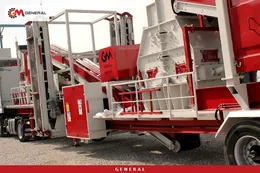
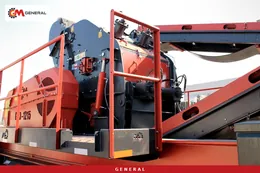
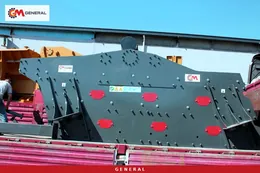
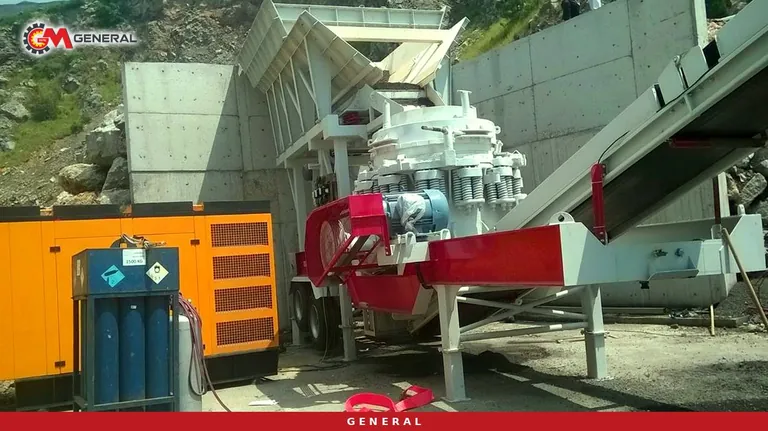
The General 944 combines a GPJ 90 primary jaw and a GM430 cone secondary on a single wheeled chassis. It accepts run-of-mine rock up to 800 mm, its output setting range is 0-100 mm, and a 1600×5000 mm three-deck horizontal screen splits the product into 0-5, 5-12 and 12-19 mm fractions. Bypass, return and stockpile conveyors are part of the line; oversize coming back from the screen is sent to the cone again, closing the circuit. That return loop is exactly what is needed to tackle flaky particles in gneiss.
A hard-stone application of the same model in Africa is listed on the site as the GNR 944 Mobile Hard-Stone Crushing & Screening Plant 120-150 t/h - Africa. That project is not in Cameroon; it can be studied as a reference for how the model is positioned in similar hard rock.
When does an impact secondary come into play?
The General 950 places a DMK01 impact crusher behind the same GPJ 90 jaw. It offers high reduction and cubical product, but in high-silica granite and gneiss the consumption of hammers and plates rises noticeably compared with a cone. If your quarry will also process a softer, less abrasive rock alongside granite, or if your customer demands very cubical fine product, the 950 is worth considering. In a pure granite-gneiss quarry, the choice usually leans towards the 944.
A split layout for larger sites
If the face moves often, the tracked GM 90JP can be considered as the primary: it takes 700 mm feed, works in the 70-180 t/h range and needs no foundation or hydraulic legs. This unit, however, is a jaw crusher only; for granite and gneiss a cone second stage has to be planned separately. A two-unit layout complicates transport and site arrangement, and its advantage over the single-chassis 944 appears only on faces that require constant movement. For the other crushers in the range, see the crushers category.
Running a cone crusher correctly on gneiss
Getting the expected particle shape from a cone such as the GM430 depends as much on operating discipline as on the machine itself. The cone crusher page gives a typical secondary reduction ratio of 6:1-8:1; a cone pushed beyond that ratio both overloads and produces more flaky particles. Points to watch in a gneiss quarry:
- Choke-feed the cone: the crushing chamber should always be full, and the feed should not arrive in bursts. Intermittent feed raises the slab ratio in gneiss.
- Size the jaw discharge to suit the cone: the closed-side setting of the primary jaw should be chosen according to the feed size the cone can accept.
- Use the closed circuit actively: returning material retained above 12-19 mm to the cone is the main mechanism that corrects shape in gneiss.
- Check the closed-side setting (CSS) regularly with the hydraulic system; as the mantle and concave wear, the product gets coarser.
- Choose the mantle and concave for high-silica rock: the product page lists manganese steel, with a high-chrome option for high silica.
Rainy season, laterite cover and clay
A humid tropical climate prevails over southern and central Cameroon; in the wet months run-of-mine material arrives wet, and overburden clay mixes with sound rock. Wet clay plasters the jaw chamber, blinds screen apertures and builds up on conveyor belts. This is the most common reason a crusher's real output falls below its rated figure.
The first measure lies in the mining itself: stripping must be done properly and the laterite cover stockpiled away from the face. On the plant side, grizzly pre-screening should remove the fine, clayey fraction before it enters the primary crusher. If the aggregate specification sets tight limits on clay and dust, a separate washing stage can be added per project; this is not standard equipment but a measure chosen on the basis of quarry data. In the drier north the problem flips to dust, and enclosed transfer points and water-spray dust suppression become the priority.
From Douala port to the quarry: shipping and power
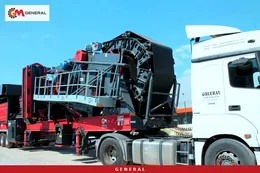
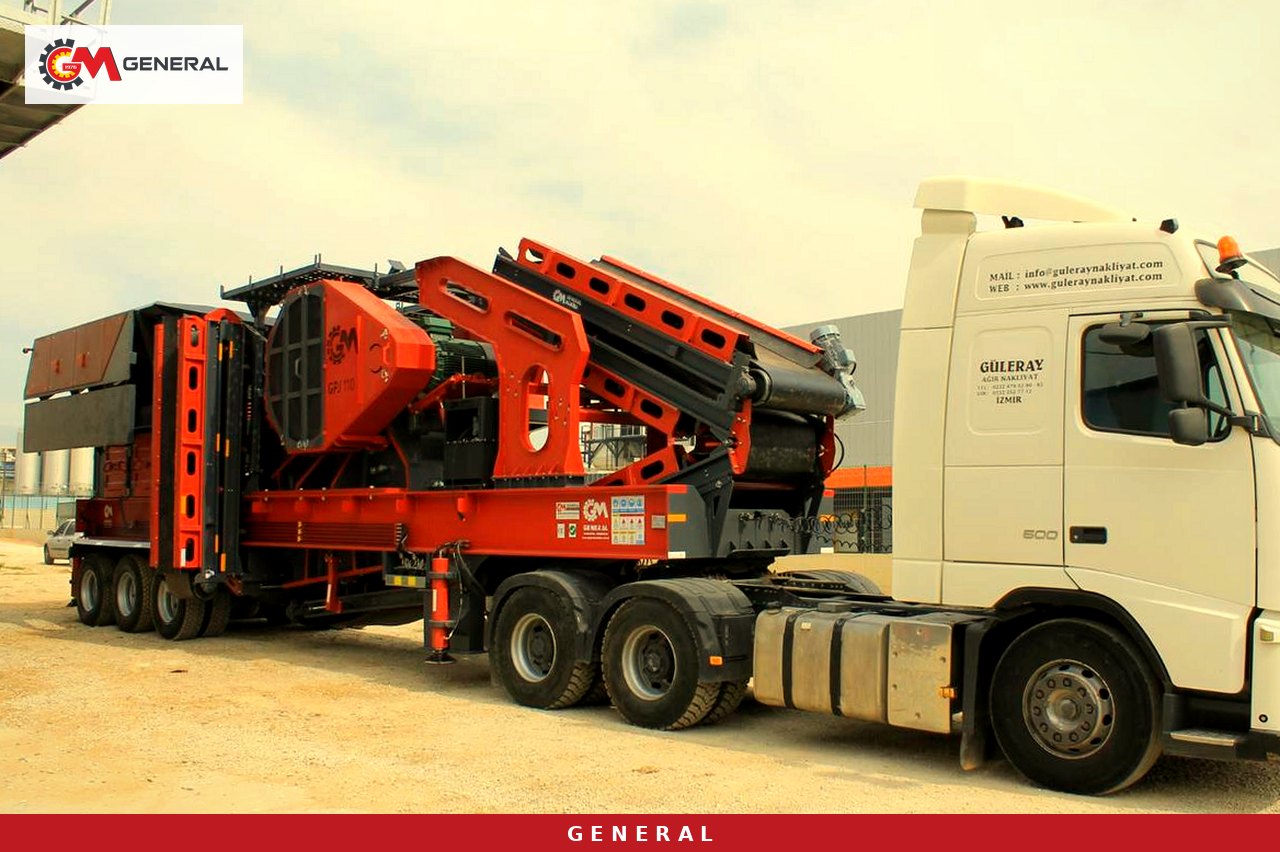
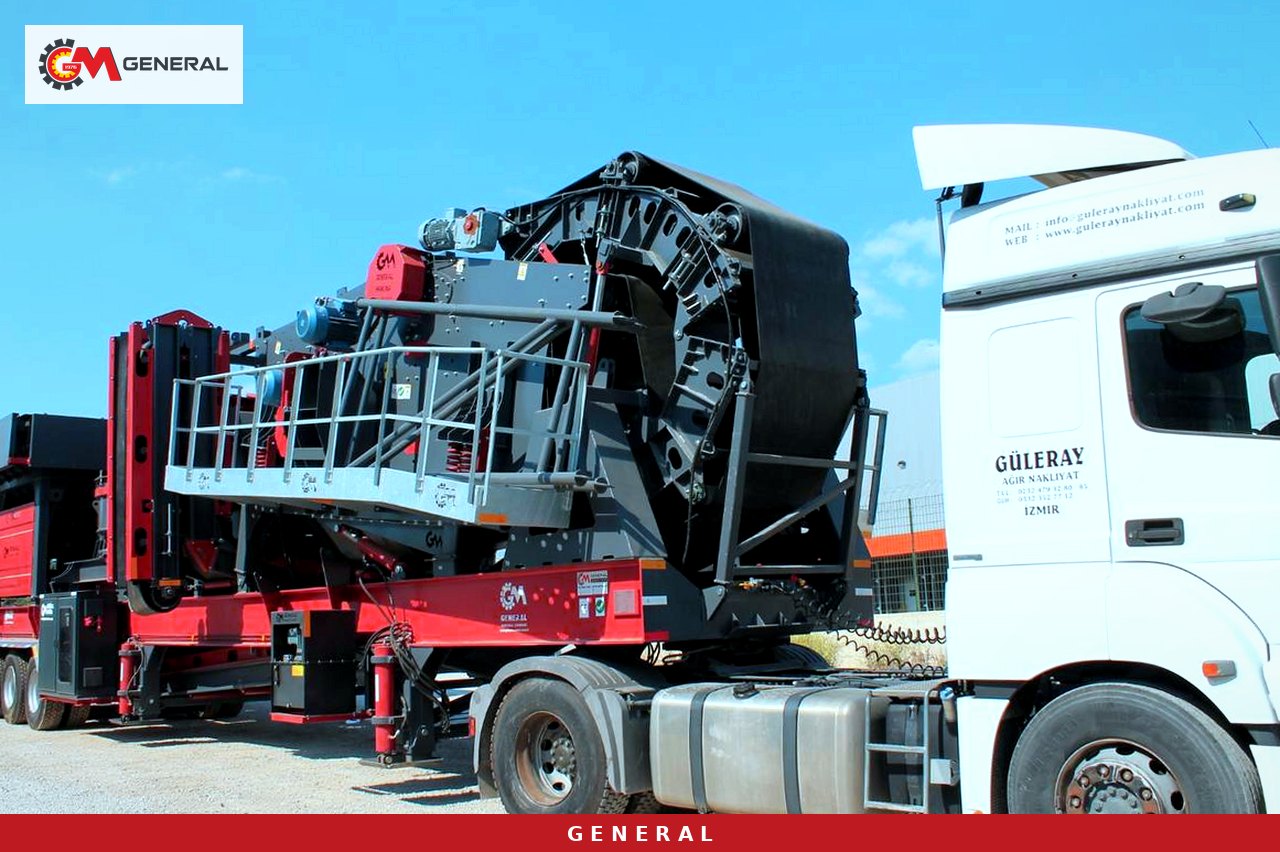
For a machine shipped from Türkiye, the main gateway into Cameroon is the port of Douala; the deep-water port at Kribi on the southern coast can also be considered as an alternative. The General 944 has transport dimensions of 4130×20350×4500 mm and weighs 70,000 kg. These figures mean bridge, bend and height restrictions on the inland route from the port must be checked in advance. Because unpaved roads change condition in the rainy season, the route plan should be made with the season in mind. For abnormal-load permits and customs procedures, obtain current information from the relevant Cameroonian authority.
Remote quarries often have no grid connection, or an unreliable one. The product page lists a 550 kVA generator for the General 944. In hot, humid air the generator's air filter and radiator need more frequent cleaning, and fuel storage must be protected from moisture. To see which combination fits your site, compare the other models on the wheeled mobile crushing and screening plants page.
Quarry data to include in the enquiry
Preparing the following data shortens the process of choosing the right configuration and firming up the price. Price is driven by the model chosen, generator and extra screen needs, wear-part preferences, any washing stage, packing and the shipping method.
- Abrasion and crushability test results of a rock sample; the approximate ratio of granite to gneiss.
- Largest block size after blasting (against the 800 mm feed limit).
- Target products: which fractions, in what proportions and to which specification.
- Overburden thickness and clay content; the operating plan for the rainy season.
- Grid power availability or generator preference.
- Route information from port to site and the available layout area on site.
For a more detailed model comparison, see the article on choosing the best mobile crushing plant for basalt and granite.
Frequently asked questions
Can gneiss yield a particle shape suitable for concrete and asphalt?
Yes, but it depends on choke-feeding the cone and on closed-circuit screening. The return loop re-crushes flat pieces and cubes them. Because the final result depends on how strongly the rock is foliated, a sample test is recommended.
What products does the General 944 deliver?
With the standard screen arrangement you get 0-5, 5-12 and 12-19 mm fractions; the output setting range is 0-100 mm. Screen apertures are set at the order stage according to your product targets.
How does the plant run without grid power?
A 550 kVA generator is specified for the General 944, so the plant can run independently of the grid. In a humid climate, generator service intervals should be shortened to suit the site.
How are price and delivery time determined?
Both are settled at the quotation stage according to the chosen configuration, extra equipment and shipping method. Once you share your quarry data, a tailored quotation is prepared.
Conclusion
For a granite-gneiss quarry in Cameroon, the simplest answer to a 120-180 TPH target is the General 944, which combines a jaw primary and a cone secondary on one chassis. Success depends on feeding the cone correctly, using the closed circuit actively and keeping clay out of the line during the rainy season. General Makina has been manufacturing in Izmir since 1976; its machines carry ISO 9001 and CE certification and a 1-year warranty excluding wear parts. Send your sample results and product targets through our contact page and we will work out the right configuration for your quarry together.
Definitions of technical terms: Glossary