EN — English
 TR — Türkçe
 DE — Deutsch
 RU — Русский
 FR — Français
 ES — Español
 AR — العربية
 SR — Српски

Ivory Coast Granite Jaw + Impact Crushing and Screening Plant 150-250 TPH
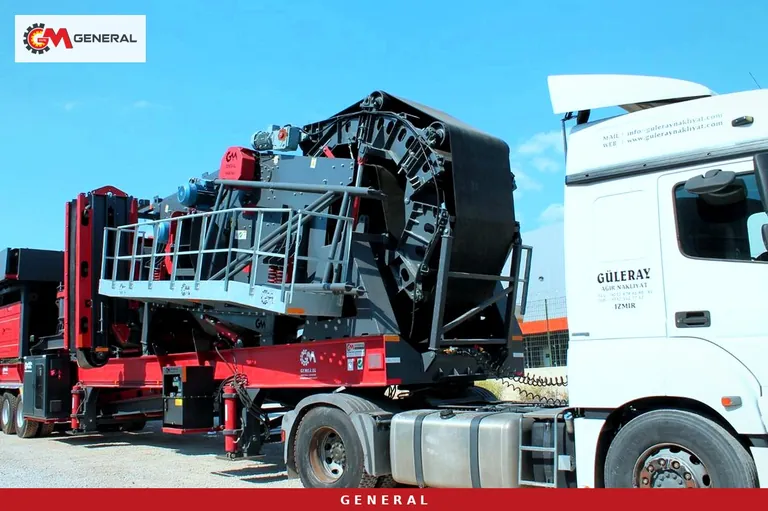
An investor opening or expanding a granite quarry in Ivory Coast has to decide the character of the crushing chain before comparing brands, with either an impactor or a cone in the second stage. This article is written for buyers targeting 150-250 TPH of granite aggregate who are considering a horizontal-shaft impactor as the secondary crusher. We explain what an impactor does well in granite, where it becomes expensive, and which real General Makina configurations cover this capacity band, with their published figures.
Across much of the country, crystalline basement rocks such as granite, granitic gneiss and migmatite sit at the surface or at shallow depth. Yet the label "granite" alone does not pick a crusher; two quarries in the same district can show clearly different free quartz content. The recommendations below should therefore be read together with a laboratory result from a sample of your own face.
An impact secondary in granite: the gain and the cost
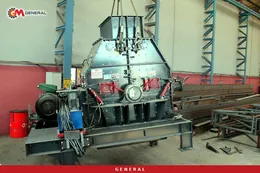
A jaw crusher breaks granite blocks by compression; the secondary impactor flings the material with blow bars mounted on a rotor and throws it against breaker plates. That impact splits each particle along its weak planes and leaves an angular, cubical chip. For a concrete batching plant or an asphalt producer, particle shape is money: aggregate with a low flakiness index balances cement and bitumen demand and compacts more evenly when laid.
The cost is wear. The blow bars and breaker plates lose a little metal each time they hit quartz grains in the granite. The General Makina product page for the GNR DMK series says so plainly: the DMK is designed for limestone, dolomite and low-to-medium abrasive rock, while a secondary cone is preferred for high-silica granite, basalt and gravel. In other words, a jaw + impact layout is the right choice for granite only under certain conditions, not always.
When the impact stage makes sense
- The sample analysis shows moderate free quartz and the rock is partly weathered or fractured.
- The main customer is a concrete or asphalt producer that specifies cubical particle shape.
- You want to reach fine fractions in a single secondary stage with a reduction ratio of about 10:1 (the figure given for the DMK series).
- The operation has the workshop and stock routine to tie blow bar changes to a planned maintenance calendar.
When you should switch to a cone
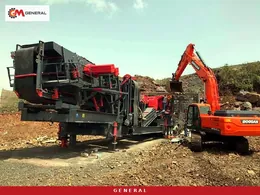
In fresh, coarse-grained, quartz-rich granite the wear cost per tonne of an impactor climbs quickly. If the sample result points that way, the General 944 which carries a GM430 secondary cone on the same frame size, gives longer metal life. The 944 and 950 share the same 70,000 kg weight and 4130×20350 mm footprint; the decision rests entirely on the character of the secondary crusher.
Three real layouts for the 150-250 TPH target
No single-chassis jaw + impact model covers the whole band on its own; the lower and upper ends are met by different machines. The table below uses only values from the product pages, and unknown cells are left blank.
| Option | Crushers | Capacity | Feed opening | Screen | Generator | Weight |
|---|---|---|---|---|---|---|
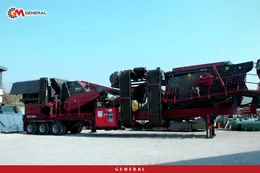
| A. General 950 (single chassis) | GPJ 90 jaw + DMK01 impact | 120-180 t/h | 800 mm | 1600×5000 mm, 3-deck | 600 kVA | 70,000 kg |
| B. GNR-MC110 (twin chassis) | GPJ 110 jaw + GS1215/DMK03 impact | 200-300 t/h | 900 mm | 2000×6000 mm, 4-deck | 750 kVA | 55,000 + 55,000 kg |
| C. Towed units | GNR 110 primary jaw + M-DMK 02 secondary | Line limit 150-250 t/h | 1100 mm | — | — | 55,000 + 38,000 kg |
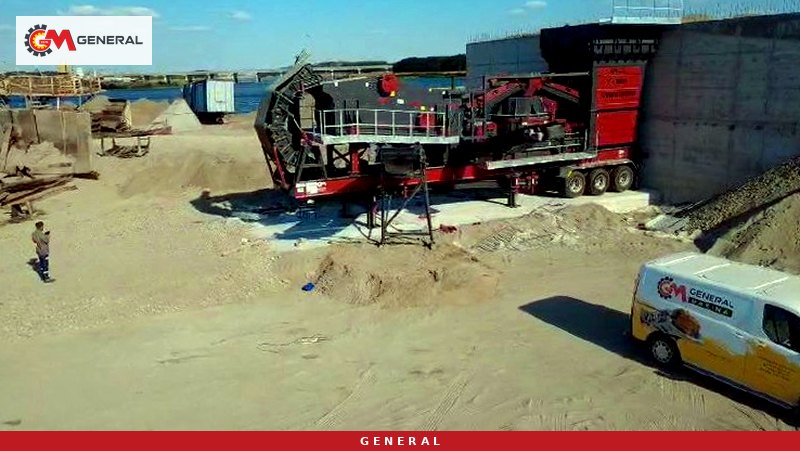
Option A addresses the lower half of the band. If the daily output target works out at 150-180 tonnes per hour, the General 950 moves on one truck, starts working in about 30 minutes and delivers 0-5 / 5-12 / 12-19 mm fractions. For a comparable use in West Africa, see the project page of the General 950 shipped to Niger.
Option B covers the top of the band and growth. The GNR-MC110 carries its primary and secondary groups on separate chassis; because the primary can run alone, you can buy only the primary in the first year and add the secondary when volumes grow. Its four-deck screen also separates a 19-40 mm fraction, an extra product for quarries selling road sub-base.
Option C is a flexible middle path. The GNR 110 towed primary jaw (GNRK 110, 180-300 t/h, 0-250 mm product) feeds an M-DMK 02, whose 0-350 mm feed acceptance takes the primary product comfortably. The real line capacity is set by the secondary's 150-250 t/h, and the screening unit is selected separately according to the product plan. You can compare the other wheeled options on the wheeled mobile crushing plants page.
Calculating the hourly target correctly
A common buyer mistake is to divide the monthly tonnage in a sales contract straight into an hourly capacity. The correct calculation accounts for the time the machine can really run: required capacity (t/h) = daily sales target ÷ (daily operating hours × availability).
Hypothetical example: with a daily target of 2,000 tonnes, a 10-hour shift and an assumed 80% availability, 2,000 ÷ (10 × 0.8) = 250 t/h is needed. If the same target is produced over two shifts, the requirement halves and the General 950 option comes into play. During Ivory Coast's rainy seasons, haul roads and stockyards can cut efficiency, so do not pick an optimistic availability figure.
Feed and clay control in a tropical climate
In granite quarries the overburden is often lateritic soil and a clayey weathering zone. If this material enters the crusher with rain, it coats the impact chamber, blinds the screen and drops capacity without warning. Three measures should be planned together:
- Grizzly pre-screening: the grizzly section of the feeder bypasses fines and soil before they reach the crusher, which also reduces blow bar wear.
- Overburden discipline: the clayey zone is stockpiled separately and never mixed with the blasted rock.
- Screen aperture and slope: if the bottom deck blinds in the wet season, aperture and feed rate are reset together with the product plan.
In hot, humid weather the cooling radiators of the generator and hydraulic unit, the air filters and the electrical panel need protection from dust and moisture. Belt covers and dust suppression sprays are measures that can be chosen per project; ask for the standard equipment list separately at quotation stage.
Blow bars and plates: the operating balance of an impact line
In a jaw + impact granite line, wear parts are the largest operating item, and the right measure is cost per tonne crushed, not part price. Wear is driven by the free quartz/silica content of the feed, not by Mohs hardness. The alloy notes on the General Makina wear and spare parts page can be summarised as follows:
- High-chrome white cast iron (about 15-25% Cr, 700-800 HB): the blow bar standard for clean, abrasive feed, but brittle; it can crack when oversize blocks or tramp metal arrive.
- Austenitic manganese steel: work-hardens under impact from 200 HB to 550 HB at the surface; suitable for jaw plates.
- Ceramic-reinforced composite: can last about 2-3 times longer than high-chrome in abrasive duty.
For the stage that takes coarse, hard impact in granite, manganese/martensitic steel and then the ceramic option are evaluated. Make this decision with the sample result; even different benches of the same quarry can show different blow bar life.
From the port of Abidjan to the quarry
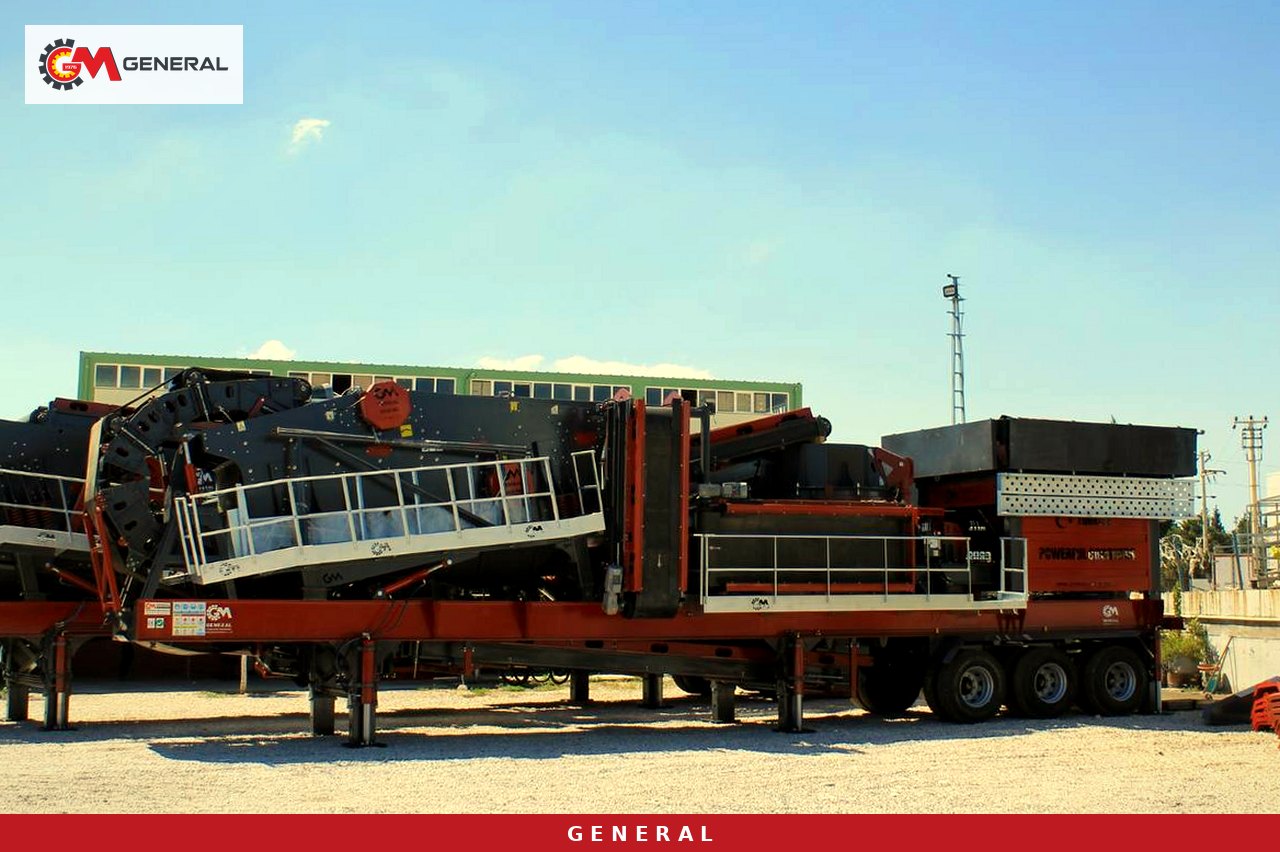
Equipment from Türkiye usually enters Ivory Coast through the ports of Abidjan or San-Pédro. After the port, the deciding factors are whether the road to the quarry can carry heavy loads and what bridge limits apply. The General 950 measures 4130×20350×4500 mm on a single chassis; the GNR-MC110 has a 3000×13500 mm primary chassis and a 4200×18300 mm secondary chassis, each weighing 55,000 kg. A twin-chassis layout can make permits easier on routes where one very heavy unit is a problem.
Route permits, escort vehicles and customs procedures follow the rules of the local authorities; confirm the exact requirements with the haulier and the relevant administration. Where the grid does not reach the quarry, generator power is decisive: the product pages state 600 kVA for the 950 and 750 kVA for the MC110.
Data to collect from the quarry before asking for a quote
- Free quartz/silica and abrasiveness test result for a granite sample
- Largest block size after blasting (to compare with 800, 900 or 1100 mm feed openings)
- Product list and ratios: demand for 0-5, 5-12, 12-19 and 19-40 mm
- Daily sales target, number of shifts and rainy-season plan
- Whether grid power exists or the plant will run on a generator
- Route and load limits from port to quarry
- Overburden thickness and clay content
Frequently asked questions
Why not choose a cone straight away instead of an impactor for granite?
A cone gives longer metal life in abrasive granite; an impactor gives an advantage in particle shape and reduction ratio. If the sample shows high quartz, the General 944 cone layout is evaluated; if it is moderate and cubical product sells at a premium, the General 950 or GNR-MC110 impact layout is considered.
Which option suits output of around 200 TPH?
200 t/h is above the General 950's 120-180 t/h range. At this level, the GNR-MC110 (200-300 t/h) or the GNR 110 primary + M-DMK 02 secondary combination (line limit 150-250 t/h) should be considered.
Can the plant run without grid power?
Yes. According to the product pages, 600 kVA of generator power is foreseen for the General 950 and 750 kVA for the GNR-MC110. Fuel supply and generator maintenance should be built into quarry logistics.
What shapes price and delivery?
Price is set by the configuration (single chassis, twin chassis or towed units), number of screen decks, generator, wear-part alloy and shipping scope. Once these items are clear, a written project-specific quotation is prepared.
Conclusion
For 150-250 TPH in Ivory Coast granite, a jaw + impact layout makes sense when demand for cubical product is strong and the rock is moderately abrasive: the General 950 at the lower end of the band, the GNR-MC110 at the upper end, and the towed primary + M-DMK 02 combination for buyers who want flexibility. If the sample shows high silica, moving to the cone-equipped 944 is the better call. General Makina has been manufacturing in Izmir since 1976; its plants carry ISO 9001 and CE certification and a 1-year warranty (wear parts excluded). Send your quarry data through our contact page and we will prepare the matching configuration and quotation.
Definitions of technical terms: Glossary