EN — English
 TR — Türkçe
 DE — Deutsch
 RU — Русский
 FR — Français
 ES — Español
 AR — العربية
 SR — Српски

Cameroon Yaoundé & Douala Mobile Crushing & Screening Plant 150-250 TPH
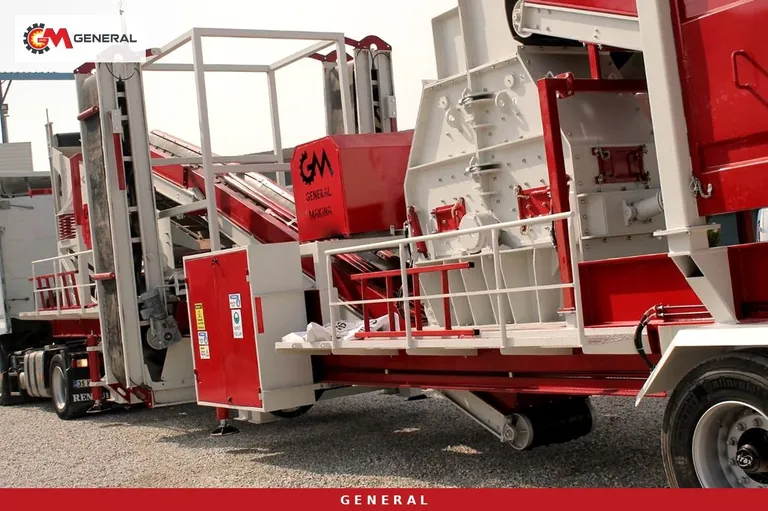
Cameroon's two largest cities stand for two crushing sites that have almost nothing in common. Yaoundé is a highland city ringed by hills, and the quarries near it mostly work crystalline basement rock, gneiss and granite. Douala sits on the Wouri estuary, on top of a sedimentary basin; hard rock is scarce right next to the city, so aggregate either comes in from inland quarries or is dug from riverbeds as sand and gravel. For a contractor shopping for a 150-250 TPH mobile crushing and screening plant, the first decision is therefore not the brand but which city's material the plant will serve. This article matches the needs of both cities to real General Makina wheeled models and lists what to watch on the rainy season, port shipment and power.
Yaoundé gneiss versus Douala sediments: one capacity, two crushing trains
Gneiss and granite are high-silica, abrasive rocks. Feeding them to an impact crusher at the primary stage is possible, but blow bars and plates wear quickly and the cost of wear parts per tonne climbs. At a quarry around Yaoundé the sensible train is a jaw crusher up front, a secondary crusher behind it and a multi-deck screen. The weathered upper zone and lateritic overburden also bring clay and soil to the face; unless that material is removed before the crusher, screen meshes blind and throughput drops.
On the Douala side the picture flips. For rounded river gravel, or low-abrasion stone hauled in from inland, a primary impactor gives both a high reduction ratio and cubical grains. Because this material is often mixed with sand, silt and clay, washing after crushing may also be needed. In other words, the same 200 TPH target means a jaw-led line in Yaoundé and an impact- and wash-led line in Douala. To compare which rock suits which crusher in more detail, the model pages in the wheeled mobile crushing plants category are a good starting point.
Which real models cover a 150-250 TPH target?
No single model in the wheeled General family spans the whole 150-250 TPH band; it is covered by four models with neighbouring capacity ranges. The table lists only values published on the product pages.
| Model | General 01 | General 950 | GNR-MC110 | General 02 |
|---|---|---|---|---|
| Capacity | 120-180 TPH | 120-180 TPH | 200-300 TPH | 250-300 TPH |
| Feed opening | 700 mm | 800 mm | 900 mm | 1000 mm |
| Generator | 550 kVA | 600 kVA | 750 kVA | 660 kVA |
| Weight | 55,000 kg | 70,000 kg | 2 × 55,000 kg | 76,000 kg |
| Screen | 1600×5000 mm, 4-deck | 1600×5000 mm, 3-deck | 2000×6000 mm, 4-deck | 2000×5000 mm, 4-deck |
| Crusher layout | GPS 1210 impactor (primary + secondary) | GPJ 90 jaw + DMK01 impactor | GPJ 110 jaw + DMK03 impactor, two chassis | GPS 1413 primary impactor |
For Yaoundé quarries: General 950 and GNR-MC110
If the target is around 150-180 TPH, the General 950 carries a GPJ 90 jaw and a DMK01 impactor together on one chassis; it accepts 800 mm feed and makes 0-5 / 5-12 / 12-19 mm fractions. Because the jaw takes the first blow despite the abrasiveness of gneiss, the impactor works on smaller, more uniform material. Once the target rises to 200-250 TPH, the right answer is the GNR-MC110: the GPJ 110 primary group and the DMK03 secondary group sit on separate chassis, it takes 900 mm feed and its 2000×6000 mm four-deck screen yields four fractions up to 19-40 mm. Since the primary chassis can run alone, an investor can open the quarry with coarse product first and bring the secondary in later.
For low-abrasion stone and Douala supply: General 01 and General 02
When limestone or low-abrasion gravel is to be crushed, an impact primary is more economical. The General 01 does primary and secondary crushing in one body with its GPS 1210 impactor and delivers 120-180 TPH. For the top of the band, 250 TPH, the General 02 runs at 250-300 TPH with a 1000 mm inlet, the widest in the family; in closed circuit it sends oversize back to the crusher and produces four fractions. Meeting 250 TPH at the bottom of its range, without pushing the machine, makes it a strong candidate for Douala supply. The same model is not recommended for granite or gneiss; there, go back to the jaw-fronted lines.
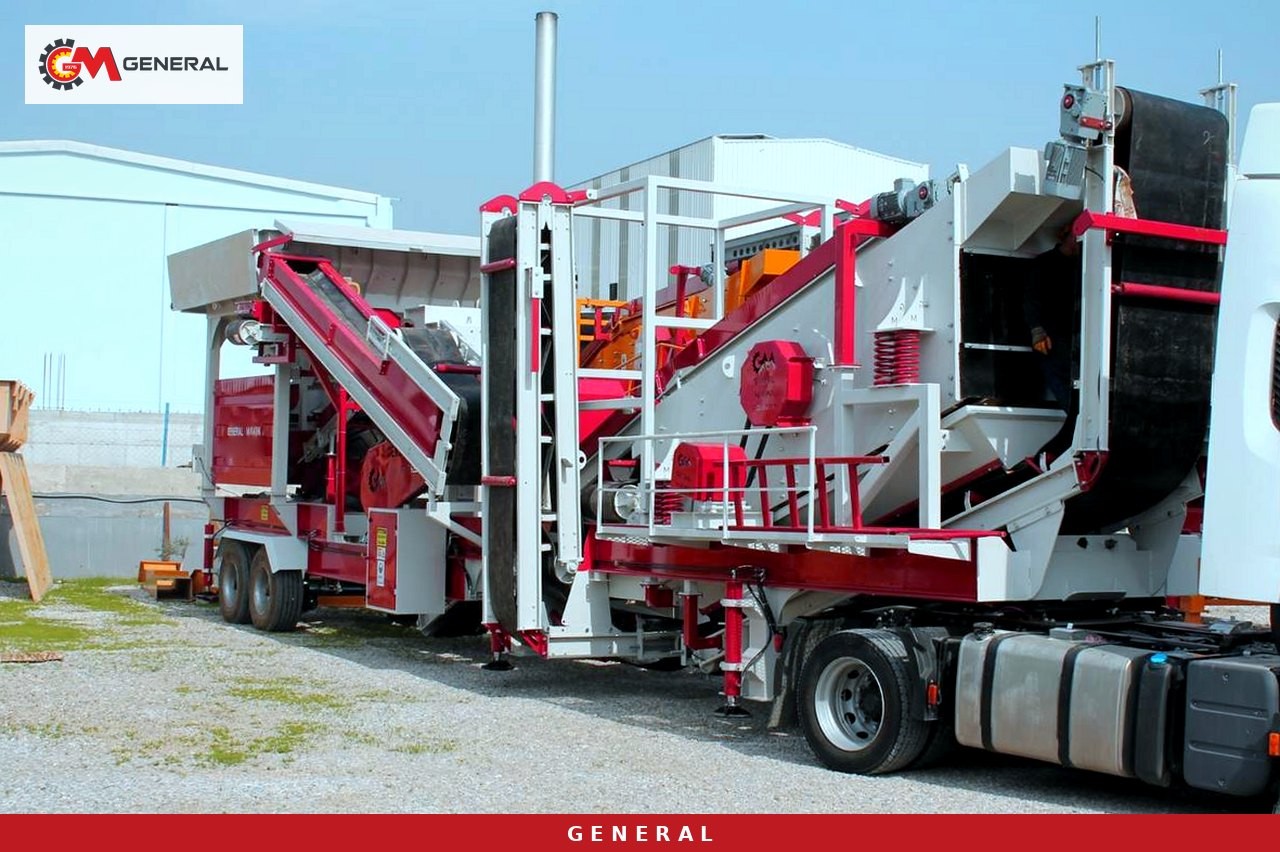
Sticky feed in the rainy season: scalping that protects tonnage
Wet seasons are long in southern Cameroon, and lateritic soil on the quarry face turns sticky once soaked. On a static grizzly feeder this material bridges the bars, clay reaches the crusher and screen wires blind. Two measures stand out:
- In the dry season and on clean rock, the by-pass section of a vibrating grizzly feeder removes fines before they reach the crusher.
- With wet, clayey feed, consider a wobbler feeder: the GWB1136 separates the muddy fines with rotating elliptical disc shafts, accepts material up to 1500 mm and works across a 75-600 TPH feed range.
- If crushed product carries too much clay to meet concrete or asphalt specifications, add washing after the screen.
- Stockpile drainage and cleaning under the belts should be written into the shift plan during wet weeks.
If river material is processed around Douala, washing can become a must. The GNR YM1650 mobile wash-and-screen plant sits in the 120-180 TPH range and is listed with other options on the sand washing and dry screening plants page. The product capacity of the crushing line and the capacity of the wash line must match; neither should bottleneck the other.
From Douala port to the site: shipping, roads and set-up
For a wheeled plant leaving Türkiye, Douala port is the natural gateway to Cameroon. At the port the machine is hitched to a tractor unit on its own chassis and driven to site. For a Douala project the trip is short; a plant bound for Yaoundé uses the main highway between the two cities. Points to watch:
On single-chassis models the weight sits on one vehicle: the General 02 weighs 76,000 kg and the General 950 70,000 kg. On the GNR-MC110 the load is split across two chassis of 55,000 kg each, which can ease permits on routes with bridge and road limits. Exact axle loads and transit permits should be confirmed with the road authority on the route and with the haulier. Whether dirt quarry roads will carry a heavy trailer in the wet season is also worth checking before shipment.
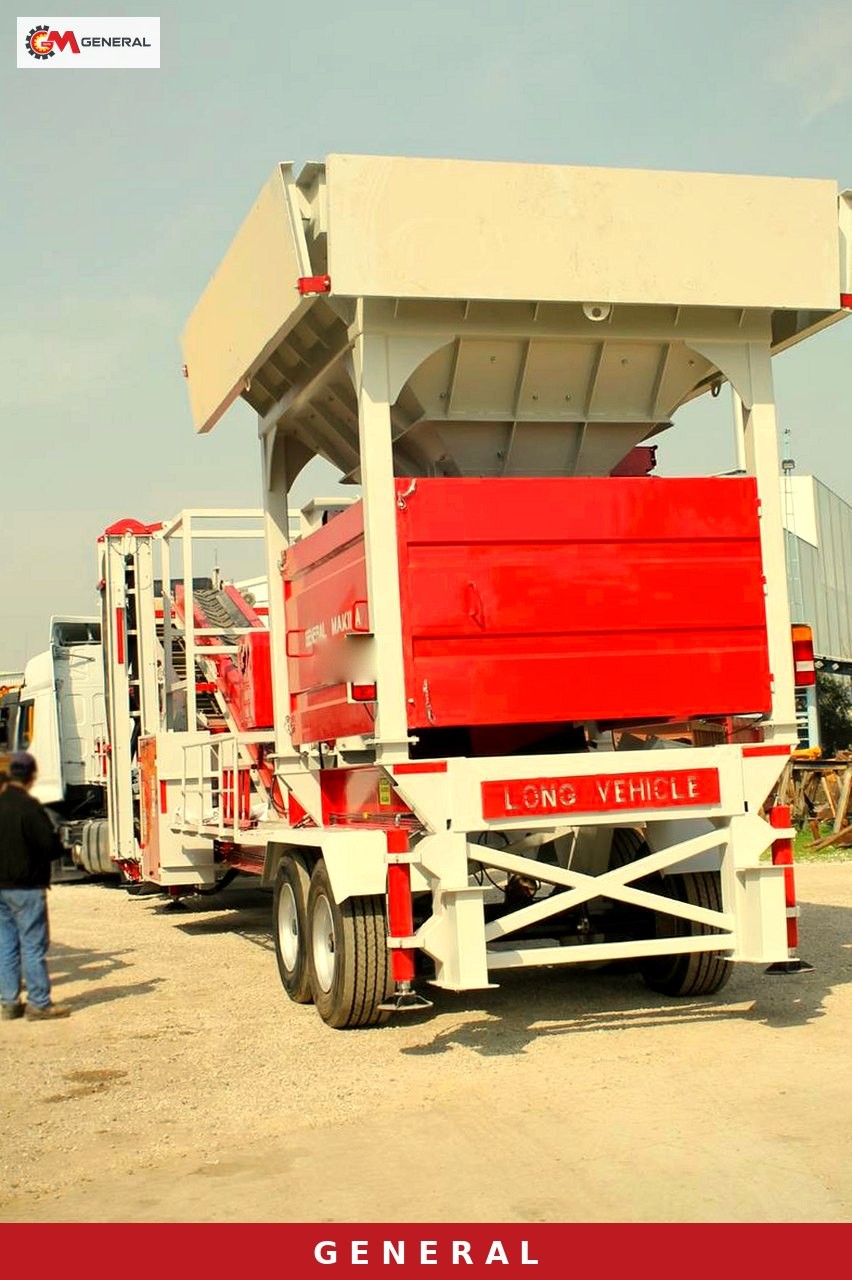
Once on site, the plant needs level, compacted ground. Because laterite softens in the rain, concrete pads or a compacted crushed-stone bed under the support legs prevent settling caused by screen and crusher vibration. A ramp that lets the loader reach the hopper comfortably belongs on the same preparation list.
Power, humidity and dust: running in Cameroonian conditions
Most quarries are far from the grid, so the plant runs on its own generator. The table values differ by model: 550 kVA for the General 01, 600 kVA for the General 950, 660 kVA for the General 02 and 750 kVA for the GNR-MC110. When sizing power, add up the load of belts, screen and any wobbler or wash unit together.
Electrics and air filters in a humid climate
High humidity means condensation inside panels and corrosion on contacts. Panel heaters, sealed cable glands and frequent checks of the generator air filter should be planned per project. In the dry season, dust suppression nozzles at the crusher discharge and transfer points, plus belt covers, are measures to weigh for operator health and for relations with nearby communities. Which of these items are included should be fixed in writing at the quotation stage.
Site data to prepare before requesting a quote
- Rock type and sample: a lab test (abrasion and compressive strength) showing gneiss, granite, limestone or river gravel.
- Largest block size coming from the face; it decides whether a 700, 800, 900 or 1000 mm inlet is needed.
- Target products: how much of each 0-5, 5-12, 12-19 and 19-40 mm fraction is needed per day.
- Clay and moisture: ideally two samples, one from the wet and one from the dry season.
- Daily operating hours and number of shifts; the hourly capacity target follows from them.
- Distance from Douala port, road condition and bridge limits.
- Project specification: the aggregate requirements should be confirmed from the relevant authority's or employer's documents.
Frequently asked questions
Can one machine serve both Yaoundé and Douala jobs?
Usually not, if the material differs. A jaw-fronted line is more economical for hard gneiss, an impact-primary line for low-abrasion stone or gravel. If you will alternate between the two cities, the jaw-fronted model handles a wider range of material, though it loses the wear advantage an impactor has on limestone.
General 02 or GNR-MC110 for 250 TPH?
The rock decides. The General 02 delivers 250 TPH at the bottom of its range on low-abrasion material. On granite and gneiss the 200-300 TPH GNR-MC110 is the right choice, because its GPJ 110 jaw does the first crushing.
What warranty and certificates apply?
The machines carry a 1-year warranty; wear parts are excluded. Production is ISO 9001 and CE certified. General Makina has been manufacturing in İzmir since 1976.
How is the price set?
Price depends on the model, crusher layout, number of screen decks, feeder type, washing needs, generator and optional dust suppression equipment. When you request a quote with your site data, a price is prepared for that specific configuration.
Decision summary
For gneiss and granite quarries around Yaoundé, the jaw-fronted General 950 or GNR-MC110 is the right starting point; for projects processing low-abrasion stone or river material for Douala, the General 01 or General 02. Feeder choice for the rainy season, and a wash unit where needed, matter as much as the capacity target. Send your sample results and target fractions through our contact page and we will settle the right configuration and quote together.
Definitions of technical terms: Glossary