EN — English
 TR — Türkçe
 DE — Deutsch
 RU — Русский
 FR — Français
 ES — Español
 AR — العربية
 SR — Српски

Sub-Saharan Africa Road Cost with a Mobile Crushing & Screening Plant 120-180 TPH
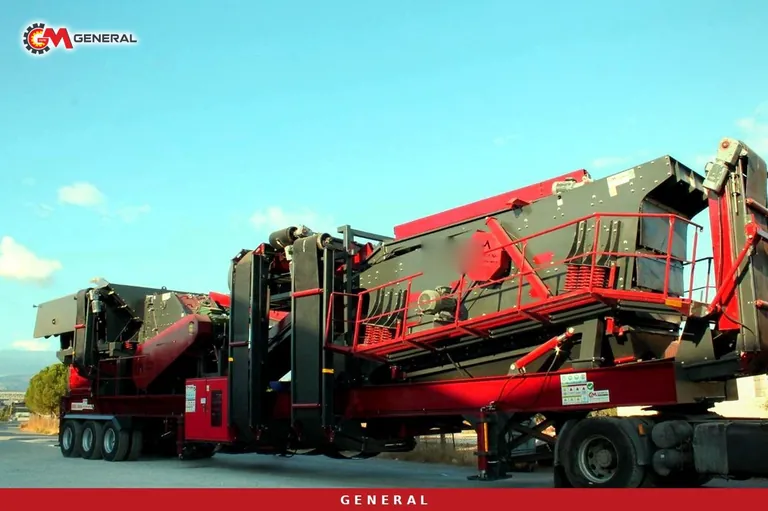
In a Sub-Saharan Africa road tender, the asphalt, bitumen and paver lines usually look clear on paper; the estimate drifts most on the cost per tonne of the crushed stone that goes into the subbase and base course. From the volcanic plateaus of East Africa to the laterite-capped granite shield of West Africa, the road contractor meets a similar picture: commercial quarries are far away, the alignment is long and there is no grid power along most sections. This article breaks down, line by line, the cost of producing aggregate next to the road with a 120-180 TPH mobile crushing and screening plant. It uses "units" instead of a currency so you can compare models and read incoming quotations on the same basis.
Note: country and corridor names in this article are a geographic frame only. Layer thickness, grading envelope and material requirements for a specific road job must be confirmed in the specification of the relevant road authority.
Cost per tonne of aggregate is built from four lines
Looking at a single figure is misleading when discussing crushed stone cost on a road site. Splitting it into four lines shows which decision moves which line:
- Ownership share (S): the plant investment divided by the operating hours you expect. Freight, customs and initial site set-up belong here too.
- Energy (E): fuel burned by the generator on an off-grid site, tracked in units per hour.
- Wear (W): the per-tonne share of blow bars, jaw plates, cone liners and screen meshes.
- Haulage (H): the per-tonne share of trucking from the quarry to the laying point.
The formula can be written as: Cost per tonne = (S + E + labour) ÷ net hourly output + W + H. Hypothetical example: if your fixed hourly costs are 1,000 units and the plant delivers 150 tonnes of net product per hour, that part alone comes to about 6.7 units per tonne. If feeding problems drop the same plant to 110 tonnes per hour, the share rises above 9 units. It is the net output you sustain on site, not the nameplate figure, that sets the cost. You can test this with your own numbers in the energy and wear cost calculator.
Haulage distance: where a mobile plant saves the most
Most road jobs in Sub-Saharan Africa are linear and long. A line supplied from a fixed quarry means slightly longer truck cycles every day as the work advances, and service roads damaged in the rainy season slow those cycles further. That is why the H line grows faster than S and W on many projects. A wheeled plant can be moved along the alignment to a suitable rock outcrop, bringing production close to the work front.
The question that drives cost here is: how many times will you relocate the plant, and how many production days will each move cost? Models that carry feeder, crusher, screen and conveyors on a single chassis reduce that loss, because they sit on hydraulic legs without a concrete foundation. When deciding, check the transport dimensions against the bridges, bends and ferry crossings on the route; for a consignment arriving through a port, the size of the load to be hauled inland must be known from the start.
Three models in the 120-180 TPH band, three cost profiles
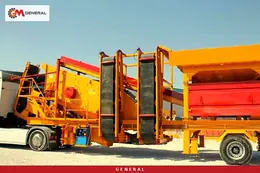
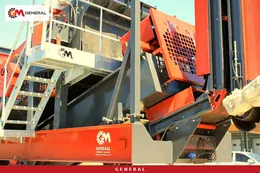
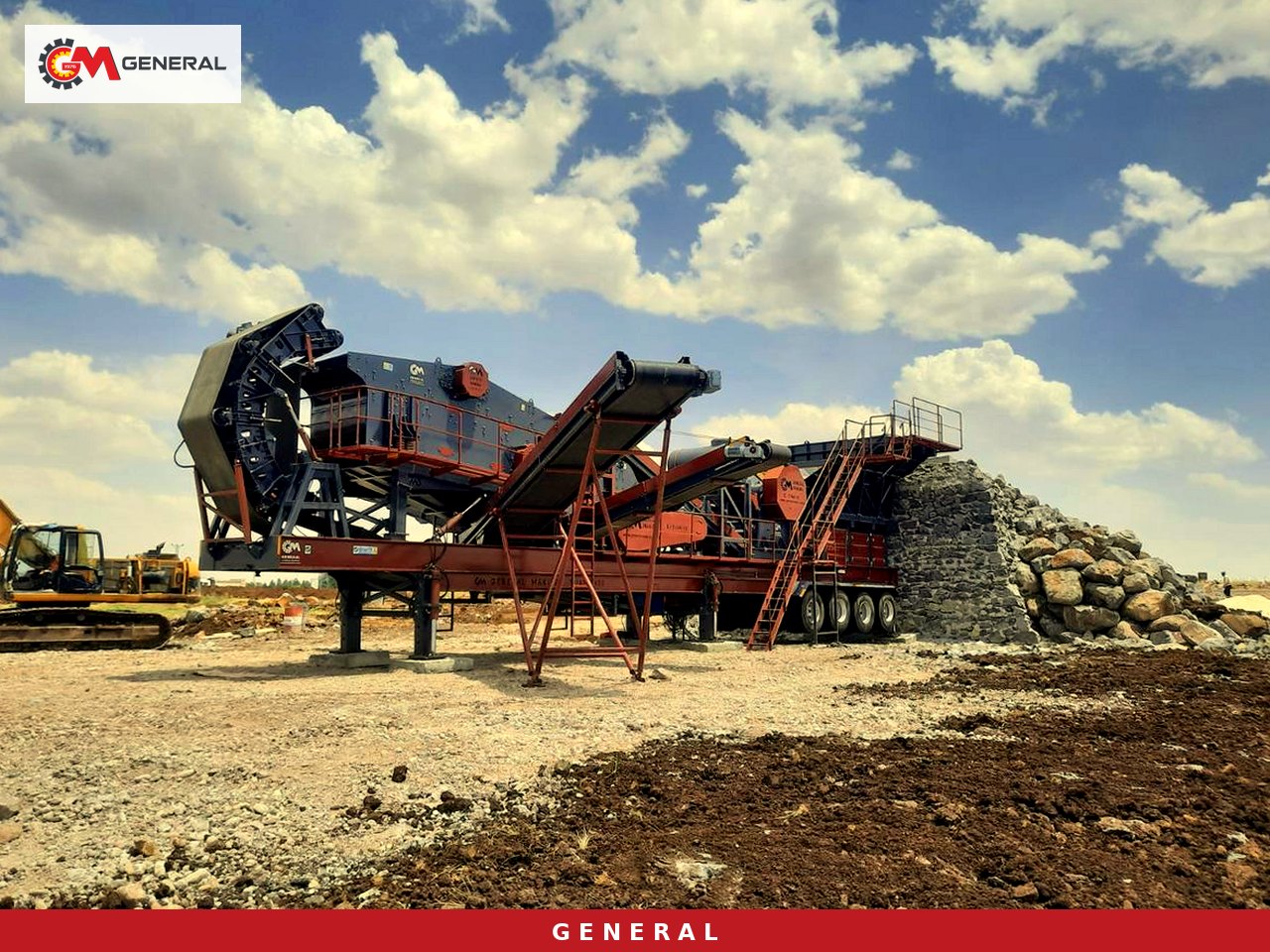
Within this capacity range, three of our wheeled mobile crushing and screening plants are direct candidates. All three sit in the same tonnage band, yet they push S, E and W in different directions.
| Value | General 950 | General 01 | General 944 |
|---|---|---|---|
| Generator | 600 kVA | 550 kVA | 550 kVA |
| Weight | 70,000 kg | 55,000 kg | 70,000 kg |
| Transport dimensions | 4130×20350×4500 mm | 4300×18500×4500 mm | 4130×20350×4500 mm |
| Capacity | 120-180 t/h | 120-180 t/h | 120-180 t/h |
| Maximum feed | 800 mm | 700 mm | 800 mm |
| Crushing layout | GPJ 90 jaw + DMK01 impact | GPS 1210 impact (primary + secondary in one body) | GPJ 90 jaw + GM430 cone |
| Product fractions | 0-5 / 5-12 / 12-19 mm | 0-5 / 5-12 / 12-19 / 19-40 mm | 0-5 / 5-12 / 12-19 mm |
| Screen | 1600×5000 mm, 3-deck horizontal | 1600×5000 mm, 4-deck | 1600×5000 mm, 3-deck horizontal |
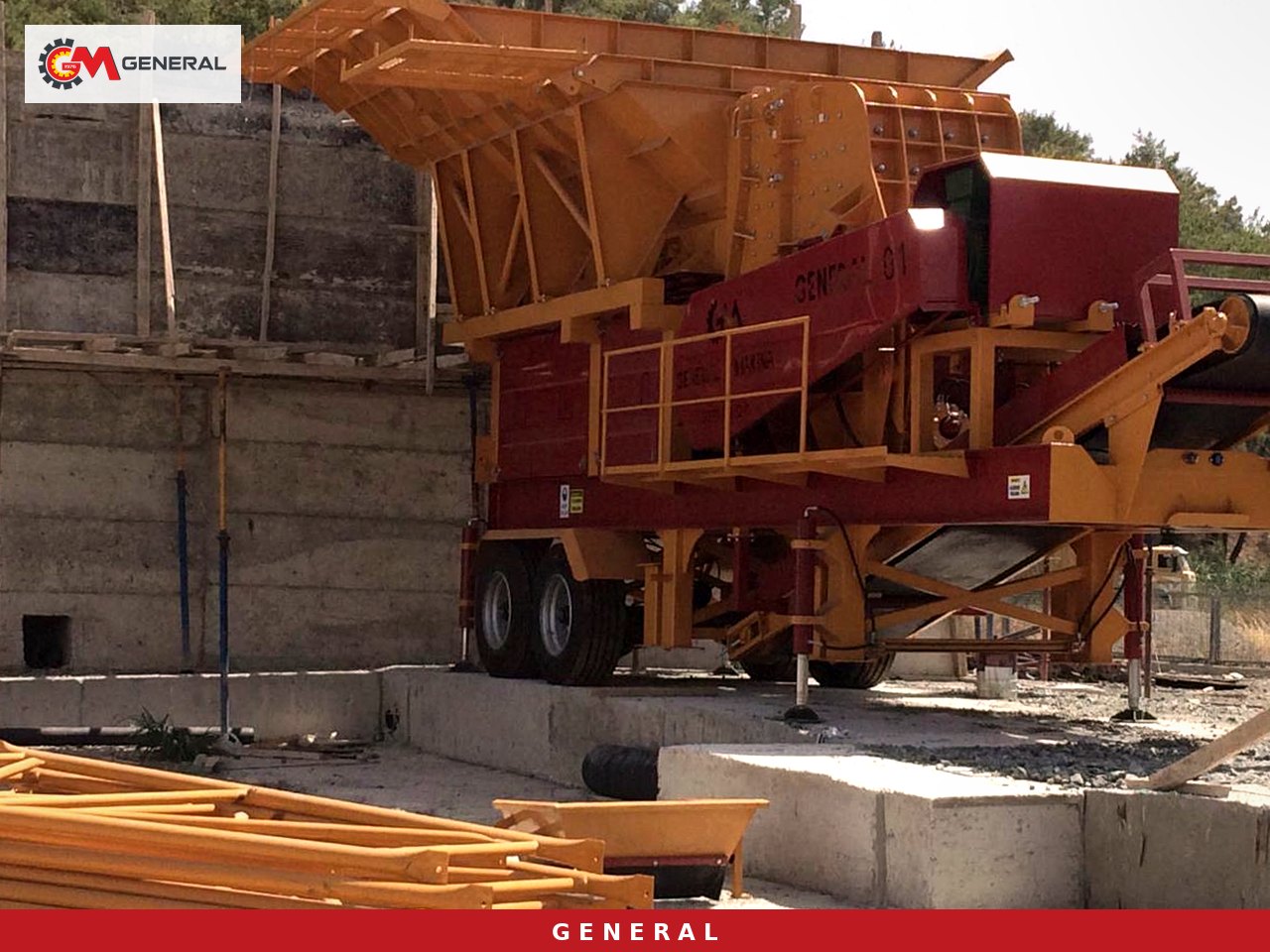
General 01: lower weight, one crusher, four fractions
The General 01 gains on the S line because it performs primary and secondary crushing in a single GPS 1210 impact crusher: there is no second crusher and its transport weight is the lowest in the table. The 4-deck screen delivers the 19-40 mm fraction needed for the road section separately, which reduces the need for an extra screening unit for the base course. Its weak point is the W line: an impact rotor needs more frequent part changes in high-silica rock. On sections fed with limestone, dolomite or mixed material, it remains the option with the lowest cost per tonne.
General 944 and 950: managing the wear budget in hard rock
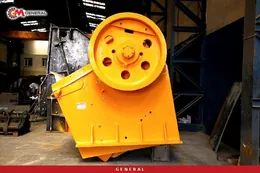
Both use a GPJ 90 jaw primary and accept 800 mm feed. The difference is the secondary. The General 944 extends metal life in abrasive stone through the compression principle of the GM430 cone crusher, pulling the W line down on a route that processes granite, quartzite and basalt. The General 950 gives higher reduction and cubical product with its DMK01 impact secondary; its generator is 600 kVA. If the surface dressing calls for cubical chippings, the 950 leads; if long part life for the base course is the priority, the 944 does. As an African example of this class, see the project page GNR 944 Mobile Hard-Stone Crushing & Screening Plant 120-150 t/h - Africa.
Rock abrasiveness and the wear part budget
The sources used for road aggregate in the region span a wide hardness range: granite and gneiss of the crystalline basement, basalt around the East African Rift, limestone in coastal and basin areas, laterite and quartzite inland. Rock can change even along one road alignment. The only reliable way to estimate the W line is to sample the outcrop you will use and have abrasiveness and compressive strength tested; ordering on an assumed value tends to empty the wear part stock faster than planned in the first months.
On a remote site, wear cost is not just the price of the part. The part takes time to reach the site by port and road; while the plant waits, the S line is loaded onto tonnes that are not produced. Planning the first replacement set together with the plant at the order stage therefore makes the cost predictable. The grizzly feeder ahead of the jaw primary separates soil and fines before they enter the crusher, cutting both wear and wasted energy; this setting matters especially in quarries where a laterite cap has been stripped.
Generator, fuel supply and the effect of climate on cost
Each of the three technical tables gives the power unit its own row; the highest rating, 600 kVA, belongs to the 950 with its DMK01 secondary, while the 01 and the 944 share 550 kVA. Engineering the power unit together with the plant removes the need for a separate energy installation; controlling the E line is then down to operating discipline on site. Measuring and logging hourly fuel use on your own site during the first weeks is more accurate than budgeting on a round assumption.
The hot, dusty dry season calls for more frequent cleaning of the air filter and radiator; a spray line for dust suppression and covered conveyors are measures that can be selected per project. In the rainy season, wet and clayey feed can blind the grizzly and screen meshes. In both periods, downtime cuts net output directly and shrinks the denominator of the formula. Sizing the fuel tank to the resupply interval and keeping a spare filter stock on site protects the S line as much as the E line.
Equipment behind the crusher also shapes the cost
Most specifications ask the road base to meet a grading envelope and sometimes cement stabilisation. To blend the fractions from the crushing and screening line on site and mix them with a binder, mechanical stabilisation and pugmill plants are used; the mobile pugmill moves with the road at 200-600 t/h. Planning this equipment together with the crushing line avoids stockpiling fractions separately and trucking them to a mixing plant, so the H line drops a second time. Whether a layer needs stabilisation depends on the specification; confirm it with the authority before deciding.
Checklist for reading quotations on the same basis
Quotations from different suppliers often cover different scopes. For a fair comparison, check that each one states clearly:
- Which rock type and which product size the capacity refers to.
- Whether the generator is included, and its kVA rating.
- Number of screen decks and fractions delivered; 19-40 mm stated explicitly if required.
- Scope of the first wear part set.
- Transport dimensions and weight; documents needed for the port and inland route.
- Warranty period and excluded parts.
- How on-site commissioning and operator training will be handled.
Once this list is filled in, you can write the S, E and W lines for each quotation and compare cost per tonne in one table. General Makina has manufactured in Izmir since 1976; the plants carry ISO 9001 and CE certification and a 1-year warranty excluding wear parts.
Frequently asked questions
What should I do if I need more than 180 tonnes per hour?
For a requirement above one plant's band there are two options: move to the 250-375 t/h class such as the General 03, or set up a two-unit arrangement. If two separate sections of the road need production at the same time, two plants may make more sense; if high tonnage is needed from a single quarry, the larger model may.
Can I choose a model without a rock test?
A preliminary selection is possible, but the W line cannot be estimated without a test. The sample result can directly change the choice between an impact and a jaw-cone layout, so taking a sample from the outcrop before ordering is recommended.
How do I get price and delivery information?
Price depends on model, generator, screen arrangement, first part set and shipping route. Send your tonnage target, rock information and site location and a project-specific quotation is prepared.
Can the plant work in the rainy season?
Yes; what matters is the moisture and clay content of the feed. Grizzly pre-screening and the right screen mesh reduce blinding, while site drainage protects haul and loading routes.
Conclusion
In Sub-Saharan Africa, road aggregate cost is shaped less by the purchase price of the plant than by haulage distance, rock abrasiveness and off-grid energy management. The General 01 for limestone and mixed feed, and the General 944 or 950 for hard abrasive rock, balance these lines in different ways. Share the rock information for your alignment and your target fractions, and request a project-specific quotation through our contact page.
Definitions of technical terms: Glossary