EN — English
 TR — Türkçe
 DE — Deutsch
 RU — Русский
 FR — Français
 ES — Español
 AR — العربية
 SR — Српски

Closed vs Open Circuit in a Mobile Crushing & Screening Plant 120-180 TPH
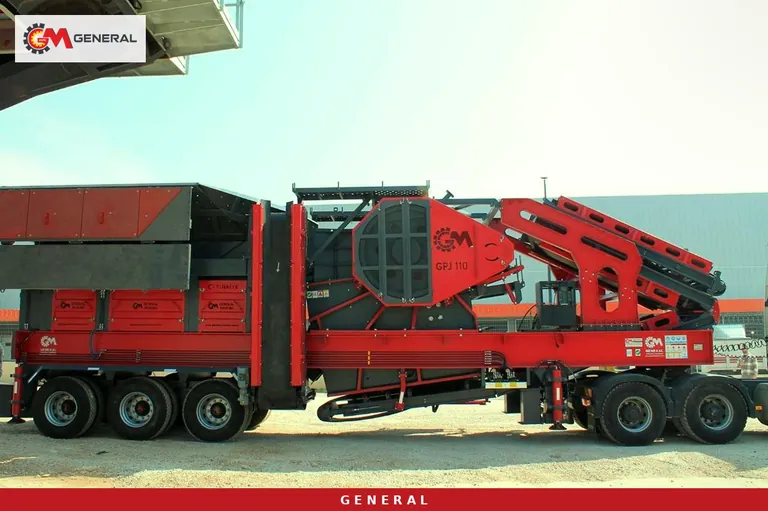
On a mobile crushing and screening plant, the closed vs open circuit decision comes down to one question: where does the oversize go after it leaves the screen? In closed circuit the screen overs ride a return conveyor back to the crusher, and the plant only discharges material that has passed the top deck of the screen. In open circuit the rock passes the crusher once; whatever stays on top of the screen drops onto a separate pile, where it is either sold or processed later on another machine. On a 120-180 TPH line this choice changes saleable tonnage, wear part consumption and even which model you should buy. Below we compare both modes from a site perspective and show, with figures, how the real General models in this band fit each circuit.
The route the material takes: how the two circuits differ
Open circuit is a straight line: feeder, crusher, screen, stockpile. The crusher setting decides how much of the product falls within the target size, yet some oversize always slips through regardless of the setting. The screen separates it and a dedicated conveyor sends it to a side pile. The line is simple, there are fewer belts, and the crusher only sees fresh feed from the face.
In closed circuit the material retained on the top deck enters a loop. The return conveyor carries it back to the crusher inlet and the cycle repeats until the stone is small enough. The result is a product list with a guaranteed top size: no oversized particle ends up in fractions such as 0-5, 5-12 or 12-19 mm. The price is that the crusher has to break the returning load on top of the fresh feed.
On site, many operations sit somewhere between the two. If the end of the return conveyor can be swung over a stockpile, the same plant can run open circuit one week and closed circuit the next. Get written confirmation of how your chosen model handles this before you sign the order.
Your product list decides the circuit
Start the circuit decision from the specification of what you sell, not from the machine. One quarry can serve two customers with two different circuits.
Jobs where the top size is capped
Ready-mix and asphalt producers buy chippings against a grading curve. A single 25 mm particle in a 12-19 mm sample can get a whole batch rejected. Concrete pavers, blocks and manufactured sand work the same way. For a quarry supplying these buyers, closed circuit is close to mandatory, because removing oversize afterwards means extra screening and extra haulage.
Jobs where the coarse fraction also earns money
Road sub-base, fill, drainage layers and slope protection accept a wider range. Here the screen overs of material that passed the crusher once and was split into three or four sizes can be shipped as a separate product. In open circuit the crusher carries less load, the same feed yields more total tonnage and the liners wear more slowly. For a quarry selling sub-base and fill with little demand for fine aggregate, open circuit is often the more sensible starting point.
Circulating load and the capacity label
In closed circuit the tonnage the crusher sees is higher than the fresh feed coming from the face. The difference is the circulating load, tracked with a simple ratio:
Circulating load ratio = returned screen overs (t/h) ÷ fresh feed (t/h)
Hypothetical example: 140 tonnes of fresh run-of-mine enter the plant per hour and 35 tonnes per hour come back from the screen. The ratio is 0.25 and the crusher is processing 175 tonnes per hour. Saleable product is still roughly 140 tonnes. Had the same machine run in open circuit, 140 tonnes would enter the crusher and 35 tonnes of oversize would go to a separate pile.
Two practical points follow. First, at quotation stage ask whether the 120-180 TPH figure refers to fresh feed or to the total load through the crusher; as rock hardness and target product change, these two numbers drift apart. Second, the circulating load reacts strongly to the crusher setting. Close the setting and the return drops while the liners work harder; open it and the return belt fills up. A belt scale on the return conveyor, or at least regular belt-cut sampling, is the most reliable way to see how much product the plant actually delivers.
Rock type also shifts the ratio. An impact crusher achieves high reduction in limestone, so returns usually stay low. In hard, abrasive basalt or granite a larger share misses the target size on the first pass; with these rocks, plan closed circuit together with a cone or impact second stage.
General models with a return conveyor in the 120-180 TPH band
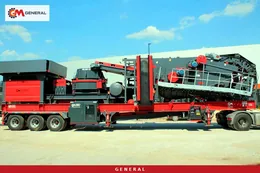
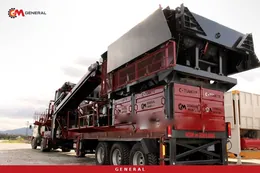
In this band three models of our wheeled range are built with a return line, which makes them suitable for closed circuit. Details are on the wheeled mobile crushing and screening plants page; the figures you need for the decision are below.
| Model | Crusher receiving the return | Crusher layout | Screen | Feed opening | Power / weight | Output fractions |
|---|---|---|---|---|---|---|
| General 01 | GPS 1210 rotor | GPS 1210 impact, primary and secondary in one body | 4 decks, 1600×5000 mm | 700 mm | 550 kVA / 55,000 kg | 0-5 / 5-12 / 12-19 / 19-40 mm |
| General 944 | GM430 cone | GPJ 90 jaw followed by GM430 cone | 3 decks horizontal, 1600×5000 mm | 800 mm | 550 kVA / 70,000 kg | 0-5 / 5-12 / 12-19 mm |
| General 950 | DMK01 impact | GPJ 90 jaw followed by DMK01 impact | 3 decks horizontal, 1600×5000 mm | 800 mm | 600 kVA / 70,000 kg | 0-5 / 5-12 / 12-19 mm |
General 01: a loop through a single rotor
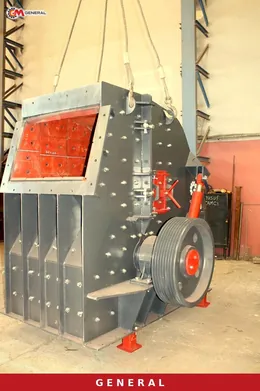
General 01 is the simplest way to run closed circuit. The GPS 1210 rotor does primary and secondary work in one body, so the returning stone goes into the same rotor. The four-deck screen produces four fractions, which lets you take 19-40 mm as a product and recirculate only the coarser material, keeping the circulating load low. In limestone quarries this layout is often the economical choice. For a working example, see the project page closed-circuit 180 t/h quarry in Türkiye with the GNR 01.
944 and 950: a second stage after the jaw
With hard rock the return is routed to the second stage rather than the jaw primary. On the 944 that stage is the GM430 cone crusher; compression breakage extends metal life in abrasive rock, and when the returning load keeps the chamber full it produces a more cubical product. The General 950 puts reduction ratio first with its DMK01 impact second stage. Both models carry a three-deck screen; if you want material above 19 mm as a separate product, specify the screen arrangement accordingly in the order.
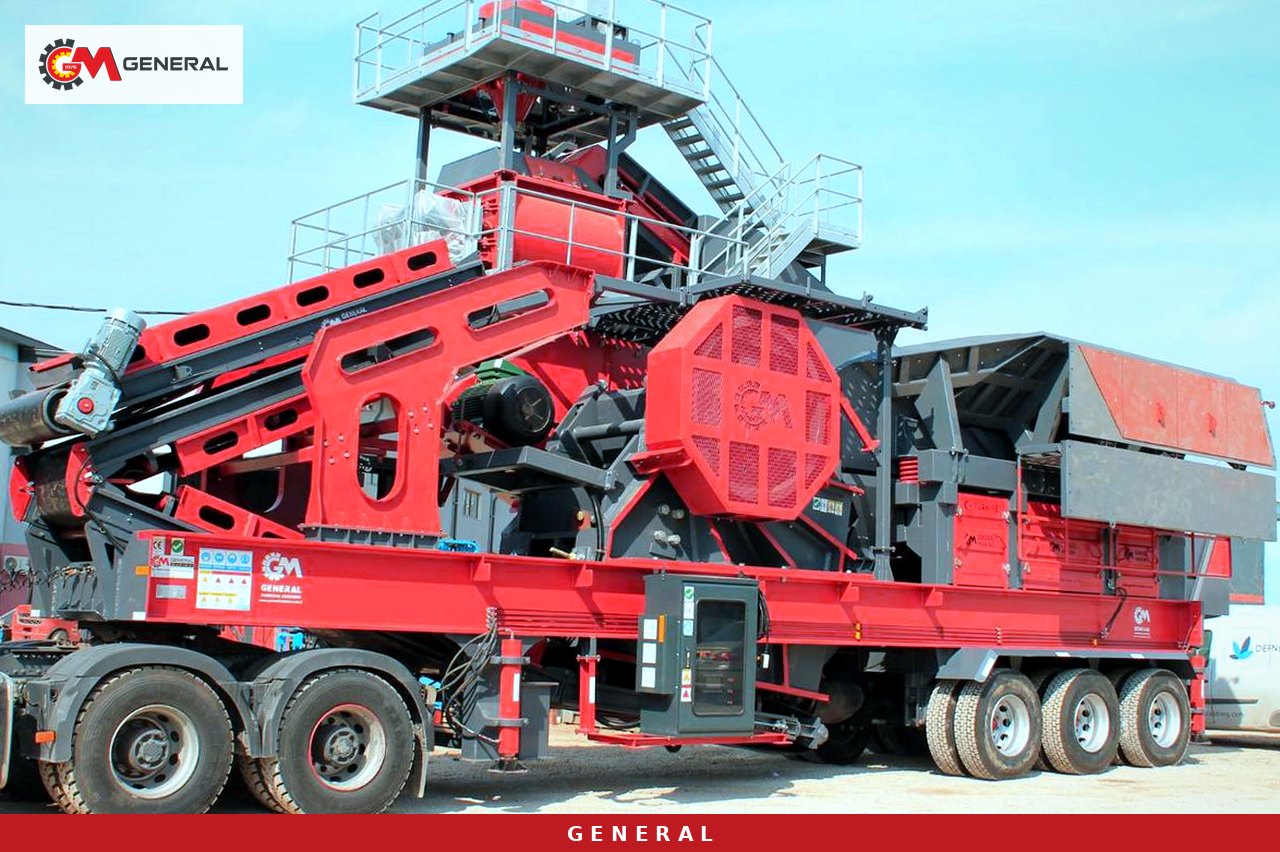
Building an open circuit with a separate screen and mobile crushers
In open circuit, having separate crushing and screening units is no drawback; it allows staged investment. The quarry starts with a crusher and one mobile screen, and if the coarse material does not sell, a second stage is added later. All units suitable for this setup are in the mobile portable crushers group.
On the screening side, the GNR ME1650 is a dry screening plant working in the same 120-180 t/h band: it accepts 0-100 mm material, weighs 18,000 kg and carries no washing unit. It splits crusher output or mixed stockpiled material into fractions; clayey or wet feed calls for the washing series instead.
Two mobile options exist for processing the coarse fraction that builds up on the side pile. The mobile pre-screen DMK takes 0-100 mm feed, delivers a 0-30 mm product and runs at 40-300 t/h; its pre-screen removes fines that are already in size before they reach the crusher, and it has two crushing chambers with manganese liners. Where particle shape matters, as with basalt, the GNR MK110 mobile cubitzer accepts feed up to 350 mm, handles 160-250 t/h and produces a 0-25 mm cubical product with a 200 kW motor; for smaller needs the GNR MK100 covers 90-130 t/h.
This combination suits quarries where demand changes with the season: coarse open-circuit material for road work in summer, fine product close to closed-circuit quality for concrete plants in winter. Still, every extra unit means one more feed point, one more thing for the operator to watch and one more loader trip; draw the full site layout before you decide.
Site checklist for choosing the circuit
Before asking for a quotation, put the answers to the following questions in writing. They show which circuit leaves a margin in your quarry.
- The fractions you will sell and the monthly demand for each; the share of products with a capped top size.
- Is there a buyer for the screen overs, or will they sit in stock and take up space?
- Rock type and abrasiveness: limestone, or basalt, granite or quartz-rich stone? Has the sample been tested in a laboratory?
- Clay and soil content in the run-of-mine. In closed circuit, fine sticky material accumulates in the loop and blinds the screen mesh.
- Width of the installation area; is there room for the return conveyor and the side stockpiles?
- Power source, grid or generator? In closed circuit the crusher motor runs at full load for longer.
- Whether the quoted capacity means fresh feed or total load, and for which crusher setting it was given.
Start the model matching with this information. A circuit recommendation made without a material sample and a target grading curve is no more than a guess.
Frequently asked questions
Does a closed-circuit plant produce fewer tonnes?
Saleable tonnage is limited by fresh feed; what changes is the load on the crusher. Because returning material uses part of the crusher capacity, the fresh feed on the same machine may need to be somewhat lower than in open circuit. How much lower depends on rock hardness and the crusher setting.
Can the same plant run in both circuits?
Yes, if the end of the return conveyor can be directed to a stockpile. Specifying this option and any extra conveyor at order stage is far less hassle than modifying the chassis on site later.
Which circuit and model suit basalt?
If you sell concrete and asphalt aggregate, closed circuit with a cone second stage after the jaw, which means the 944, is the safe choice in terms of wear. If high reduction and cubical product come first, consider the 950. Make the final decision after a sample test.
What determines the price?
Crusher layout, number of screen decks, the number of return and stockpile conveyors, generator requirement and transport method all set the price. The figure comes with a quotation prepared from your product list and material data.
The decision
If you sell concrete and asphalt aggregate with a guaranteed top size, run closed circuit and choose the crusher with the circulating load included. For sales weighted towards fill and sub-base, open circuit gives more total tonnes with less wear and a simpler line. Either way, General Makina plants carry ISO 9001 and CE certification and a 1-year warranty excluding wear parts. Send your product list and rock data through our contact page and we will define the right circuit and model for your 120-180 TPH target together.
Definitions of technical terms: Glossary