EN — English
 TR — Türkçe
 DE — Deutsch
 RU — Русский
 FR — Français
 ES — Español
 AR — العربية
 SR — Српски

Namibia Desert Aggregate Mobile Crushing & Screening Plant 120-180 TPH
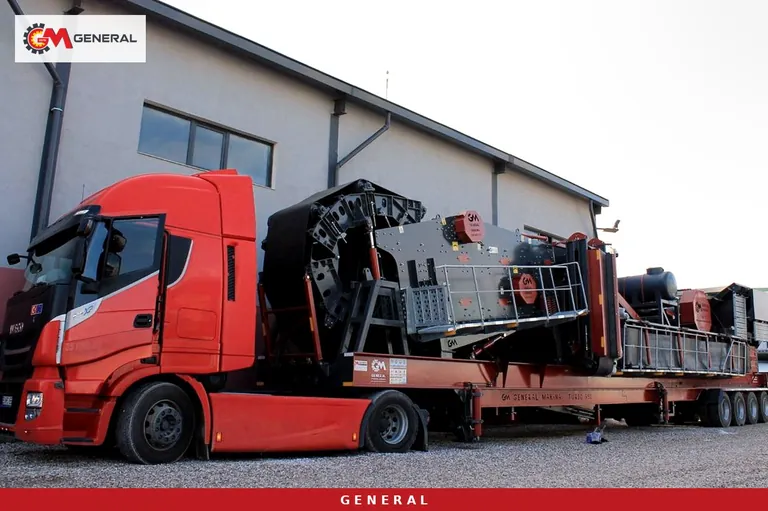
For a contractor or quarry operator entering the aggregate business in Namibia, the first trap is that much of the country is covered in sand. The idea that "there is sand everywhere, so material will never be a problem" usually collapses in the concrete laboratory: wind-blown sand from the Namib Desert is fine, single-sized and rounded, and it does not provide the angular, well-graded material that concrete and asphalt need. That is why, from the coastal towns to the inland plateau, construction aggregate really comes from crushing and screening sound rock. This article looks at how to choose a mobile crushing and screening plant targeting 120-180 TPH for Namibia's desert conditions, built around rock type, the sand shortfall, scarce water, wide temperature swings and shipment through Walvis Bay.
Coastal strip versus inland plateau: two quarry profiles in one country
A plant working along the Atlantic coast, around Walvis Bay and Swakopmund, meets damp sea fog in the morning and hot, dusty wind from inland in the afternoon. Salty air combined with moisture accelerates corrosion on bolt heads with chipped paint, on electrical terminals and in conveyor pulley bearings. For this zone, the paint system, panel sealing and a spare fastener kit must be discussed in the order.
The inland plateau where Windhoek sits, and the settled regions further north, are drier, with sharper day-night temperature differences. Here the main enemy is not salt but fine dust and metal and rubber parts that expand and contract between day and night. The same model can go to both regions; the difference shows in the option list and the maintenance plan.
On the rock side there is no single recipe either. Granite and marble are known in the central part of the country, schist, quartzite and dolerite dykes in many areas, and below the desert surface there is often a lime-rich crust called calcrete. Calcrete and marble are relatively soft and low in abrasion; granite and quartzite wear out jaw plates and blow bars quickly. Do not decide on the crusher type before you are certain which rock you will process: have samples from different benches of the quarry tested for compressive strength, Los Angeles abrasion and silica content.
Why dune sand falls short for concrete: doing the manufactured sand maths
On its long journey, wind-blown sand loses its edges and collects in almost a single grain size. In a concrete mix such sand does not supply the intermediate sizes that fill the voids between particles; for the same workability it needs more water and cement and puts the strength target under pressure. In asphalt, rounded grains tend to slide instead of interlocking. In practice there are two routes: using manufactured sand on its own, or blending dune sand with manufactured sand in a limited ratio. The concrete laboratory decides which ratio meets the specification.
This finding has a direct effect on machine selection. If the plant is expected to deliver usable 0-5 mm manufactured sand as well as chippings, the secondary crusher has to produce cubical, well-filled fines. With the same feed, an impact secondary usually produces more fines and more cubical particles than a cone secondary; the cone, in turn, wins on wear-part life in abrasive rock. Writing down your sand demand in tonnes is the first piece of data that settles the model choice below.
Candidate models in the 120-180 TPH band and where they differ
Below are the wheeled models that cover the range in the title, with the technical data from their product pages. Screen mesh openings and the fraction split are defined in the order according to the rock to be processed.
| Model | Crusher layout | Capacity | Max. feed | Screen | Generator | Weight |
|---|---|---|---|---|---|---|
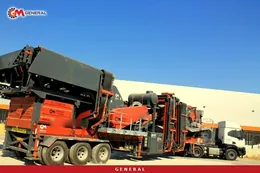
| General 944 | GPJ 90 jaw + GM430 cone | 120-180 t/h | 800 mm | 1600×5000 mm, 3-deck horizontal | 550 kVA | 70,000 kg |
| General 950 | GPJ 90 jaw + DMK01 impact | 120-180 t/h | 800 mm | 1600×5000 mm, 3-deck horizontal | 600 kVA | 70,000 kg |
| General 01 | GPS 1210 impact (primary + secondary) | 120-180 t/h | 700 mm | 1600×5000 mm, 4-deck | 550 kVA | 55,000 kg |
| General 800 | PDK 1280 primary impact | 80-150 t/h | 600 mm | 1300×4000 mm, 3-deck | 450 kVA | 35,000 kg |
For granite, quartzite and dolerite quarries: General 944
In siliceous, hard rock, the GM430 cone secondary on the General 944 works by compression and extends the life of metal parts in abrasive material compared with an impact rotor. The 800 mm feed opening accepts large blasted blocks without a separate pre-crusher. Product sizes are 0-5 / 5-12 / 12-19 mm. If the sand shortfall is large, the fines from the cone should be trialled in the laboratory.
When the same quarry must deliver mostly manufactured sand: General 950
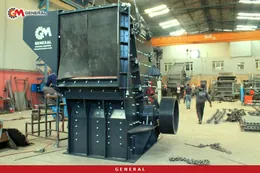
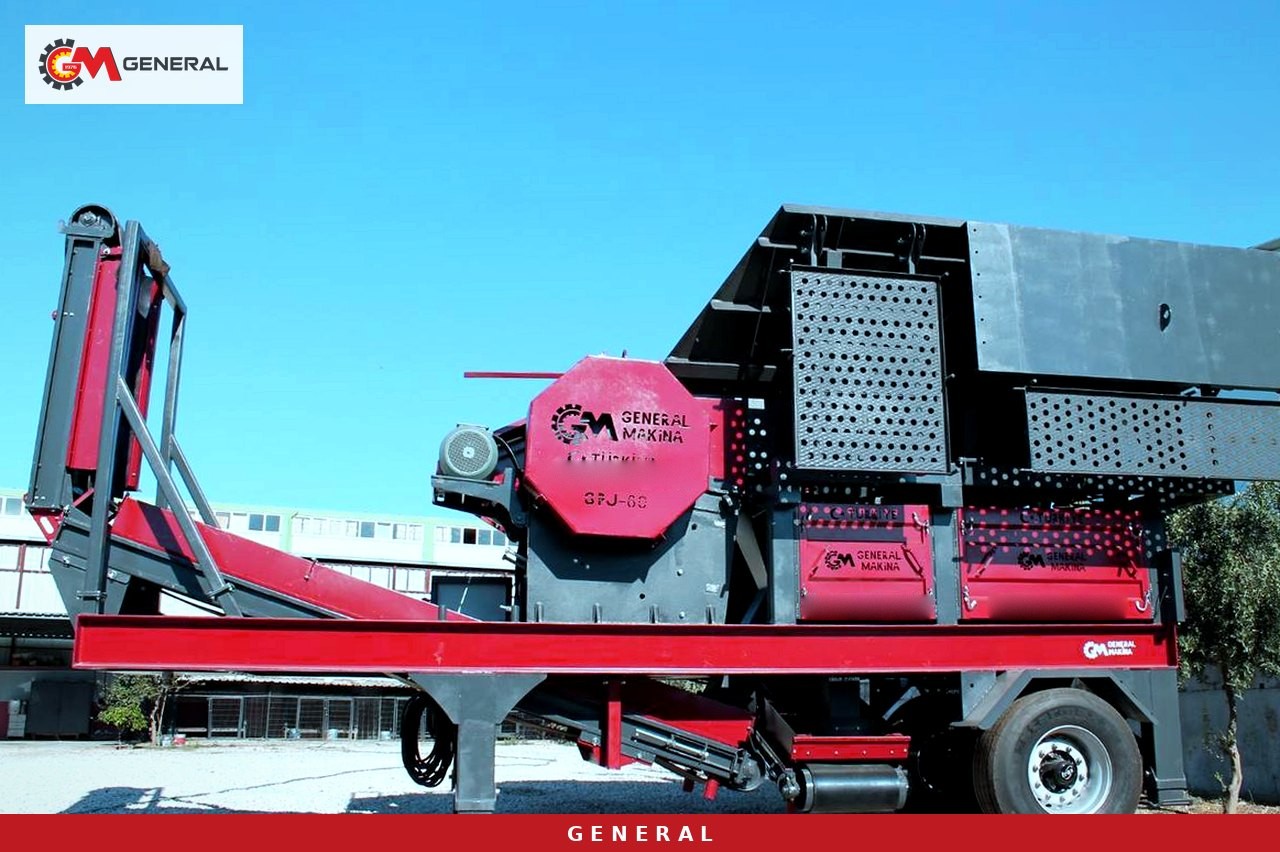
The General 950 uses the same GPJ 90 jaw and the same transport dimensions as the 944; the difference is the DMK01 impact secondary. High reduction and cubical grains supply the angular fines that dune sand lacks. In hard rock, blow bars are changed more often; that is the operating cost paid for sand quality.
For calcrete, marble and mixed feed: General 01 and General 800
The GPS 1210 on the General 01 does primary and secondary work in one housing; it takes 700 mm feed and its 4-deck screen gives four products: 0-5 / 5-12 / 12-19 / 19-40 mm. Its 55,000 kg weight is an advantage on the road compared with its two 70-tonne siblings, and it is an economical answer for low-abrasion calcrete and marble. The General 800 covers the lower half of the band at 80-150 t/h. It is not enough on its own for a steady 180 TPH, but at 35,000 kg it can be considered for small quarries or as a support unit on a second site.
If the work is on an old alluvial bed with loose gravel rather than a quarry, the 120-180 t/h, 18,000 kg GNR ME1650 dry screening unit can be added to the line for screening before or after crushing. All washing and dry screening options are listed in the sand washing and dry screening plants category, and every wheeled crushing line on the wheeled mobile crushing plants page.
Dust control with scarce water: putting water where it counts
On a desert site water usually comes from a borehole or by tanker, and every litre is planned. So instead of running sprinklers along the whole plant, focus on the points where dust is generated: the crusher discharge, screen outlets, conveyor transfer points and the drop height onto the stockpile. A nozzle line producing fine mist at these points gives the same suppression with far less water. Nozzle type, pump and tank volume are not standard equipment on General models; they are measures selected in the project according to the site's water source.
- Covers with rubber skirts at conveyor transfer points and belt covers: they reduce the fines lifted by wind.
- Keeping the discharge height of stockpile conveyors low: the shorter the drop, the smaller the dust cloud.
- Enclosed housing over the screen with an extraction and filter unit: considered for quarries near settlements.
- Speed limits on haul roads and wetting of the road surface: truck dust often exceeds crusher dust.
- Moderate wetting when manufactured sand is the target: excess moisture blinds the 0-5 mm screen mesh and lowers sand yield.
Sandstorms, midday heat and cool nights: the machine's sensitive points
Air intake and cooling
The air filters of the generator and drive motors are the parts that need the most frequent maintenance on a desert site. Choose a cyclone pre-filter and an easily accessible filter housing; link replacement to the differential pressure gauge, not to hours. Fine sand packed into radiator fins is the main cause of engine overheating; reverse blowing with compressed air must become part of the daily routine. 550 kVA for the General 944 and 01 and 600 kVA for the General 950 are product data; at high ambient temperatures the selection should be confirmed with the generator maker's derating table.
Electrical panel and sensors
The door seal, cable glands and ventilation louvre of the panel are the routes dust takes. Keeping the panel's internal temperature under control with a filtered fan or an air-conditioning unit reduces failures of the frequency drive and PLC. These items are project-specific options; ask for them as a separate line in the quotation.
Bearings, belts and wear parts
A bearing housing that heats up by day and cools at night draws in air and dust with every cycle. Labyrinth-sealed housings and regular regreasing break that cycle. For conveyor belts, a sun-resistant rubber cover and a tension check morning and evening are recommended. If granite or quartzite is processed, having at least one spare set of jaw plates, cone liners or blow bars on site prevents production from stopping while a second shipment arrives from the port.
From Walvis Bay port to the quarry: shipping and installation
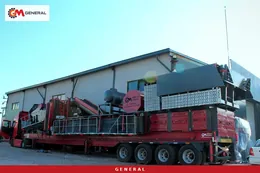
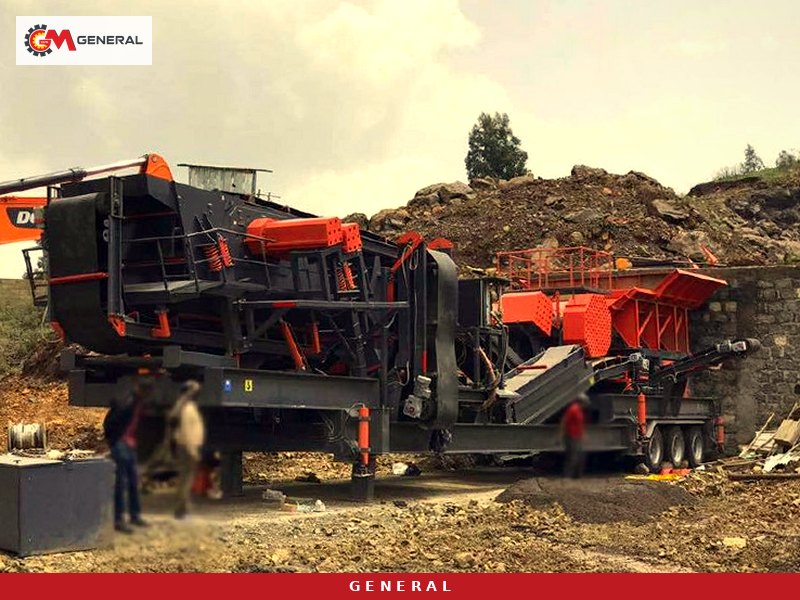
Wheeled plants leaving Türkiye travel by sea to Walvis Bay and from there by road to inland regions. The wheeled chassis is an advantage here: the plant runs from the port to the site on its own axles behind a tractor unit, with no separate low-loader needed. Transport dimensions are 4130×20350×4500 mm for the General 944 and 950, 4300×18500×4500 mm for the General 01 and 3600×15500×4500 mm for the General 800. Because these sizes may fall into the abnormal load class, confirm route permits and escort requirements in advance with the competent road authority in Namibia and with your haulier.
No concrete foundation is needed on site; the hydraulic legs sit on level, compacted ground. If there is loose sand on the surface, wide steel pads or a compacted gravel bed must be prepared under the legs; otherwise vibration will tilt the plant over time. Knowing the prevailing wind direction and placing the control cabin and operator walkway upwind, with stockpiles downwind, keeps the crew from breathing dust all day.
If you will supply aggregate to a specific road, dam or port expansion job, take the required grading and daily volume from the relevant authority's specification. This article contains no official quantity or schedule for any project.
Frequently asked questions
Is a single plant enough for 180 TPH in Namibia?
According to their product data, the General 944, 950 and 01 work in the 120-180 t/h range. Continuous output near the upper limit depends on rock hardness, feed size, moisture and the required product split. The calculation is made after sample testing; if extra margin is needed, a higher-capacity model or a second unit is evaluated.
Is it enough just to screen dune sand?
Usually not. Because wind-blown sand is squeezed into a narrow grain range, screening cannot create the required grading. Blending with manufactured sand or using manufactured sand entirely is needed; the concrete laboratory sets the ratio.
Are dust suppression nozzles and a filtered panel included with the machine?
Mist nozzles, covered conveyors and filtered panels are options selected according to site conditions. If you state your site's water source and the distance to the nearest settlement when asking for a quote, the package is prepared accordingly.
Which items determine the price?
The model, whether the generator is included, dust and climate options, the quantity of spare wear parts and the delivery terms (ex works or delivered to port) are the main items. For a concrete figure you need to request a quotation for your site.
What to bring to the quotation table
For an accurate configuration offer, gather the following data in a single file:
- Rock type and laboratory results (compressive strength, abrasion, silica content)
- Largest block size after blasting
- Daily operating hours and target tonnage
- Required products, the share of each and the separate manufactured sand demand
- The site's water source and grid power situation
- Whether installation is on the coast or the inland plateau, and the distance to the nearest settlement
In Namibia's desert conditions, the right plant is defined less by catalogue tonnage than by a secondary crusher matched to the rock, dust control that uses water sparingly and electrical and mechanical equipment protected against sand. General Makina has been building crushing and screening plants in Izmir since 1976; the products carry CE and ISO 9001 and are covered by a 1-year warranty excluding wear parts. Reach us through our contact page with your quarry data, and we will work out together which of the 944, 950 and 01 layouts fits your site.
Definitions of technical terms: Glossary