EN — English
 TR — Türkçe
 DE — Deutsch
 RU — Русский
 FR — Français
 ES — Español
 AR — العربية
 SR — Српски

Angola Luanda Infrastructure Mobile Crushing & Screening Plant 200-300 TPH
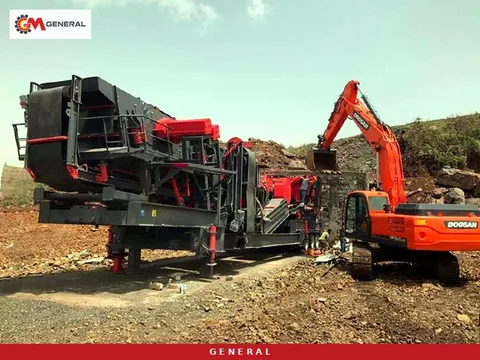
A contractor planning aggregate for a ring-road section, a stormwater channel or a bridge pier in Luanda soon finds that the material can come from two very different sources. The coastal belt on which the capital sits is a sedimentary basin dominated by limestone, sandstone and red clayey soils. Tougher stone for concrete and road surfacing comes from crystalline rock such as granite and gneiss further inland. The same crusher does not process both with the same efficiency. When selecting a mobile crushing and screening plant for 200-300 TPH, the first question is not "which model?" but "which rock?". This article looks at a plant for Luanda infrastructure by rock source, work item, climate and port logistics, and bases every recommendation solely on the technical data published on our product pages.
The work programme, aggregate specification and quality classes of any specific road, channel or housing project belong to the relevant authority and the main contractor in Angola. The guidance below concerns equipment selection; always confirm grading limits against the authority's specification.
Where does Luanda's stone come from?
What decides plant selection is the hardness of the rock and its silica content. Around Luanda there are two pictures that look nothing alike in this respect.
Sedimentary rock in the coastal belt
Quarries close to the city mostly work limestone and sandstone. These rocks have low to medium abrasiveness and suit an impact crusher well: the impact principle gives a high reduction ratio and cubical grains, while blow bar life stays reasonable. The point to watch is the clay bands between the layers. Clay arriving with the run-of-mine rock contaminates the product and blinds the screen meshes unless it is removed at the feed section.
Crystalline rock inland
Granite and gneiss contain free quartz. A primary impact crusher will break them, but wear parts are consumed quickly and the parts cost per tonne climbs. Here a jaw crusher is preferred at the first stage, followed by an impact or cone crusher at the second. A firm decision requires a quarry sample tested in a laboratory for abrasiveness and compressive strength, and the accuracy of any plant quotation depends on those results. Our article on choosing a mobile plant for basalt and granite is a useful guide at this stage.
Infrastructure work items and what 200-300 TPH means on site
Infrastructure work in Luanda does not call for a single product. Asphalt surfacing and concrete need 0-5, 5-12 and 12-19 mm chippings; road sub-base and fill need a coarser fraction; drainage channel bedding needs clean, screened stone. The number of screen decks and the mesh openings decide how many products can be separated in one pass; our product pages list four fractions for the models in the 200-300 TPH band (0-5 / 5-12 / 12-19 / 19-40 mm).
To turn hourly capacity into a daily requirement, use this formula: daily output = net hourly capacity × actual operating hours. A hypothetical example: 250 t/h net output and 10 actual operating hours a day give 2,500 tonnes. The word "net" matters here; the catalogue range shifts with the hardness and moisture of the feed and the fineness of the required product. Planning to run near the top of the range on limestone feed and near the bottom on hard granite is a realistic starting point.
Wheeled models in the 200-300 TPH band
The table below compares models that meet the target range on their own or in combination, using the values on our product pages. Unknown cells are marked "—".
| Model | Capacity | Crushers | Generator | Screen | Max. feed | Weight |
|---|---|---|---|---|---|---|
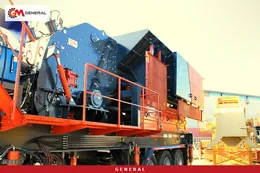
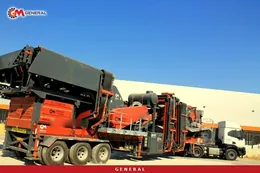
| GNR-MC110 (twin chassis) | 200-300 t/h | GPJ 110 jaw + DMK03 impact | 750 kVA | 2000×6000 mm, 4 decks | 900 mm | 2 × 55,000 kg |
| General 02 | 250-300 t/h | GPS 1413 primary impact | 660 kVA | 2000×5000 mm, 4 decks | 1000 mm | 76,000 kg |
| General 03 | 250-375 t/h | GPS 1415 primary impact | 750 kVA | 2400×5000 mm, 4 decks | 900 mm | — |
| 2 × General 950 | 2 × 120-180 t/h | GPJ 90 jaw + DMK01 impact (each) | 600 kVA (each) | 1600×5000 mm, 3 decks (each) | 800 mm | 2 × 70,000 kg |
The model that delivers 200-300 t/h with a jaw primary in a single plant is the GNR-MC110. General 02 and 03 work with an impact primary and stand out on limestone-dominated feed. A single General 950 or General 944 gives 120-180 t/h, so it cannot cover this band alone; two units set up side by side reach the target, and one keeps producing while the other is in maintenance. All wheeled options are listed on the wheeled mobile crushing plants page.
Three set-up scenarios by quarry type
Crystalline quarry: GNR-MC110
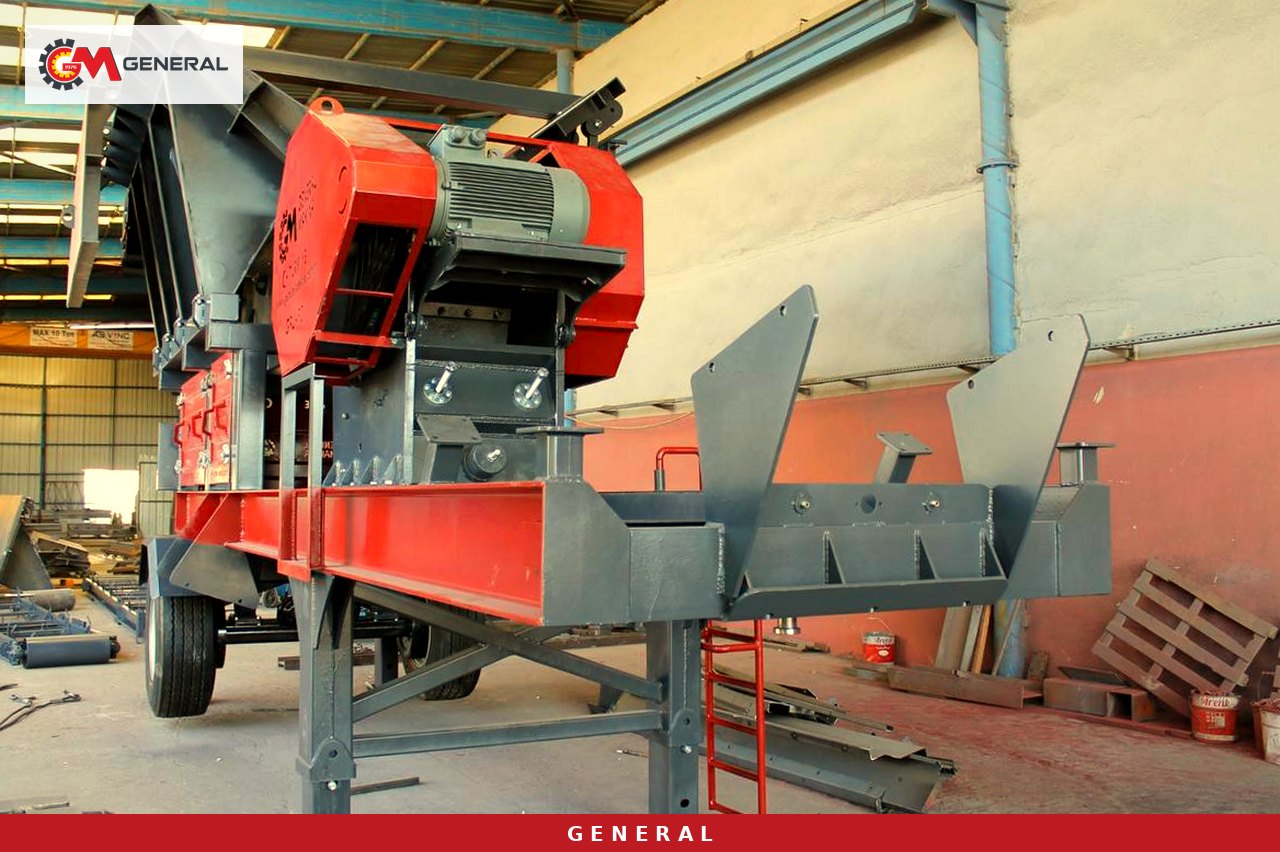
If granite or gneiss is to be processed, the GNR-MC110 is the first candidate. The GPJ 110 jaw crusher reduces blocks of up to 900 mm by compression; the DMK03 impact secondary gives the product a cubical shape. Because the two chassis can work independently, coarse fill can be produced with only the primary group running, and the secondary group is connected once chippings are needed. For a contractor in Luanda this means running the primary alone during earthworks and the full line during the pavement phase.
Coastal limestone quarry: General 02 or General 03
If the feed is mainly limestone, an impact primary is the more economical answer. General 02 accepts large blasted blocks without pre-crushing through its 1000 mm inlet and produces 250-300 t/h. Where demand may exceed 300 t/h, General 03, with its 2400×5000 mm four-deck screen and 250-375 t/h range, is the next step up. On both models, choosing the right opening for the grizzly pre-screening on clay-banded feed directly affects efficiency.
Two separate sites: two General 950 units
When two jobs run at the same time in the north and south of the city, two General 950 units can be more flexible than one large plant. Each produces 120-180 t/h with a GPJ 90 jaw and a DMK01 impact crusher and travels on a single truck. Combined in one quarry, the two units reach the 200-300 t/h target; when the jobs separate, each goes to its own site. If the abrasiveness test comes back high, two General 944 units with cone secondaries are considered on the same logic.
If the quarry will stay in one place for years and the product range will grow, fixed crushing plants should also be on the table; with no chassis transport limit, more screen decks can be used.
Clay, rain and dry-season dust: operating measures
Luanda's climate alternates between a rainy period and the cool, dry cacimbo season. Each places a different load on the plant.
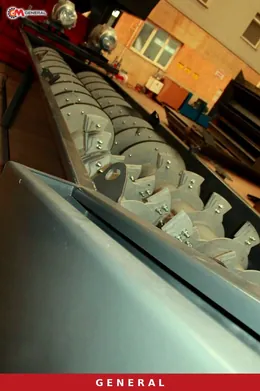
In the rainy period clayey soil gets wet and sticky. The by-pass section of the vibrating grizzly feeder removes this fine, clayey fraction before it enters the crusher; its opening should be chosen to match the clay content of the quarry. If the screen meshes start blinding, the openings on the lower decks can be enlarged, or a washing screen option can be considered for the project. Material build-up on conveyor return drums and softening of the ground under the chassis legs are also typical problems in this period; a compacted stone base should be prepared under the support legs.
In the dry season dust comes to the fore. Measures that can be selected for the project include water-spray dust suppression at the crusher discharge and conveyor transfer points, conveyor covers, and frequently changed air filters for the generator and the electrical panel. On sites close to the coast, salty air accelerates corrosion on painted surfaces and electrical connections; keeping panel doors closed and checking connections periodically belongs in the maintenance plan.
From the Port of Luanda to the quarry: transport and installation
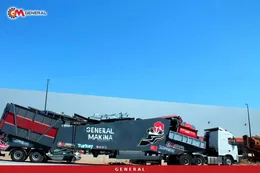
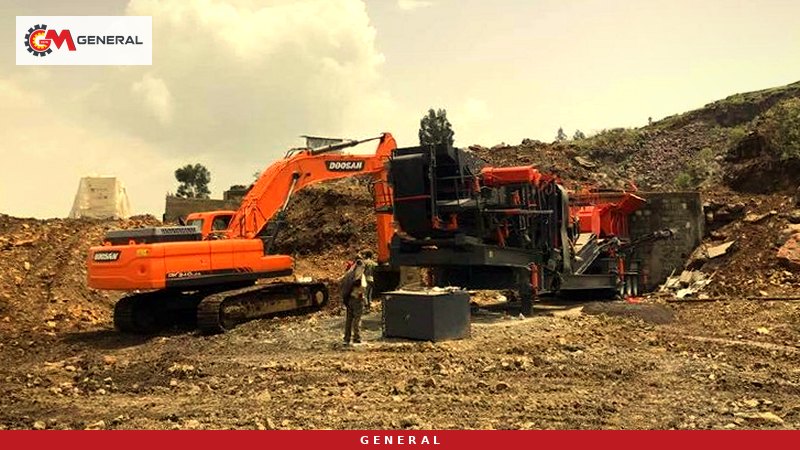
A wheeled plant leaving Izmir reaches the Port of Luanda by sea and is towed by road to the quarry. The advantage of a wheeled chassis is that it moves as one towable unit rather than as modules lifted off one by one by crane. The two chassis of the GNR-MC110 travel separately: the primary chassis measures 3000 × 13500 mm and the secondary chassis 4200 × 18300 mm. Bridges, flyovers and tight junctions on the route must be checked against these dimensions in advance. On site, folding hydraulic conveyors and support legs allow installation without a concrete foundation.
Clarifying the following before requesting a quotation speeds up both the right model choice and accurate pricing:
- Rock type and laboratory results (abrasiveness, compressive strength)
- Largest block size after blasting and the clay content of the run-of-mine rock
- Required fractions and the daily quantity of each
- Is grid power available, or will the plant run on a generator?
- Height and width restrictions on the route between the port and the quarry
- Dust suppression and washing requirements
Frequently asked questions
Is a jaw primary necessary for limestone near Luanda?
No. Limestone has low abrasiveness, so the impact primary on General 02 and General 03 gives higher reduction and a more cubical product in this rock. A jaw primary comes into its own in siliceous rock such as granite and gneiss.
Can the plant run at a quarry with no grid power?
Yes. Generator ratings for the models in the table are stated on the product pages: 750 kVA for GNR-MC110 and General 03, 660 kVA for General 02 and 600 kVA for each General 950.
What warranty and certificates apply?
The plants carry ISO 9001 and CE certification and come with a 1-year warranty, excluding wear parts. After-sales spare parts support is provided to the extent stated on the product pages.
What determines price and delivery time?
Price depends on the model, options (generator, dust suppression, additional conveyors), screen mesh selection and shipping method. The delivery plan is based on the production schedule at the time of order. Send us your rock data and product list and a firm quotation will be prepared.
Conclusion
Choosing a 200-300 TPH mobile crushing and screening plant in Luanda starts with the rock: General 02 or General 03 with an impact primary for limestone in the coastal belt, the GNR-MC110 with a jaw primary for granite and gneiss inland, and two General 950 units for scattered sites are the sensible solutions. Grizzly pre-screening for the rainy period, dust suppression for the dry season and dimension checks for the port route should all be part of the plan. Share your sample results and product list with us; for a configuration and quotation matched to your Luanda project, reach us through our contact page.
Definitions of technical terms: Glossary