EN — English
 TR — Türkçe
 DE — Deutsch
 RU — Русский
 FR — Français
 ES — Español
 AR — العربية
 SR — Српски

Angola Granite Jaw + Cone Aggregate Crushing Plant 150-250 TPH
An investor planning a granite quarry in Angola usually meets two very different materials on the first site visit: a weathered, sandy granite at the surface that crumbles in the hand, and a few metres below it sound rock that a hammer barely chips. The crushing line is designed around keeping these two apart. This article explains why a primary jaw and a secondary cone are the right pair for an Angolan granite quarry aiming at 150-250 tph, which real models cover that band in which layout, and what has to be settled in advance on a project that runs from the port to the inland plateau.
On the plateaus and uplands of the interior, Precambrian basement rocks such as granite, gneiss and migmatite cover large areas, and granite often shows as hills and outcrops. That general picture still says nothing about one particular quarry. Compressive strength, abrasiveness and crushability change from vein to vein, so we recommend laboratory tests on samples taken from your face before the selection is finalised.
Weathered overburden versus sound granite: two loads on one line
In a tropical climate the upper part of a granite body interacts with water and heat over a long time and turns into a clayey, sandy cover. This material does the crusher no good; it sticks in the jaw cavity, blinds screen wires and raises the share of unwanted fines in concrete aggregate. Sound granite brings the opposite load: it demands high crushing force and wears metal surfaces quickly because of its free silica.
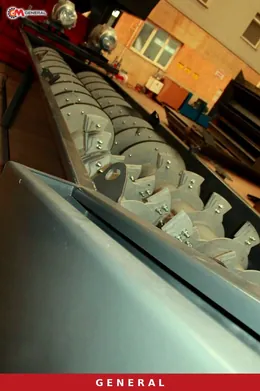
Instead of trying to solve both loads in one machine, they should be separated at the front of the line. A vibrating grizzly feeder sends fines and soil through the gaps between its bars to a by-pass belt before they reach the crusher, while the oversize rock advances at a rate that keeps the jaw mouth full. If the overburden is thick, stockpiling the stripping material separately and feeding only clean rock to the crusher protects both capacity and aggregate cleanliness.
In sound granite the jaw crusher is the right primary because it works by compression. The same logic continues in the second stage: a cone crusher breaks the stone by squeezing it repeatedly between the head and the concave, so on a highly abrasive rock like granite its parts consumption is clearly lower than that of an impact rotor.
Splitting the 150-250 tph band into two real layouts
The range in the title is wide and no single model covers all of it. Splitting the band in two also makes the investment decision clearer.
Lower band: the single-chassis General 944
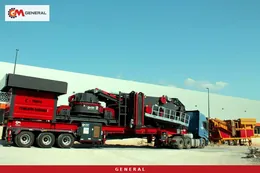
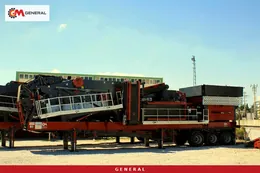
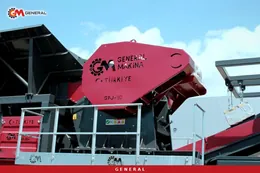
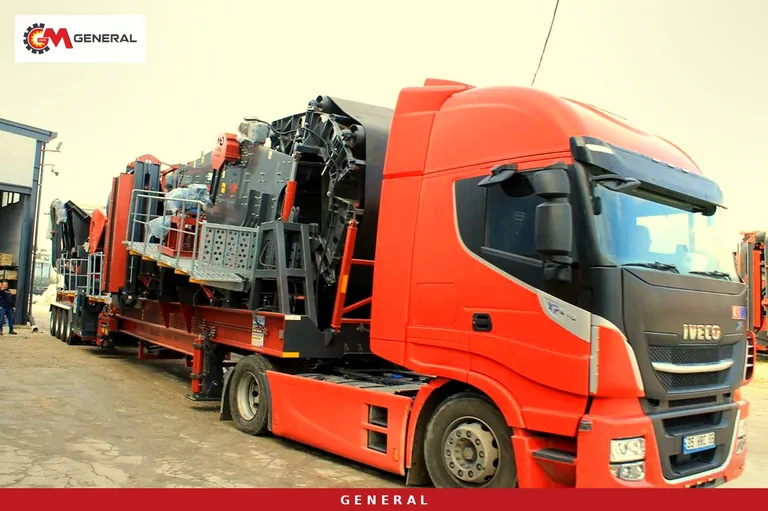
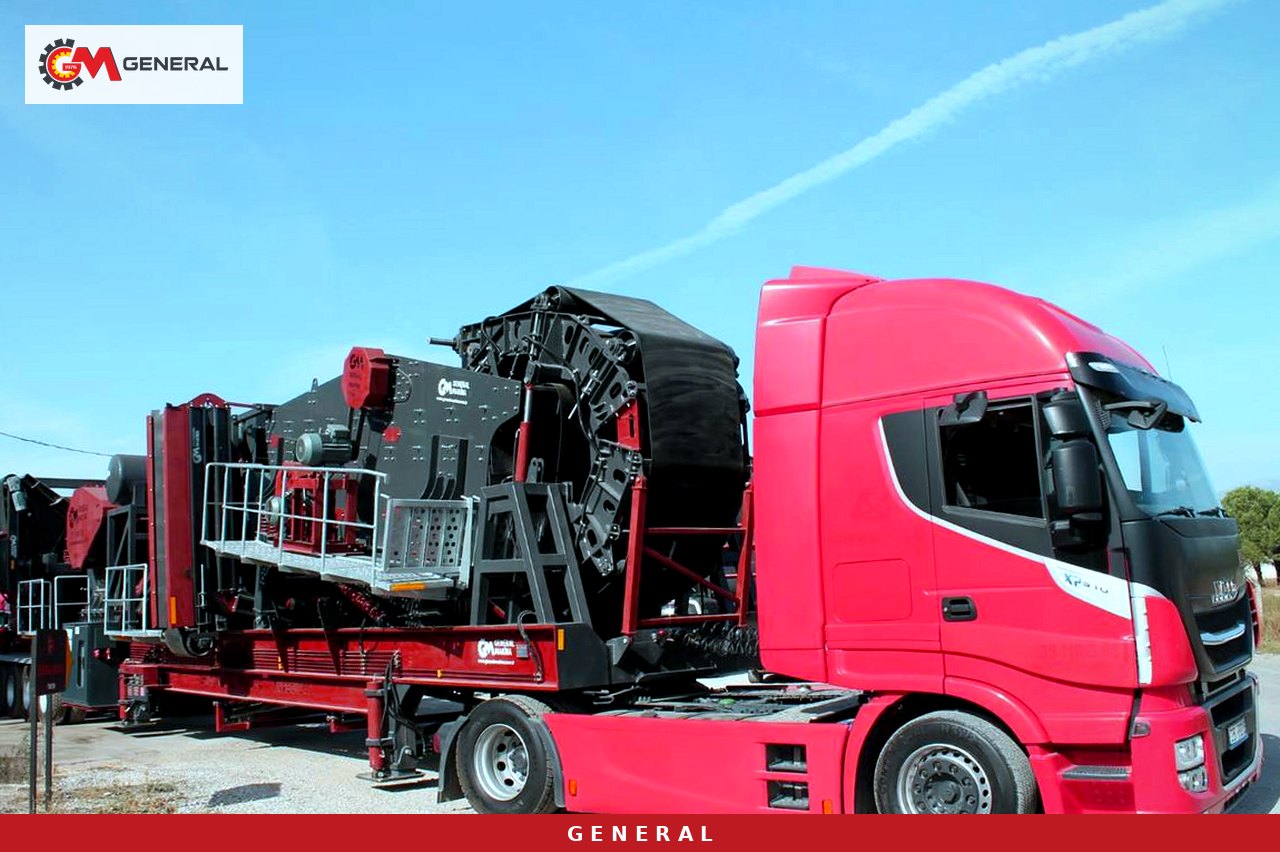
The General 944 combines a GPJ 90 primary jaw and a GM430 secondary cone on one wheeled chassis and produces 120-180 tph. It accepts feed up to 800 mm, its output setting is 0-100 mm, and its 1600×5000 mm three-deck horizontal screen separates 0-5 / 5-12 / 12-19 mm fractions. It takes its power from a 550 kVA generator and weighs 70,000 kg. If your target is around 150-180 tph and the quarry life is short or the location changes, this unit is enough on its own.
Upper band: a stationary line built around the GNRK 110 jaw
Above 200-250 tph, fixed crushing plants are the sounder basis. At the inlet sits a GNR 110 grizzly feeder (1100×4750 mm, 200-300 tph, 2x7.5 kW). In the primary stage the GNRK 110 jaw crusher with its 1100×850 mm opening offers 200-350 tph with a 110/132 kW motor. Cone crushers handle the secondary and tertiary stages, and screens in the GNR 2060 (2000×6000 mm) or GNR 2460 (2400×6000 mm) class split the fractions. Model-specific capacity and power tables for the cone are supplied per project.
| Criterion | General 944 (single chassis) | Stationary line: GNR 110 + GNRK 110 + cone |
|---|---|---|
| Capacity | 120-180 tph | Feeder 200-300 tph, jaw 200-350 tph |
| Primary crusher | GPJ 90 jaw | GNRK 110 jaw, 1100×850 mm opening |
| Secondary crusher | GM430 cone | Cone crusher (model per project) |
| Max. feed size | 800 mm | About 0.8-0.9 of the opening width |
| Screen | 1600×5000 mm, three-deck horizontal | GNR 2060 / GNR 2460 class |
| Power | 550 kVA generator | Primary motor 110/132 kW; total per project |
| Weight | 70,000 kg | Jaw 33,000 kg; others per project |
| Best fit | Short-lived or relocating quarry | Quarry working the same bench for many years |
There is also a third route in between: the GNR 110 wheeled primary jaw unit (1100×4750 mm feeder, 180-300 tph, 55,000 kg) arrives on site as the first stage, and the cone crusher and screens are added later as separate units. This approach makes sense for a quarry that wants to stage its investment over the first years. Other single-chassis options are listed under wheeled mobile crushing plants.
Balancing the settings between jaw and cone
What decides the output of a jaw + cone line is not the capacity of each machine on its own but how well they match. If the jaw's closed-side setting (CSS) does not send material of a size the cone can take, the tonnage on paper never materialises.
CSS and the cone's feed size
A cone crusher generally accepts 50-250 mm feed (up to 300 mm in some layouts) and works at a reduction of roughly 6:1-8:1 in the secondary stage and about 10:1 in the tertiary stage. A jaw crusher's typical reduction ratio is 4:1-9:1. Setting the primary jaw wider than the cone can handle causes build-up in front of the cone and overloads the return belt. Too tight a setting strains the jaw and lowers primary capacity. The right point is set by the breakage behaviour of the granite and the target fractions.
Keeping the cone choke-fed
A cone crusher gives its most cubical product when its chamber stays full (choke feed): stones break against each other as well as against the metal surfaces. A cone fed in bursts raises the share of flaky particles and causes uneven wear on the concave and mantle. That is why placing a surge pile or a controlled feed belt between jaw and cone, especially on a stationary line, directly improves the particle shape of granite aggregate.
Wear-part selection in granite depends on the same balance. Jaw plates and cone liners are usually cast in austenitic manganese steel; Mn18/Mn22 grades are preferred in high-silica rock. Liner change intervals should be fixed from tonnes-per-part records kept in the first months, not by guesswork.
From the port to the inland plateau: transport and power plan
Many granite sites in Angola lie inland, far from the coast. Equipment arrives at a port such as Luanda, Lobito or Namibe and is trucked from there. That journey directly affects the choice of equipment.
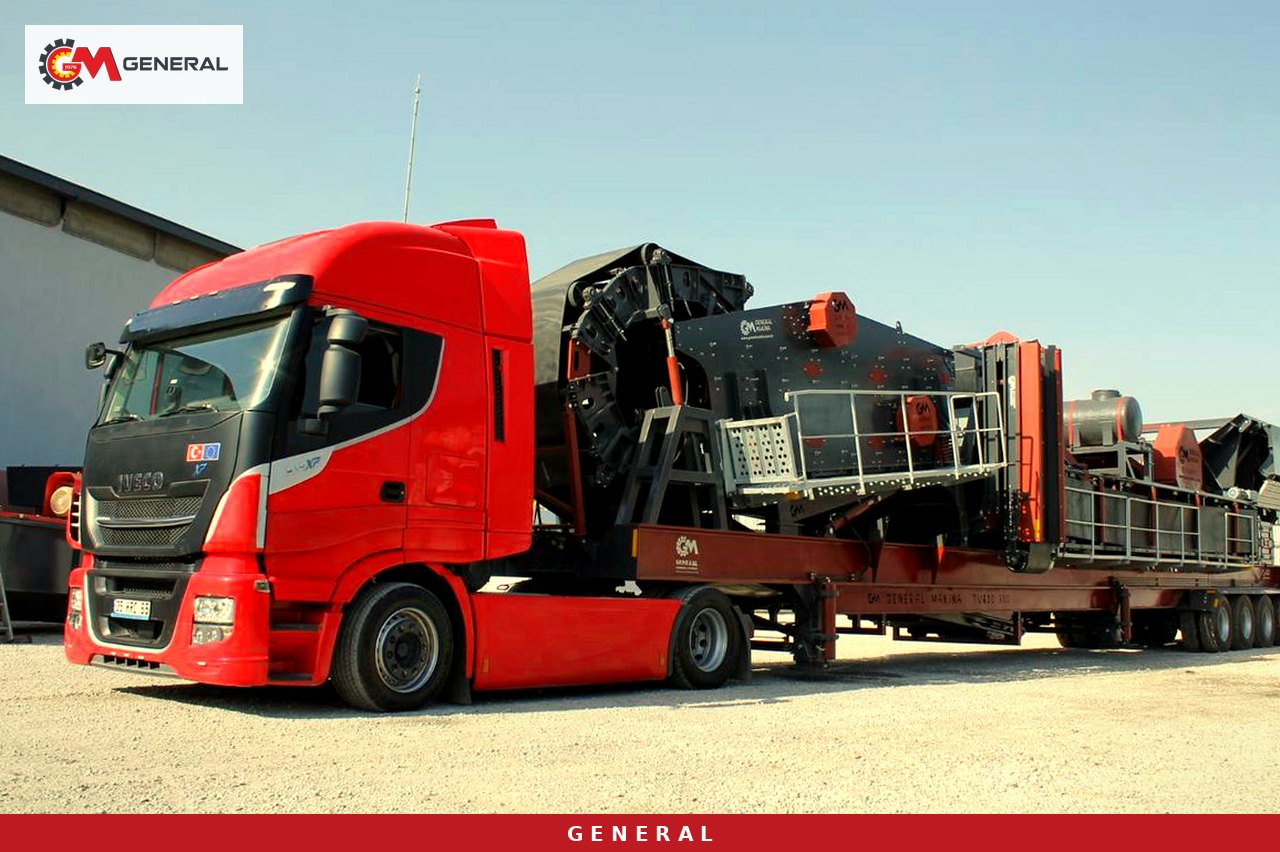
A single-chassis unit moves as one piece at 4130×20350×4500 mm and 70,000 kg; bridge, bend and axle-load limits along the route have to be checked with the haulier beforehand. A stationary line, by contrast, arrives as many separate items in containers and as open cargo and needs concrete foundations, erection and electrical connections on site. If quarry life is short or uncertain, that foundation investment and erection labour is a strong argument for the mobile unit.
On the power side, inland sites often have no grid or an unreliable one. The General 944 runs independently on its 550 kVA generator. For a stationary line, generator size is calculated per project from the sum of crusher and screen motors; where grid power exists, the connection capacity must be confirmed with the relevant utility.
Operating settings for the dry and rainy seasons
In Angola's interior the year divides clearly into dry and rainy seasons. Each brings a different problem to the crushing line.
- Dust in the dry season: water-spray dust suppression at transfer points, belt covers and frequent checks of generator and engine air filters are measures that can be selected per project.
- Heat in the dry season: hydraulic oil and generator cooling capacity should be specified for a hot climate and radiators cleaned regularly.
- Clay in the rainy season: wet weathered overburden sticks to grizzly bars and screen wires; grizzly spacing and screen apertures should be adjusted for this period.
- Ground in the rainy season: the hydraulic legs of a mobile unit must stand on compacted, drained ground.
- Stockpiles all year: the area for unwashed sand and fine fractions should be graded so that rainwater does not contaminate the material.
If the clay content of the fines exceeds the concrete specification, a washing stage has to be assessed separately; that decision is made from sample analysis.
The quarry file behind an accurate quote
How accurate a quote for a granite quarry turns out depends on the quality of the data sent. With the following information ready, we can build the configuration without guesswork:
- Compressive strength and abrasiveness test results of granite samples from the quarry.
- Estimated thickness and clay content of the weathered overburden.
- Largest block size after blasting.
- Target hourly output and daily operating hours.
- Required fractions (concrete, asphalt, sub-base) and the applicable specification.
- Distance from the site to the port and road conditions on the route.
- Grid power status or generator preference.
- Estimated operating life of the quarry.
We cover the general logic of crusher selection for abrasive rock in our article on the best mobile crushing plant for basalt and granite. Project information, tender specifications and permit conditions should always be confirmed with the relevant authority and the project documents.
Frequently asked questions
Why is a cone recommended instead of an impact secondary for Angolan granite?
Granite has a high free silica content. Because the cone crusher breaks stone by compression, metal wear and parts cost are clearly lower than with an impact rotor. An impact secondary comes to the fore in less abrasive rock where higher reduction and cubical grains are wanted.
Can the General 944 reach 250 tph?
No. The General 944 is rated at 120-180 tph. For a 200-250 tph target, consider a stationary line built on the GNRK 110 primary jaw, or the GNR 110 wheeled primary unit followed by a separate cone stage.
How do warranty and spare-parts support work?
General Makina equipment carries a 1-year warranty; wear parts are excluded. The company holds ISO 9001 and CE certification. Planning spares such as jaw plates and cone liners together at the first quotation stage reduces the risk of downtime at a remote site.
How are price and delivery time determined?
Both depend on the chosen configuration, the number of crushers and screens, the power solution and the shipping route. Once we have your quarry data, we prepare a project-specific quote.
Conclusion
For 150-250 tph of granite aggregate in Angola, a jaw + cone layout is the right foundation; the real decision is which end of the band you will work at. In the lower band the General 944 gives a fast start on one chassis; in the upper band a stationary line built on the GNRK 110 jaw suits a long-life quarry. Our team in İzmir, building crushing and screening equipment since 1976, is ready to review your quarry data: contact us and we will work out the right configuration and quote together.
Definitions of technical terms: Glossary