EN — English
 TR — Türkçe
 DE — Deutsch
 RU — Русский
 FR — Français
 ES — Español
 AR — العربية
 SR — Српски

Zimbabwe Harare Granite Aggregate Crushing Plant 120-180 TPH
Anyone planning an aggregate line around Harare starts from two facts: the rock under the city is granite almost everywhere, and that granite shows up as a weathered, crumbly cover near the surface and as fresh, hard, abrasive rock further down. A plant expected to supply crushed stone for housing blocks, commercial buildings, road rehabilitation and concrete block yards at 120-180 TPH has to handle both layers at once. This article explains which real models fit that band for Harare granite, how to build the product list backwards from site demand, how the rainy season and altitude shape the plant layout, and how shipping to a landlocked country is planned.
Two layers in Harare granite: weathered cover and fresh rock
Harare and its surroundings sit on Zimbabwe's broad granite basement; the rounded granite hills (kopjes) around the city are its most visible sign. When a quarry is opened, the first bench usually yields weathered, sandy-clayey granite that crumbles by hand. Further down the rock becomes fresh, rich in silica, hard to break and aggressive on metal.
This split drives the plant design. If the weathered cover enters the crusher, it packs in the jaw cavity, blinds the screen meshes and carries unwanted fines into the product. Fresh granite, on the other hand, eats impact crusher blow bars quickly, while jaw and cone crushers working by compression stay on the economical side. Our recommendation for a Harare quarry is therefore a line that breaks the large rock with a jaw, keeps compression crushing in the second stage and removes fines with a grizzly section before the crusher.
Every quarry is different; even two slopes of the same hill can vary in quartz content. Before deciding, have samples from your face tested for abrasion and compressive strength and attach the results to your enquiry.
Building the product list backwards from the job site
Before choosing crushers, pin down which fractions your Harare buyers want and in what proportion. Ready-mix producers ask for sand and two chip sizes, concrete block yards consume mostly fines, and road works need coarser sub-base material. This demand mix sets the number of screen decks and the setting of the secondary crusher.
The three-deck horizontal screen on General 944 and General 950 delivers 0-5, 5-12 and 12-19 mm as standard, which covers most of the concrete and block market. If road work also needs 19-40 mm, the GNR-MC110 with its four-deck screen or a separate screening unit comes into play. Mesh openings are agreed at order stage, so stating the gradation required by Harare project specifications up front saves time changing meshes on site. Always confirm the specification limits with the relevant authority or the project consultant.
Fraction shares also shape the stockyard layout. The fastest-selling product should have its stockpile closest to the truck route, while slow-moving coarse material belongs at the back of the site.
Real configurations that fit 120-180 TPH
Three routes cover this capacity range, all built from wheeled mobile crushing and screening plants and semi-fixed units. The right one depends on rock character, how many years the quarry will stay in one place and your growth plan.
General 944: first candidate for fresh granite
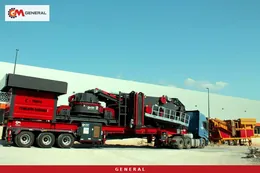
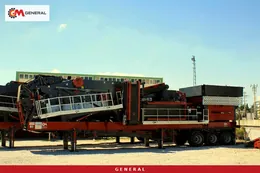
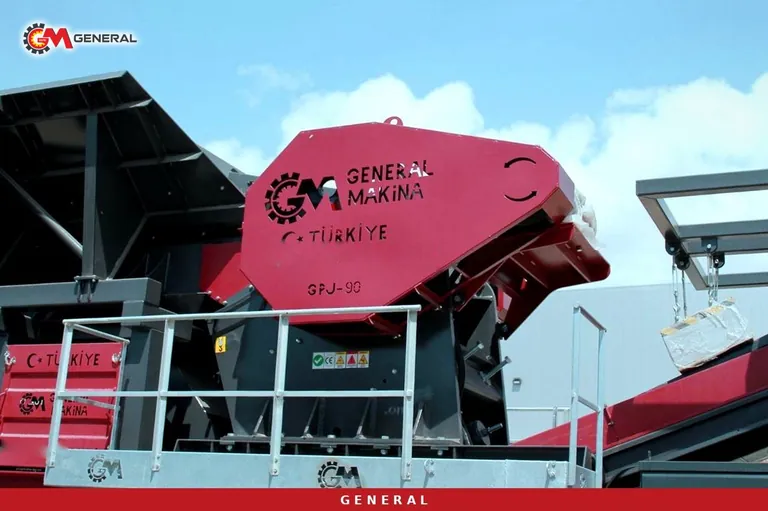
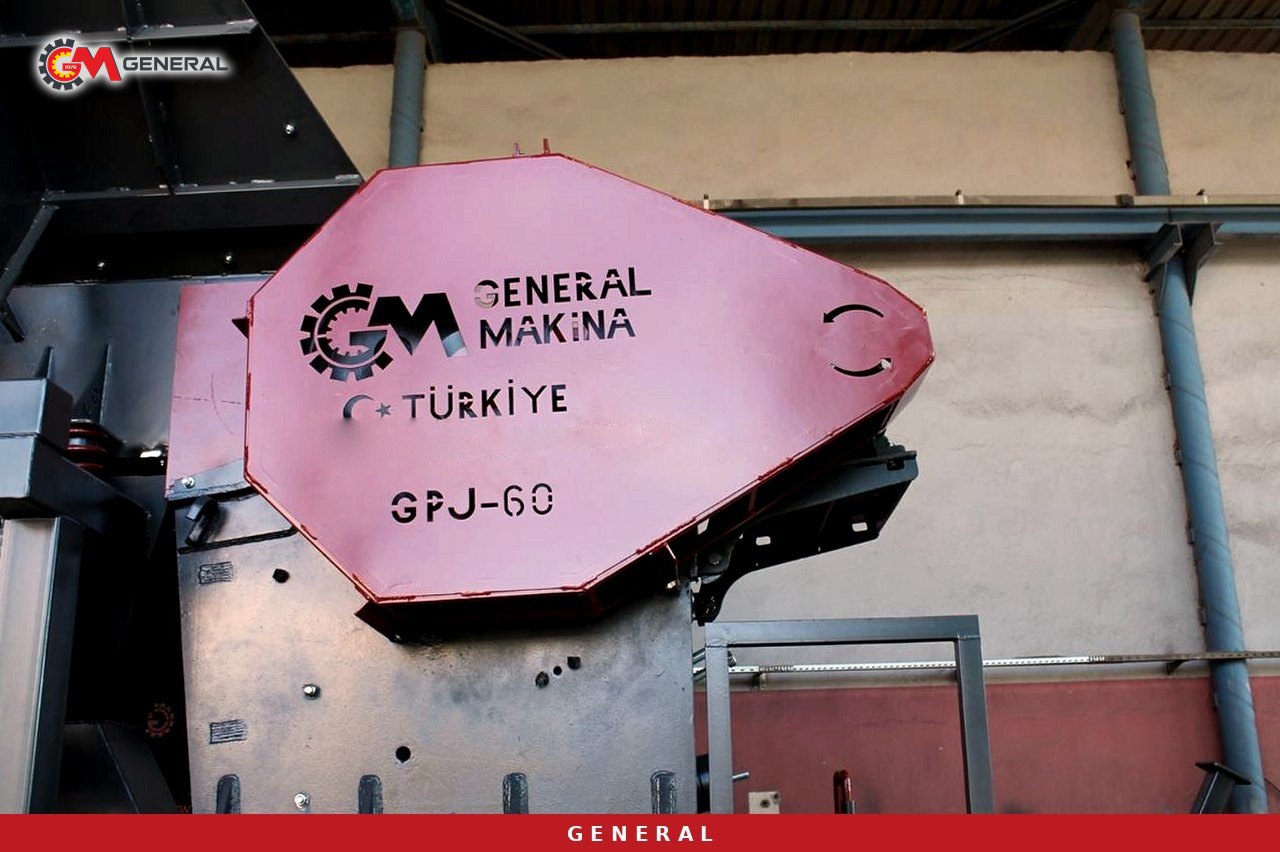
General 944 combines a GPJ 90 jaw primary and a GM430 cone secondary on one wheeled chassis. It accepts feed up to 800 mm, produces 120-180 TPH and has a 0-100 mm discharge setting range. Because the cone stage squeezes material repeatedly, metal life is long in fresh granite and the product is cubical. If the body of your Harare quarry is hard granite, this is the model to look at first.
General 950: for softer seams
General 950 pairs the same GPJ 90 primary with a DMK01 impact secondary; capacity, feed size and chassis dimensions match the 944. The impact stage gives high reduction and a distinctly cubical grain, but in high-silica granite the blow bars need changing more often. If a partly weathered, softer seam will be worked for a long time, the 950 is worth considering; in fresh granite the 944 comes first.
Modular route: mobile primary, cone and screen
If the quarry will stay in one place for many years, the line can also be built from separate units. The GNR 90 mobile primary jaw crusher (GNRK 90 jaw, 1000×3800 mm feeder) runs at 70-180 TPH and accepts 0-1100 mm feed. Adding a cone crusher and a GNR 1650 or GNR 2060 vibrating screen creates a semi-fixed layout close to stationary stone crushing and screening lines. The cone crusher's model and capacity table is issued per project. This route stays open to a second cone or a VSI later.
| Item | General 944 | General 950 | Modular (GNR 90 + cone + screen) | GNR-MC110 |
|---|---|---|---|---|
| Primary | GPJ 90 jaw | GPJ 90 jaw | GNRK 90 jaw | GPJ 110 jaw |
| Secondary | GM430 cone | DMK01 impact | Cone (per project) | GS1215 / DMK03 impact |
| Capacity | 120-180 TPH | 120-180 TPH | 70-180 TPH (primary unit) | 200-300 TPH |
| Maximum feed | 800 mm | 800 mm | 0-1100 mm | 900 mm |
| Screen | 1600×5000 mm, 3 decks | 1600×5000 mm, 3 decks | GNR 1650 or GNR 2060 | 2000×6000 mm, 4 decks |
| Fractions | 0-5 / 5-12 / 12-19 mm | 0-5 / 5-12 / 12-19 mm | Depends on meshes | 0-5 / 5-12 / 12-19 / 19-40 mm |
| Generator | 550 kVA | 600 kVA | — | 750 kVA |
| Weight | 70,000 kg | 70,000 kg | Primary unit 25,000 kg | 2 × 55,000 kg |
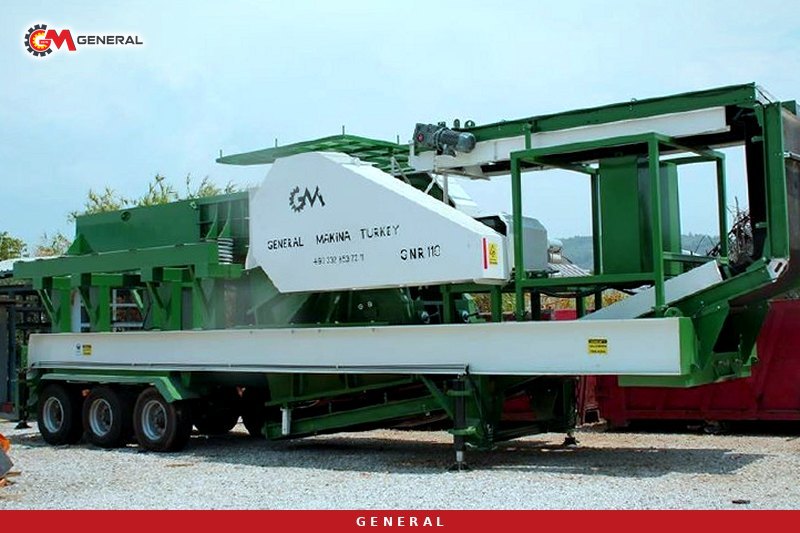
If demand goes beyond 180 TPH, the GNR-MC110 is the natural next step: the GPJ 110 jaw primary and the impact secondary sit on two separate chassis, and the primary group can run on its own. Factor in the wear cost of an impact secondary in fresh granite when deciding.
Rainy season, altitude and dust: running a Harare site
On Zimbabwe's high plateau rain falls mainly in the summer months, with the rainy season running roughly from November to March. During this period the weathered granite cover gets wet and turns clayey. The grizzly by-pass on the feeder separates this material before the crusher, but with very wet feed the grizzly opening and the discharge direction of the by-pass conveyor have to be adjusted to the season. Stockpiling clean granite and scheduling overburden stripping in the dry months before the rains reduces lost production.
In the dry months the issue is dust. Crusher discharge, screen outlets and belt transfers are the main sources. Water-spray dust suppression, covers at transfer points and belt covers are measures that can be selected per project; for quarries close to the city, check local environmental requirements with the competent authority and build them into the design.
Power and altitude
A 550 kVA generator is specified for General 944 and 600 kVA for General 950. Harare lies on a high plateau, and diesel generators commonly lose output at altitude; confirm the real output of your chosen generator at this elevation with its manufacturer. Even where a grid connection is possible, keeping the generator as a backup against outages protects continuity. Engine cooling and air filters belong near the top of the maintenance list during dusty months.
Shipping to landlocked Zimbabwe
Zimbabwe has no coastline. A plant leaving Izmir reaches a port in a neighbouring country by sea, for example Beira in Mozambique or Durban in South Africa, and is then hauled to Harare by road. Port choice, border crossings and transit documents should be planned together with the freight forwarder.
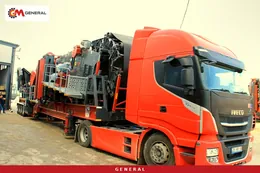
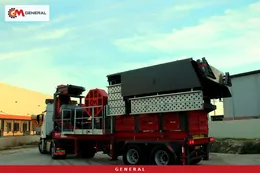
General 944 and 950 travel on a single wheeled chassis with a loading dimension of 4130×20350×4500 mm and a weight of 70,000 kg. These dimensions may require oversize permits in the countries along the route; clarify permit conditions with the carrier in advance. The two chassis of the GNR-MC110 travel separately (3000×13500 mm and 4200×18300 mm, 55,000 kg each). In the modular route the primary unit weighs 25,000 kg, but the cone crusher and screen need a concrete base or a solid steel platform.
The wheeled chassis pays off on arrival: set on hydraulic legs on level, compacted ground, the plant can start producing without waiting for foundation concrete. When preparing the site, solve the truck turning area, stockpile positions and rainwater drainage in the same plan.
Wear parts and a pre-enquiry checklist
In fresh granite, wear parts are the item that sets operating cost. Jaw plates are made of austenitic manganese steel (Mn13/Mn18), which work-hardens on the surface under impact. In the cone crusher the mantle and concave liners are replaced. With a long supply chain to Harare, ordering a spare set of jaw plates and cone liners for the first year together with the plant is a sound step. The plant carries a 1-year warranty; wear parts are excluded.
Collect the following before requesting a quotation:
- Test results for samples of your granite (abrasion index, compressive strength) and the estimated thickness of the weathered cover
- Target hourly capacity and number of daily shifts
- Required fractions and the approximate share of each (concrete, blocks, roads)
- Maximum block size and the blasting and loading method
- Grid power availability or generator preference
- Preferred port and the condition of the road to site
- How many years the quarry will run in one place and any capacity expansion plan
Frequently asked questions
Can an impact secondary be used on Harare granite?
It can, but in fresh, siliceous granite the blow bars wear faster. For weathered or softer seams the General 950 may make sense; if the main body is hard granite, the cone-secondary General 944 gives lower wear cost.
Can one plant produce both concrete and road material?
The 944 and 950 deliver three fractions (0-5, 5-12, 12-19 mm). If a coarser road material such as 19-40 mm is also required, the four-deck GNR-MC110 or an additional screening unit is needed.
Does production stop in the rainy season?
It does not have to. The grizzly by-pass removes wet fines, and stripping overburden and stockpiling clean granite in the dry season makes the transition easier.
What determines the quotation?
The chosen configuration, number of screens and conveyors, generator, spare parts package and port of delivery are the main items. Send your quarry data and a project-specific offer is prepared.
Conclusion
For 120-180 TPH granite aggregate around Harare, the safest start is the General 944 with its jaw primary and cone secondary; the 950 suits softer seams, the modular route suits a long-life fixed quarry, and the GNR-MC110 is the answer above 180 TPH. Your granite tests and product list decide the final choice. Send your quarry details to our team, building crushing and screening plants in Izmir since 1976, and request a quotation through our contact page.
Definitions of technical terms: Glossary