EN — English
 TR — Türkçe
 DE — Deutsch
 RU — Русский
 FR — Français
 ES — Español
 AR — العربية
 SR — Српски

0-5, 5-12, 12-22 mm Production Plan for a 150-250 TPH Aggregate Crusher Plant
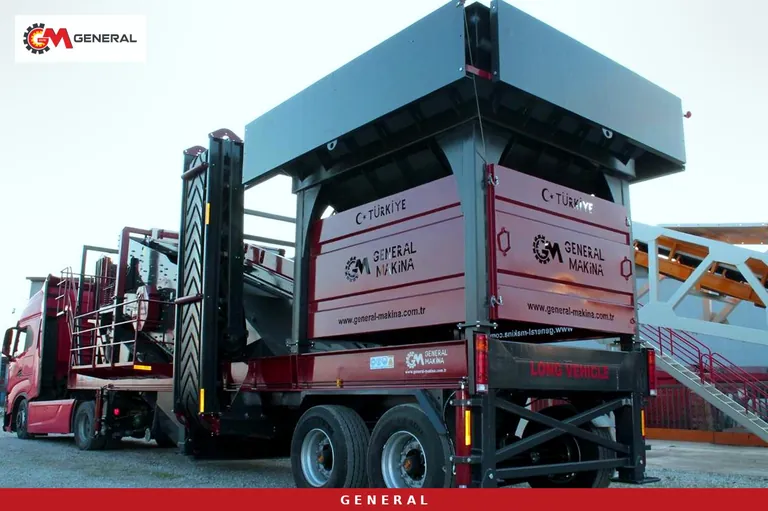
An aggregate quarry rarely succeeds or fails on hourly tonnage alone. What counts at the end of the month is which stockpile shrank and which one is blocking the yard. The ready-mix plant draws 0-5 mm sand and 5-12 mm chippings every day, the asphalt contractor buys 12-22 mm in campaigns, and a week later the 12-22 pile is sitting across the truck road. This article explains how we plan the output of three commercial fractions (0-5, 5-12 and 12-22 mm) on a crushing and screening plant working in the 150-250 TPH band: which cut points go to the screen, which real models deliver that tonnage, and how stockpile imbalance is corrected on site.
The fraction limits are set by your customer or by the project specification. EN 12620 or ASTM C33 for concrete, and the road authority's technical specification for pavement layers, state the tolerances on the lower and upper sieves. The calculations below are a planning method; obtain the acceptance limits in writing for every contract.
Start the plan from the sales table
Before anyone touches a crusher setting, you need a monthly demand table: which customer takes how many tonnes of which fraction, and in which months demand rises. Without that table the plant simply produces whatever distribution the crushers give naturally, and that distribution seldom matches the market. On basalt or granite, a jaw primary followed by a cone secondary usually gives a full 5-12 and 12-22 product while the sand share stays limited. On limestone an impact crusher pushes the fines up and 0-5 mm comes out in abundance.
The plan rests on one formula: fraction tonnage = plant capacity × that fraction's share of crusher output. The share is read from the laboratory sieve analysis of a sample taken during a trial crush. A hypothetical example: on a line running at 200 TPH, if the output shares are 35% for 0-5, 30% for 5-12, 25% for 12-22 and 10% above 22 mm, the plant makes 70 t/h of sand, 60 t/h of fine chippings and 50 t/h of coarse chippings, while the remaining 20 t/h returns to the crusher. These percentages are an illustration only; your rock will behave differently, and no quotation should be built on them before a sample is tested.
Cut points on the screen decks: 22, 12 and 5 mm
Three products plus one return stream means a three-deck screen. The top deck removes everything above 22 mm and sends it back to the crusher, the middle deck cuts at 12 mm, and the bottom deck takes out the sand at 5 mm. On a four-deck screen the fourth deck either serves an extra product (for example 22-40 mm sub-base) or splits the sand cut so the bottom deck carries less load.
The name of a fraction and the aperture of the screen mesh are never the same number. On an inclined screen the particle passes the opening at an angle, the aperture opens up as the wire wears, and damp sand narrows it. For that reason the mesh fitted for a 5 mm cut is fixed by trial once slope and moisture are known. As the General Makina product pages also state, mesh apertures and output grading are defined at the order stage according to the material to be processed.
Why the bottom deck carries the heaviest load
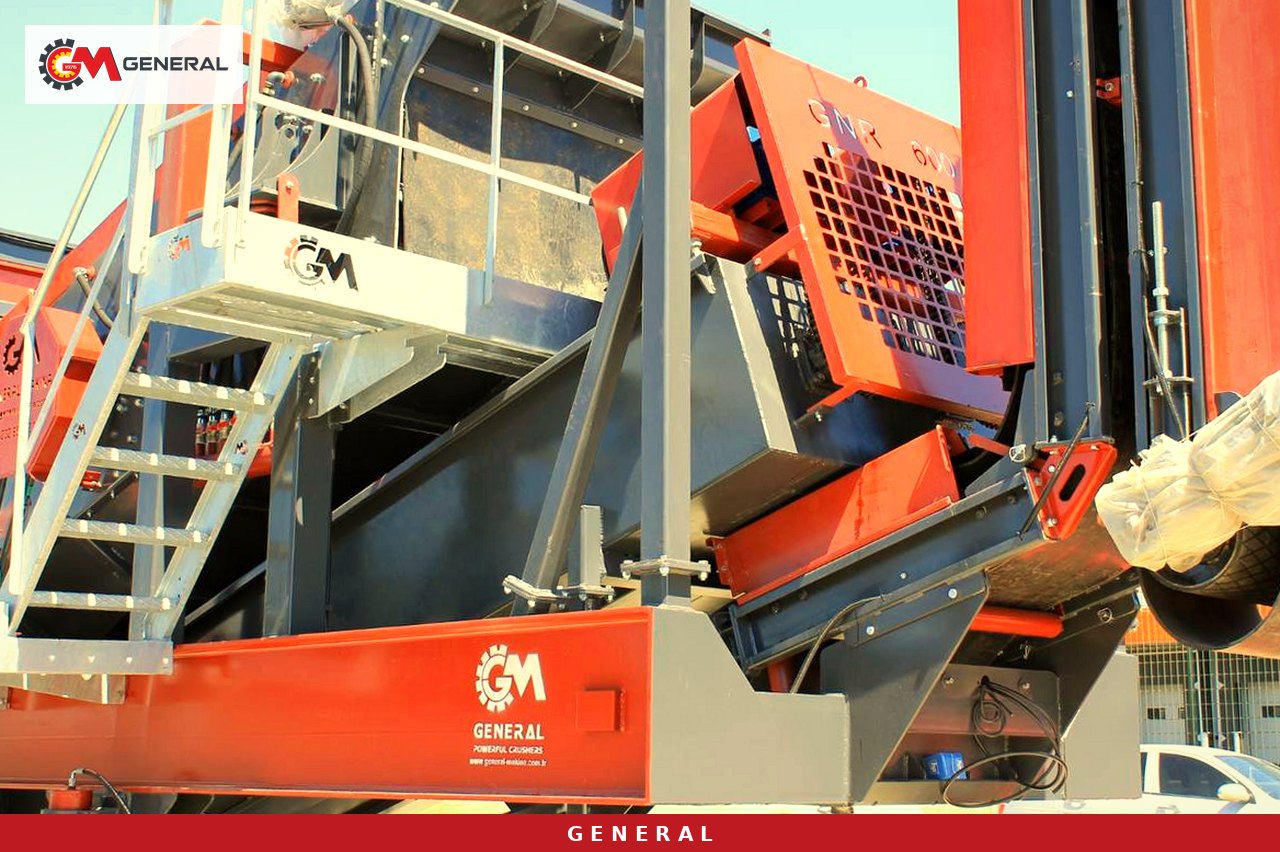
All of the sand passes through every deck and lands on the bottom one. The GNR ME2060 technical page notes that each lower deck loses roughly 10% of capacity and that bed depth at the discharge end should not exceed 3-4 times the aperture. At a 5 mm cut, if the bed grows beyond 15-20 mm the sand rides on top, spills into the 5-12 pile and spoils two products at once. In a plan with high 0-5 demand, screen area is chosen for this deck.
Departing from the standard list for 12-22 mm
The pages for the General 02, General 03 and GNR-MC110 give the standard product list as 0-5 / 5-12 / 12-19 / 19-40 mm. For a market that wants 12-22 mm, the mesh on the middle and top decks is changed accordingly at the order stage; the screen body and drive stay the same. Writing this fraction clearly into the enquiry lets the factory fit the correct mesh before shipment.
Figures for four line options
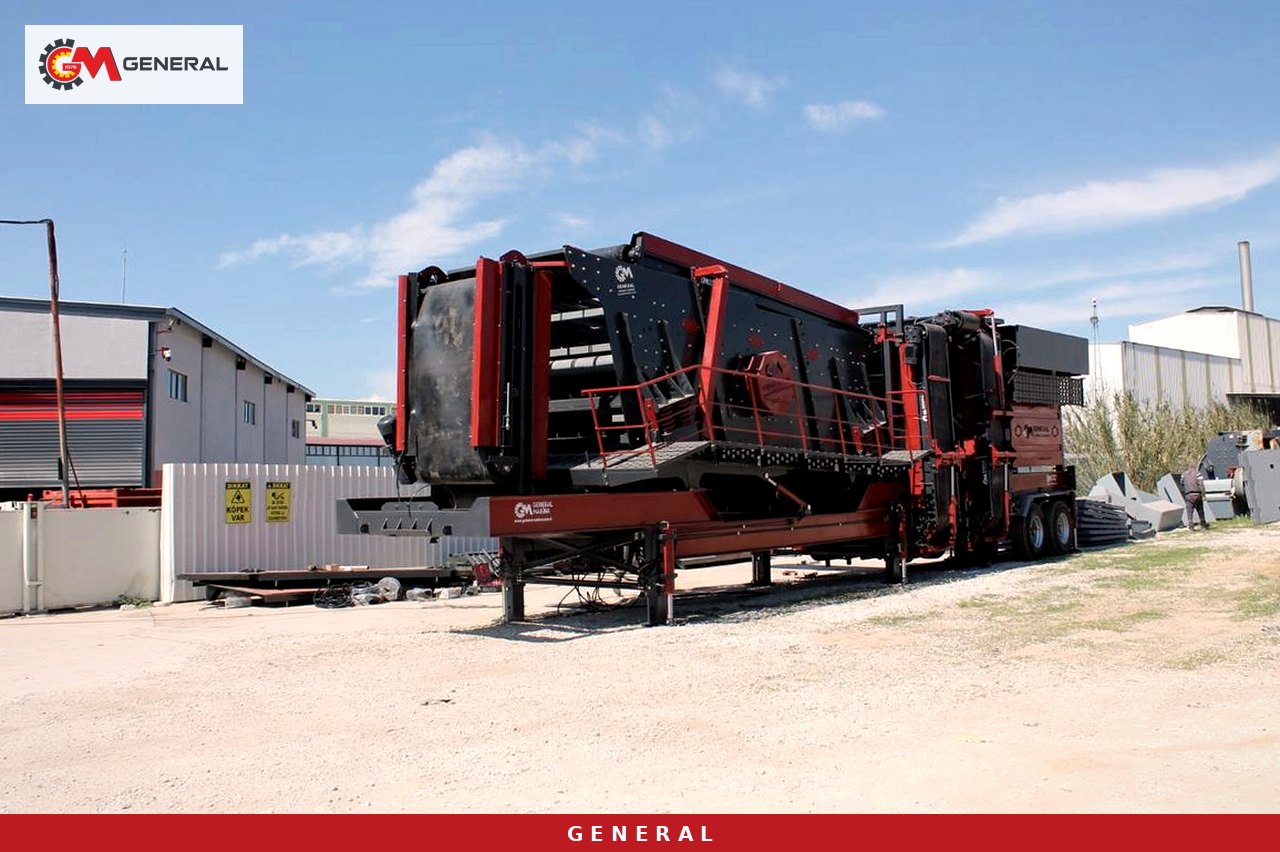
For a 150-250 TPH target we propose four configurations, from a single chassis up to two units. Every figure comes from the technical tables on the product pages; unknown values are left blank.
| Configuration | Capacity | Max. feed | Screen | Power unit | Suitable rock |
|---|---|---|---|---|---|
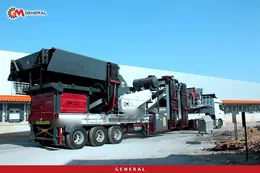
| GM 125 tracked impactor + GNR ME2060 mobile screen | 150-250 t/h (GM 125); 200-350 t/h (ME2060) | 700 mm | 2000×6000 mm, 3 decks | 550 kVA (GM 125) | Limestone, low-abrasive stone |
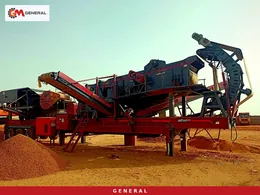
| GNR-MC110 twin chassis (GPJ 110 jaw + DMK03 impactor) | 200-300 t/h | 900 mm | 2000×6000 mm, 4 decks | 750 kVA | High tonnage, hard rock included |
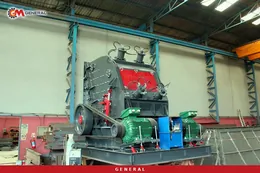
| General 02 (GPS 1413 impactor) | 250-300 t/h | 1000 mm | 2000×5000 mm, 4 decks | 660 kVA | Limestone, recycling |
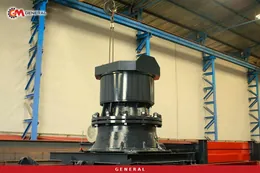
| 2 × General 944 (GPJ 90 jaw + GM430 cone) | 2 × 120-180 t/h | 800 mm | 1600×5000 mm, 3 decks (each) | 550 kVA (each) | Basalt, granite, quartz |
The GM 125 does no screening by itself. When its discharge conveyor feeds the 20 m³ hopper of the ME2060, the triple-deck screen separates four fractions and the plus-22 mm material returns to the crusher by belt. The General 02 works at the top of the band; in a quarry planned below 250 TPH part of its capacity would sit idle. For a closed-circuit field example of this model, see the General 02 250 t/h site application. On hard, abrasive rock a single-chassis cone line stops at 180 TPH, so two 944 units are installed in parallel; when one goes down for maintenance the other keeps producing. Other wheeled models can be compared in the wheeled mobile crushing and screening plants category.
Sand shortage or surplus: building the balance in the crusher and on the screen
Three-product plans most often show one of two pictures: there is not enough sand and 12-22 piles up, or the sand overflows and the chippings run out. Each one is corrected differently.
Too little sand, coarse chippings piling up
The first step is to close the secondary crusher setting (CSS on a cone, apron gap on an impactor) so the output curve shifts finer. The second step is to divert the surplus 12-22 to a sand maker. Among the GNR series vertical shaft impactor (VSI) models, the GNR 800 is listed with 40-50 mm feed and 55-160 t/h capacity for exactly this job; it turns 12-22 mm into cubical 0-5 mm sand. Converting chippings into sand changes product value, so the decision belongs to the sales table.
Too much sand, chippings running short
On limestone an impact crusher produces too many fines. Typical fixes are reducing rotor speed and opening the apron gap, using grizzly pre-screening ahead of the primary so that fines do not enter the crusher, and cutting back the return stream. If the sand stockpile keeps growing, splitting 0-5 mm into 0-2 and 2-5 creates two products that can be sold to different buyers; this needs a fourth screen deck.
Shift planning and stockyard layout
Three fractions mean three separate stockpiles and at least three truck loading points. The discharge height of the stockpile conveyors sets the pile volume. Once a pile is full, segregation starts at the belt end: coarse particles roll down to the toe, so the outside of the 12-22 pile is coarse and the inside fine. Telling the loader operator to cut the pile in layers from the front keeps that segregation from reaching the customer.
The 0-5 mm sand pile should sit on ground that drains. After rain, wet sand sticks at the belt end and the batching plant receives damp material on its scales. On windy sites the sand pile is also a dust source; water sprays at the belt end and a wind-break wall are measures that can be selected per project.
Taking a sample from each pile at the start of the shift and running a quick sieve analysis catches a drifting curve within one shift instead of one day. Mesh changes and crusher adjustments should be logged in the same book with the same timestamp, so that when the curve goes wrong you can read what changed.
Checklist before you order
- Has the monthly fraction demand (tonnes) and its seasonal swing been written down?
- Has a laboratory hardness and abrasiveness test been run on a sample from the quarry?
- Is there an output sieve analysis from a trial crush?
- Have the tolerances for the three fractions (lower and upper sieve limits) been obtained from the customer in writing?
- Is the largest block size after blasting known, and does it fit the feed opening of the chosen model?
- Is the energy source decided: grid or generator?
- Is the stockyard big enough for three piles and a loading road?
- Has a fallback for sand surplus or shortage (VSI, fourth screen deck) been considered?
We describe stage by stage how crusher and screen combinations are arranged in the article on the role of primary, secondary and tertiary crushers in mobile plants. Screen body options are on the aggregate and sand screens page.
Frequently asked questions
Can the same line produce both 12-19 and 12-22 mm?
Not at the same time. The cut point is set by the mesh, so for two products you either change mesh and produce in campaigns, or define an extra cut on a four-deck screen. Which one suits you depends on the demand table.
Can manufactured sand replace natural sand in concrete?
Yes, if particle shape, fines content and specification compliance are met. Sand shaped by a VSI comes out cubical. The fines limit is written in the specification; do not decide without a laboratory result.
Should I choose 150 TPH or 250 TPH?
Divide the monthly sales target by operating hours and add the return stream. If the result sits near the top of the band, a model with a higher ceiling such as the GNR-MC110 or General 02 makes more sense; near the bottom, the GM 125 with a mobile screen is the better fit.
How are delivery time and price determined?
They depend on configuration, number of screen decks, energy source and shipping method, and are confirmed in a project-specific quotation prepared from that information.
What to send us for the plan
A three-fraction production plan starts with the sales table rather than the crusher, takes shape on the screen decks and holds up through shift samples. Send us your monthly demand table, the rock sample test results and the largest block size, and we will work out the configuration, screen cut plan and power demand together. The plants we have built in Izmir since 1976 carry ISO 9001 and CE certification and a 1-year warranty excluding wear parts. For a quotation, write to us through our contact page.
Definitions of technical terms: Glossary