EN — English
 TR — Türkçe
 DE — Deutsch
 RU — Русский
 FR — Français
 ES — Español
 AR — العربية
 SR — Српски

Gambia Small-Scale Aggregate Crusher Plant 60-100 Ton Per Hour
For a road contractor, a block maker or a small quarry operator in Gambia, buying a crushing plant is rarely about a large multi-stage line. It is about one correctly sized machine to start with. The country's narrow strip of land along the river, the port of Banjul on its island, growing construction demand around Kanifing and Brikama, and the scarcity of hard-rock sources all point to 60-100 tph as a sensible entry point. This article compares real models in that band using catalogue values, explains how Gambia's typical materials shape machine choice, and works through the practical questions from the port to the site so you can make a purchasing decision.
Note: every model below is a new, factory-built machine. For the technical specification of any particular road, bridge or housing project, confirm the current documents with the relevant authority or employer; the country context given here is a general frame only.
Where aggregate comes from in Gambia: laterite, sandstone and coastal sand
Most of Gambia sits on sedimentary rock. The materials met most often in the field are sandstone, iron-rich laterite crusts and sand deposits along the coast and riverbanks, while hard-rock sources such as granite and basalt are limited. That picture drives crusher selection directly. A laterite crust can be hard and abrasive in one pit and soft and clayey a few hundred metres away. Sandstone, depending on how well it is cemented, gives either sound chippings or an excess of fines.
The first step is therefore to have a few samples from the pit tested in a laboratory for compressive strength, abrasion index and clay and moisture content. If the results show hard, abrasive material, a jaw crusher is preferred for the first stage; on soft, low-abrasive material an impact crusher gives both a more cubical product and a higher reduction ratio. Separating clay layers before they reach the crusher deserves its own line in the plan for Gambian pits.
What small-scale means: from daily demand to hourly capacity
The most common mistake in purchase talks is equating demand with a machine's top rating. The correct method divides daily or weekly aggregate demand by real working hours:
Required hourly capacity = daily target (tonnes) ÷ (shift hours × availability)
A hypothetical example: an operation targeting 480 tonnes a day, running one 8-hour shift and able to use roughly three quarters of that time productively because of maintenance, feeding waits and loading stops, needs 480 ÷ (8 × 0.75) = 80 tph. That sits in the middle of the 60-100 tph band and leaves a margin so the machine is not driven at its limit all day. On easier material such as sandstone the same machine can approach the top of the band; on hard laterite crust it is safer to plan near the bottom.
The product side must be counted too. Block and concrete producers mostly want fine and medium fractions, while road sub-base needs a wider grading. The number of screen decks and the mesh apertures are therefore set at the order stage from the product list.
Three real options for 60-100 tph
The table compares models that can be considered for small-scale production in Gambia, using the values from their product pages. Cells that are unknown or do not belong to that model are shown as “—”.
| Option | Capacity | Max. feed | Crusher | Screen | Generator | Weight |
|---|---|---|---|---|---|---|
| General 640 (single chassis, closed circuit) | 60-100 tph | 500 mm | GPJ 60 jaw + GNR 50 impact | 1200×4000 mm, triple-deck | 300 kVA (optional) | 38,000 kg |
| General 800 (single chassis, primary impact) | 80-150 tph | 600 mm | PDK 1280 impact | 1300×4000 mm, triple-deck | 450 kVA | 35,000 kg |
| GNR 90 primary jaw unit | 70-180 t/h | — | GNRK 90 jaw | — | — | 25,000 kg |
| M-DMK 01 secondary impact unit | 120-180 t/h | 350 mm | Secondary impact, 160 kW | Feeder with by-pass screen | — | 32,000 kg |
Starting with one machine: General 640
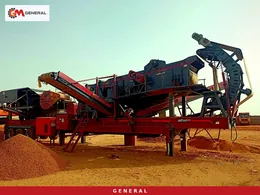
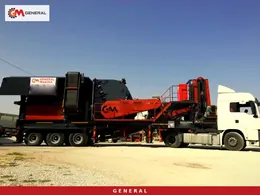
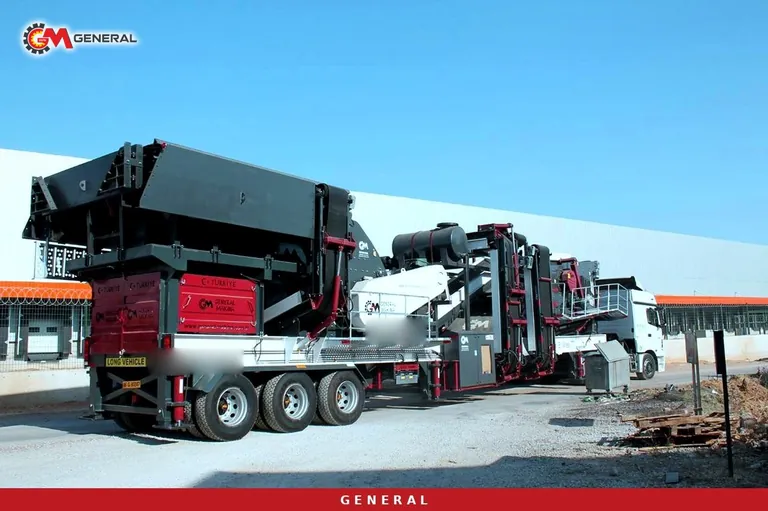
The General 640 is the most compact way to cover 60-100 tph on a single chassis. The GPJ 60 jaw does the first break, the GNR 50 impactor gives the product its final size and cubical shape, a 1200×4000 mm triple-deck screen splits the flow into 0-5, 5-12 and 12-19 mm, and oversize returns to the crusher on the recirculation belt. Starting with a jaw keeps metal consumption in check on hard laterite crust while still handling sandstone without trouble. A 300 kVA generator option covers sites far from the grid. Being movable by a single truck is a real advantage on Gambia's narrow road network.
If soft laterite and sandstone dominate: General 800
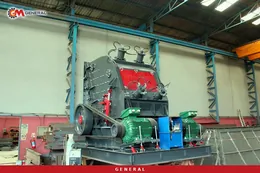
When tests show low-abrasive material, the General 800 is worth considering. Its PDK 1280 primary impactor delivers a high reduction ratio and cubical product in one stage; with 80-150 tph it covers the 60-100 tph target with a comfortable margin and leaves room to raise tonnage later with the same machine. On hard, high-silica laterite veins, however, the wear parts of an impact primary go faster, so the decision must rest on sample testing.
Growing in stages: separate primary and secondary units
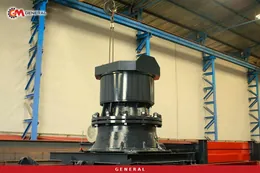
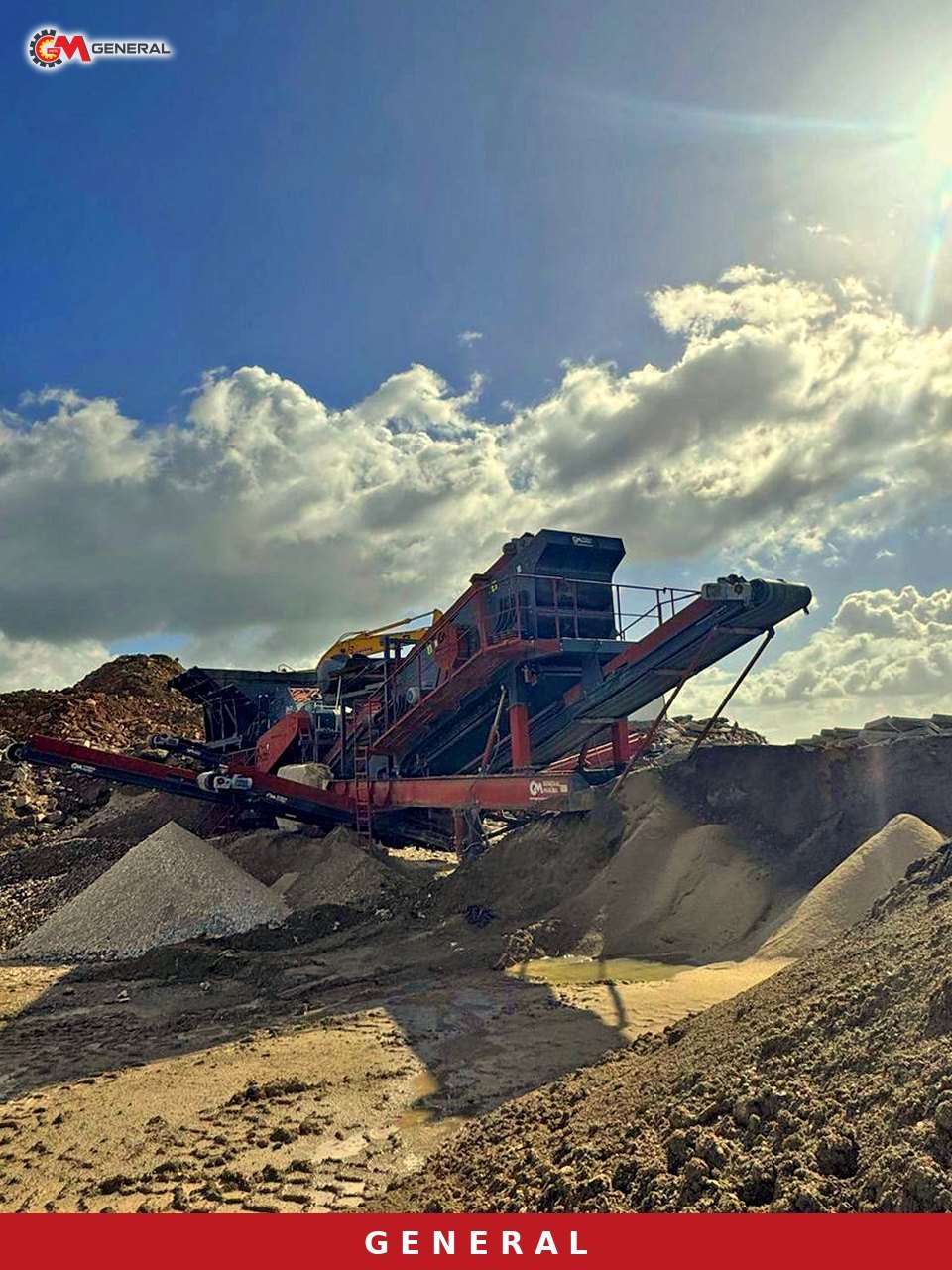
For an investor who wants to split the budget into steps, single-chassis mobile crusher units open a different route. The GNR 90 primary jaw unit (70-180 t/h) can produce road fill and coarse material in phase one; adding the M-DMK 01 secondary impact unit (120-180 t/h, 0-50 mm product) later provides finer, cubical chippings. The by-pass screen on its feeder removes soil-laden fines before the crusher, which cuts crusher wear on clayey laterite overburden. This layout needs a separate screen for full grading; on dry material the GNR ME1650 mobile dry screening plant (120-180 tph) can take on that job.
From Banjul to the pit: port, river and road
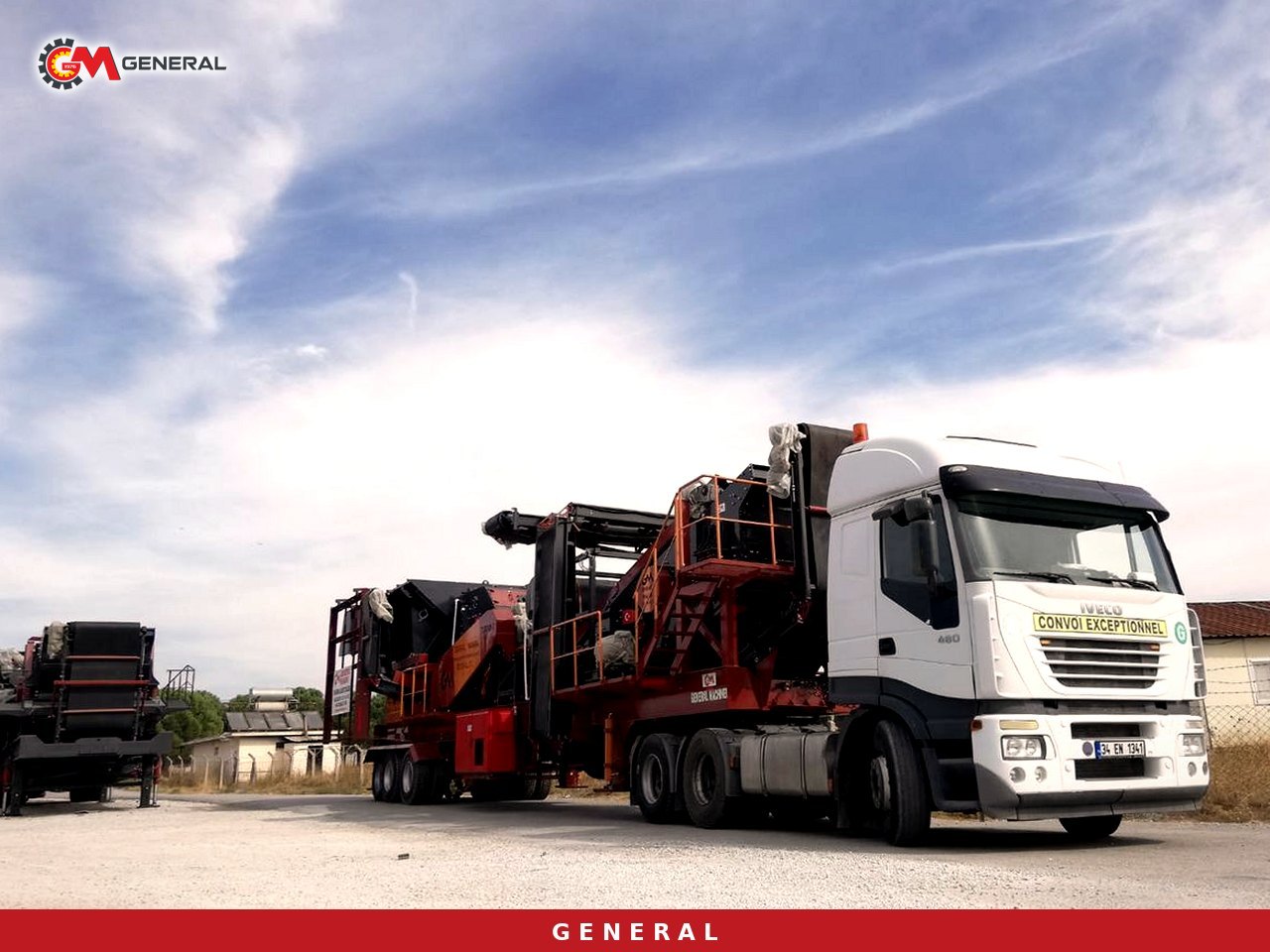
A mobile plant arriving in Gambia will most likely enter through the port of Banjul. Because wheeled chassis travel on their own axles behind a tractor unit, there is no container stripping and reassembly; but the load and dimension limits of bridges and ferry crossings between the port and the site must be checked in advance. Rules for heavy and long vehicles may differ on river crossings and on roads to the interior; confirm the current rules with the relevant transport authority.
The transport dimensions are 3500×17000×4500 mm for the General 640 and 3600×15500×4500 mm for the General 800. These are the starting data for both shipping and road planning. On site the machine is set up on hydraulic legs without foundations; even so, the ground must be compacted so it will not soften in the rainy season, and drainage must be planned.
Rainy season, harmattan dust and salty air
In Gambia part of the year is wet and part is dry and dusty. The two periods load the plant in different ways.
- Wet period: wet, clayey feed blinds screen meshes. Grizzly pre-scalping and the by-pass should remove the fine, soil-laden fraction before the crusher, and mesh apertures should be reviewed for this season.
- Dry, dusty period: dust carried by the harmattan wind fills generator and engine air filters quickly. Shortening filter check intervals and planning water-based dust suppression at transfer points are measures that can be chosen per project.
- Coast and humidity: on sites near Banjul and the coastline, salty air speeds up corrosion in electrical panels and exposed metal; panel protection class and paint system should be discussed at the order stage.
- Wear parts: the hard iron-oxide parts of laterite crust wear jaw plates and blow bars; planning a spare wear-part set for the first year together with the machine reduces downtime risk.
Cost drivers for a small investor
We give no price figures here, because a quotation is shaped by the choices below and prepared separately for each project:
- A single-chassis closed-circuit plant, or separate units added in stages?
- Primary crusher type: jaw for hard laterite, impact for soft material.
- Generator need: a site that can connect to the grid, or a fully independent one?
- Number of screen decks and the fraction list: fine product for blocks and concrete, or road sub-base?
- Climate measures such as dust suppression, panel protection and corrosion-resistant paint.
- A first-year spare wear-part set and the scope of port shipment.
All machines carry ISO 9001 and CE certification and a 1-year warranty excluding wear parts. For a broader comparison across capacity classes, see the wheeled mobile crushing plants page.
Frequently asked questions
Should I choose a jaw or an impact crusher for Gambian laterite?
It depends on sample testing. Where hard iron-oxide crust dominates, the jaw-led General 640 is the better fit; on soft, low-abrasive laterite or sandstone the impact primary of the General 800 gives a more cubical product.
Will the plant run on a site with no grid power?
Yes. The product pages list a 300 kVA generator option for the General 640 and a 450 kVA generator for the General 800. Fuel planning should be done separately according to working hours on site.
Can a 60-100 tph plant be expanded later?
With separate units, yes: a GNR 90 primary unit can be joined by an M-DMK 01 secondary unit and a screening plant to grow the line in steps. With a single-chassis plant, growth usually means adding a second crusher or screen.
How do I find out price and delivery time?
Both depend on the chosen configuration, options and shipping scope. Send material data, target products and site conditions and a quotation is prepared for you.
Conclusion
The key to small-scale aggregate production in Gambia is knowing the material and calculating capacity against real working hours. The General 640 for hard laterite, the General 800 for soft material and separate primary and secondary units for staged investment are sensible starting points. Share your sample results and product list and we will define the right configuration together: contact us for a quotation and technical discussion.
Definitions of technical terms: Glossary