EN — English
 TR — Türkçe
 DE — Deutsch
 RU — Русский
 FR — Français
 ES — Español
 AR — العربية
 SR — Српски

Africa Mines Primary Jaw Crushing and Screening Plant 400 TPH
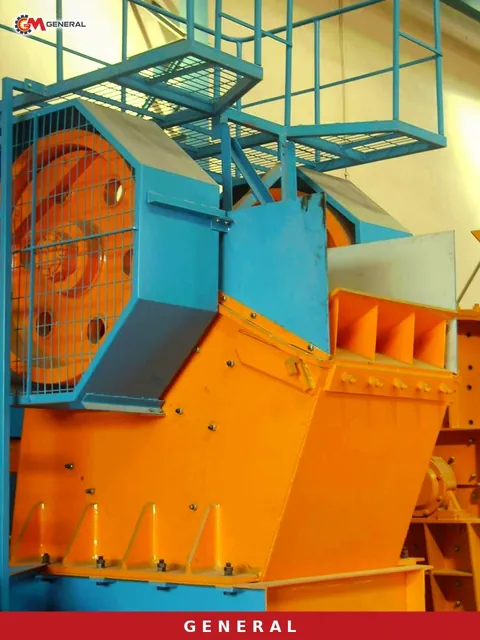
For a mining operation in Africa, a 400 TPH primary crushing line is the gate through which ore enters the plant: the pace at which haul trucks unload, the level of the pre-process stockpile and the shift plan all depend on how smoothly that gate works. In this article we walk through how to design a jaw-based primary crushing and screening plant that meets the 400 TPH target with real models, for ore types ranging from the gold fields of West Africa to the copper belt of Central Africa and the phosphate quarries of North Africa.
All model, dimension and capacity values are taken from our product catalogue. We give no information about any specific mining licence, tender or operator; please confirm your project's technical specification with the relevant mining authority or tender documents. For line scope and layout options, see our fixed crushing plants page.
Reading the 400 TPH target correctly: daily tonnage, shifts and reserve margin
The figure a mine planner gives is usually an annual or daily tonnage, while a crusher catalogue lists an hourly rate. What links the two is net operating time. The relationship to use is: required hourly capacity = daily tonnage ÷ (shift hours × availability). Availability covers stoppages such as waiting for blasting, truck queues, jaw setting adjustments and wear part changes.
A hypothetical example: 7,200 tonnes of ore must be crushed per day, two shifts give 20 hours in total and availability is taken as 0.90. 7,200 ÷ (20 × 0.90) = 400 t/h. If the same tonnage is squeezed into a single 10-hour shift, the target rises to 800 t/h, which is no longer a job for one primary crusher. That is why the first thing we ask when preparing a quotation is not capacity but the shift pattern.
The second issue is reserve margin. Mine ore changes with the face; some days it arrives coarser, some days more clayey. A machine sitting exactly on the lower limit of its catalogue range will fall short of target on a bad day. For 400 TPH, choosing a crusher whose capacity range extends above 400 is the simplest way to absorb that fluctuation.
The backbone of the line: GNR 140 feeder and GNRK 130 jaw crusher
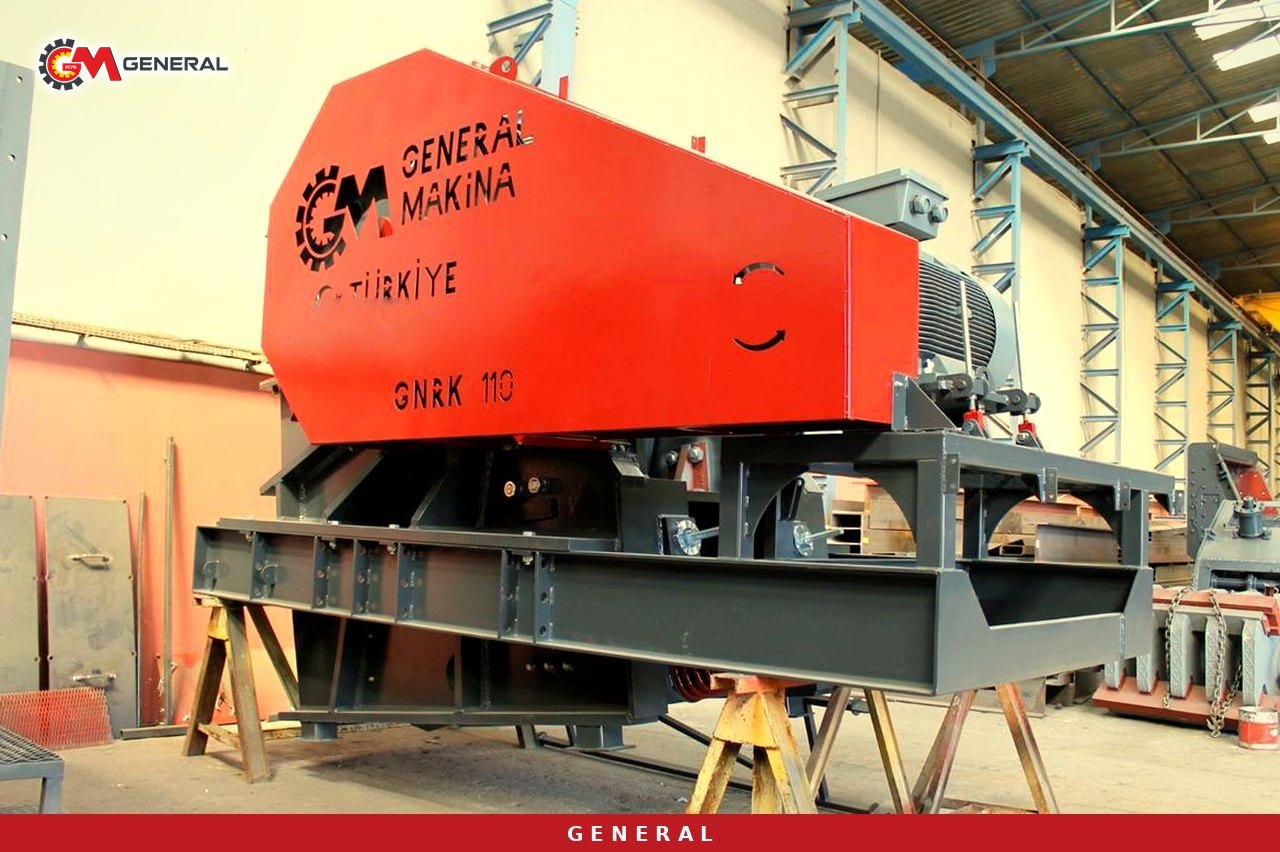
Within the GNRK series jaw crusher family, two models meet 400 TPH with a single machine. The GNRK 130, with a 1300×1000 mm opening and a 160 kW motor, works in the 400-500 t/h range; the GNRK 140 delivers 500-600 t/h with a 1400×1100 mm opening and a 200 kW motor. The 200-350 t/h range of the GNRK 110 falls below this target, but it appears in the table as an option for operations that prefer to split the tonnage into two parallel lines.
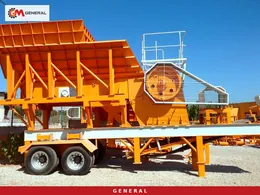
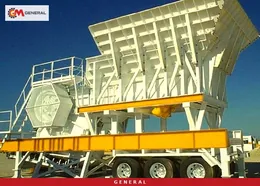
On the feed side, the model able to carry the same tonnage as the crusher is the GNR 140 vibrating grizzly feeder: 1400 mm width, 5000 mm length, 2×9.2 kW drive and 350-600 t/h capacity. Part of our crusher feeders range, the GNR series accepts lumps up to 1500 mm and is installed with a hopper volume between 15 and 100 m³. Hopper volume is selected according to truck body size and truck arrival interval; the aim is that the crusher never runs empty between one truck tipping and the next arriving.
| Configuration | Crusher capacity (t/h) | Crusher opening (mm) | Discharge setting (mm) | Crusher motor (kW) | Crusher weight (kg) | Feeder |
|---|---|---|---|---|---|---|
| Single line, GNRK 130 (main recommendation) | 400-500 | 1300×1000 | 125-250 | 160 | 42,500 | GNR 140: 350-600 t/h, 2×9.2 kW |
| Single line, GNRK 140 (large blocks, growth margin) | 500-600 | 1400×1100 | 135-300 | 200 | 47,000 | GNR 140: 350-600 t/h, 2×9.2 kW |
| Two parallel lines, 2 × GNRK 110 | 2 × 200-350 | 2 × 1100×850 | 150-225 | 2 × 110/132 | 2 × 33,000 | 2 × GNR 110: 200-300 t/h, 2×7.5 kW |
Why the GNRK 130 is the main recommendation
The 400-500 t/h range of the GNRK 130 meets the target at its lower limit and leaves roughly a quarter in reserve at the top. Its 42,500 kg weight is lighter than the 47,000 kg of the GNRK 140; that difference makes it easier to plan the crusher foundation, crane selection and road transport. The discharge setting ranges from 125 to 250 mm, and that setting directly determines the choice of conveyor and screen further down the line.
When the GNRK 140 comes into play
If a significant share of blasted blocks exceeds one metre, or if a tonnage increase is planned over the life of the mine, the GNRK 140 should be considered. According to the catalogue rule, the largest acceptable lump is about 0.8-0.9 times the opening width; on the GNRK 140 this corresponds to roughly 1.1-1.25 m. A wider opening cuts the time spent waiting at the crusher with a rock breaker and reduces the need for secondary blasting.
The screening stage: what to separate before and after the crusher
At a mine primary station, screening does two separate jobs. The first is before the crusher, removing fines and soil so they never enter the crushing chamber; the second is after the crusher, dividing the primary product into sizes suited to the next stage of the process.
Before the crusher: by-pass grizzly and G-type grizzly screen
The grizzly section at the end of the GNR 140 feeder sends material that drops through the bars straight to the conveyor without passing through the crusher. On sites with a high share of weathered upper-zone ore or blast fines, this by-pass alone may not be enough; in that case a G-type grizzly screen is added between feeder and crusher. The ELKG series produces linear vibration with two vibromotors, its grizzly bars are Mn13-type manganese castings and the bar spacing is adjustable. The catalogue range of 100-400 t/h for grizzly screens means that at a 400 TPH target this unit will run at the top of its band, so the by-pass ratio must be calculated from a sample. Every tonne of fines that enters the crusher wears the jaw plates for nothing and fills the chamber, cutting throughput.
After the crusher: primary product split with a twin screen
Material from a GNRK 130 with a 125-250 mm discharge setting is split into two or three streams depending on the ore preparation circuit: an oversize fraction going to the secondary crusher, an intermediate fraction that can go straight to stockpile and a fine fraction to be removed from the process. A single-body circular screen is listed in the catalogue at 100-400 t/h; to keep the screen deck from choking under a continuous 400 t/h flow, the twin vibrating screen is the safer choice. The twin configuration runs two screen bodies together and covers 100-500 t/h. The model table runs from GNR 1020 to GNR 2470; size and number of decks are selected according to the grading of the primary product and the required cut sizes. Planning should allow for the fact that each additional deck reduces capacity by about 10%.
Adjusting to ore type: from quartz-veined gold to clayey copper
At African mine sites, the same tonnage arrives as very different materials. The line's settings are determined not by tonnage but by the ore's abrasiveness and moisture.
Quartz-veined gold ore. At many gold sites in West Africa, ore arrives with fresh quartz-bearing rock. When the free silica content is high, the jaw plate alloy is shifted from Mn13 to Mn18 or Mn22. The compression principle of the jaw crusher keeps metal consumption low on this type of material compared with impact-type primary crushers.
Oxide-zone copper and cobalt ore. In the copper belt of Central Africa, material from the upper zones can be clayey and wet. Wet clay packs the crushing chamber; it becomes necessary to widen the bar spacing, strengthen pre-screening and, if needed, place a washing or scalping step ahead of the crusher. Where grizzly blinding is severe, a wobbler feeder is considered instead of a grizzly feeder.
Iron and manganese ore. With high bulk density ore, the same volume brings more mass into the crusher. Belt width and pulley selection are based on tonnage rather than volume, and feeder throughput is also set according to the bulk density of the ore.
Low-abrasion materials such as phosphate and limestone. In such quarries in North Africa, a jaw primary is still a safe starting point; if product shape and fines content matter, an impact crusher can be considered at the next stage.
Whichever group applies, the final decision is made by sample testing. The abrasion index and moisture of a specific deposit cannot be written down by guesswork; the laboratory result should be part of the quotation file.
Off-grid mine site: transport, power and dust
Many African mines are far from the grid, and equipment travels from the port by road. For a 400 TPH jaw line, three points must be settled before ordering.
Transport. Crushers are heavy single-piece loads: the GNRK 130 weighs about 42,500 kg and the GNRK 140 about 47,000 kg. Bridges, bends and road surface along the route from port to site should be checked in advance, and the crane capacity needed to set the crusher on its foundation should be planned.
Power. The installed power of the line is the sum of the crusher motor (160 kW on the GNRK 130), the feeder (2×9.2 kW on the GNR 140), and the screen and conveyor motors. Without a grid, the generator is sized for this total and for the starting current of the large motors. In a hot, dusty environment, adequate air circulation for cooling the generator and electrical panel, plus regular filter maintenance, must be planned.
Dust. In the dry season, the crusher discharge point, the screen deck and conveyor transfers produce the most dust. Measures that can be selected for the project include water-spray dust suppression, enclosed chutes at transfer points and conveyor covers. Besides protecting operator health, these measures also extend bearing and motor life.
Our references in Africa include the General 950 mobile crushing and screening plant in Niger. That project has a capacity of 240 t/h; it is a mobile solution on a different scale from a 400 TPH fixed primary line.
Information to collect on site before requesting a quotation
- Daily and annual tonnage target, shift pattern and expected availability.
- Largest block size after blasting, and the share of fines and soil in the run-of-mine feed.
- Ore type; abrasion and moisture values from a sample.
- Required top size of the primary product and the fractions to be separated on the screen.
- Haul truck body volume and tipping direction (for hopper volume selection).
- Power source: grid voltage or generator use.
- Port, road route and crane availability on site.
- Water source for dust suppression and requirements of the environmental specification.
With this information we turn the feeder, crusher, screen and conveyors into a single layout as a stationary crushing plant and work out concrete foundation loads and conveyor lengths.
Frequently asked questions
Is a single GNRK 130 enough for 400 TPH?
With a catalogue range of 400-500 t/h, the target is met by one machine. However, this value varies with the material, feed grading and discharge setting; on a line with a high fines share and a weak by-pass, practical throughput drops. We confirm the exact capacity together with sample data.
Can an impact primary crusher be used instead of a jaw?
On quartz-bearing, abrasive ores, the metal parts of an impact-type primary crusher wear out quickly. An impact primary only makes sense on soft, low-silica material; for mining applications our main recommendation is the jaw crusher.
Which certificates and warranty are provided?
Our machines carry ISO 9001 and CE certification. The warranty period is 1 year; wear parts such as jaw plates and grizzly bars are excluded. We have been manufacturing in Izmir since 1976.
What determines the price and delivery plan?
Crusher model, feeder and hopper volume, screen type and number of decks, conveyor lengths, steel structure, dust suppression and automation scope, and the shipping method determine the price. The delivery plan is also confirmed in the quotation according to this scope.
Brief assessment
For African mines, the backbone of a 400 TPH jaw primary line is the GNR 140 feeder with the GNRK 130 jaw crusher; with large blocks or a growth plan, the GNRK 140 comes in. The by-pass grizzly, a G-type grizzly screen where needed and a twin screen after the crusher make sure the line really carries this tonnage. Send your tonnage, ore and site details through our contact page and we will prepare a layout and quotation for your project.
Definitions of technical terms: Glossary