EN — English
 TR — Türkçe
 DE — Deutsch
 RU — Русский
 FR — Français
 ES — Español
 AR — العربية
 SR — Српски

Africa Mines: Jaw or Impact Crushing and Screening Plant 150-250 TPH?
An engineer laying out the crushing circuit of an African mine is really negotiating with the ore's chemistry when picking the first machine. Quartz-veined gold deposits in West Africa, the hard wall rock of the Central African copper-cobalt belt, iron ore on the edge of the Sahara and the phosphate and limestone pits of North Africa do not call for the same primary crusher. For an operation targeting 150-250 TPH, the choice between jaw and impact crushing decides wear-part consumption, particle shape, generator size and the second stage of the plant all at once. Below we build that decision step by step, using the verified catalogue values of real models.
Reading the ore: no crusher choice before abrasivity is measured
The first criterion that settles the crusher type is abrasivity, not hardness. The working threshold is this: when free silica exceeds 10 percent or the Bond abrasion index (Ai) is above 0.15, an impactor's blow bars can be gone within hours, and a jaw becomes the only sensible primary. Granite, basalt, quartzite and quartz-bearing ores fall into that class. In limestone, dolomite and soft low-silica rock, on the other hand, an impact crusher delivers both a higher reduction ratio and more cubical product.
The difficulty at African mines is that both classes often sit inside the same licence. The oxidised upper zone comes out soft and clayey, while fresh rock a few benches lower is harder and richer in quartz. A circuit that runs comfortably with an impactor at a gold site's opening can start fighting blow-bar costs as the pit deepens. That is why we advise taking samples not just from surface but from the different levels you will mine over the life of the pit, and having silica and Ai measured in a laboratory. General knowledge of regional rock types gives direction; your own sample report picks the crusher.
Compression versus free impact in day-to-day operation
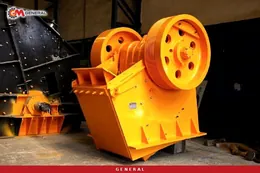
In a jaw crusher, material is broken by compression between a fixed jaw and a moving jaw swinging on an eccentric shaft, then falls by gravity through the closed-side setting (CSS). Because there is little sliding between metal and stone, wear stays manageable even on quartz-rich ore. Jaw plates are cast in austenitic manganese steel (Mn13/Mn18), which work-hardens under impact; for very high-silica ore Mn18/Mn22 is preferred. Typical reduction runs from 4:1 to 9:1.
In a horizontal-shaft impactor (HSI), blow bars on the rotor hurl material against breaker plates, and breakage happens by free impact rather than compression. General reduction sits in the 4:1-6:1 band and can reach 20:1 on limestone. That can shrink the need for a second stage and gives cubical aggregate. The price is the blow bars: high-chrome white iron for clean abrasive feed, manganese or martensitic steel where tramp iron from blasting is a risk, and ceramic-insert composite bars for very high-silica material. The right alloy sets the cost per tonne; the wrong one leaves the crusher idle on site.
Real models that fit the 150-250 TPH band
We split the options that cover the target range into two groups: single-chassis units that do primary crushing only, and mobile plants that bring primary, secondary and screen together. Every value in the table below comes from the product catalogues; unknown cells are marked with a dash.
| Model | Crushing principle | Feeder (mm) | Max. feed (mm) | Capacity (t/h) | Power | Weight (kg) |
|---|---|---|---|---|---|---|
| GNR 90 (GNRK 90 jaw) | Compression | 1000×3800 | 1100 | 70-180 | — | 25,000 |
| GNR 110 (GNRK 110 jaw) | Compression | 1100×4750 | 1100 | 180-300 | — | 55,000 |
| M-PDK02 | Free impact | 1200×4750 | 1200 | 200-300 | 250 kW motor | 45,000 |
| M-PDK01 | Free impact | 1500×5000 | 1200 | 250-500 | 315 kW motor | 50,000 |
| GNR-MC110 (GPJ 110 + DMK03) | Compression + impact | — | 900 | 200-300 | 750 kVA generator | 2 × 55,000 |
| General 950 (GPJ 90 + DMK01) | Compression + impact | — | 800 | 120-180 | 600 kVA generator | 70,000 |
When primary crushing alone is enough
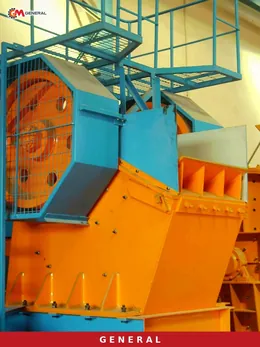
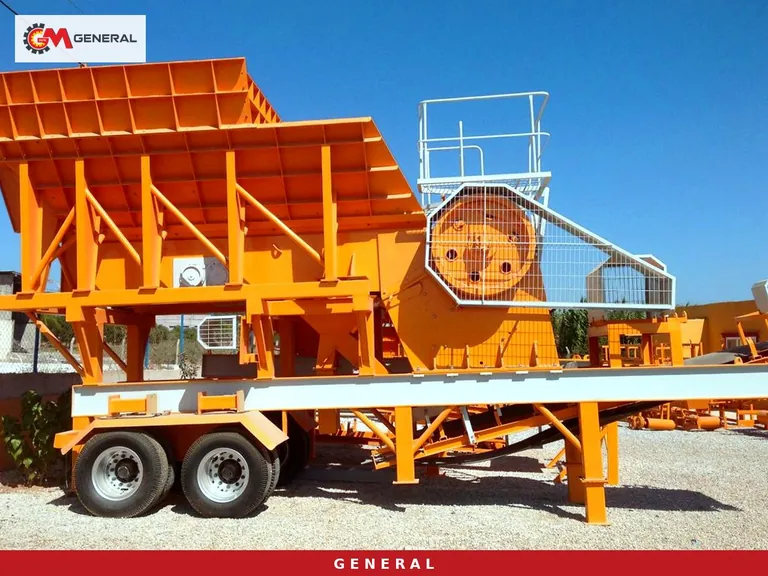
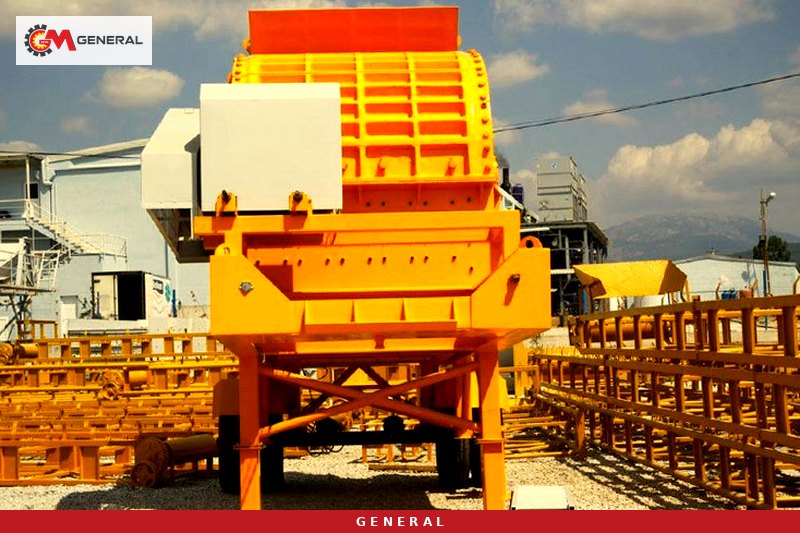
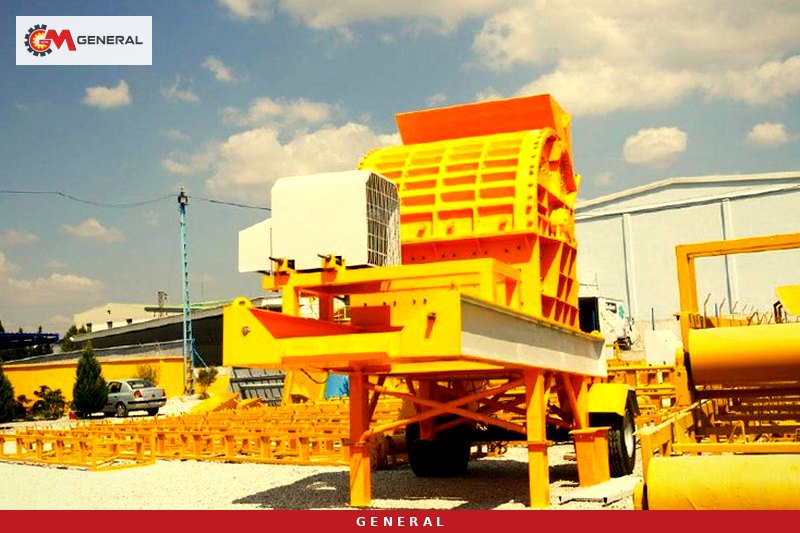
If crushed ore goes on to a grinding circuit or a stationary secondary station, what you need is a single-chassis primary unit. For quartz-veined gold ore, iron ore or hard wall rock, the GNR 110 model of the mobile primary jaw crusher with feeder hopper covers the whole target band at 180-300 t/h; the GNR 90, at 70-180 t/h, stays at the lower end. The unit accepts 0-1100 mm feed, delivers 0-250 mm product and is set up on hydraulic legs without foundations. If the ore comes from a low-silica limestone or phosphate deposit, the mobile primary impact crusher series takes over: the M-PDK02 gives 200-300 t/h, the M-PDK01 250-500 t/h, and its 0-70 mm cubical product often removes the need for a secondary. Other single-chassis units are listed under portable rock crushers.
When primary, secondary and screen sit in one contract
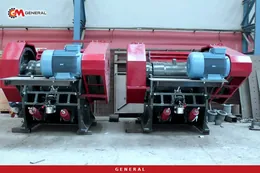
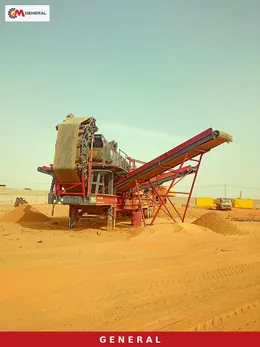
If the mine will also sell road base, fill or concrete aggregate, a screened plant is required. The GNR-MC110 spreads a GPJ 110 jaw primary and a DMK03 impact secondary across two separate chassis; with 200-300 t/h capacity, a 900 mm feed opening and a 2000×6000 mm four-deck screen it separates 0-5, 5-12, 12-19 and 19-40 mm fractions. Because the primary chassis can run on its own, you can buy the primary first and add the secondary once output grows. In this layout the jaw takes the abrasive first blow and the impact secondary gives cubical shape to the reduced material. For sites below the band, the General 950 (120-180 t/h) applies the same logic on a single chassis; compare the rest on the wheeled mobile crushing and screening plants page.
Feeding, power and haulage decisions on African sites
Dust in the dry season, clay in the wet season: a primary crusher at an African mine has two separate enemies. A jaw fed with wet, sticky clay will pack its crushing chamber, so clayey ore from the oxide zone should either be washed beforehand or removed by grizzly pre-screening. An impactor tolerates clay somewhat better, yet damp fines stick to the breaker plates and cut throughput. For the dusty season, dust suppression nozzles, enclosed conveyor transfers and more frequent engine air-filter changes are measures that can be chosen per project.
On sites far from the grid, the power decision depends on the crusher type. The 250 kW main motor of the M-PDK02 and the 315 kW motor of the M-PDK01 are the starting data for generator selection; the catalogue specifies a 750 kVA generator for the GNR-MC110 plant and 600 kVA for the General 950. The generator has to be sized with feeder, conveyor and screen loads counted alongside the crusher. On the haulage side, single-chassis units are towed by one truck; machines bound for landlocked countries first reach an ocean port and then travel by road to site. So compare chassis dimensions and axle loads against the bridge and road limits of the transit route in advance.
Wear-part planning at a remote site also changes with crusher type. On a jaw the main consumable is the pair of jaw plates; on an impactor the blow-bar set and breaker plates are tracked together. Set the change interval from measurements taken in the first weeks of running rather than from a catalogue: measuring and logging blow-bar or plate profile at fixed tonnage steps reveals the wear curve of your own ore within a few weeks. Keeping at least one spare set on site, allowing for the time a part needs to reach the port and then the mine, stops the crusher from standing idle while it waits for parts.
Site data to gather before asking for a quote
To recommend the right crusher we only need the information below. None of it requires a lengthy study, but every item can change the crusher type:
- Ore and wall-rock type, plus silica content and Bond Ai of samples taken from different levels
- Largest block size after blasting (above 1100 mm the primary choice changes)
- Hourly target and daily operating hours; 150 and 250 TPH point to different models
- Where the crushed product goes: grinding circuit, stockpile or aggregate sales
- Clay and moisture conditions, and how the ore behaves in the wet season
- Power source: grid, an existing generator fleet or a new generator
- Port of arrival and the road route to site, including bridge and tonnage limits
- If a tender specification exists, particle size and capacity requirements confirmed with the relevant authority
As African examples on our site, the General 950 mobile crushing plant delivered to Niger (240 t/h) and the 150 t/h basalt crushing and screening project in Jijiga, Ethiopia show how plants built around a jaw primary are configured in hard rock.
Frequently asked questions
Can an impact primary be used at a gold mine?
Not if the ore is quartz-veined. Once silica passes 10 percent and Ai passes 0.15, blow bars wear out very quickly. In that case a jaw primary, followed where needed by an impact or cone secondary, is the right arrangement.
Can a single unit handle 250 tonnes per hour?
Yes. On the jaw side the GNR 110 (180-300 t/h), and on the impact side the M-PDK02 (200-300 t/h) and M-PDK01 (250-500 t/h) deliver that tonnage on one chassis. Real capacity varies with ore hardness, block size and the required product setting.
Which certificates and warranty apply?
The machines carry ISO 9001 and CE certification. A 1-year warranty is given, excluding wear parts. Manufacturing in Izmir since 1976, the company exports to the Middle East, North Africa, Russia, the Turkic republics and the Balkans.
What drives the price?
Model and capacity, whether a primary unit or a full plant is required, extra equipment such as generator and screen, wear-part alloy, packing and the port of arrival all shape the price. Once you send your site data, a project-specific quotation is prepared.
Settling the decision
Start with a jaw on quartz-rich, abrasive ore; on low-silica limestone, dolomite or phosphate an impact primary gets more done in a single stage. Where both rock classes share one licence, a twin-chassis plant with a jaw primary and impact secondary is the most flexible route. Send your sample report, target capacity and port of arrival through our contact page and we will prepare the configuration and quotation for your site together.
Definitions of technical terms: Glossary