EN — English
 TR — Türkçe
 DE — Deutsch
 RU — Русский
 FR — Français
 ES — Español
 AR — العربية
 SR — Српски

Africa Concrete Plant + Aggregate Crushing Plant 120-180 TPH Layout
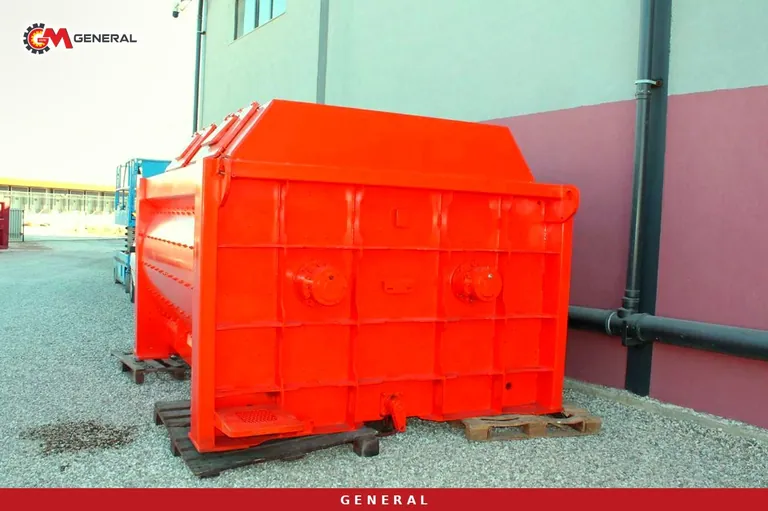
A contractor who brings both a crusher and a concrete batching plant to an African dam, port extension or long road section is really building a single factory: run-of-mine rock goes in at one end and concrete comes out into truck mixers at the other. Even if each machine is well chosen on its own, a poorly planned stockpile yard, power distribution, water line or truck route between them means the batching plant waits for aggregate while the crusher stops because the piles are full. This article sets out the engineering sequence for fitting 120-180 TPH of crushing capacity and a 100-120 m³/h batching plant into one plan. Every technical value comes from our product pages; we give no data about any specific African project, tender or quarry. Please confirm the rock type, specification and permits for your site with the relevant authority and with sample testing.
Treat both plants as one flow sheet
A shared site plan starts with material flow, not with a machine catalogue. Draw the point where trucks tip run-of-mine rock first, then the crushing and screening plant, the fraction stockpiles, the batching plant's aggregate bins and finally the concrete loading bay. Every arrow in that chain is a handling job, and every handling job means either a conveyor or a wheel loader.
Five stations from quarry face to truck mixer
In a typical combined plant the stations line up like this: (1) feed hopper and vibrating feeder, (2) primary and secondary crusher with screen, (3) a separate stockpile for each fraction, (4) the batching plant's four-compartment aggregate bin and weigh belt, (5) mixer and truck mixer loading point. Stations one and two belong to the crushing plant, four and five to the batching plant. Station three appears in nobody's catalogue, and that is exactly where the layout succeeds or fails.
Why the stockpile buffer is not negotiable
The crushing line and the batching plant do not run in the same hours or at the same rhythm. The batching plant produces batch by batch as truck mixers arrive; on a pour day it may run hard in the morning and lightly in the afternoon. The crusher, by contrast, is efficient when fed steadily, and frequent stop-starts increase wear. The piles between them decouple these two rhythms. Because the bins of a mobile batching plant hold only a few hours of consumption, the real buffer is always the ground stockpile. Planning that yard on a concrete slab with dividing walls keeps fractions from mixing and protects the grading the mix design calls for.
From concrete volume to crushing capacity
The batching plant talks in m³/h, the crusher in t/h. The bridge between them is the mix design: required aggregate (t/h) = actual concrete output (m³/h) × aggregate per m³ (t/m³). A hypothetical example: a plant whose mix uses 1.9 t of aggregate per m³ and produces 100 m³ per hour consumes 190 t of aggregate. That seems to exceed the top of a 120-180 TPH crushing plant, but batching plants rarely run at rated output for a whole shift. Running the crusher on a longer shift than the batching plant and building the difference into stockpiles is the most common answer on remote African sites.
The second check is fraction balance. Your mix wants fine sand, medium and coarse chippings in set ratios, while the crusher delivers whatever distribution the rock's fracture behaviour gives. If the mix needs a lot of coarse material and the crusher produces surplus sand, one fraction will always run short even when total tonnage is sufficient. That is why we ask for your mix designs and a sample sieve analysis together at the quotation stage.
Three options for the crushing side at 120-180 TPH
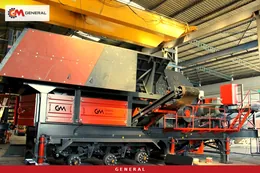
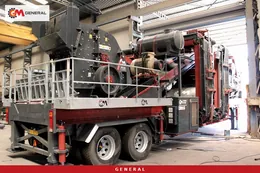
Three of our wheeled crushing and screening plants cover this range. The choice is driven by rock hardness and abrasiveness and by the largest size the mix requires.
| Feature | General 944 | General 950 | General 01 |
|---|---|---|---|
| Capacity | 120-180 t/h | 120-180 t/h | 120-180 t/h |
| Crusher arrangement | GPJ 90 jaw + GM430 cone | GPJ 90 jaw + DMK01 impact | GPS 1210 impact (primary+secondary) |
| Maximum feed | 800 mm | 800 mm | 700 mm |
| Screen | 1600×5000 mm, 3-deck | 1600×5000 mm, 3-deck | 1600×5000 mm, 4-deck |
| Product fractions | 0-5 / 5-12 / 12-19 mm | 0-5 / 5-12 / 12-19 mm | 0-5 / 5-12 / 12-19 / 19-40 mm |
| Generator | 550 kVA | 600 kVA | 550 kVA |
| Weight | 70,000 kg | 70,000 kg | 55,000 kg |
In hard, abrasive rock such as granite, quartzite or basalt, the General 944 stands out: its cone secondary crushes by compression, so wear parts last longer than in an impact crusher. Where the same hard rock must yield more cubical chippings and a higher reduction ratio, the General 950 is the one to evaluate. In low-abrasion rock such as limestone, and where the mix calls for a coarse 19-40 mm fraction, the four-deck screen of the General 01 adds an extra stockpile. Granite, basalt and limestone quarries all occur across different regions of Africa; which one sits in your quarry only a laboratory test can tell.
The batching side: mobile Titan 100, Magnum 120 or a stationary build?
Concrete batching plant selection comes down to two questions: hourly concrete demand and how many years the plant will stay in one place. If the plant moves to another job when the project ends, a trailer-chassis mobile model makes sense; if ready-mix will be produced at the same point for many years, a stationary model does.
| Feature | M-Titan 100 (mobile) | M-Magnum 120 (mobile) | Titan 100 (stationary) | Magnum 120 (stationary) |
|---|---|---|---|---|
| Capacity | 100 m³/h | 120 m³/h | 100 m³/h | 120 m³/h |
| Mixer | Twin shaft, 2 m³ | Twin shaft, 3 m³ | Twin shaft, 2 m³ | Twin shaft, 3 m³ |
| Mixer motor | 2×45 kW | 2×55 kW | 2×45 kW | 2×55 kW |
| Aggregate bin | 4×15 m³ | 4×20 m³ | 4×25 m³ | 4×30 m³ |
| Cement silo | 100 t | 100 t | Optional 60/80/100 t | Optional 60/80/100 t |
A four-compartment bin pairs naturally with the three or four fractions of the crushing plant: the three products of the 944 or 950 go into three compartments, and the fourth can be reserved for natural or washed sand. With the 01, four compartments take four fractions directly. Weighing and silo details are on our mobile concrete batching plant page.
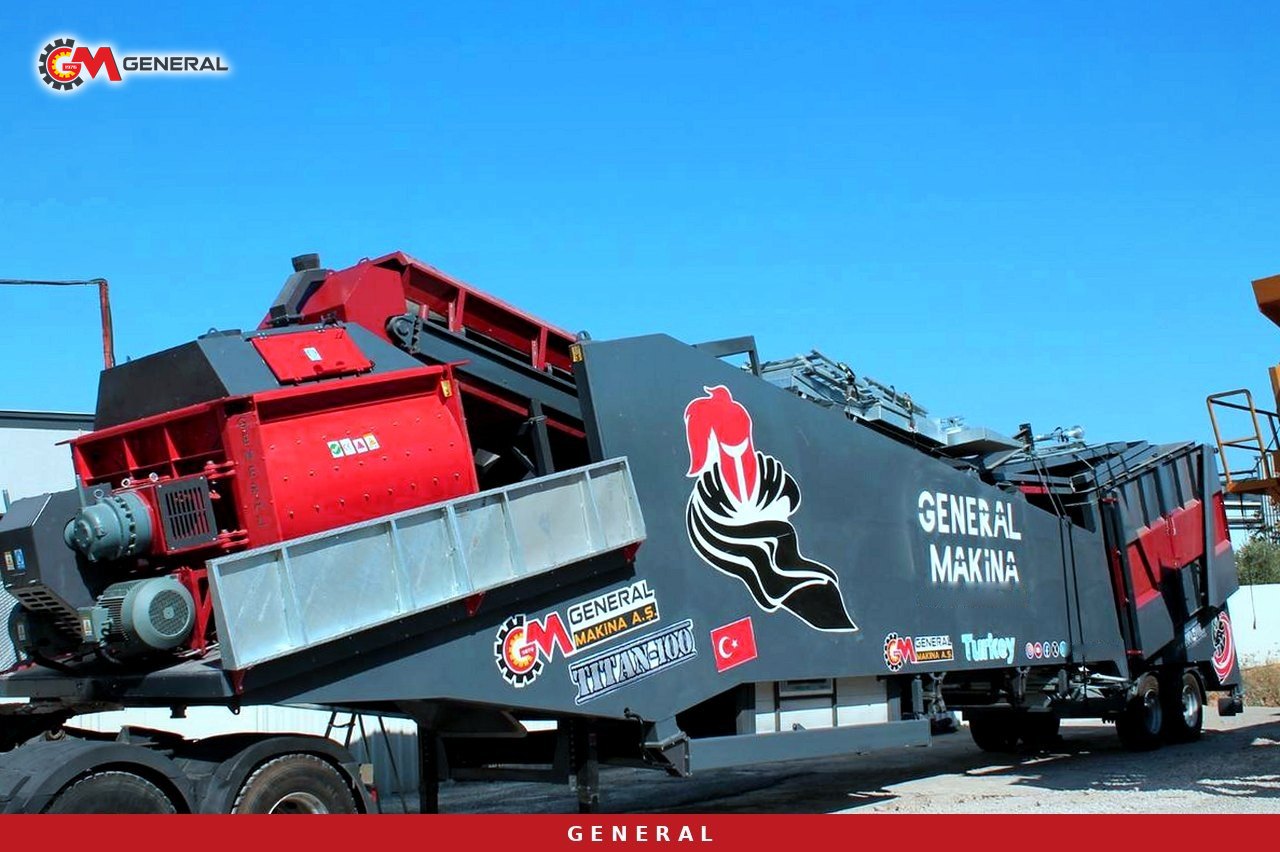
As real references on the continent, see our Titan 100 mobile concrete batching plant in Tanzania (100 m³/h) and the GNR 944 hard stone crushing plant in Africa (120-150 t/h). These are separate deliveries; we draw the shared site concept separately for your project.
Site layout: wind, power, water and truck traffic
Once machines are chosen, most mistakes are made in the layout drawing. On hot, dusty African sites four topics dominate.
Keeping crusher dust away from the batching plant
The crushing and screening point should sit downwind of the batching plant relative to the prevailing wind. Otherwise fine dust drifts onto the batching plant's weighing and control equipment, motor cooling ducts and mixer top. On the crushing side, water-spray dust suppression and enclosed belt transfers are measures that can be chosen per project. On the cement silo, a top filter, safety valve and aeration jets are standard; that filter captures the dust from tanker filling.
Power: two separate loads, one distribution plan
On African sites where the grid is weak or distant, the crushing plant runs on its own generator: 550 kVA for the 944 and 01, 600 kVA for the 950. The batching plant load comes from mixer motors (2×45 kW on the Titan 100), conveyors, screw conveyors and compressor; its generator is sized separately from the plant's motor list. Feeding the two plants from separate generators rather than one large set prevents a crusher fault from stopping a concrete pour.
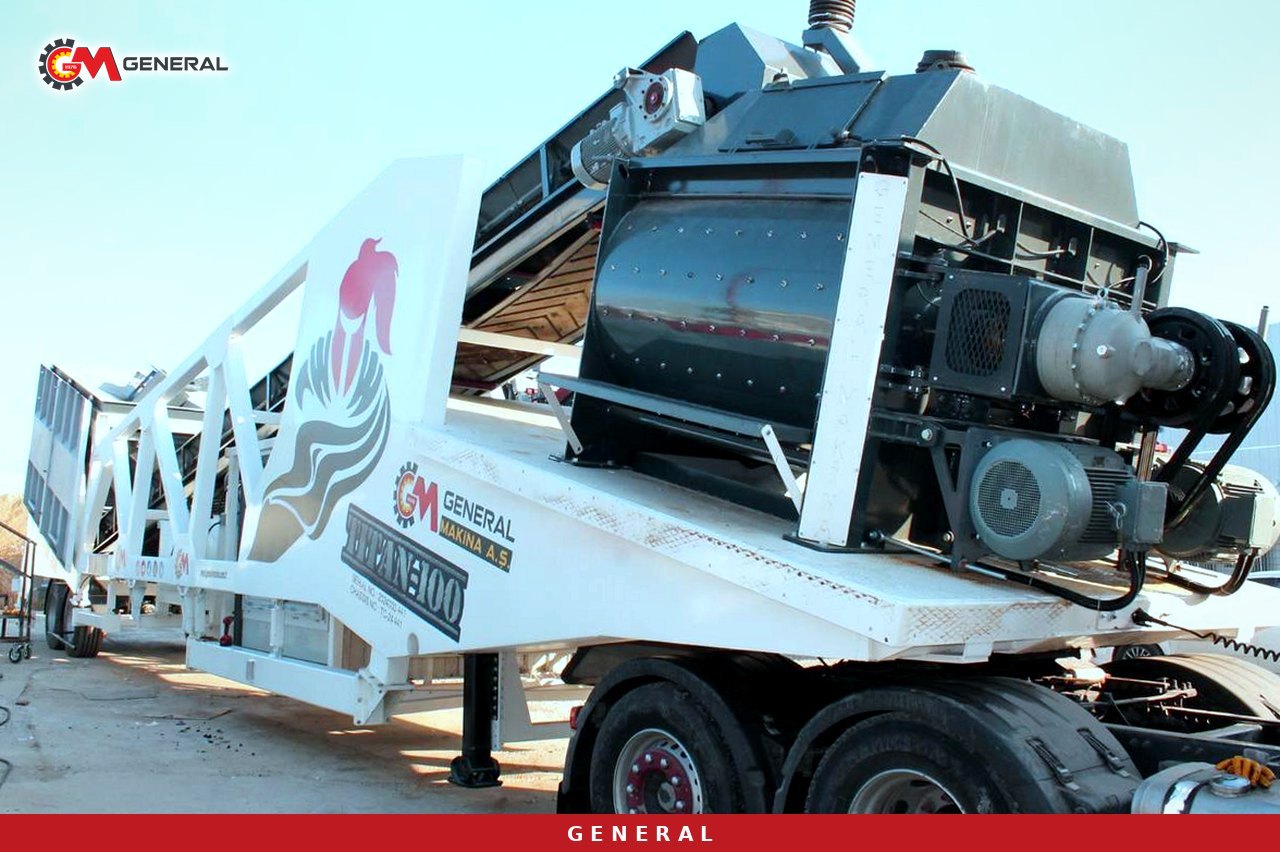
On the water side, the batching plant needs weighed water per batch according to the mix; water weighing on the Titan 100 is 600 litres. If washing is planned, extra water and a settling pond are required. For truck traffic the rule is simple: run-of-mine trucks and truck mixers must not cross paths. A one-way loop protects both safety and the batching plant's loading rhythm.
If the sand is dirty, wash it before it reaches the mixer
When crushed sand or river sand carries too much clay and silt, the mix design fails: water demand rises and strength drops. With dry, clean material the GNR ME1650 (120-180 t/h, 18,000 kg) screens only. With clayey material the GNR YM1650 (120-180 t/h, 21,000 kg), carrying a washing screen and sand screw, comes into play. Clay content is determined by sand equivalent or methylene blue testing, and that test should be done before any machine is ordered.
Site information to settle before shipment
- Rock type, hardness and abrasion test of a run-of-mine sample.
- Concrete mix designs and fraction ratios in each mix.
- Daily concrete demand and daily operating hours of the batching plant.
- Prevailing wind direction and the area that can be levelled.
- Is there grid power, or will both plants run on generators?
- Water source, flow rate and whether washing is needed.
- Road route from the port of arrival to site, with bridge and bend limits.
- Whether the cement silo will be bolted (shipped in containers) or welded.
For remote and overseas shipment a bolted silo fits knocked-down in a container and is assembled on site; a welded silo arrives in one piece and suits shorter distances.
Frequently asked questions
Should I link the crusher and the batching plant with a conveyor or a loader?
On most sites, moving material from fraction stockpiles to the bins is done with a loader, because no other system matches a stockpile's flexibility as a buffer. A direct conveyor link is worth considering only where stockpile space is very tight and one fraction dominates consumption.
Can one crushing plant feed two batching plants?
Yes, if total aggregate demand is covered by the crushing plant's capacity and operating hours. The calculation is done separately for each batching plant with the formula above and then added up; fraction balance is checked as well.
Can I find out installation and delivery time now?
Timing depends on model choice, shipping method, port of arrival and site preparation. Once those are clear we prepare a project-specific plan; quoting a generic duration would be misleading.
What determines the price?
Crusher arrangement, number of screen decks, batching plant model, silo count and type, washing needs, generator, automation options and delivery terms. Our quotation shows each of these items separately.
Conclusion
When setting up a crusher and a ready-mix plant together in Africa, good machine selection is half the job; the other half is the stockpile buffer between them, separate power supply, wind-aware placement and truck routes that never cross. On the crushing side the 944, 950 or 01 and on the batching side the Titan 100 or Magnum 120 can form a balanced line. Our equipment, built in Izmir since 1976, carries ISO 9001 and CE certification and a 1-year warranty (wear parts excluded). Send your mix designs, sample data and site sketch through our contact page and we will prepare the shared site plan and quotation with you.
Definitions of technical terms: Glossary