EN — English
 TR — Türkçe
 DE — Deutsch
 RU — Русский
 FR — Français
 ES — Español
 AR — العربية
 SR — Српски

Africa 2,000 Tons per Day: Choosing a 200-250 TPH Aggregate Crushing Plant
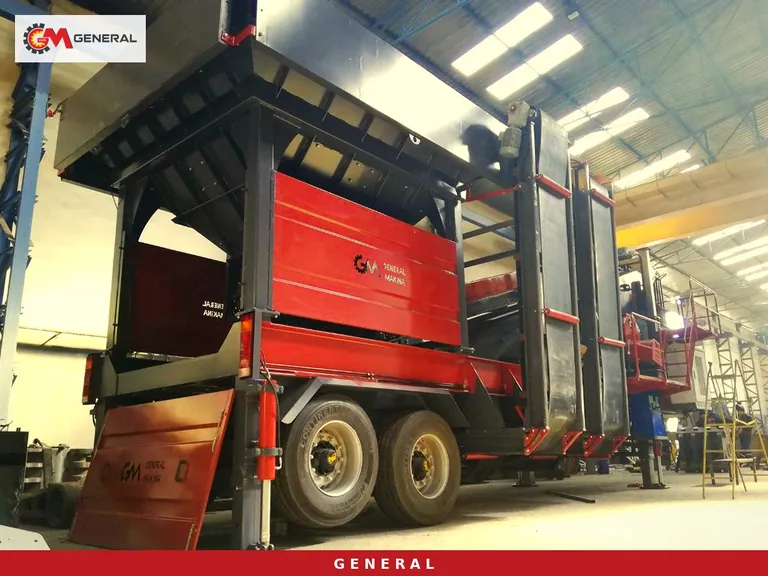
In Africa, the aggregate plan for a road, dam or housing contract usually starts with a single number: 2,000 tons per day. On paper it looks simple, yet when it is translated into a crusher choice, two unanswered questions lead to a plant that is either undersized or needlessly large: how many net production hours will the site actually run each day, and which crushing principle suits the rock in the quarry? This article first converts daily tonnage into hourly capacity, then compares real configurations in the 200-250 TPH band, taking into account the rock contrast between the limestone quarries north of the Sahara and the granite, gneiss and basalt sites of the interior.
Converting 2,000 tons per day into hourly capacity
A daily target cannot be compared directly with the t/h figure in a brochure. Two multipliers sit in between: shift length and availability. The formula is: required hourly capacity = daily tonnage ÷ (shift hours × availability). Availability covers losses such as truck waiting, screen mesh changes, jaw setting adjustments, generator refuelling and breaks.
A site running one shift
Hypothetical example: with a single 10-hour shift and 85% availability, 2,000 ÷ (10 × 0.85) ≈ 235 TPH is needed. If the shift drops to 8 hours and losses rise to 20%, the requirement becomes roughly 312 TPH. The same daily target points to two different machine classes. At a remote quarry, night lighting, security and crew accommodation are difficult, so most contractors stay on one shift; in that case 200-250 TPH is the floor and anything above it is your safety margin.
If two shifts are possible
With 16 working hours and 80% availability, about 156 TPH is enough for 2,000 tons. A smaller, lighter line becomes possible, but the window for maintenance shrinks and wear part changes move into the night shift. Make the decision from the site's real working calendar, not from the machine budget; if one shift is planned, going below the 200-250 TPH band means missing the target on every day with rain, a breakdown or a haulage delay.
Rock type decides the crushing principle
Africa is not a single geological setting. Limestone and dolomite quarries are common in North Africa and along coastal belts; basement rocks such as granite and gneiss dominate much of the interior, and basalt is prominent in the volcanic zones of East Africa. These three groups do not respond the same way to the same crusher.
- Low-abrasion limestone and dolomite: a primary impact crusher gives high reduction and cubical grains in one stage, an efficient route to concrete aggregate.
- Granite, gneiss, quartzite: as silica content rises, blow bar consumption in an impact crusher climbs. Here a jaw primary with a cone secondary extends metal life thanks to compression crushing.
- Basalt: after the jaw primary, the choice between a cone and an impact secondary depends on the required grain shape and the wear budget.
Do not classify your own quarry rock by guesswork. Send a sample to an accredited laboratory for compressive strength, Los Angeles abrasion value and silica content; at the quotation stage these results largely settle the crusher type.
Three configurations for 200-250 TPH
The real options covering this band fall into three groups: a single-chassis wheeled impact plant, a twin line with two wheeled units running in parallel, and a stationary line built on concrete foundations. Every figure in the table below comes from the technical data on the product pages.
| Configuration | Capacity | Primary crusher | Max. feed | Screen | Power |
|---|---|---|---|---|---|
| General 02 (single chassis) | 250-300 t/h | GPS 1413 impact | 1000 mm | 2000×5000 mm, 4-deck | 660 kVA |
| General 03 (single chassis, 4 axles) | 250-375 t/h | GPS 1415 impact | 900 mm | 2400×5000 mm, 4-deck | 750 kVA |
| General 944 + General 950 (twin line) | 2 × 120-180 t/h | 2 × GPJ 90 jaw | 800 mm | 2 × 1600×5000 mm, 3-deck | 550 + 600 kVA |
| Stationary: GNR 110 feeder + GNRK 110 | 200-350 t/h (GNRK 110) | GNRK 110 jaw, 1100×850 mm opening | — | GNR 2050, 2000×5000 mm | 110/132 kW (crusher motor) |
On limestone, one chassis may be enough
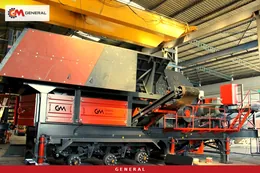
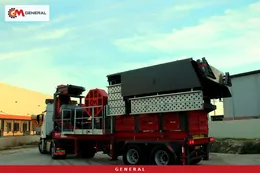
General 02 rated at 250-300 t/h, covers the 2,000 tons per day target comfortably on a single shift; its 1000 mm feed opening accepts large blasted blocks without pre-breaking. The four-deck screen separates 0-5, 5-12, 12-19 and 19-40 mm fractions in one pass. Its transport weight is 76,000 kg, which makes bridge and bend checks necessary on the route from port to site. For a contractor who wants more screening area and headroom at the top end, General 03 is the next step with a 2400×5000 mm screen and a 750 kVA power unit. Both models are impact-based, so wear cost in high-silica granite must be calculated separately.
A twin line for hard rock
In a granite or basalt quarry, two jaw-equipped wheeled units can make more sense than one impact plant. General 944 (GPJ 90 jaw + GM430 cone) and General 950 (GPJ 90 jaw + DMK01 impact) each produce 120-180 t/h; together they reach 240-360 t/h. This layout has a key advantage: when one unit goes down for maintenance, daily output halves instead of dropping to zero. The cone-secondary 944 prioritises metal life on abrasive stone, while the impact-secondary 950 delivers a more cubical product. For an example of this family at work in West Africa, see the General 950 project in Niger.
An operation that will stay in the same quarry for ten years or more deserves a separate look at stationary crushing plants: a GNR 110 grizzly feeder (200-300 t/h) ahead of a GNRK 110 jaw crusher, followed by a cone secondary and a GNR 2050 screen, can be expanded without the transport limits of a mobile chassis. Cone crusher model values are supplied per project, so they are not shown in the table.
Screening and stockpiles: the overlooked bottleneck
On many sites the crusher delivers the capacity, yet the daily target is lost at the stockpile. In a line producing four fractions, site demand often concentrates on one product, for example a 0-40 mm mix for road base, or 5-12 and 12-19 mm for concrete. If the number of decks and mesh openings are not chosen for that demand, the crusher recirculates and the return conveyor overloads.
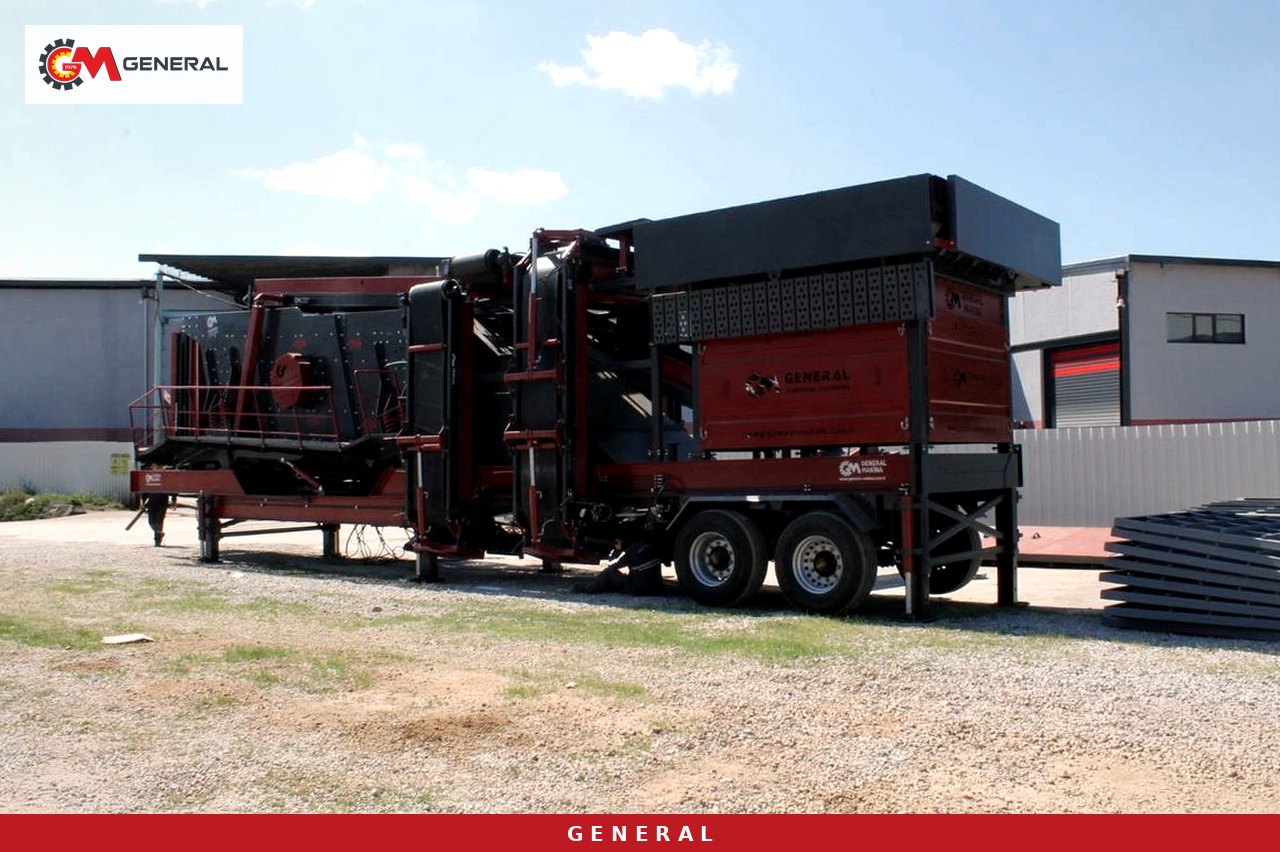
This is where the GNR ME1650 mobile dry screening plant can play a supporting role. With 120-180 t/h capacity and a 0-100 mm feed limit, it re-screens stockpiled crusher output into fractions, or screens naturally fine quarry material without sending it through the crusher at all. It runs on an 18,000 kg single chassis from a generator or the grid. It has no washing unit; for clayey material, washing and screening plants are the right choice.
Power, haulage and climate on a remote site
A large share of African quarries are far from the grid. The kVA rating of a wheeled plant's power unit is therefore a fuel logistics decision: 660 kVA is planned for General 02, and a total of 1,150 kVA installed power for the twin line. Fuel tank location, refill frequency and the need for a standby generator should be written into the installation plan.
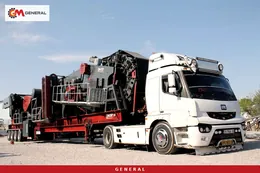
Wheeled chassis help with haulage: General 03 can be towed by road from port to site on its 4-axle chassis built to international transport standards. Even so, bridge load limits, unpaved stretches and sections that become impassable in the rainy season must be surveyed in advance between the port gate and the quarry.
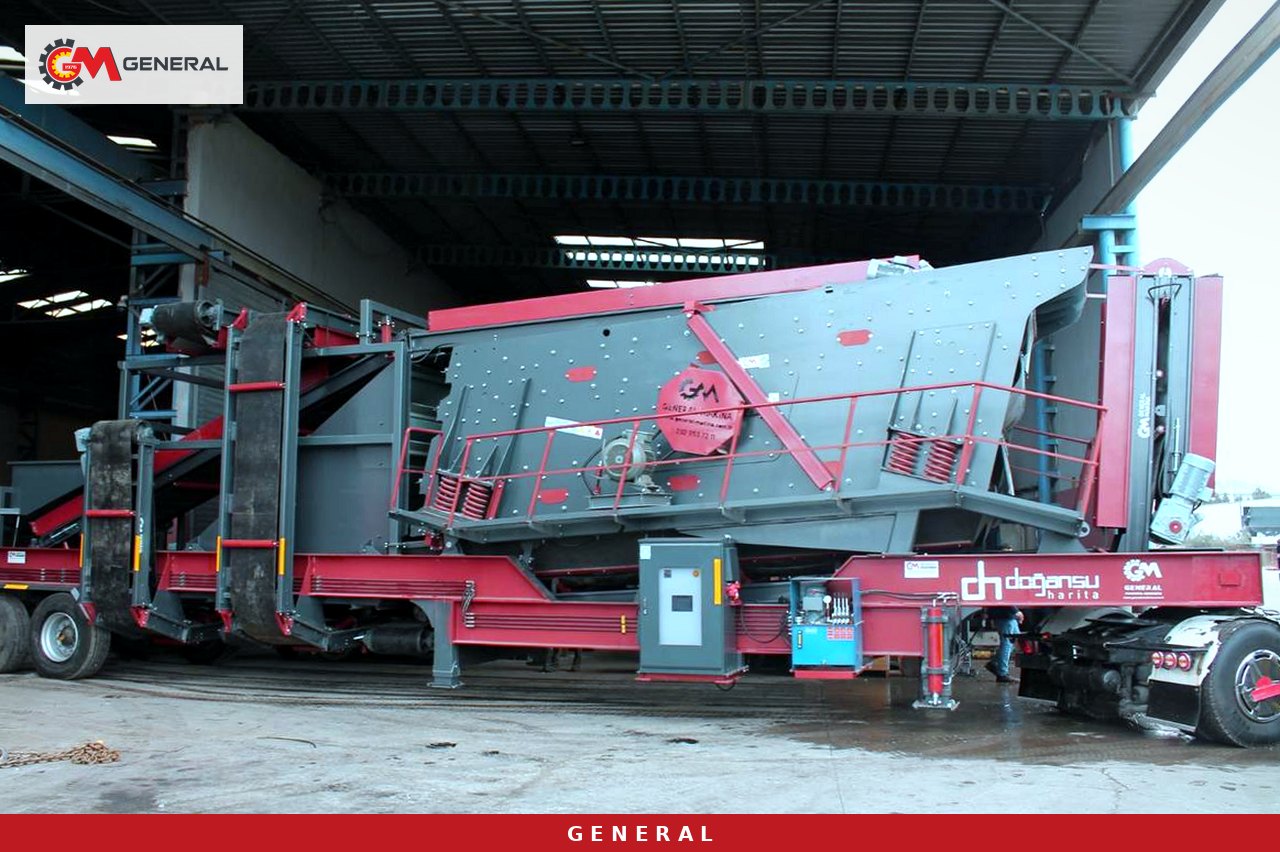
In hot, dusty climates three measures are chosen per project: a spare set of air filters for more frequent changes, water-spray dust suppression at transfer points and covered conveyor hoods. Ask for them as separate line items in the quotation, as site-dependent options rather than standard equipment.
Checklist to prepare before requesting a quotation
- Daily target tonnage, planned number of shifts and hours.
- Laboratory results for the rock sample: compressive strength, abrasion value, silica content.
- Largest block size after blasting (for feed opening selection).
- Required fractions and the daily share of each.
- Power source: distance to the grid, or generator and fuel plan.
- Port of arrival, route from port to site and road restrictions.
- The project's aggregate specification; confirm grading and flakiness limits with the relevant authority.
When these seven items accompany the enquiry, quotations can be compared on the same basis. You can browse all model families on the mobile crushing and screening plants page.
Frequently asked questions
For 2,000 tons per day, is one plant or two plants safer?
On low-abrasion rock such as limestone, a single General 02 or General 03 is enough. On hard granite or basalt, two jaw-equipped units prevent a total stop on maintenance days and lower wear cost.
How much margin should I leave to hit the daily target?
Add a margin on top of the calculated hourly requirement that can recover lost days. Derive it from your own calendar based on the rainy season, haulage pattern and maintenance programme; do not treat the brochure's upper capacity limit as a continuous operating value.
What warranty and certificates apply?
The plants have been manufactured in Izmir since 1976 and hold ISO 9001 and CE certification. The warranty is 1 year, excluding wear parts, and after-sales spare parts support is provided.
What determines the quoted amount?
Crusher type and number, screen decks, generator rating, extras such as dust suppression, shipping method and port of arrival are the main items. A firm figure is given only in a quotation prepared from site data.
Conclusion
2,000 tons of aggregate per day corresponds to the 200-250 TPH band on a single shift. On limestone, the single-chassis impact General 02 or General 03 leads; on hard rock, a twin line of General 944 and General 950; and in a long-life quarry, a stationary line built around the GNRK 110. Send us your quarry sample, shift plan and port of arrival, and we will define the right configuration together: contact page.
Definitions of technical terms: Glossary