EN — English
 TR — Türkçe
 DE — Deutsch
 RU — Русский
 FR — Français
 ES — Español
 AR — العربية
 SR — Српски

East Africa Road Aggregate: Choosing a 150-250 TPH Aggregate Crushing Plant
When a road contract is awarded in East Africa, the aggregate plan is usually fixed before the site camp is even built, and changing it later is expensive. The same 150-250 TPH target calls for very different machine layouts on the Ethiopian highlands, along the Kenyan Rift, across the basement rock of Tanzania and Uganda, or on the Indian Ocean coast. This article works backwards from the road cross-section: first which layer demands which particle size and shape, then which crusher the rock can tolerate, and finally how the length of the alignment shifts the choice between wheeled, tracked and modular portable units.
Read the cross-section first: every layer is a different product
Before anyone discusses crushers, the typical section from the tender documents belongs on the table. A common build-up on the region's trunk roads is a natural-gravel subbase, a crushed-stone base and either a surface dressing or asphalt concrete on top. The three layers differ in tonnage share and in quality demand; size the machine for the most difficult product and the others usually fall into place.
Surface dressing chippings
Single and double surface dressings are widespread in the region. The chippings must fall in a narrow size band, be clean and be cubical; flaky particles lie flat in the bitumen film and get plucked out under traffic. It is the smallest product by tonnage and the strictest by specification. Flakiness index and abrasion limits are set by the road authority's technical specification, so put those values next to the laboratory result for your own rock before choosing the machine.
Crushed-stone base and subbase
Most of the volume sits here. For a base course what matters is a continuous grading curve, not one single fraction, so the plant must be able to feed the 0-5 mm fines back into the blend in a controlled way instead of discarding them. Where a cement-stabilised base is specified, the crushed aggregate goes on to a mixing plant; our mechanical stabilisation and plant-mix units with 3-5 cold silos and a 2×22 kW twin-shaft mixer, can be linked behind the crushing line.
Asphalt concrete aggregate
If asphalt concrete is used through towns and on heavily trafficked sections, three or four separate fractions must build up evenly in the stockpiles. A line with a four-deck screen makes stockpile management easier here; a three-deck screen may force you to merge one fraction or add a separate screening unit.
From the Rift Valley to the coast: three rock groups, three approaches
East African geology can be read roughly in three groups, and the distinction drives the crusher type directly. To decide which group your quarry belongs to, take samples and have abrasivity, compressive strength and Los Angeles abrasion tests run; the outline below is only a first screening.
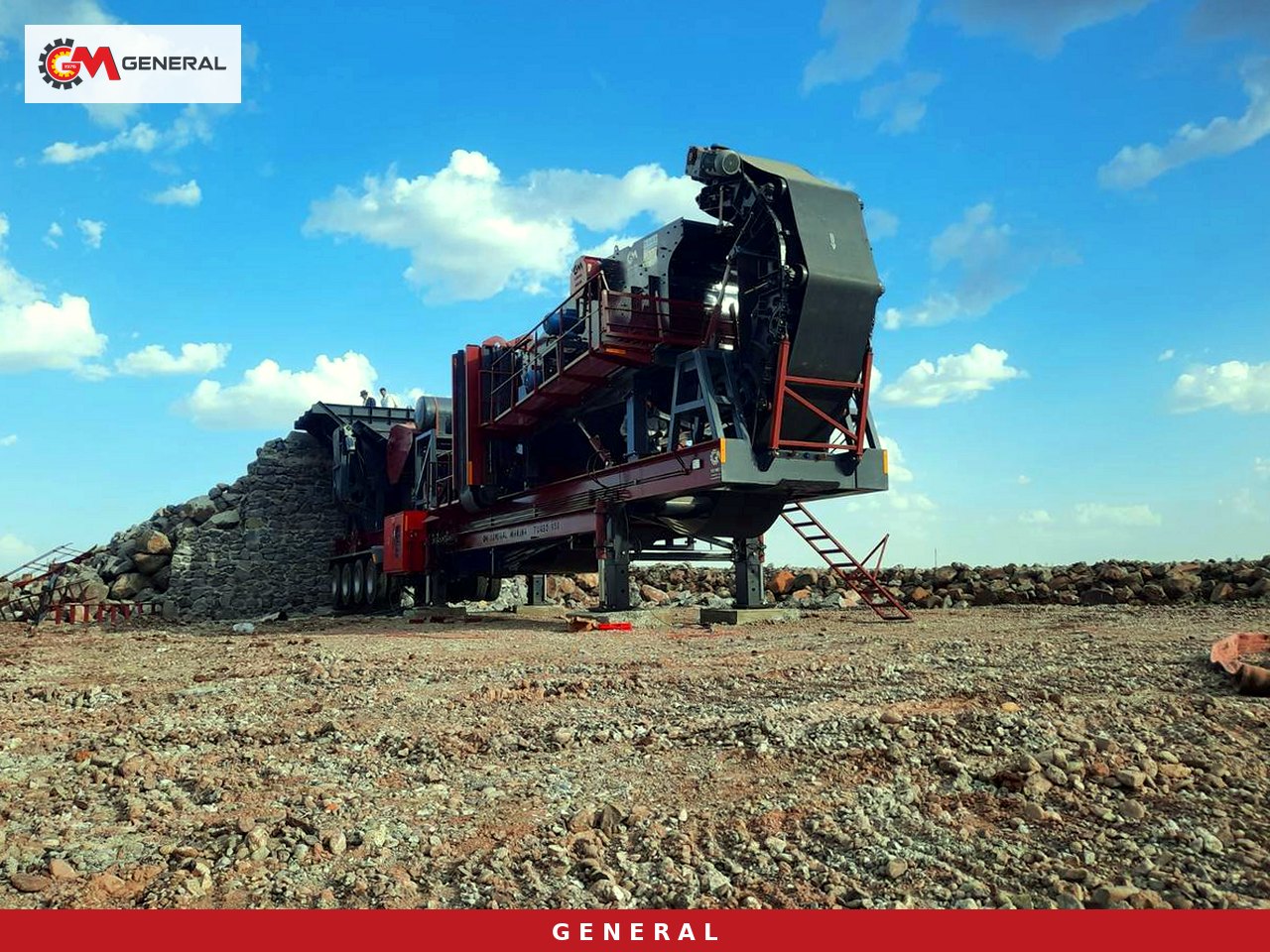
- Volcanic rock: basalt, trachyte and phonolite quarries are common along the Rift system in Ethiopia and Kenya. They are hard and often abrasive; a jaw at the primary stage followed by a cone or a cubicizer makes sense. As a real example from the region, see our 150 t/h basalt crushing and screening project in Jijiga, Ethiopia.
- Basement rock: granite, gneiss and quartzite dominate inland Tanzania and Uganda. With high silica, blow bars in an impact secondary wear quickly; crushers working by compression keep metal consumption under control.
- Coastal limestone: the coral-derived limestone on the Kenyan and Tanzanian coast is low in abrasion. A primary impactor gives high reduction and cubical grains in one stage, but whether its strength meets the surface dressing requirement must be tested separately.
Matching real models to 150-250 TPH
The table sets the options from our catalogue that sit closest to this range side by side. Capacities are manufacturer ranges; actual throughput depends on feed size, moisture, fines content and the required product split. Cells that are unknown or vary by unit are marked “—”.
| Configuration | Crusher sequence | Capacity (t/h) | Max. feed (mm) | Generator | Suited rock |
|---|---|---|---|---|---|
| GNR-MC110 (twin chassis, wheeled) | GPJ 110 jaw + DMK03 impact | 200-300 | 900 | 750 kVA | Basalt, granite |
| GM 125 (tracked) | GNR PDK02 impactor, 200 kW | 150-250 | 700 | 550 kVA | Coastal limestone, low-abrasion stone |
| Portable GNR 110 jaw + GNR MK110 cubicizer | GNRK 110 jaw + rotor cubicizer (200 kW) | 160-250 (limited by cubicizer) | (per unit) | — | Medium-abrasive basalt, phonolite |
| General 944 (single chassis) | GPJ 90 jaw + GM430 cone | 120-180 | 800 | 550 kVA | Hard, abrasive rock |
| General 03 (single chassis) | GPS 1415 impactor | 250-375 | 900 | 750 kVA | Limestone, low-abrasion stone |
First candidate for volcanic and basement rock
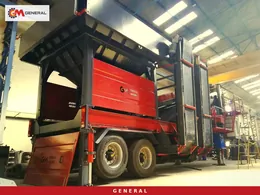
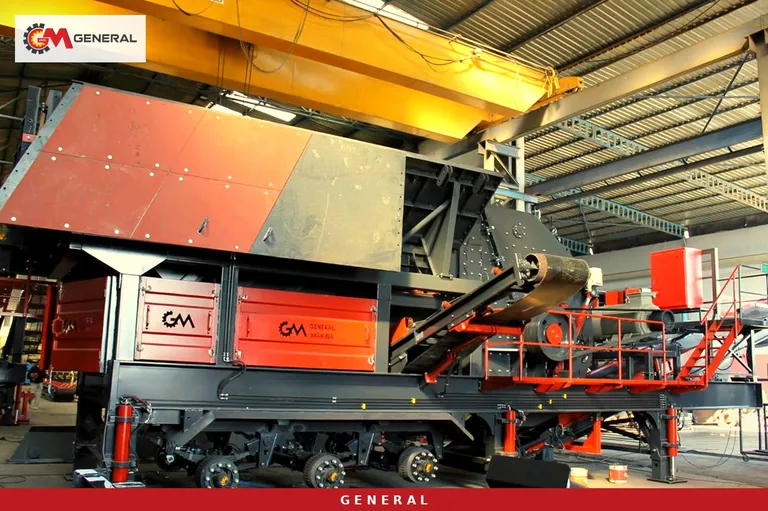
The GNR-MC110 carries a GPJ 110 primary jaw and a DMK03 secondary impactor on two separate chassis; its 2000×6000 mm four-deck screen separates 0-5, 5-12, 12-19 and 19-40 mm fractions. Each chassis weighs about 55,000 kg, so the load is not piled on one vehicle. Because the primary group can run alone, it is useful in the early months of road building when only fill and coarse base stone are needed. In very high-silica granite or quartzite, watch the wear on the impact secondary and, if necessary, move to the cone-equipped General 944. The 944 delivers 120-180 TPH from one unit, covering the lower half of the range.
Coastal limestone and frequently relocated work
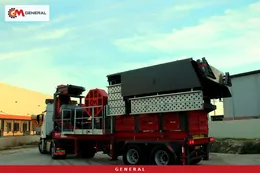
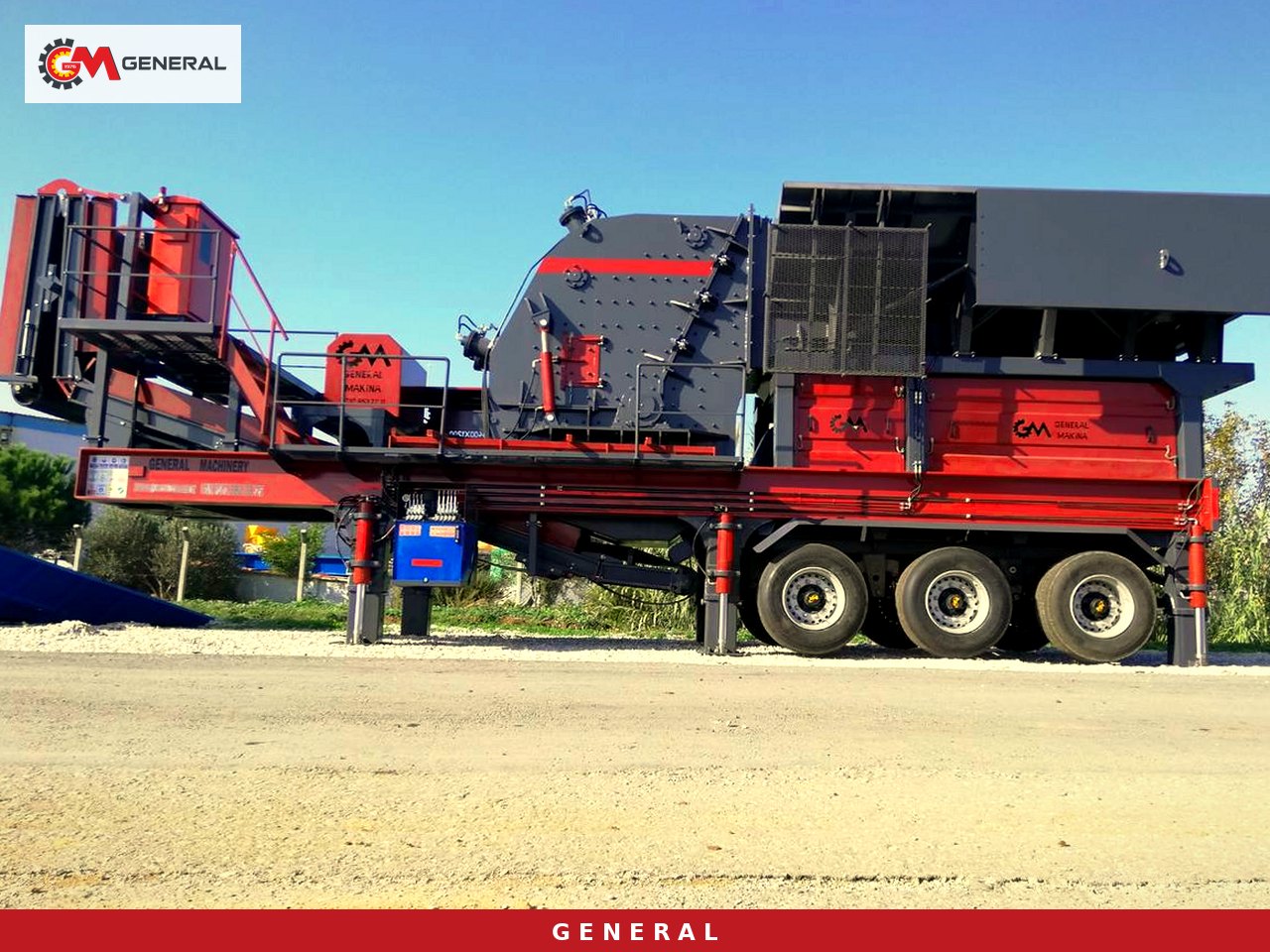
The GM 125 travels on its own tracks with a 6 m³ hopper and a 1360×2160 mm grizzly pre-screen, and needs no ground preparation. At 48,000 kg and 150-250 TPH it fits this article's target exactly. All tracked options are on the track-mounted mobile crushers page. The General 03, at 250-375 TPH, sits above the range; consider it if one quarry will supply two sites or if concrete work is later added to the road contract.
A modular line that grows in stages
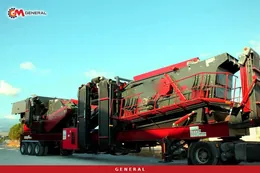
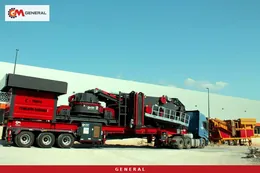
A line built from portable units carries each stage on its own chassis: the GNR 110 primary jaw (180-300 t/h, 55,000 kg) is followed by a GNR MK110 that delivers 0-25 mm cubical product. The cubicizer's Hardox 500 liners suit reshaping surface dressing chippings in medium-abrasive basalt. A separate screening unit is essential in this layout. Details are in the portable rock crushers category, while single-chassis closed-circuit alternatives are listed under wheeled mobile crushing and screening plants.
Plant location on a long alignment: fixed quarry or moving camp?
Road sections in East Africa are often long and linear. If the quarry stays at one end, the haul distance for aggregate trucks grows every month; at some point moving the machine to a second quarry near the middle of the road becomes cheaper than hauling. A simple formula helps: haul cost per tonne = (average haul distance × truck cost per km) ÷ truck payload. When that value exceeds the total cost of dismantling and re-erecting the plant divided by the remaining tonnage, it is time to move.
Single-chassis wheeled units have the edge in this calculation, because folding conveyors and hydraulic legs let them be set up without foundations. The twin-chassis GNR-MC110 needs two prime movers to be planned. The tracked GM 125 is the most flexible for short moves inside the quarry, but it still goes on a low-loader for long road transport.
High altitude, two rainy seasons and dust
On a line working in the Ethiopian or Kenyan highlands, the output of a diesel generator drops with altitude. State the site elevation in the enquiry and compare the total load of crusher and conveyor motors with that corrected output. Heat and dust call for shorter air-filter service intervals, a check on electrical panel cooling and water-spray dust suppression at belt transfer points; these measures are selected per project.
Much of the region has two rainy periods a year. In the wet months clay and topsoil from the quarry mix into the feed; a grizzly pre-screen removes those fines before they reach the crusher. If clay content is high, washing may be needed. In the dry season the main issue is dust: covered conveyors and attention to wind direction at stockpiles protect both worker health and relations with nearby settlements.
The file to prepare before requesting a quote
When the following information arrives complete, the configuration proposal is settled in one round with no later revisions:
- Laboratory results for quarry samples: compressive strength, abrasivity, Los Angeles abrasion value.
- The road cross-section and, for each layer, the specified grading and shape limits.
- Split of total tonnage across layers and the contract duration.
- Largest block size to be fed from the quarry and the blasting method.
- Site elevation, availability of grid power, generator preference.
- Port of entry and road route for the machine, with weight and width restrictions along the way.
- How many times the plant is expected to relocate along the alignment.
Frequently asked questions
Can one line produce both surface dressing chippings and base material?
Yes, but the line must be built around the chippings. A secondary or cubicizer that gives cubical grains, plus a four-deck screen, separates the chippings and sends the remainder to the base blend. If base tonnage is very large, adding a separate small cubicizer for chippings takes pressure off the main line.
Can an impact secondary be used in a basalt quarry?
In medium-abrasive basalt, yes, though blow-bar change intervals will be shorter than in limestone. If sample results show high silica, a cone-secondary layout or a cubicizer with Hardox liners gives a lower wear cost per tonne.
What warranty and certificates apply?
Our machines carry ISO 9001 and CE. The warranty runs for one year; wear parts are excluded. General Makina has been manufacturing in Izmir since 1976.
What drives the quotation?
The selected crusher sequence, number of screen decks, generator rating, added equipment such as dust suppression and pre-screening, packing and sea freight are the main factors. That is why we recommend a project quotation based on the file above rather than a general figure.
Conclusion
On an East African road project the right answer to 150-250 TPH depends on the rock group and the layer specification: in volcanic and basement rock the GNR-MC110 or a modular jaw-plus-cubicizer line, on coastal limestone the GM 125, and for hard-rock work in the lower half of the range the General 944. Send us your sample results, cross-section and route details and we will prepare the matching configuration and quotation: contact us.
Definitions of technical terms: Glossary