EN — English
 TR — Türkçe
 DE — Deutsch
 RU — Русский
 FR — Français
 ES — Español
 AR — العربية
 SR — Српски

Ghana Road & Bridge Aggregate Crushing Plant 150-250 TPH
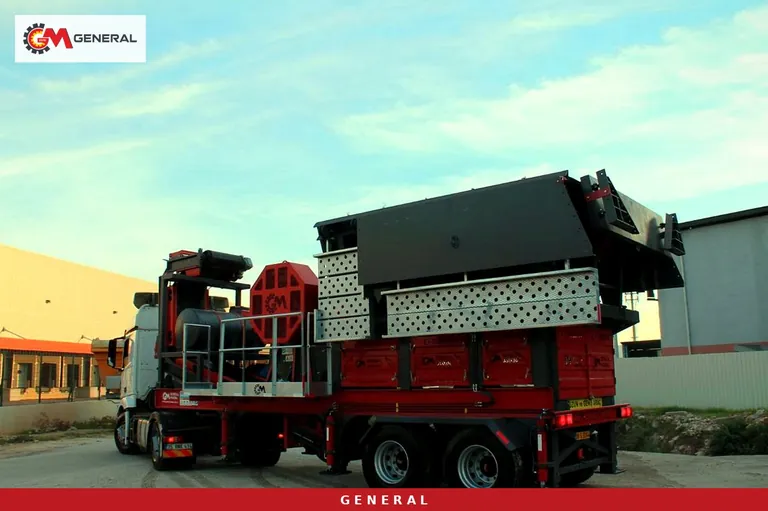
A contractor sourcing aggregate for a road or bridge contract in Ghana has to win two different products from the same quarry: clean, cubical concrete aggregate for piers, girders and the bridge deck, and well-graded sub-base and base material for the road itself. A range of 150-250 TPH can serve both needs together. Yet tonnage alone does not decide which crusher layout to buy. Rock hardness, the clay that washes into the feed during the rainy season and the route the machine takes from the port to site weigh just as heavily. Below we read our catalogue data against Ghanaian site conditions and compare four real configurations.
Bridge concrete and road base: two specifications from one quarry
In bridge concrete, particle shape and cleanliness govern. Flaky, elongated particles reduce workability and need more water and cement to reach the same slump, while clay coating the particle surface weakens the bond with the cement paste. In road base the governing criterion is the grading curve: the bearing capacity of a rolled layer comes not from an abundance of one fraction but from coarse and fine particles meeting in the right proportion.
The first decision is therefore where the tonnage concentrates. On a long road section, base and sub-base material make up most of the volume; pier and deck concrete is smaller in tonnage but tighter in specification. Confirm limits such as abrasion loss, shape index and clay-silt content in the project's technical specification and the documents issued by the road authority or supervising engineer; crusher selection follows those limits.
Calculate hourly capacity instead of guessing it: required TPH = total aggregate demand (t) ÷ (working days × net operating hours per day). Hypothetical example: 300,000 t of demand, 150 working days and 10 net hours a day gives 200 TPH. To absorb shifts lost to rain and maintenance stops, it makes sense to pick a model rated above the calculated figure.
Rock and material profile in Ghana
Hard rock of granite, gneiss and schist origin is common across the south and west of the country, while sandstone and shale dominate the Volta basin. At many quarries a thick laterite and clay overburden covers the sound rock. That variety means an impact crusher may run efficiently on one project and burn through its manganese parts quickly on another within the same country. Taking samples and testing Los Angeles abrasion, compressive strength and silica content before committing to a quarry is the basis of model selection; do not classify a particular quarry's rock by guesswork.
If laterite and stripping waste reach the crusher, they cut capacity and contaminate concrete aggregate. The GNR vibrating grizzly feeder delivers run-of-mine rock up to 1500 mm to the crusher in a steady flow at 75-600 tph, and its grizzly by-pass removes fines and soil before they enter the crusher. The separated material can often be reused as fill.
Matching models to 150-250 TPH
The table groups our wheeled models that cover the target range by rock type. Every figure comes from our product pages; values not listed are set per order to suit the material.
| Model | Crusher layout | Capacity | Max. feed | Screen | Generator | Weight | Suited rock |
|---|---|---|---|---|---|---|---|
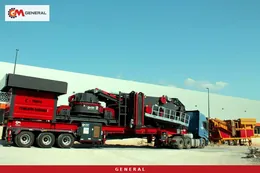
| General 944 | GPJ 90 jaw + GM430 cone | 120-180 tph | 800 mm | 1600×5000 mm, 3-deck | 550 kVA | 70,000 kg | Granite, gneiss, quartzite |
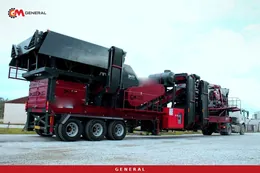
| GNR-MC110 | GPJ 110 jaw + DMK03 impact (twin chassis) | 200-300 tph | 900 mm | 2000×6000 mm, 4-deck | 750 kVA | 2 × 55,000 kg | Hard rock, high tonnage |
| General 800 | PDK 1280 primary impact | 80-150 tph | 600 mm | 1300×4000 mm, 3-deck | 450 kVA | 35,000 kg | Limestone, low-abrasion stone |
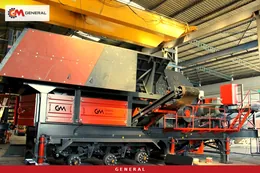
| General 02 | GPS 1413 primary impact | 250-300 tph | 1000 mm | 2000×5000 mm, 4-deck | 660 kVA | 76,000 kg | Limestone, low-abrasion stone |
Granite and gneiss: jaw primary, then cone or impact secondary
At the bottom of the range, around 150 TPH of hard rock, the General 944 is enough as a single unit. Its GPJ 90 jaw breaks blocks up to 800 mm and the GM430 cone reduces the material by compression; in high-silica stone the cone's metal life is markedly longer than that of an impact secondary. Watch the screen: the 944's catalogue fractions are 0-5, 5-12 and 12-19 mm. If road base needs a 19-40 mm fraction, the screen apertures must be specified accordingly at order stage, or a separate screen added to the line.
Once the target climbs to 200-250 TPH, the GNR-MC110 comes to the fore. Its GPJ 110 jaw primary and DMK03 impact secondary sit on two separate chassis, and the primary group can run on its own. That lets you produce embankment fill and coarse sub-base with the primary alone during the phase before cubical bridge aggregate is needed. The four-deck 2000×6000 mm screen separates 0-5, 5-12, 12-19 and 19-40 mm in a single pass.
Limestone and low-abrasion stone: primary-impact units
Where the quarry is limestone or soft sandstone, a primary impactor gives a high reduction ratio and cubical particles. The General 800 produces 80-150 tph with its PDK 1280 crusher and, at 35,000 kg, is one of the lightest units in the family; for a 150 TPH target, choose it knowing it will run at the top of its range. If 250 TPH is required, the General 02, with a 1000 mm inlet and a GPS 1413 crusher, sits in the 250-300 tph band. We do not recommend a primary-impact layout on granite and gneiss: wear-part consumption soon dominates operating cost.
A quarry serving several contracts: a fixed installation
If the quarry will feed several road and bridge jobs from the same spot for years, consider a stationary crushing plant instead of a mobile unit. Fixed lines can produce more fractions and make maintenance more predictable over the long term, at the price of relocation flexibility. For work that must move as the road section advances, wheeled mobile crushing plants are the better choice.
Rainy season, clay and the washing decision
Southern Ghana has two rainy seasons a year. During those months laterite and clay from the quarry face enter the feed as mud; screen cloths blind, and the clay-silt value of concrete aggregate can exceed the specification limit. In the dry season the grizzly by-pass is often sufficient, while the same quarry may need washing in the wet season. Have samples tested for both dry and wet conditions before the line is set up.
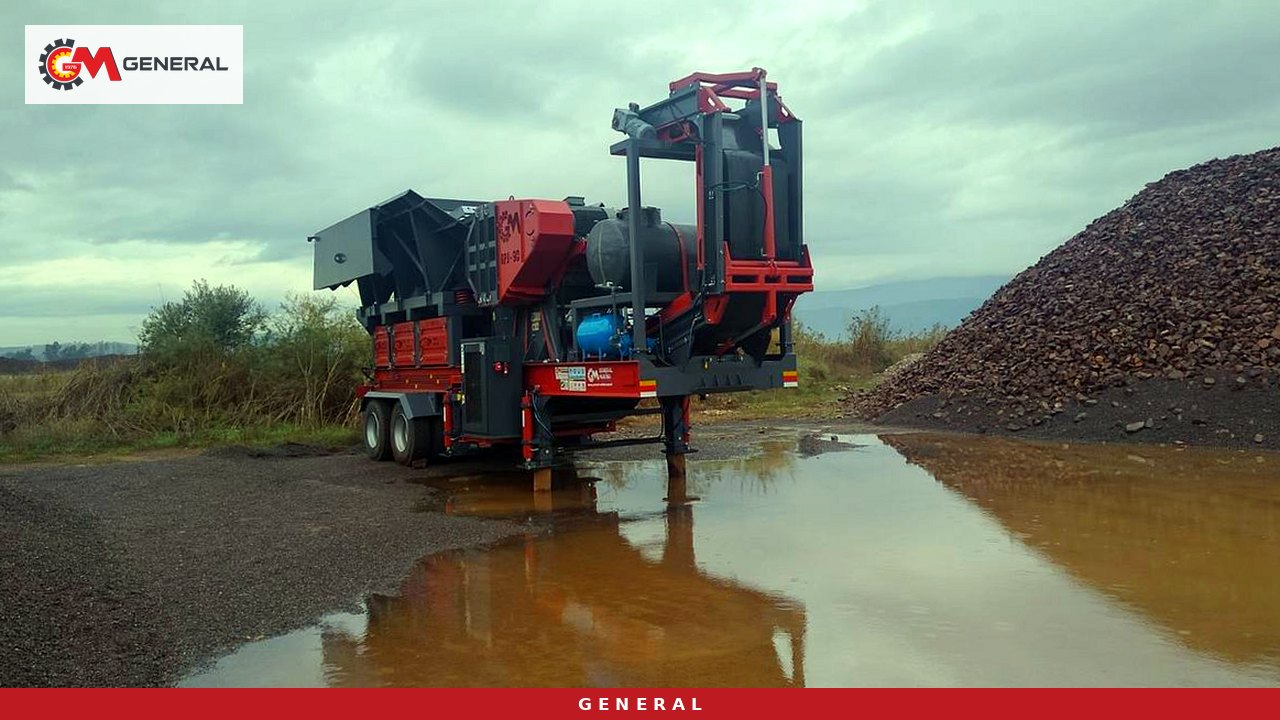
If washing is required, the options among our washing and screening plants can be assessed; the Mobil 90, for example, crushes, washes and screens clayey gravel up to 800 mm in one pass at 90-150 tph with its GPJ 90 jaw. The wash-water source, settling ponds and where the sludge goes belong in the site plan. Laying the stockpile area on compacted, sloped ground keeps rainwater from collecting beneath product heaps.
From port to site: transport, set-up and power
Equipment shipped to Ghana is usually discharged at Tema or Takoradi and hauled to site by road. Here model weight is more than a catalogue line: the General 800 weighs 35,000 kg, the General 944 70,000 kg and the General 02 76,000 kg, while the GNR-MC110 splits its load over two 55,000 kg chassis. Confirm the load limits of bridges along the route and the transit permits with your haulier in advance; overlooking the capacity of existing bridges while hauling a machine to a bridge job is a common planning mistake.
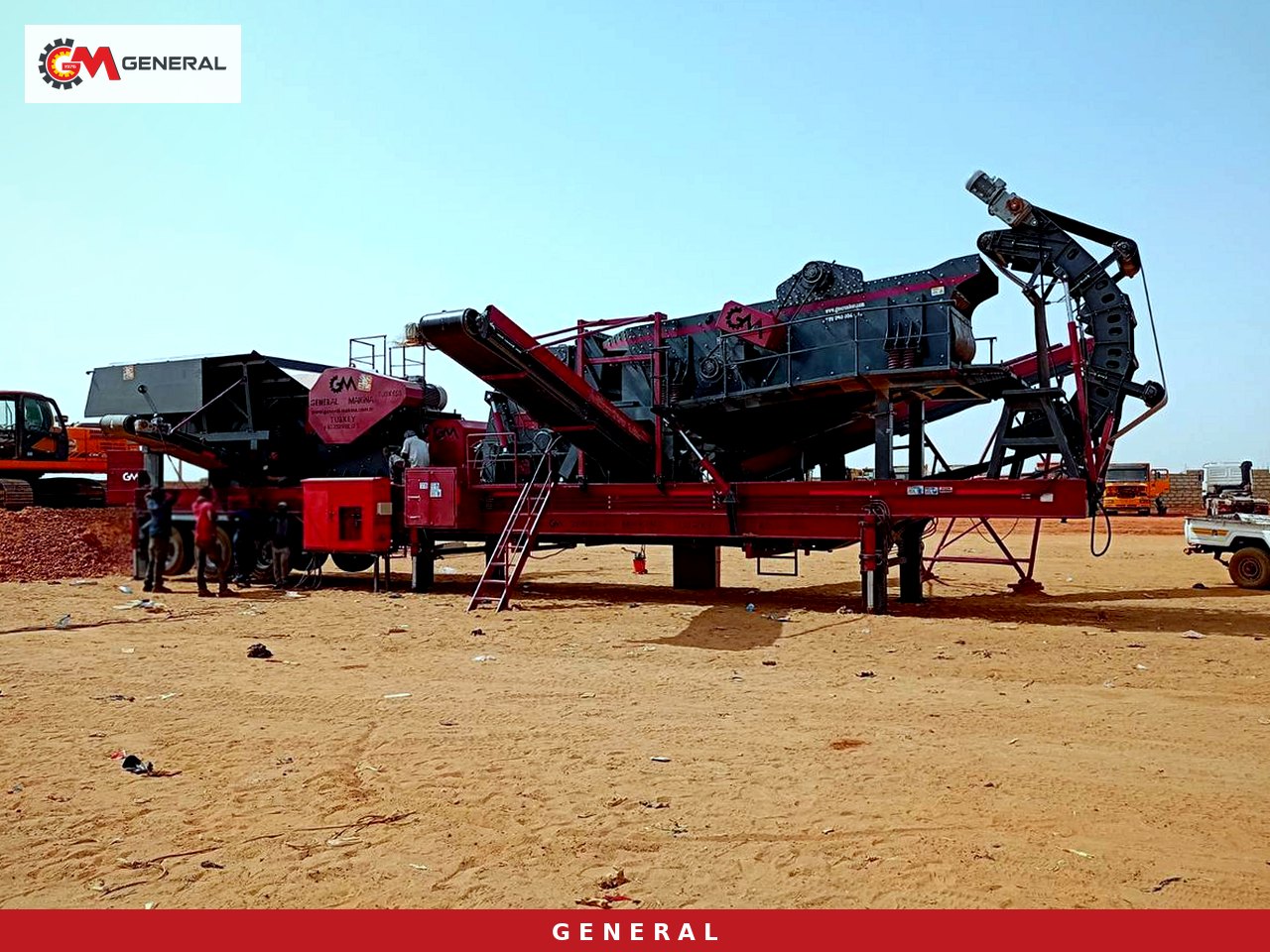
On road sections far from the grid, power comes from a generator; the kVA values in the table directly drive fuel logistics and the decision on a standby set. In hot, humid weather, radiator cores and air filters need cleaning more often; spray nozzles for dust suppression and covered conveyors are measures that can be added per project. Our wheeled units set up without a concrete foundation using hydraulic legs and folding conveyors, but the ground must be level and compacted.
What to prepare before requesting a quote
- Laboratory results for the quarry sample: abrasion loss, compressive strength, silica content.
- Clay-silt ratio for the dry and wet seasons, and whether washing is needed.
- Fractions required separately for bridge concrete and road base, with estimated tonnage for each.
- Net daily operating hours and the calculated TPH target.
- Largest run-of-mine block size (for choosing the feed opening).
- Discharge port, road route and bridge load limits along it.
- Grid connection or generator, and how fuel will be supplied.
- Whether the plant will move to a following project.
Frequently asked questions
Is one plant enough for both bridge concrete and road base?
In most cases, yes; the difference lies in screen setup and stockpile management. A GNR-MC110 or General 02 with a four-deck screen separates four fractions in one pass; for road base the fractions are blended to hit the curve, while concrete aggregate is stockpiled separately and protected.
Why is the General 02 not recommended for Ghanaian granite?
The General 02 is a primary-impact unit designed for limestone and low-abrasion stone. In hard, siliceous rock the blow bars and plates of an impactor wear fast; for such rock, the General 944 or GNR-MC110, which start with a jaw primary, fit better.
What certificates and warranty apply?
Our machines carry CE and ISO 9001 certification, with a 1-year warranty excluding wear parts. General Makina has built crushing and screening plants in Izmir since 1976.
What determines price and delivery time?
Model and layout, number of screen decks, feeder and conveyor choice, washing needs, generator and shipping method set the price. Delivery time is stated in writing in the quotation according to the order content and production schedule.
Conclusion
When selecting a 150-250 TPH plant for road and bridge work in Ghana, test the rock first and then calculate the tonnage: on granite and gneiss the General 944 or GNR-MC110, on limestone the General 800 or General 02 are the right starting points. Plan for possible rainy-season washing and the port-to-site route from day one. Send us your sample results and fraction list and we will work out the configuration for your project together: request a quote through our contact page.
Definitions of technical terms: Glossary