EN — English
 TR — Türkçe
 DE — Deutsch
 RU — Русский
 FR — Français
 ES — Español
 AR — العربية
 SR — Српски

Togo Lomé Port Expansion Aggregate Crushing Plant 150-250 TPH
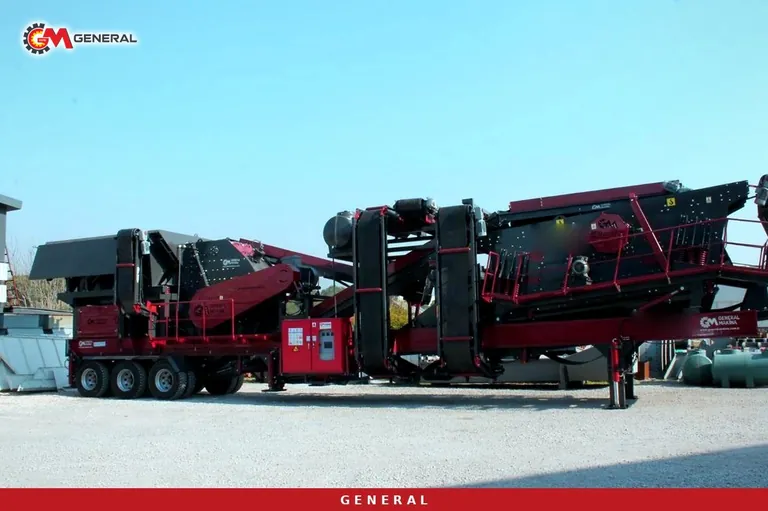
For a contractor taking on a new quay, container yard or breakwater at the Port of Lomé, aggregate starts at the stockpile in front of the batching plant, and it is often the weakest link in the programme. Sound rock does not sit right behind the Togolese coast; the stone comes from inland, is crushed and screened there, and travels down to the waterfront by truck. This article sets out which real models can cover 150-250 TPH for a job on the scale of the Lomé port expansion, how the choice shifts with rock type, and what has to be planned between the machine landing at Lomé and the first tonne at the quarry. Project scope, quantities and the aggregate specification belong to the port authority and the tender documents; check everything below against your own specification.
What a port build asks of aggregate: three separate consumers
A port expansion does not consume one kind of material. Splitting demand by end use is the foundation of crusher and screen selection. At a port like Lomé, which handles both container and transit cargo, three consumers wait for material at the same time.
Quay walls, caissons and precast concrete
Quay walls, caissons, pier caps and precast units are high-strength concrete working in a marine environment. The coarse aggregate must be clean, cubical and low in fines; flaky, elongated particles cut pumpability and strength. The secondary stage of the crushing line decides this: an impact secondary or a choke-fed cone crusher is chosen for cubical shape.
Container yard pavement and base layers
Container stacking areas need thick base and sub-base layers designed for the wheel loads of heavy handling equipment. By volume this is the largest item, and it needs material that fits a grading envelope and flows without interruption. What matters here is the number of screen decks and the ability to blend fractions in the required proportions later.
Breakwater and fill material
Breakwater armour stone is selected at the quarry face, not produced by a crusher. The plant's job is to make the graded material defined for filter and core layers and to keep oversize blocks out of the crusher. Setting part of the blasted rock aside as armour candidates also lowers the block size arriving at the feed opening and reduces the risk of the primary crusher bridging.
Where the stone will come from: coastal sediment versus inland crystalline rock
Lomé stands on a low coastal strip of sandy and clayey sediments; this cover offers no sound rock suitable for concrete aggregate. Limestone deposits are known within the sedimentary basin in the southeast, while gneiss, granite and quartzite of the crystalline basement outcrop in the interior and north of the country. A quarry opened for a port job at Lomé is therefore likely to be inland, in hard and abrasive rock.
This general picture has two consequences for machine selection. First, in siliceous rock such as gneiss and quartzite, the blow bars and liners of an impact crusher wear quickly, and wear-part consumption becomes the main item in cost per tonne. Second, if limestone or another low-abrasion stone is found, primary-impact plants run more economically with high reduction and cubical product. Only laboratory results from samples taken on site can tell you which case you are in: compressive strength, Los Angeles abrasion value and silica content belong in the enquiry file. Do not guess the rock properties of a specific quarry; have samples tested.
The laterite and clayey overburden above the quarry counts too. In the wet season this cover turns sticky; if it does not pass the grizzly and travels into the crusher, it ruins the cleanliness requirement for concrete. The by-pass section of the vibrating grizzly feeder separates this fine, soil-laden part before the crusher, and the separated material can be used for fill work in the port area.
Reading the 150-250 TPH target correctly
The range in the title is a production target, not a model name. Three corrections apply when turning daily or monthly demand into a nominal hourly capacity:
- Real operating hours: subtract shift pattern, maintenance stops and days lost to rain.
- Efficiency allowance: nominal capacity is defined for dry, well-graded feed; wet, clayey or very coarse feed lowers hourly output.
- Product split: the share of each fraction in the specification changes the circulating load on the screen and the crusher.
A hypothetical example: if you need Q tonnes per day, effective operating time is H hours per day and the efficiency factor is k, the required nominal capacity is Q / (H × k). This simple formula shows whether you should sit at the low or high end of 150-250 TPH, and whether one large line or two separate units makes more sense. Because concrete pours on port work are tied to fixed dates, keeping a buffer of a few days in the stockpile is safer than choosing an optimistic k.
Three real configurations for the Lomé job
The options below are based on published technical data for the wheeled mobile crushing and screening plant family. You can compare every primary, secondary and tertiary crusher type on the crushers page.
One line for hard gneiss and granite: GNR-MC110
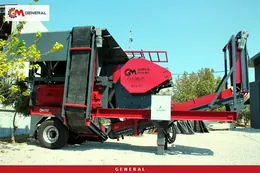
The GNR-MC110 carries a GPJ 110 primary jaw and a DMK03 secondary impactor on two separate chassis, produces 200-300 TPH and accepts 900 mm feed. Its 2000×6000 mm four-deck screen separates 0-5 / 5-12 / 12-19 / 19-40 mm fractions, so concrete aggregate and base material come off the same line. The twin chassis lets the primary group run on its own: during quarry development you can run only the primary to make fill, then bring the secondary group in when concrete work starts. Each chassis weighs 55,000 kg and the plant is powered by a 750 kVA generator.
Two units in parallel: General 944 and General 950
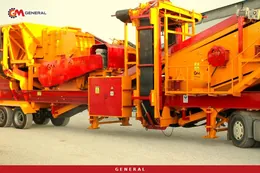
The General 944 and the General 950 share the same GPJ 90 primary jaw, 800 mm feed and 120-180 TPH capacity; the difference is the secondary. The 944's GM430 cone works by compression, giving long metal life in abrasive rock; the 950's DMK01 impactor gives high reduction and cubical grains. Together they add up to a nominal 240-360 TPH, and while one unit is in maintenance the other keeps producing at 120-180 TPH. On port work tied to a pour schedule, this redundancy is a real safeguard compared with a single large line. The limitation: the 1600×5000 mm three-deck horizontal screen on both models gives 0-5 / 5-12 / 12-19 mm; if the specification includes a 19-40 mm fraction, a separate screening solution is needed.
If limestone is found: General 02 or General 01
If the quarry opens in a low-abrasion limestone, primary-impact plants come to the fore. The General 02 produces 250-300 TPH with its GPS 1413 impactor and has the widest feed opening in the family at 1000 mm. For the lower half of the target, the General 01 does primary and secondary work in one body with its GPS 1210 rotor, produces 120-180 TPH and takes 700 mm feed. Neither model is recommended for gneiss or quartzite; wear-part consumption on impact parts drives the cost per tonne up fast.
| Model | Role on the Lomé job | Capacity | Generator | Crushers | Weight | Max. feed | Screen |
|---|---|---|---|---|---|---|---|
| GNR-MC110 | Single line in hard rock | 200-300 TPH | 750 kVA | GPJ 110 jaw + DMK03 impact | 2 × 55,000 kg | 900 mm | 2000×6000 mm, 4-deck |
| General 944 | One leg of a twin line in abrasive stone | 120-180 TPH | 550 kVA | GPJ 90 jaw + GM430 cone | 70,000 kg | 800 mm | 1600×5000 mm, 3-deck |
| General 950 | Cubical concrete aggregate in a twin line | 120-180 TPH | 600 kVA | GPJ 90 jaw + DMK01 impact | 70,000 kg | 800 mm | 1600×5000 mm, 3-deck |
| General 02 | High tonnage in limestone | 250-300 TPH | 660 kVA | GPS 1413 impact | 76,000 kg | 1000 mm | 2000×5000 mm, 4-deck |
| General 01 | Lower half of the target in limestone | 120-180 TPH | 550 kVA | GPS 1210 impact (primary + secondary) | 55,000 kg | 700 mm | 1600×5000 mm, 4-deck |
When the machine lands at Lomé: from quay to quarry
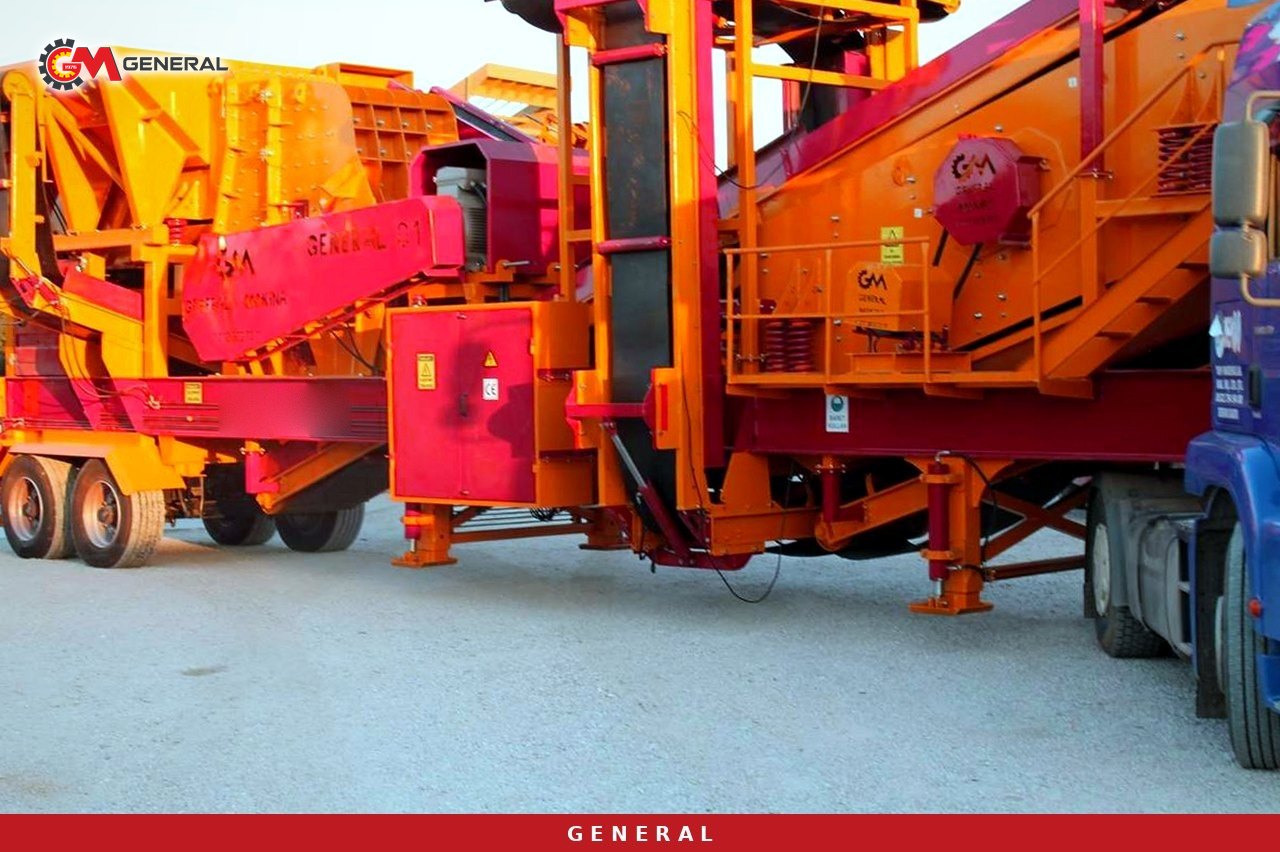
This job has an unusual twist: the port the plant will serve is also the machine's point of entry. Wheeled mobile plants come off the ship on their own axles, hitched to a tractor unit, and are towed by road to the quarry. In a port where expansion works are under way, unloading, temporary storage and customs areas may move; confirm the shipping plan against the port operator's arrangements at the time.
The main road running inland from Lomé is also the transit corridor to the Sahel countries, with heavy truck traffic. Get the current rules on axle loads, dimension limits and abnormal-load permits from the relevant authority. The table values help here: the General 02 is a single 76,000 kg unit, while the GNR-MC110 splits its weight across two 55,000 kg chassis. On a route with narrow bridges or restrictions, the twin-chassis layout can make planning easier.
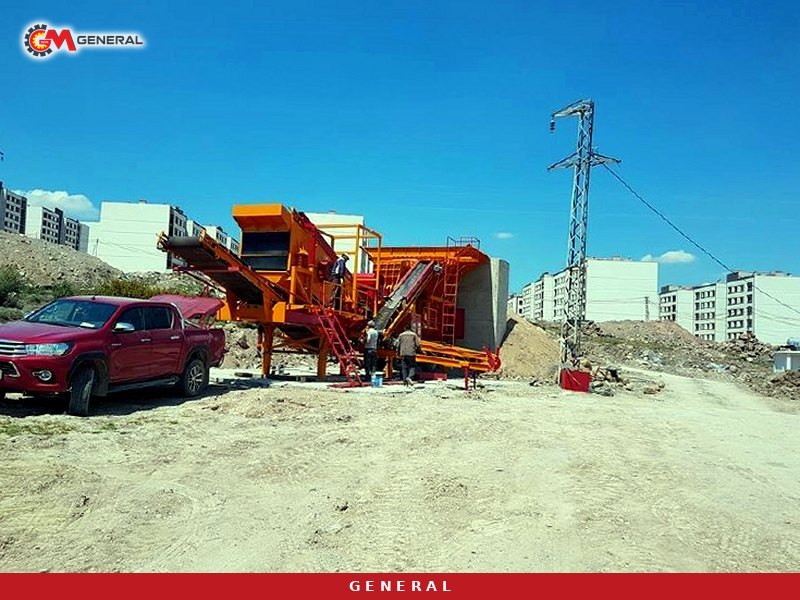
At the quarry no concrete foundation is needed; the plant is set on hydraulic legs, the conveyors are unfolded and the cabling is done. The real preparation is the ground: feed ramp, truck turning area, rainwater drainage and distances that keep stockpiles from mixing must all be arranged in advance. Concrete fractions for the port mixing with base material means a pile rejected at laboratory acceptance.
Coastal climate, humidity and power: operating measures
Southern Togo has two rainy seasons a year, and sites near the coast see humid, salty air. These two factors affect the operating routine more than model choice:
- Separate wet, clayey run-of-mine at the by-pass section of the grizzly feeder; clay entering the crusher blinds the screen and lowers hourly output.
- Discuss dust and moisture sealing for electrical cabinets and the generator at quotation stage, as a measure that can be selected for the project.
- In salty air, put periodic checks of paint, cable connections and bolted joints into the maintenance plan.
- In the dry season, use water-spray dust suppression on stockpiles and conveyor transfer points; work areas and settlements around the port need protection from dust.
- At an inland quarry without a grid connection, power comes from the model's generator; the 550-750 kVA values in the table are the starting point for planning fuel logistics.
- Keep manganese wear castings and screen meshes on site from day one; waiting for parts at a remote quarry translates directly into delay on the port schedule.
Frequently asked questions
Does breakwater armour stone come from the crushing plant?
No. Armour blocks are selected and set aside at the quarry face. The crushing plant produces graded material such as filter, core and concrete aggregate. Separating oversize blocks first keeps pieces larger than the GNR-MC110's 900 mm or the General 02's 1000 mm feed opening out of the line.
What happens to the plant when the port job ends?
Wheeled mobile plants are towed rather than dismantled and rebuilt. When the Lomé work is complete, the same equipment can move to an inland road job or another quarry. The twin chassis of the GNR-MC110 also gives the flexibility to use one group separately if the next job needs only the primary.
What warranty and certificates apply?
General Makina has manufactured in Izmir since 1976; the plants carry ISO 9001 and CE certification. The warranty period is 1 year, excluding wear parts.
What determines price and delivery time?
Price depends on the model, secondary crusher type, extra screen or conveyor needs, generator choice, climate-related options and the way the plant is shipped to Lomé. Delivery time depends on the production schedule at the time of order and is confirmed in writing in the quotation.
Decision summary
On a job the size of the Lomé port expansion, the first question is rock type, not capacity. If the quarry opens in gneiss, granite or quartzite, a single GNR-MC110 line or a General 944 and 950 pair are sensible starting points; in limestone, the General 02 or General 01. Send your rock test results, required fractions and their proportions, daily production target, operating hours, power situation and the quarry's distance from the Port of Lomé through our contact page and we will prepare a suitable configuration and quotation.
Definitions of technical terms: Glossary