EN — English
 TR — Türkçe
 DE — Deutsch
 RU — Русский
 FR — Français
 ES — Español
 AR — العربية
 SR — Српски

Kenya Mombasa Port Aggregate Crushing Plant 200-300 TPH
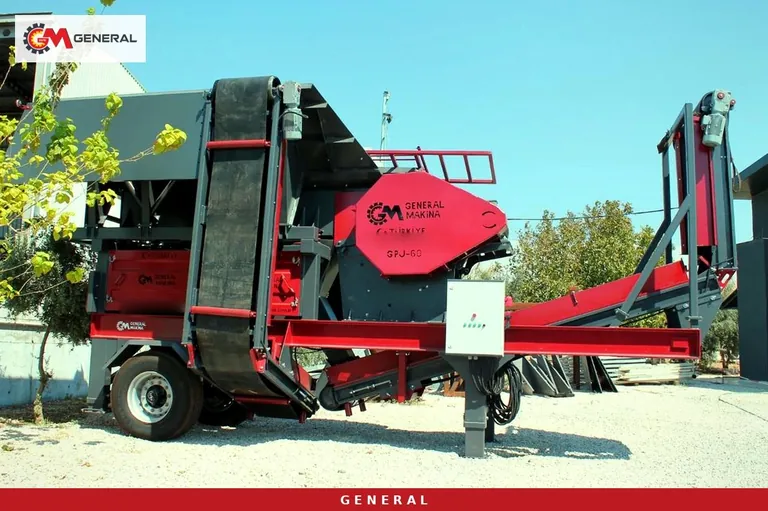
A quarry around Mombasa that supplies port work runs on a different product list from one that feeds a highway job. Quay and pile-cap concrete needs aggregate, reclamation and backfill need graded crushed stone, and container yards and service roads need base material, sometimes all within the same shift. A rate of 200-300 tonnes per hour is a sensible target range for serving that mix from one quarry. This article compares the real models in our line-up that fall within the range, using catalogue data, and explains how stone and climate on the Kenyan coast shape the choice. We give no information on the volume, schedule or specification of any particular port tender; confirm those from the documents of the contracting authority.
The product range Mombasa port work calls for
Aggregate demand on port structures cannot be reduced to one grading curve. Material going to the batching plant must be clean, cubical and stockpiled by fraction; for fill and road formation, grading and compactability matter most. So the first question when choosing a plant is not "how many tonnes?" but "what share of the total is concrete fraction and what share is fill or base?"
In practice three product groups decide the layout: 0-5 mm crusher sand, 5-12 and 12-19 mm concrete chippings, and 19-40 mm or coarser base or drainage stone. Plants with a four-deck screen separate those four cuts in one pass; on a three-deck screen 19-40 mm does not come out as its own cut, so extra screening is planned if it is needed. Very large blocks for breakwater cores or armour layers come straight from blasting and sorting at the face, not from the crusher, and should not be counted in the crushing plant's capacity.
Stone changes between the coastal strip and the interior
Rock type differs clearly between the Kenyan coast and the inland areas. Quarries close to Mombasa are commonly associated with coral-derived limestone and sandstone, while volcanic rock and metamorphic basement rock become more typical towards the interior and the Rift. Which quarry supplies the job decides the crusher arrangement more than capacity does. In every case, samples from the face should be lab-tested for abrasion, compressive strength and clay content.
Coral limestone and sandstone
On relatively soft, low-abrasion stone a primary impact crusher gives high reduction and cubical grains in a single stage. Porous coral limestone can produce a higher share of fines and dust, so scalping soil and fines away before the crusher directly affects both wear and the quality of concrete aggregate. If the stone is meant for concrete, water absorption and chloride content should be tested as well.
Hard volcanic and metamorphic rock
In hard stone with a high silica content an impact primary wears quickly and the cost of parts per tonne climbs. With such rock a jaw crusher for coarse reduction followed by an impact or cone secondary gives a more balanced result. If Mombasa port work is to be supplied from an inland quarry, the machine should be chosen for that rock.
Real model options for 200-300 TPH
The table below contains only figures from our product pages. Unknown cells are marked "—". Capacities vary with hardness, moisture and the required product cuts, so treat the table as a pre-selection tool.
| Configuration | Crushers | Capacity | Max. feed | Screen | Generator | Suited stone |
|---|---|---|---|---|---|---|
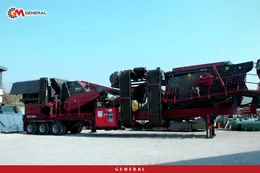
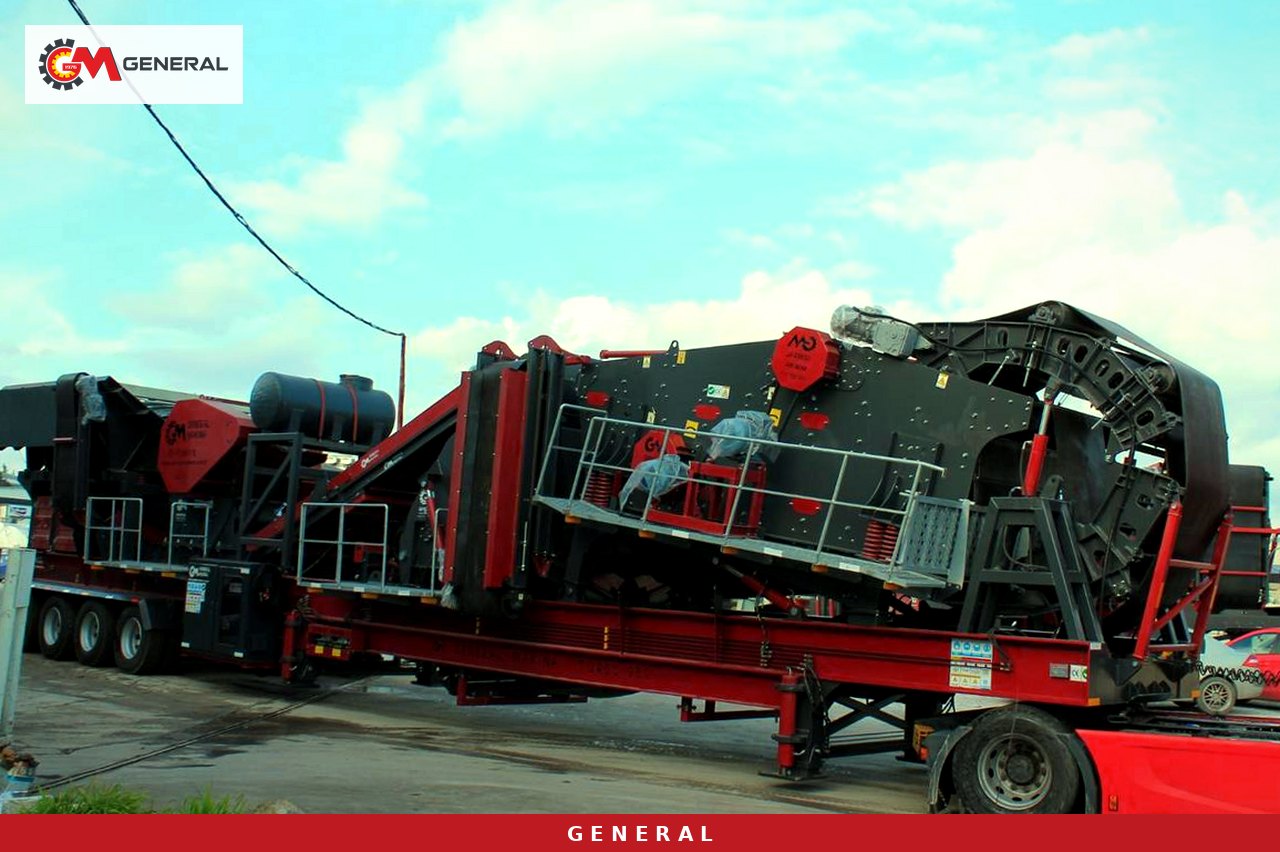
| GNR-MC110 (twin chassis) | GPJ 110 jaw + GS1215/DMK03 impact | 200-300 tph | 900 mm | 2000×6000 mm, 4 decks | 750 kVA | Hard, abrasive |
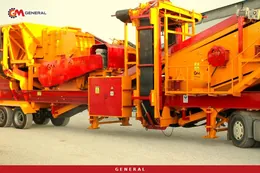
| General 02 | GPS 1413 (GNR PDK02) primary impact | 250-300 tph | 1000 mm | 2000×5000 mm, 4 decks | 660 kVA | Limestone, low abrasion |
| General 03 | GPS 1415 primary impact | 250-375 tph | 900 mm | 2400×5000 mm, 4 decks | 750 kVA | Limestone, low abrasion |
| 2 × General 950 | Each GPJ 90 jaw + DMK01 impact | 2 × 120-180 tph | 800 mm | 1600×5000 mm, 3 decks (each unit) | 600 kVA (each unit) | Hard, abrasive |
Single chassis, twin chassis or two separate units
If the quarry yields coral limestone, the General 02 accepts large blasted blocks through its 1000 mm inlet and separates four cuts in one pass on its four-deck screen. Where tonnage might rise above 300 tph, the General 03 leaves headroom with its 250-375 tph range and 2400×5000 mm screen; its four-axle chassis, folding hydraulic conveyors and hydraulic legs shorten setup. If the stone is hard, the GNR-MC110 comes to the front: the GPJ 110 jaw primary and the GS1215/DMK03 impact secondary travel on two separate chassis of 55,000 kg each, and the primary group can run on its own when needed. That lets an operator start with the primary and bring in the secondary once volumes grow.
Two General 950 units together reach 240-360 tph. Compared with a single plant they mean more parts and more operators, but one unit keeps producing while the other is under maintenance. If daily concrete pours on the port job cannot tolerate a stoppage, that redundancy is a serious decision criterion. All wheeled options are compared on the mobile crushing plants page.
Turning hourly capacity into daily demand
The most common mistake at tender stage is matching catalogue capacity directly to daily demand. The correct calculation is: required hourly capacity = total daily demand (tonnes) ÷ (shift hours × availability factor). The availability factor covers wear-part changes, feed interruptions, rain days and maintenance stops, and it is a value you need to set for your own site.
Hypothetical example: a quarry needing 2,000 tonnes a day, running one 10-hour shift with availability taken as 0.8, needs 2,000 ÷ (10 × 0.8) = 250 tph. That calls for a model working in the upper half of the 200-300 tph range; spread across two shifts, the same demand could be met by a smaller configuration. Running the calculation separately for concrete fractions and fill material also shows which screen layout is required.
Operating measures for salty air, humidity and dust
At a quarry near the port, the machine faces humid, salt-laden air and, in dry spells, dust. The measures below should be treated as options selected per project, not as model standard equipment:
- Dust- and moisture-protected housings for electrical panels and the generator, with regular filter checks.
- Water-spray dust suppression at conveyor transfer points and belt covers where required.
- Periodic checks of exposed metal surfaces and bolted joints in the saline environment, with early repair of paint damage.
- Pre-separation with a grizzly feeder in the wet season so that clay and mud do not reach the crusher.
- An on-site stock of manganese jaw plates and impact crusher blow bars.
A vibrating feeder with a grizzly section removes fines and soil before they enter the crusher. The primary crusher's parts then wear more slowly and carry no needless load; with damp coral limestone, this separation is also the first step towards keeping concrete aggregate clean.
Unloading at Mombasa port, road haul and setup
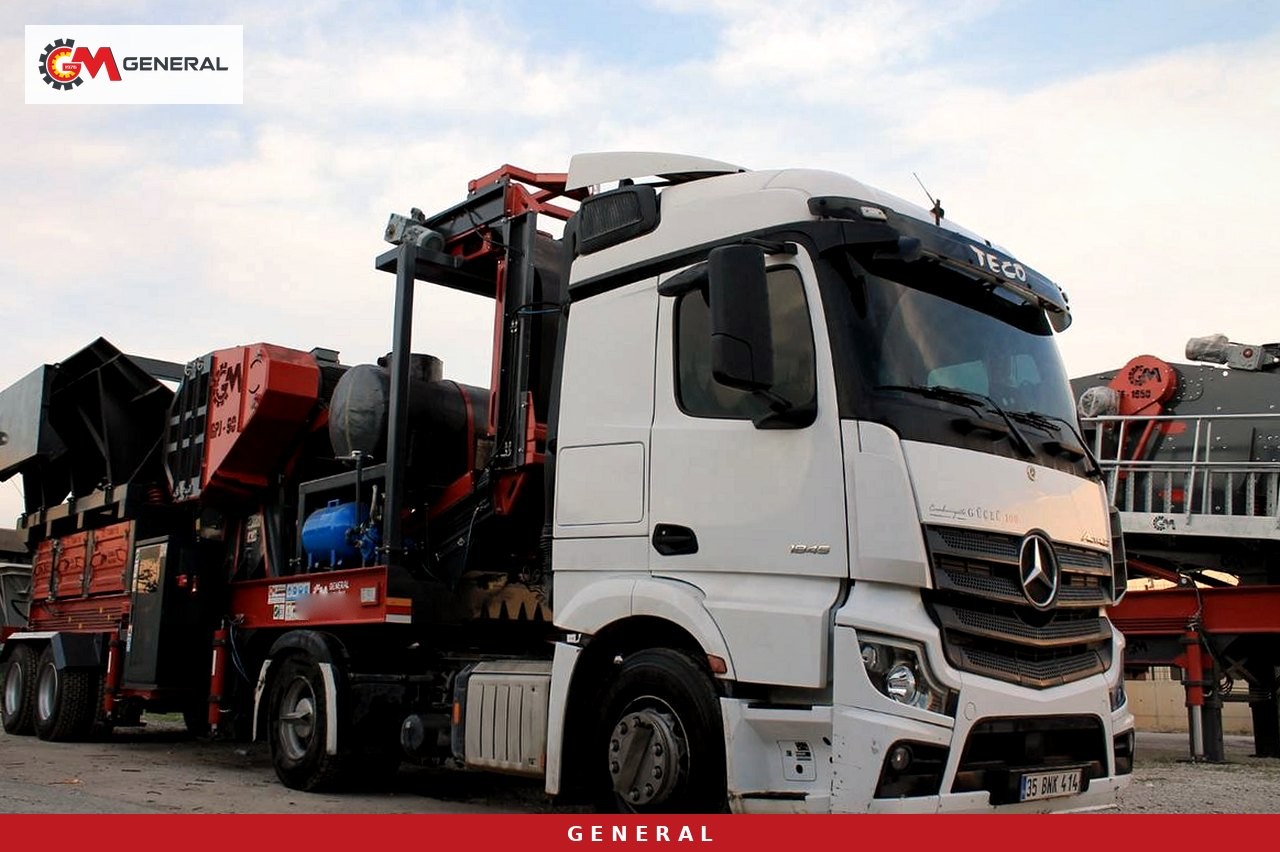
This project has an unusual twist: the machine enters the country through the very port it will supply with aggregate. Wheeled plants can be towed on their own chassis, so after discharge they are coupled to a tractor and hauled by road to the quarry. Turning radii, bridge load limits and permit requirements along the route should be checked by the contractor before shipment; we give no fixed durations or rules on this.
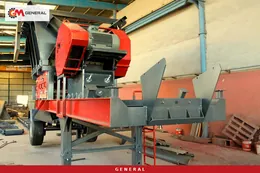
Dimensions decide a lot here. The General 02 transports at 4340×20600×4500 mm and 76,000 kg; for the General 950 the figures are 4130×20350×4500 mm and 70,000 kg. On the GNR-MC110 the load is split over two chassis of 55,000 kg each, with the primary chassis at 3000×13500 mm and the secondary at 4200×18300 mm. On a restricted heavy-haul route the twin chassis can be an advantage. According to its product data, the General 950 is ready to work within 30 minutes of arriving on site.
On power, every option runs on its own generator: 660 kVA for the General 02, 750 kVA for the General 03 and the GNR-MC110, 600 kVA for the General 950. If the quarry is far from the grid, fuel supply and generator maintenance belong in the work programme from day one. If the quarry has a long life and steady tonnage, stationary crushing plants are worth considering too; they can produce eight or more product sizes but require concrete foundations and a longer installation.
Pre-order checklist
For an accurate quotation, please send us:
- Quarry location and stone type: coastal coral limestone or hard rock from inland?
- Lab results: abrasion, compressive strength, clay and moisture content.
- Largest blasted block size and feeding method (loader, truck, excavator).
- Product list and daily tonnage per fraction, with concrete and fill shares stated separately.
- Shift pattern and target availability.
- Power source: grid or generator?
- Route from the port to the quarry and any transport restrictions.
Frequently asked questions
Can one plant produce both concrete aggregate and fill?
Yes. With four-deck screens, the General 02, General 03 and GNR-MC110 separate 0-5 / 5-12 / 12-19 / 19-40 mm cuts in one pass. Shares and screen apertures are set at order stage to suit the stone.
Which model suits coral limestone near Mombasa?
On low-abrasion stone the primary-impact General 02 or General 03 delivers cubical grains and high reduction. If lab results show high silica, the jaw-primary GNR-MC110 or two General 950 units should be preferred.
What warranty and certificates apply?
Our machines carry ISO 9001 and CE certification, with a 1-year warranty excluding wear parts. We have been manufacturing in Izmir since 1976.
What determines price and delivery time?
The chosen configuration, number of screen decks, generator, extra conveyors, spare-parts package and shipping terms set the price. Delivery time depends on the production schedule at the time of order; both are confirmed in the quotation.
Conclusion
For a 200-300 TPH aggregate plant serving Mombasa port work, the real decision is whether the quarry draws on soft coastal limestone or hard inland rock. On soft stone the General 02 and General 03 are realistic options; on hard stone, the GNR-MC110 or two General 950 units. Send your stone analysis and product list through our contact page and we will prepare a suitable configuration and quotation.
Definitions of technical terms: Glossary