EN — English
 TR — Türkçe
 DE — Deutsch
 RU — Русский
 FR — Français
 ES — Español
 AR — العربية
 SR — Српски

Tanzania Railway & Road Aggregate Crusher Plant 200-300 TPH
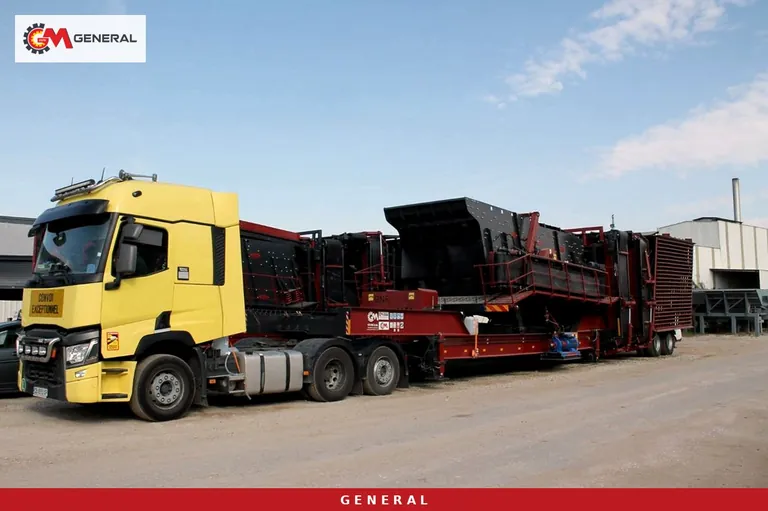
A contractor building a railway section in Tanzania together with its feeder roads does not deal with one aggregate product but with three: coarse, angular ballast laid under the track, the sub-base and base layers of the road, and clean, cubical chippings for the concrete in culverts, bridges and station structures. The 200-300 TPH in the title is a sensible target band for the combined demand of these three products. Even so, the choice of machine is decided less by tonnage than by how abrasive the rock is, how fast the line advances and how the equipment travels from the port of Dar es Salaam to site. Below we match the real models in our catalogue data against these criteria and compare a single plant, a two-unit set and a fixed line side by side.
Under the track, in the road, inside the structures: three products on Tanzanian corridors
Ballast is the layer that holds the sleepers in place, spreads train loads into the formation and drains rainwater quickly. To do that job the particles must be angular, hard and clean; as the fines content rises, the layer holds water, gradually turns to mud and the track geometry suffers. Ballast grading, abrasion resistance and shape limits are defined in the railway authority's specification. Confirm these values in writing with the relevant railway authority or the project specification before plant design starts; screen apertures and crusher settings are chosen directly from that document.
On the road side the expectation is different. Sub-base and base courses do not need an excess of one size but the right blend of coarse and fine; the bearing capacity of a rolled layer comes from that balance. Here fines are not a defect but part of the recipe. For concrete structures, particle shape and cleanliness come first: flaky particles and clay-coated surfaces demand more water and cement for the same workability and lower the strength.
In short, the ballast line works to keep fines out, while the road-base line tries to add them back in a controlled way. One plant can do both, but screen decks, by-pass conveyors and stockpile points have to be planned for it. Working out where the bulk of the tonnage sits comes before choosing the crusher arrangement.
Tanzanian rock: granite-gneiss, volcanic stone and coastal limestone
Much of inland Tanzania sits on ancient basement rock, and granite and gneiss quarries are common there. In the north, around the volcanic mountains, basaltic rock types occur. Along the coast, softer rocks such as coral-derived limestone and sandstone are found. These three groups ask very different things of a crusher.
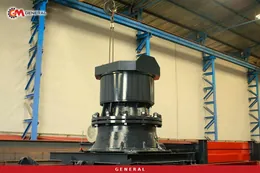
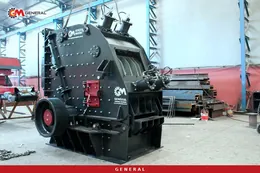
Granite and gneiss are hard and high in silica. They can be good ballast candidates, but they wear out the blow bars and plates of an impact crusher quickly. In these rocks a jaw crusher at the primary stage followed by a cone crusher working on the compression principle is the safer arrangement for metal life. An impact secondary gives a more cubical product; if it is preferred, wear-part consumption should be measured in a trial crush.
Soft coastal limestone often fails the abrasion criterion of a ballast specification and is better used for road sub-base or fill. An impact crusher achieves a high reduction ratio on this stone with reasonable wear. Whether a quarry is suitable for ballast is decided by laboratory results, not by general geology. Take samples from every candidate quarry for Los Angeles abrasion, shape index and water absorption tests and attach the results to your enquiry; we firm up our machine proposal on that basis.
Four configurations for 200-300 TPH built from real models
The capacity ranges in the catalogue are operating ranges that vary with the material and the required product size. The table below contains only values published on our model pages; unpublished cells are left as "—".
| Configuration | Crushers | Capacity | Max. feed | Power | Transport |
|---|---|---|---|---|---|
| GNR-MC110 (one plant, two chassis) | GPJ 110 jaw + GS1215/DMK03 impact | 200-300 t/h | 900 mm | 750 kVA generator | 2 chassis, 55,000 kg each |
| GNR 110 primary + GNR MK110 cubicizer | GNRK 110 jaw + rotor cubicizer | 180-300 t/h (primary) / 160-250 t/h (MK110) | 1100 mm (unit) / 350 mm (MK110) | MK110 motor 200 kW | Primary unit 55,000 kg; MK110 |
| 2 × General 944 | Each GPJ 90 jaw + GM430 cone | 120-180 t/h each | 800 mm | 550 kVA each | 70,000 kg each |
| Fixed crushing and screening line | Jaw + cone or impact, by rock type | Project-specific | — | — | On concrete foundations |
GNR-MC110: the model that covers the title band as a single plant
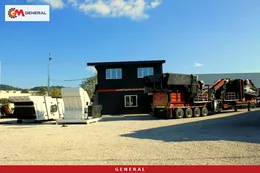
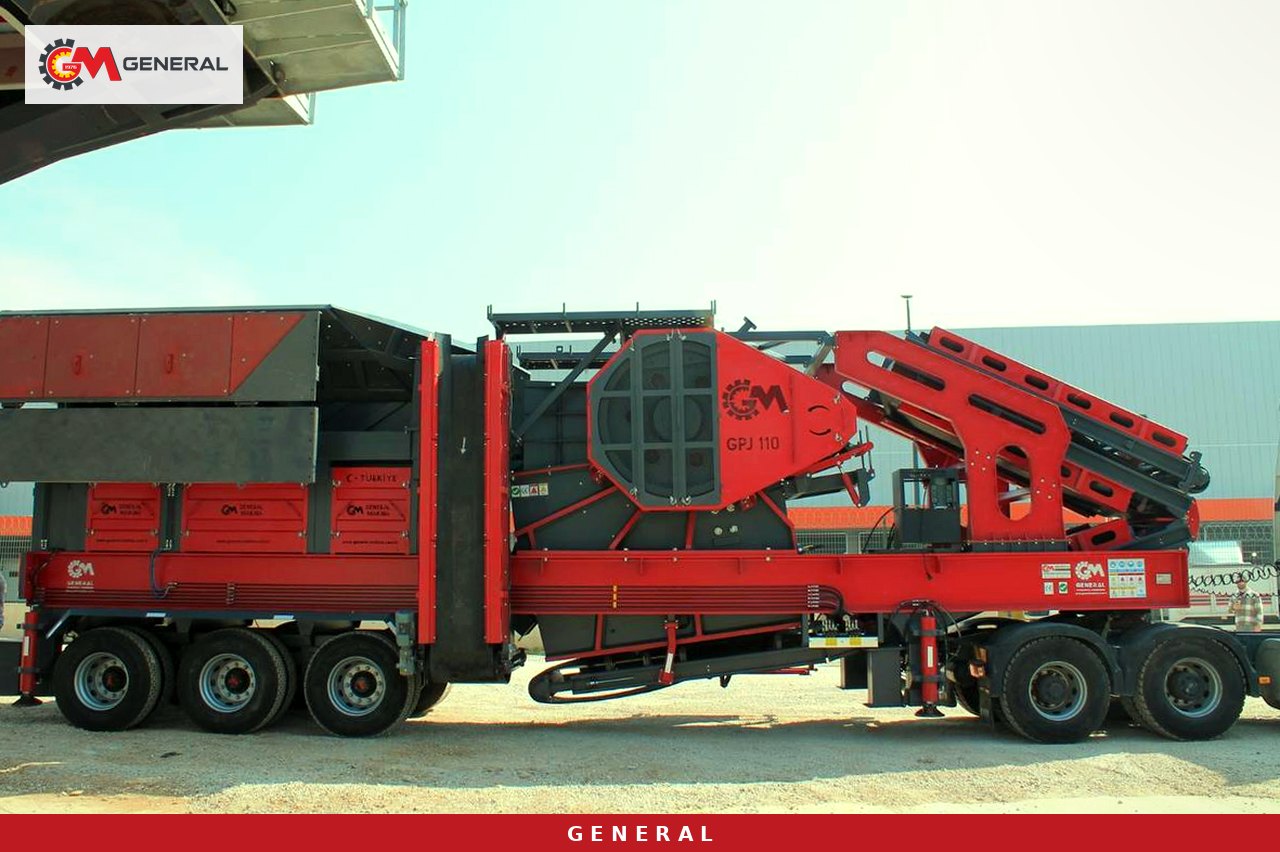
The GNR-MC110 is a wheeled plant on two chassis, and its 200-300 t/h range matches the target in the title exactly. The first chassis carries the feeder hopper and the GPJ 110 jaw; the second carries the GS1215/DMK03 impact secondary and a 2000×6000 mm four-deck screen. Standard product sizes are 0-5, 5-12, 12-19 and 19-40 mm, with a 0-100 mm output setting. Because ballast is coarser than these standard fractions, screen mesh apertures should be specified at order stage according to the ballast specification. The fact that the primary group can run on its own is a real advantage here: when coarse crushed material is needed the secondary can be taken offline, and for road base both groups run together. In a granite-gneiss quarry, verify the wear-part consumption of the impact secondary with a trial crush.
Jaw primary plus cubicizer: flexibility on two separate chassis
The GNR 110 mobile primary jaw unit accepts feed up to 1100 mm and works in the 180-300 t/h range, with a 0-250 mm product. Behind it, the GNR MK110 mobile cubicizer takes material up to 350 mm and delivers a 0-25 mm cubical product at 160-250 t/h. This pair makes sense where particle shape decides the job, as in concrete and asphalt chippings. Ballast is coarser than the cubicizer's 0-25 mm output, so in this set-up ballast is produced by passing the primary product over a separate screen or through a separate secondary unit. The cubicizer's Hardox 500 liners do well in moderately abrasive basalt; in rock with very high free quartz, monitor liner life and consider the cone alternative.
Two General 944 units: a twin cone-secondary line for hard granite
The General 944 combines a GPJ 90 jaw primary with a GM430 cone secondary and produces 120-180 t/h on its own. Two units together give a combined band of 240-360 t/h, so the 200-300 t/h target is met with redundancy: production does not stop completely while one unit is under maintenance. The compression-type cone crusher is an advantage for metal life in siliceous rock such as granite and gneiss. Each unit separates 0-5, 5-12 and 12-19 mm fractions on a 1600×5000 mm three-deck screen; for ballast, the screen arrangement needs to be redefined. Splitting the two units between separate quarries can also be used to supply two worksites on a long corridor at the same time.
Fixed line: corridors fed from one quarry for years
If railway and road works will be fed from the same quarry for years, fixed crushing plants should be considered. With no chassis transport limit, a larger feed opening and more screen decks can be used, which makes it easier to send ballast, base material and concrete aggregate to separate stockpiles at once. The capacity and flow sheet of a fixed plant are prepared for each project from quarry data. Where haul distances grow as the line advances, combining a fixed line with mobile units is also worth costing.
As the line advances, the quarry moves too: planning mobile plants
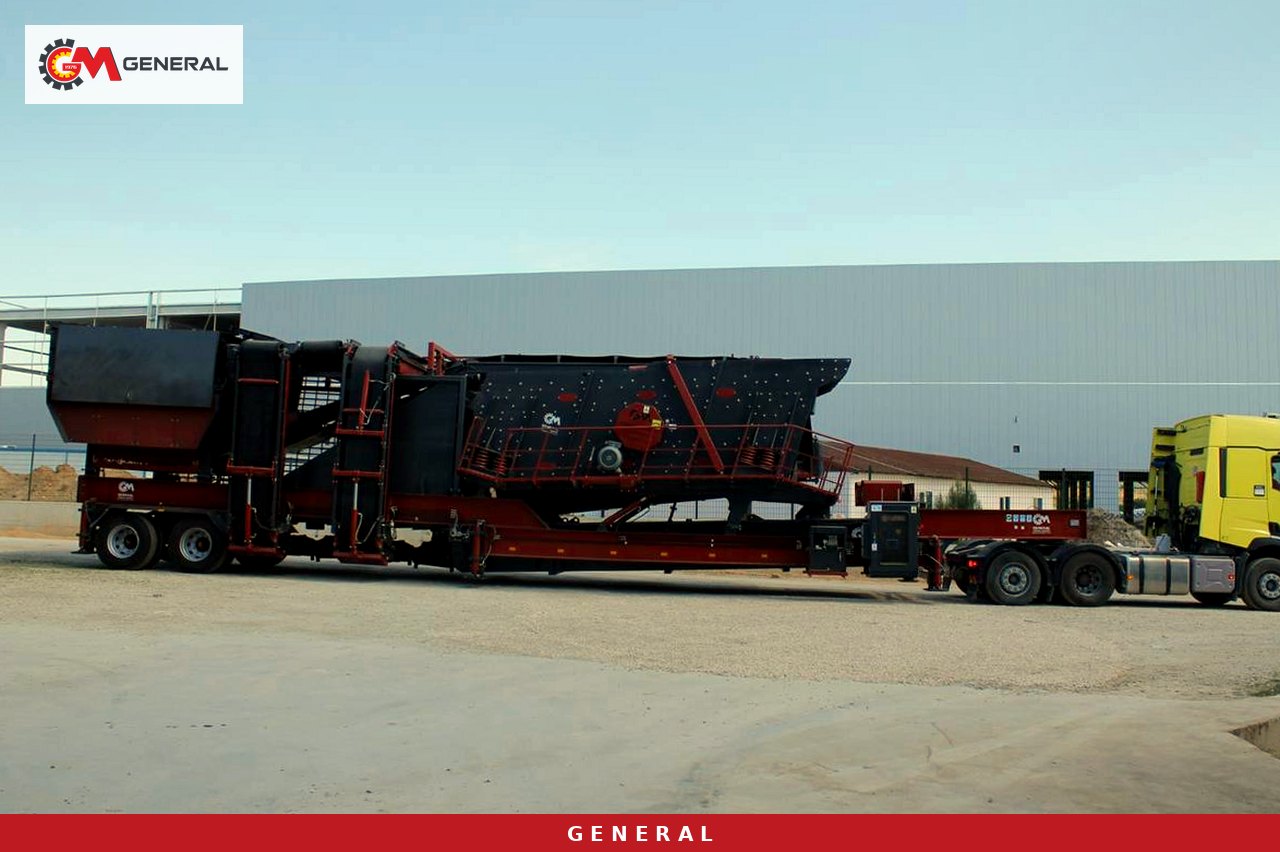
Railway construction is linear, not point-based. As earthworks and track works move forward kilometre by kilometre, the haul distance for ballast and base material keeps growing. A large share of aggregate cost arises not in the crusher but in the truck body. On long Tanzanian corridors it is therefore normal for the quarry and plant location to change several times during the programme; wheeled mobile crushing plants are designed for exactly this scenario.
Answer these questions in order: where along the corridor are usable quarries, and which ones meet ballast quality? How many months of production will each quarry provide? At what point does haul distance make relocating the plant worthwhile? A simple comparison answers the last one: if the relocation cost (dismantling, transport, set-up and lost production days) is lower than the remaining tonnage multiplied by the difference in haul cost per tonne, move the plant forward. Enter your own truck and fuel data; even working in hypothetical units makes the decision clearer.
Single-chassis mobile crusher units also support staged growth: buy the primary unit first to start embankment and coarse material work, then add the second stage once the programme is firm. The ability of the GNR-MC110 primary chassis to run on its own offers the same logic inside one plant.
From the port of Dar es Salaam to site: shipping, power and climate
For export deliveries, machines usually reach the port of Dar es Salaam by sea and are then hauled inland by road. At quotation stage, give the haulier the dimensions and weight of each chassis and have bridge and road limits on the route checked. On the GNR-MC110, splitting the load over two chassis means two separate pieces of 55,000 kg each; the General 944 is a single 70,000 kg piece with a 4130×20350×4500 mm transport dimension. Abnormal-load permits and escort requirements should be confirmed with the relevant Tanzanian authorities.
Much of a corridor runs through sites with no grid connection, so generator choice matters. The published values are 750 kVA for the GNR-MC110 and 550 kVA for the General 944. In the hot, dusty dry season, engine and generator cooling, air-filter change intervals and dust-suppression water need planning on site. In the rainy season, clay and mud entering the feed should be separated by pre-screening and the by-pass arrangement; if clay content is high, washing for concrete aggregate should be assessed separately. Measures such as covered conveyors, spray nozzles and settling ponds can be selected to suit the project.
We have a delivery on the concrete side in Tanzania as well: a Titan 100 mobile concrete batching plant with a capacity of 100 m³/h was shipped to the country. On railway and road projects, clean aggregate from the crushing and screening plant feeds the batching plant that produces bridge and culvert concrete directly; planning both investments together simplifies stockpiles and haulage.
The file to prepare before requesting a quotation
- Monthly tonnage estimate and grading specification for ballast, sub-base, base and concrete aggregate separately.
- Laboratory results from each candidate quarry: abrasion, shape index, water absorption, clay and silt content.
- Largest block size in the quarry and blasting method (to select the primary feed opening).
- Planned quarry locations along the corridor and the expected working period at each.
- Route from port to site, with bridge and road load limits.
- Power source (generator or grid) and fuel logistics.
- Water source, dust suppression and washing needs.
- Experience of the operating and maintenance crew and training expectations.
An enquiry sent with this information turns into one clear configuration proposal instead of a generic price with several options.
Frequently asked questions
Can ballast and road base come from the same plant?
Yes, but through different flows. For ballast, fines are screened out; for road base, fine and coarse fractions are blended back according to the recipe. The number of screen decks and the layout of stockpile conveyors should be designed around these two product flows.
GNR-MC110 or two General 944 units in a granite quarry?
If you want one plant, one mobilisation and a direct match to 200-300 t/h, choose the GNR-MC110; if you value the wear advantage of a cone secondary in siliceous rock and continued production while one unit is down, two General 944 units come first. Test results from quarry samples make the final call.
What warranty and certificates apply?
General Makina has been manufacturing in Izmir since 1976. The machines carry ISO 9001 and CE certification, and the warranty is 1 year, excluding wear parts. Spare parts and after-sales support are provided to the extent stated on our product pages.
What determines the price?
Model and number of stages, screen deck count, generator choice, wear-part material, additional conveyors and stockpile belts, packing and sea freight are the main price items. A firm figure is given in a quotation prepared from the file above.
Conclusion
Choosing a plant to supply 200-300 TPH of aggregate to railway and road projects in Tanzania starts with the ballast specification and the quarry's test results. The GNR-MC110 suits buyers who want a single plant; the GNR 110 primary with the MK110 cubicizer suits those who put particle shape first; two General 944 units suit redundant operation in hard granite; and a fixed line suits corridors fed from one quarry for years. Send your quarry data and tonnage plan through our contact page and our engineers will prepare a project-specific configuration and quotation.
Definitions of technical terms: Glossary