EN — English
 TR — Türkçe
 DE — Deutsch
 RU — Русский
 FR — Français
 ES — Español
 AR — العربية
 SR — Српски

Syria Reconstruction Rubble Recycling Crusher and Screener Plant 100-200 TPH
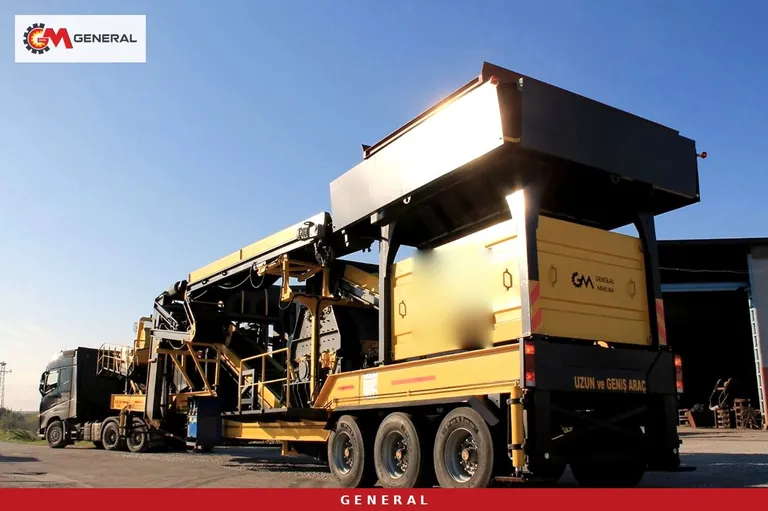
When the debris of a destroyed or heavily damaged neighbourhood in Syria is cleared, the material that comes out bears little resemblance to quarry rock: column and slab fragments, hollow concrete blocks, stone wall blocks, plaster, ceramics, cable, steel, sometimes timber frames and soil, all in the same bucket. Hauling that pile out of town and dumping it costs trucks, fuel and landfill space. Crushing and screening the same pile close to the clearance site turns it into a graded material that can serve as road fill, sub-base, trench bedding and block-making feed. Below we explain which crusher, which screen and which site layout to choose for a rubble recycling line running at 100-200 TPH, using the catalogue figures of real models.
Important note: material specifications for reconstruction programmes in Syria, the permitted uses of recycled aggregate and permits for debris sites belong to the relevant municipalities and public authorities. Before selecting machines, confirm the project specification and the current conditions of the authority.
Before rubble reaches the crusher: safety and sorting
With material recovered from damaged buildings, the steps before the crusher matter as much as the crusher itself. In conflict-affected districts the possibility of unexploded ordnance inside the debris means authorised clearance teams must work before any machine enters the site. That is the responsibility of the project owner and the competent bodies, not the equipment supplier; the plant layout should only cover areas whose clearance has been confirmed. Older buildings may also contain asbestos roofing or pipes; suspect material must be collected separately and never enter the crushing line.
Pre-sizing and pre-sorting with the excavator
A demolition excavator with a hydraulic breaker or shear reduces large slabs, cuts long rebar and pulls out light waste such as timber, plastic and fabric. A primary impact crusher accepts big blocks, but a slab trailing a metre of steel bridges the feed chute and stops the line. The aim is that every piece entering the hopper is below the feed limit of the chosen model and reasonably clean: 700 mm for the General 01, 1200 mm for the M-PDK02, 350 mm for the M-DMK 01.
Steel, cable and fine soil
An impact crusher is effective at freeing concrete from reinforcement; steel released from broken concrete drops onto the discharge belt and has to be picked off there. An overband magnet and a hand-picking platform should be planned as project-specific additions depending on the debris, not as standard equipment of the catalogue models. A considerable share of rubble is soil and plaster dust; removing it ahead of the crusher cuts wear and lowers the fines content of the end product. The screen and by-pass belt on the feeder table of the M-DMK series do exactly this, and the grizzly vibrating feeder of the General 01 also removes fines before they reach the crusher.
Four realistic configurations for 100-200 TPH
The range in the title is a target band. Our catalogue has one wheeled crushing and screening plant that covers it on its own, plus three combinations that put the crusher and the screen on separate chassis. All values in the table are catalogue data from the product pages; unknown cells are marked "—".
| Configuration | Crusher | Max. feed | Crusher capacity | Screen | Weight | Power data |
|---|---|---|---|---|---|---|
| A: General 01 (single chassis) | GPS 1210 impactor | 700 mm | 120-180 t/h | 1600×5000 mm, 4-deck, on chassis | 55,000 kg | Generator 550 kVA |
| B: M-PDK02 + GNR ME1650 | Primary impactor (HSI) | 1200 mm | 200-300 t/h | ME1650: 120-180 t/h, 0-100 mm feed | 45,000 kg + 18,000 kg | Crusher motor 250 kW; screen on generator or grid |
| C: M-PDK02 + GNR ME2060 | Primary impactor (HSI) | 1200 mm | 200-300 t/h | ME2060: 2000×6000 mm, 3-deck, 200-350 t/h | 45,000 kg + | Crusher motor 250 kW; screen motor 22 kW |
| D: M-DMK 01 + GNR ME1650 | Secondary impactor (HSI) | 350 mm | 120-180 t/h | ME1650: 120-180 t/h | 32,000 kg + 18,000 kg | Crusher motor 160 kW |
A: crushing and screening on one chassis with the General 01
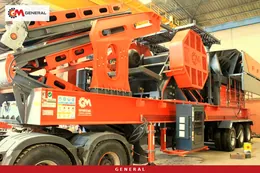
The General 01 carries a GPS 1210 triple-pendulum impact crusher, a 4-deck screen and a return conveyor on the same chassis. Because it runs in closed circuit, oversize goes back to the rotor and the plant separates 0-5, 5-12, 12-19 and 19-40 mm fractions in a single pass. Its 120-180 t/h capacity sits in the middle of the band. One unit means it moves as a single chassis when the clearance site changes and needs fewer conveyor connections at set-up. Its limit is the 700 mm feed opening: large slab pieces must be broken below that size by the excavator.
B and C: a primary impactor with a separate screen
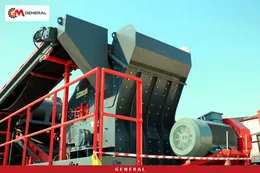
The M-PDK02 accepts feed up to 1200 mm and delivers a 0-70 mm product, which eases the excavator's workload on sites where pre-sizing capacity is limited. On its own the crusher is a 200-300 t/h unit, but the screen behind it sets line capacity. Paired with the GNR ME1650 the line in practice runs at 120-180 t/h; the 0-70 mm crusher output stays within the ME1650's 0-100 mm feed limit. For an operator aiming at the top of the range, around 200 TPH, the ME2060 is the better screening unit: a 20 m³ hopper, a 100 mm grizzly over the hopper and a 2000×6000 mm 3-deck screen handling 200-350 t/h. Since the crusher's lower capacity limit is 200 t/h, this set-up makes sense at the upper end of the band rather than in the middle.
D: the M-DMK 01 for pre-reduced rubble
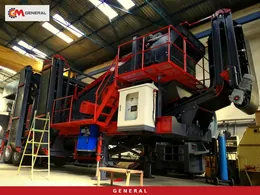
If the debris is already broken below 350 mm by the excavator, model 01 of the secondary M-DMK series (120-180 t/h, 160 kW, 32,000 kg) offers a lighter starting point. The screen and by-pass belt on its feeder table send soily fines to stockpile before they enter the crusher. If bigger blocks arrive, this set-up is wrong and a primary unit is required.
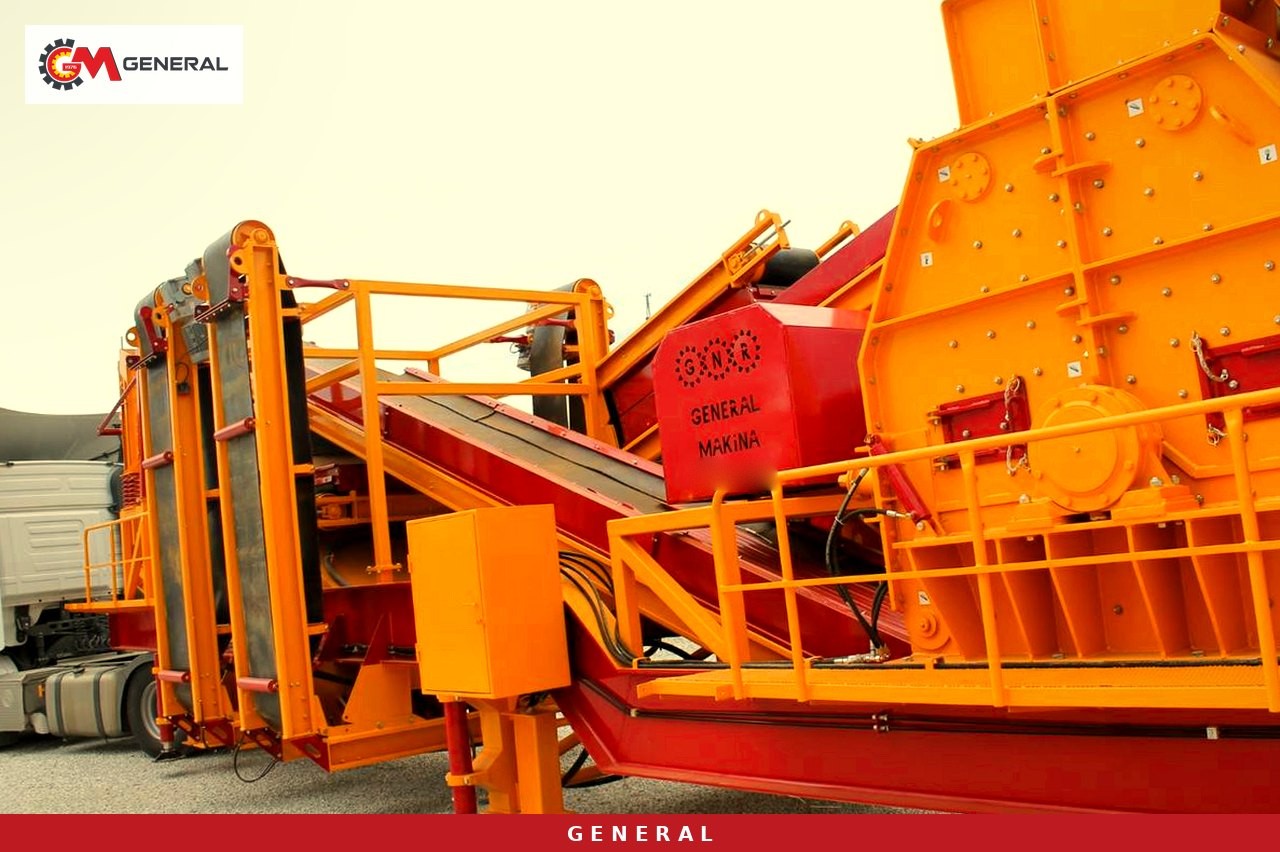
Division of work between crusher and screen, and the products you get
In rubble recycling the crusher breaks concrete and brick and releases the rebar; the value is created by the screen. Unscreened 0-70 mm crushed material can only be used as rough fill. Once the same material is split into fractions, the fine part can go into pipe bedding and sand-type fills, the middle fractions into sub-base and drainage layers, and the coarse part into temporary roads and platform fill. The project specification and laboratory tests decide which fraction may be used where, so have product samples tested regularly during the first months.
The impact crusher stands out here because of the material's character. Concrete, brick and limestone-based wall stone are low-abrasive; impact gives high reduction and cubical grains. Limestone dominates in western and coastal Syria, while basalt building stone is common in the south. If the debris contains a high share of basalt wall blocks, blow-bar wear accelerates; in that case run a wear assessment on a sample and, if needed, consider a jaw-primary combination.
Choosing the blow bar
The selection rule on the product pages is clear for rubble: tough manganese or martensitic blow bars for mixed feed with a risk of tramp steel, high-chrome white iron for clean, abrasive feed. High-chrome parts are harder but brittle; a piece of steel in the rubble can break them. Ask for the alloy and dimension list of wear parts at the quotation stage and plan to keep at least one spare set on site.
Latakia, Tartus or road haulage: shipping and site layout
From Izmir there are two natural routes to Syria: by sea via the Mediterranean ports of Latakia and Tartus, or directly by road across the common land border with Türkiye. Which crossing and route can be used, and the customs and import conditions, can change over time, so the buyer and the carrier must confirm them before contract. Wheeled-chassis units travel on the road behind a tractor; the transport dimensions are 4300×18500×4500 mm for the General 01 and 3800×10800×4500 mm for the ME1650. These sizes call for advance checks of bridges, overpasses and urban turns along the route.
When choosing a debris processing area around Aleppo, Homs or Damascus, three criteria come first: an access that trucks can reach without entering damaged streets, separate areas for the incoming debris pile and the product stockpiles, and a location as far as possible from housing. If crusher and screen are on separate chassis, the length of the link conveyor and the stockpile height of the stacking belts define the footprint. Ground must be compacted to carry the outriggers of a heavy chassis.
Power, dust and operating in the heat
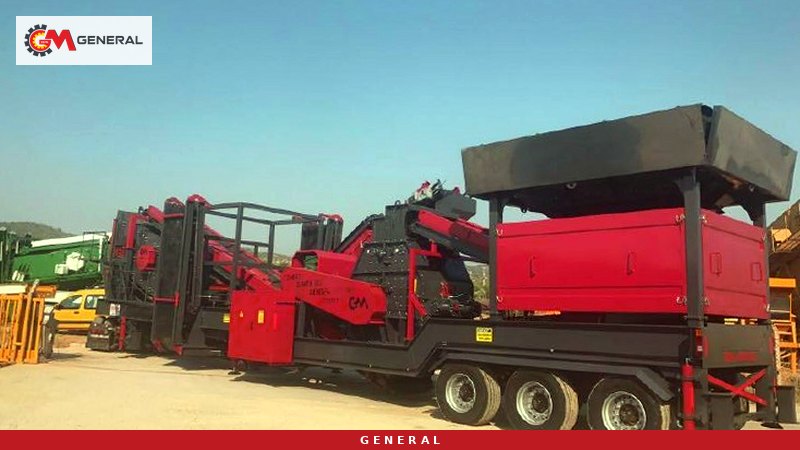
Most debris sites should not count on a reliable grid connection; plan the plant to run on its own generator. The catalogue generator value for the General 01 is 550 kVA. For lines built from separate units, generator size is calculated in the project from the total load of crusher motor, screen and conveyors; the ME1650 and ME2060 can run on a generator or the grid. Through long, hot summers, dust and heat put the most strain on the electrical panel and engine cooling. Add the following list to the site plan:
- Water-spray dust suppression at the crusher inlet, screen discharge points and stacker drop points (a project-specific option).
- A shaded, ventilated position for generator and panel; a fan-cooled panel is standard on the ME2060, extra protection for the other units is defined in the project.
- More frequent air filter checks during dusty periods, with spare filters on site.
- Seal checks on conveyor skirt rubbers and transfer chutes; plaster and brick dust is fine and light.
- Separate containers for steel and light waste at the receiving pile, with regular collection of recovered metal.
- A check of guards, emergency stops and lock-out arrangements around crusher and screen before every shift.
Information to include in your quotation request
- Approximate composition of the debris: reinforced concrete, block, stone wall, brick and soil share; photos if possible.
- Largest expected piece size after excavator pre-sizing.
- Target hourly capacity and daily operating hours.
- Required product fractions and their uses: fill, sub-base, block making and so on.
- Power situation: is there a grid, or will a generator be used?
- Delivery mode: port or land border, target city and site access conditions.
- Site dimensions and distance to the nearest housing.
With this information it becomes clear which configuration in the table fits. To review the complete machine set, see the concrete (C&D) recycling plant page; for other wheeled options browse the mobile stone crushers and portable rock crushers categories.
Frequently asked questions
Can a single unit process 200 tonnes of rubble per hour?
The catalogue capacity of the General 01 is 120-180 t/h. To reach 200 TPH, the two-unit set-up with the M-PDK02 and the ME2060 working together is more suitable; the real figure depends on debris composition and the product fractions required.
Does steel in the rubble damage the crusher?
The impact crusher does the job of separating rebar from concrete, but long, thick bars must be cut by the excavator beforehand. With mixed feed, manganese or martensitic blow bars reduce the risk of breakage caused by steel.
Is an impact crusher also suitable for basalt-heavy debris?
An impact crusher does break basalt, but blow-bar wear rises markedly. For debris with a high basalt share a sample assessment should be made and, if needed, a jaw-primary combination considered.
What warranty and certificates apply?
The machines carry ISO 9001 and CE certification and a 1-year warranty excluding wear parts. Price and delivery schedule are set in the quotation according to configuration and shipping route.
Conclusion
For rubble recycling in Syria, the right plant is chosen by debris content and pre-sizing capacity. If 120-180 t/h and a single unit are enough, the General 01; for large blocks and a target near 200 tonnes, the M-PDK02 with a separate screen; for pre-reduced rubble, the M-DMK 01 with the ME1650 are sensible starting points. Share your debris data with our team, which has been building machines in Izmir since 1976, and request a quotation through our contact page.
Definitions of technical terms: Glossary