EN — English
 TR — Türkçe
 DE — Deutsch
 RU — Русский
 FR — Français
 ES — Español
 AR — العربية
 SR — Српски

Stockpile & Radial Conveyors for a 200-300 TPH Stone Crushing Plant
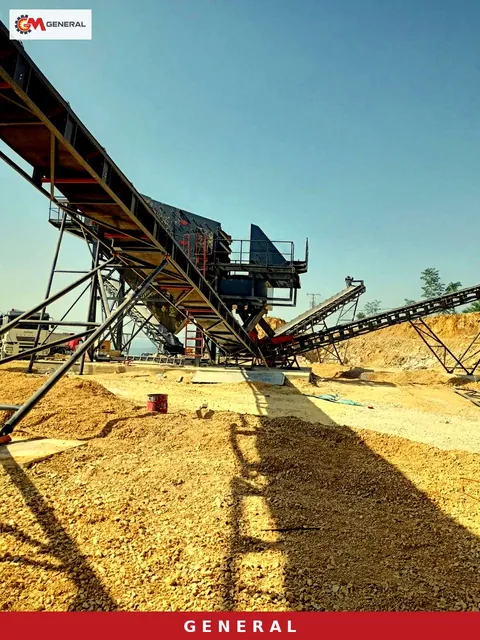
When the crusher stops on a 200-300 TPH stone crushing plant and trucks can still be loaded, the stockpile area is what makes it possible. The piles in front of the crusher and at the screen discharge work like a spring between the quarry face and the customer: they absorb material when production runs ahead and give it back when loading speeds up. This article shows how to calculate pile volume, when a fixed stockpile conveyor is enough and when a radial conveyor pays off, and how many separate stockpile points to plan for our models in the 200-300 TPH class. Model figures come from our product pages; volume calculations are hypothetical examples and are marked as such.
Treating the stockpile yard as the plant's buffer
A crushing and screening plant runs on three different rhythms. Blasting and digging at the face are intermittent, the crusher and screen want a steady feed rate, and loading follows the customer's truck schedule. The stockpile yard separates these three rhythms. An operator who keeps the yard small ends up slowing the crusher because no trucks arrived, or stopping the whole line because one product pile is full. That stop pushes up cost per tonne directly, because power and labour keep running while no saleable tonnage moves.
To size the buffer, ask a simple question: for how many hours should loading continue if the plant stops? The required stock equals the hourly draw of that product multiplied by this time. If you plan a full shift of downtime for maintenance, keep at least one shift of draw of your best-selling product in the pile. The reverse also applies: on a line that feeds a concrete batching plant or an asphalt plant continuously, the product that plant consumes needs a bigger pile than the others.
Calculating pile volume
Crushed stone falling off a head pulley piles up at its natural angle of repose. That angle depends on particle shape, moisture and fines content; measuring it on site with your own quarry material is the most reliable approach. The volume calculation is pure geometry and behaves differently for the two pile types.
The conical pile of a fixed conveyor
A conveyor whose head pulley stays at one point builds a cone. Volume is V = (π / 3) × r² × h, where h is pile height and r is base radius, found from r = h / tan(angle of repose). Hypothetical example: pile height 8 m, angle of repose 37°. The base radius comes out at about 10.6 m and the volume at about 944 m³. With a loose bulk density of 1.6 t/m³, the pile holds roughly 1,510 tonnes. Suppose the plant produces 300 TPH and, hypothetically, 90 TPH goes to the 0-5 mm product: this cone fills in about 17 hours.
The kidney-shaped pile of a radial conveyor
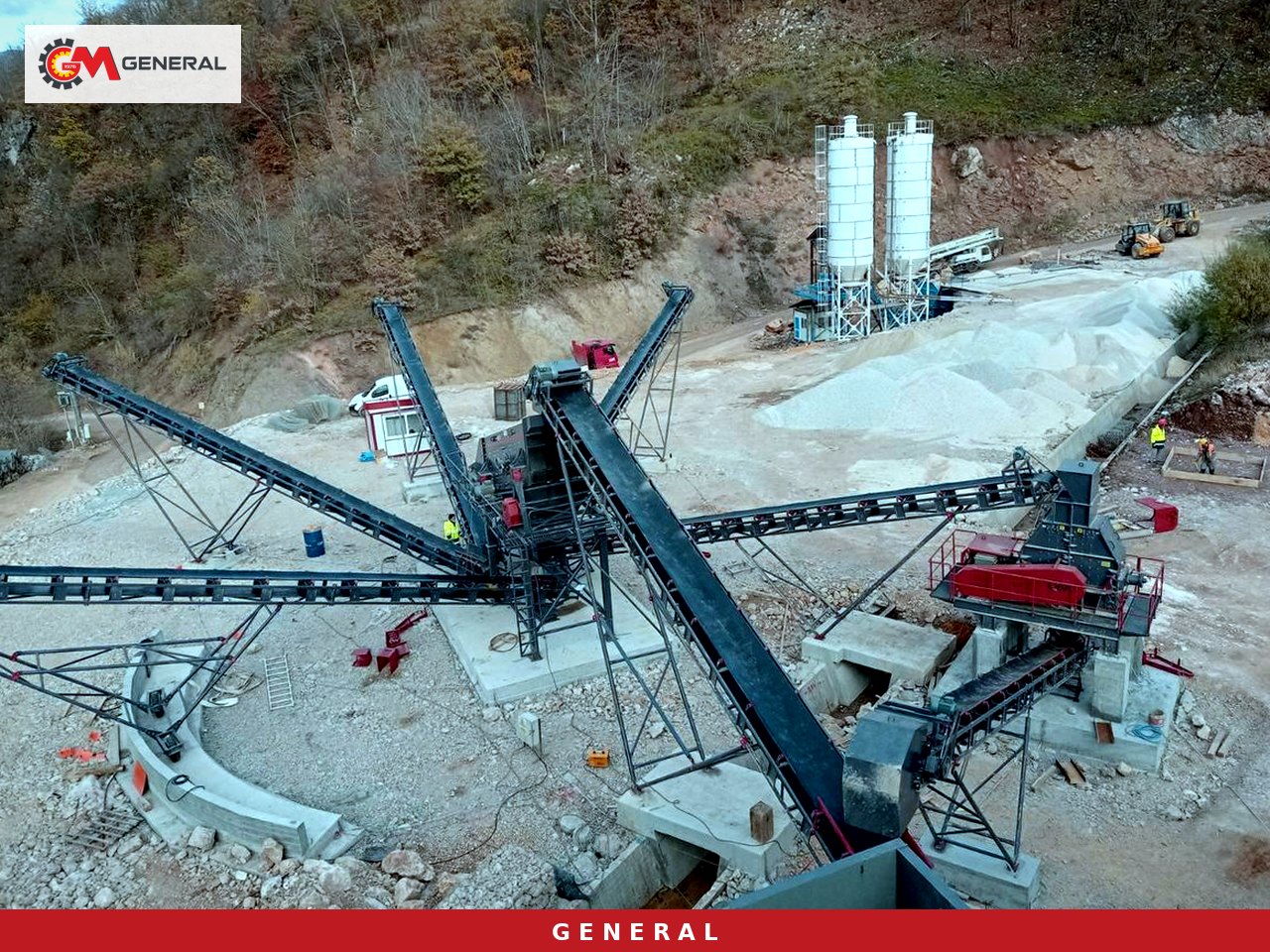
A radial conveyor slews around a pivot at its tail end and the head pulley travels along an arc. The pile stops being a cone and stretches into a kidney shape. The extra volume follows from Pappus's rule: the ridge along the arc holds θ × R × r × h, where θ is the slewing angle in radians and R is the horizontal distance from the pivot to the pile axis. With the same 8 m height and 37° angle, R = 30 m and a 90° slew add about 4,000 m³ of ridge. The total becomes about 4,950 m³, more than five times the conical pile. Conveyor height stays the same, yet storage grows; the gain comes from slewing the conveyor, not lengthening it.
| Pile type | Volume (m³) | Approx. tonnes | Ratio to conical pile |
|---|---|---|---|
| Fixed conveyor, conical pile | 944 | 1,510 | 1.0 |
| Radial conveyor, R = 30 m, 90° slew | 4,950 | 7,910 | 5.2 |
| Radial conveyor, R = 30 m, 180° slew | 8,950 | 14,320 | 9.5 |
These values do not belong to a real site. When you repeat the calculation with your own dimensions, subtract the parts of the pile the loader cannot reach: a pile worked by a wheel loader gives up almost every tonne, while in a system reclaimed through an under-pile tunnel the edges that never flow to the tunnel opening stay behind as dead stock.
Fixed stockpile conveyor versus radial conveyor
A fixed stockpile conveyor is a plain, low-investment solution: a frame, two legs and a drive unit. One conveyor is installed per product and each builds its own cone. If the yard is wide and every product pile can stay at a few thousand tonnes, a fixed conveyor is enough. Its weakness shows when the pile reaches the head pulley: either the conveyor stops or the loader keeps pushing the pile aside. That pushing burns fuel, crushes the material and contaminates it.
A radial conveyor stores the same product by spreading it around a single pivot. Because it can lay the pile down in layers, segregation of coarse and fine particles inside the pile drops. The loader can reclaim from one end while the conveyor fills the other. In return, it needs a pivot foundation, level ground for the travel wheels and a clear area along the arc. Manual, motorised or automatic slewing options are selected per project; they are not standard equipment on every model and are discussed at the quotation stage.
Products and stockpile points on 200-300 TPH models
The number of screen decks decides how many stockpile conveyors you need. A screen that makes four products means four piles and therefore four stockpile points. The table below brings together product-page data for our models in this capacity range.
| Model | Capacity (TPH) | Screen | Product sizes | Stockpile conveyor data | Power |
|---|---|---|---|---|---|
| General 02 | 250-300 | 2000×5000 mm, 4 decks | 0-5 / 5-12 / 12-19 / 19-40 mm | Return and stockpile conveyors | 660 kVA |
| General 03 | 250-375 | 2400×5000 mm, 4 decks | 0-5 / 5-12 / 12-19 / 19-40 mm | Folding hydraulic conveyors | 750 kVA |
| GNR-MC110 | 200-300 | 2000×6000 mm, 4 decks | 0-5 / 5-12 / 12-19 / 19-40 mm | Conveyors on the secondary chassis | 750 kVA |
| GNR ME2060 (dry screening) | 200-350 | 2000×6000 mm, 3 decks | 4 products | 600 mm stockpile conveyors, 800 mm main conveyor | Generator or grid |
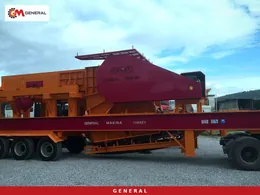
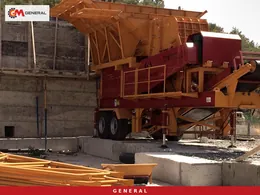
The wheeled General 02 and the twin-chassis GNR-MC110 deliver four products to separate piles with their own conveyors. The ends of these conveyors sit close to the machine, so the piles stay small. If you will work at the same spot for a long time, adding a separate stockpile conveyor at the end of each machine conveyor is the easiest way to raise pile height and volume. The dry-screening GNR ME2060 sends each product to its own pile on a dedicated 600 mm stockpile conveyor; it suits a second stockpile hub for pre-screening ahead of a crusher or for river material. Other wheeled options are on the mobile crushing and screening plants page, and solutions for a permanent line on concrete foundations are on the stationary crushing plants page.
Pile-head measures against segregation, dust and contamination
When material falls freely from height, coarse particles roll to the toe of the pile and fines stay at the top. This segregation is the usual reason for out-of-spec samples, especially on wide-range products such as 0-40 mm and on road base material. Reducing drop height, building the pile in layers and reclaiming from one face only all limit segregation.
Dust depends on the same drop height. At the end of a 0-5 mm crushed sand conveyor, wind carries off the fines: product is lost and the neighbouring pile gets dirty. A telescopic discharge chute or water spray at the head pulley are measures you can choose according to site and climate. Placing the fine product pile downwind and the coarse products upwind of the prevailing wind costs nothing extra.
The most common cause of contamination is the ground. The bottom layer of a pile built straight on soil mixes with mud, and the loader bucket carries that mud into the upper layer. Compacted fill or a concrete floor, plus dividing walls between products, keep piles from spilling into each other.
Stockpile conveyor equipment
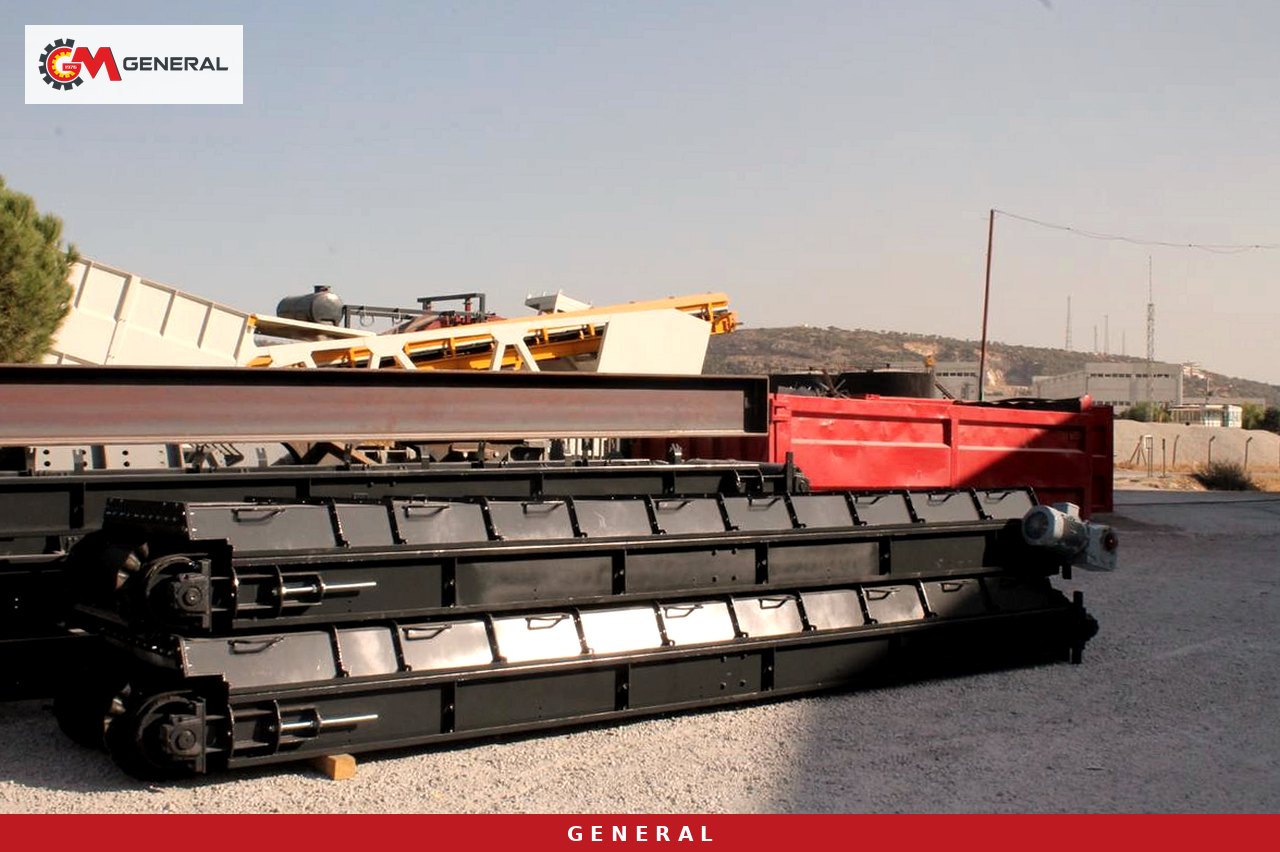
Stockpile conveyors are often the longest and steepest conveyors on the line. We build our belt conveyors in seven widths from 500 to 1200 mm, to any required length, for capacities of 50-1000 TPH. The belt accepts particles up to 250 mm. The standard belt is EP 100 with four plies; under an impact crusher, EP 125 with four plies is used. Carrying idlers are 76 mm in diameter at a maximum spacing of 1 m, and return idlers sit at 3 m spacing. Frame plate is 4 mm on 600-900 mm conveyors and 5 mm on 1000-1200 mm conveyors, and the bolted modular design makes transport and installation easier.
On a steep stockpile conveyor, chevron or cleated belting is considered instead of a flat belt. Drive is by geared motor or by belt and pulley. A backstop gearbox that stops the loaded belt running back on an incline, a pull-cord emergency switch, a speed counter and PLC-controlled automatic lubrication can be added as options. All conveyor options are collected on our aggregate belt conveyors page.
Pre-installation site checklist
- Write down each product's hourly share and the target buffer time, and derive pile volume from these two.
- Measure the angle of repose of your own material on site rather than assuming it.
- For a radial conveyor, check the position of the pivot foundation and the levelness of the ground along the slewing arc.
- Draw a loader and truck route that keeps traffic away from conveyor legs and pile toes.
- Position the fine product pile according to the prevailing wind.
- Plan compacted fill or concrete for the pile floor and dividing walls between products.
- Plan signage that bans walking under conveyors and around piles, and keep the emergency stop switch within reach.
Frequently asked questions
Does a radial conveyor replace a fixed conveyor on every site?
No. On a narrow valley floor, or on a site where a few thousand tonnes per pile is enough, a fixed conveyor is simpler and easier to maintain. A radial conveyor stands out where you must increase storage at the same conveyor height and can spare room for the slewing arc.
How should I choose the length of a stockpile conveyor?
First set the target pile height, then keep the incline at an angle the material can travel without sliding back and work out the required length. Our conveyors are built to any required length, so length follows your site dimensions.
Are the mobile plant's own conveyors enough for stockpiling?
For short jobs, yes. If the machine will work at the same point for months, adding separate stockpile conveyors at the ends of its conveyors reduces pile pushing by the loader and increases storage.
What information should I send for a quotation?
Hourly capacity, product sizes and the approximate share of each, material type, a site plan or sketch, target pile height and buffer time. With this we settle belt width, length and the choice between fixed and radial conveyors together.
Let us draw your yard layout together
On a 200-300 TPH line, the stockpile yard shapes output as much as the crusher does. Calculate pile volume with the formula, choose fixed or radial conveyors to suit the width of your site, and take segregation and dust measures at the pile head. Send your sketch and product split through our contact page and we will prepare a project-specific quotation with belt width, length and the number of stockpile points.
Definitions of technical terms: Glossary