EN — English
 TR — Türkçe
 DE — Deutsch
 RU — Русский
 FR — Français
 ES — Español
 AR — العربية
 SR — Српски

South Africa Quarry High-Capacity Stone Crushing Plant 300-500 TPH
For an investor running a quarry in South Africa, or preparing a newly permitted site for production, 300-500 tonnes per hour sits above the range where mobile machines are comfortable and at the lower step of large stationary lines. At this size the decision is less about “which crusher” and more about whether material can flow from the crusher to the stockpile without hitting a bottleneck. Below we look at the hard rock types common in South African quarries, three configurations that can be built from real General Makina models, and the belt-to-screen balance that quotations often overlook.
Every capacity, feed opening and motor rating in this article comes from our product pages. Once your rock type, post-blast block size and target fractions are clear, the configuration that fits your site becomes obvious.
How plant logic changes between 300 and 500 TPH
Around 300 t/h a single wheeled plant or a compact stationary line can do the job. Close to 500 t/h every stage has to be sized on its own: the primary crusher opening, the feeder width, the screen area and the belt widths must all carry the same tonnage. The weakest link sets the real capacity of the plant; put a 300 t/h screen behind a 500 t/h jaw crusher and you own a 300 t/h plant.
The second point is what the capacity figure actually means. Gross run-of-mine feed to the crusher is not the same as saleable aggregate; soil and fines removed by pre-scalping are part of the gross number. A hypothetical example: a quarry crushing for a net 10 hours a day and targeting 4000 tonnes of saleable product needs an average of 4000 ÷ 10 = 400 t/h. The share removed by scalping and planned stoppages are added on top. Building the calculation this way shows whether your line sits at the low or the high end of the range.
In South African quarries, rock type decides the crusher chain
South African aggregate production rests on very varied geology. Dolerite in the Karoo basin, andesite and quartzite around Gauteng, and granite and hornfels in the Western Cape are well-known quarry rocks, while limestone and dolomite are worked in some regions. This variety means two quarries in the same country can need completely different crusher chains.
In hard, high-silica rock such as dolerite, quartzite and granite, compression crushers lead: a jaw primary followed by a cone secondary. With manganese jaw plates and cone liners, this pair keeps wear cost per tonne low. In low-abrasion limestone and dolomite, a primary impact crusher delivers a very high reduction ratio and cubical grains in a single stage. We recommend determining which group your quarry belongs to with abrasion and compressive strength tests on samples; at quotation stage these results change the model choice directly.
Three realistic configurations based on model data
The table below compares the main machines that can serve a 300-500 TPH target, using the values on our product pages. Values that depend on the project are shown as “—”.
| Machine | Type | Capacity (t/h) | Feed / opening (mm) | Power |
|---|---|---|---|---|
| GNRK 130 | Jaw primary | 400-500 | 1300×1000 opening | 160 kW |
| GNRK 140 | Jaw primary | 500-600 | 1400×1100 opening | 200 kW |
| GNR PDK01 | Primary impact | 250-500 | 1000 feed | 315 kW |
| GNR-MC110 | Wheeled, jaw + impact | 200-300 | 900 feed | 750 kVA generator |
| General 03 | Wheeled, primary impact | 250-375 | 900 feed | 750 kVA generator |
| Cone crusher | Secondary / tertiary | — | — | — |
Configuration A: stationary line with jaw primary and cone secondary for hard rock
In a dolerite or quartzite quarry, the simplest route to 400-500 t/h is a GNRK 130 from the GNRK series jaw crusher family as the primary. Its 1300×1000 mm opening accepts large blasted blocks; 160 kW and 400-500 t/h fit this range exactly. If the target may exceed 500 t/h, the GNRK 140 (500-600 t/h, 200 kW) leaves one step of headroom. One or two cone crushers follow the primary; since the cone model table is issued per project according to rock and target product, we size the number of secondaries together with sample results. Among stationary crushing plants this is the longest-lasting layout.
Configuration B: primary impact line for limestone and dolomite
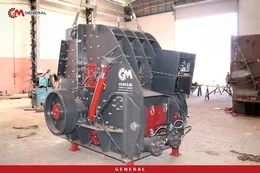
If the quarry produces low-abrasion limestone or dolomite, the GNR PDK01 primary impact crusher covers the whole range on one machine at 250-500 t/h. Its 1400×1500 mm rotor and 1000 mm feed size are paired with a 315 kW motor; the high single-stage reduction in limestone can reduce the need for a secondary. Running the same machine on dolerite or granite, however, raises blow bar consumption quickly. Configuration B therefore makes sense only when sample tests show low abrasiveness.
Configuration C: staged growth with two wheeled units
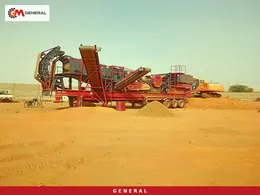
If the permit term is uncertain, or the quarry will move to another site within a few years, two wheeled plants can replace a concrete foundation. Two GNR-MC110 units running in parallel, each delivering 200-300 t/h, reach a combined 400-600 t/h. Because the MC110 primary and secondary chassis can run independently, you can start with one unit and add the second as tonnage grows. In a limestone quarry, a General 03 (250-375 t/h, 2400×5000 mm 4-deck screen) covers the lower half of the range on its own. Linking the output of two machines to shared screen and stockpile belts requires a material-flow plan as careful as on a stationary line.
At high tonnage, feeder, screen and belt line must not create a bottleneck
In this capacity class, plant efficiency is often set not by the crusher but by the equipment that conveys and separates the material. Ahead of the primary, a GNR 140 vibrating feeder, 1400 mm wide and 5000 mm long, rated 350-600 t/h (2×9.2 kW), feeds a 500 t/h line comfortably; its 15-100 m³ hopper volume and feed size up to 1500 mm absorb fluctuations in truck tipping rhythm. The grizzly by-pass section separates soil and weathered rock, common in blasted muckpiles, before they enter the crusher.
On the screening side a single conventional screen stays within 100-400 t/h. Above 400 t/h, a vibrating twin screen reaches 100-500 t/h with its double deck surface and prevents screen blinding; if needed, two screens are installed in parallel.
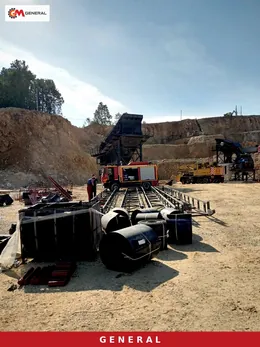
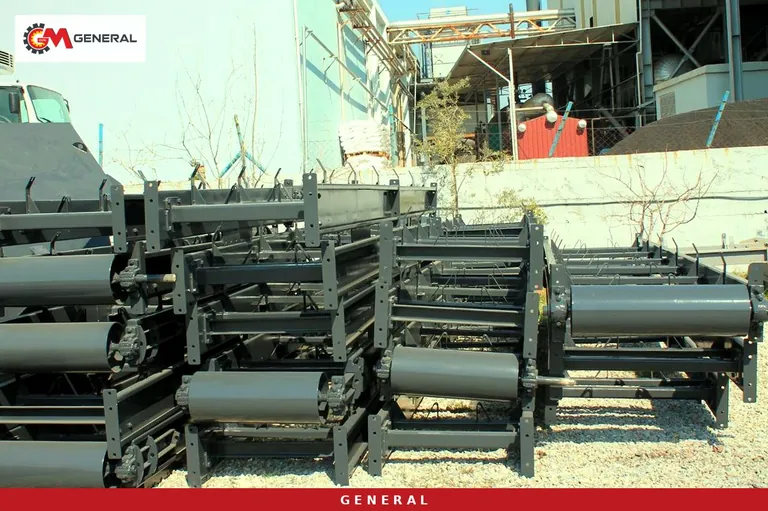
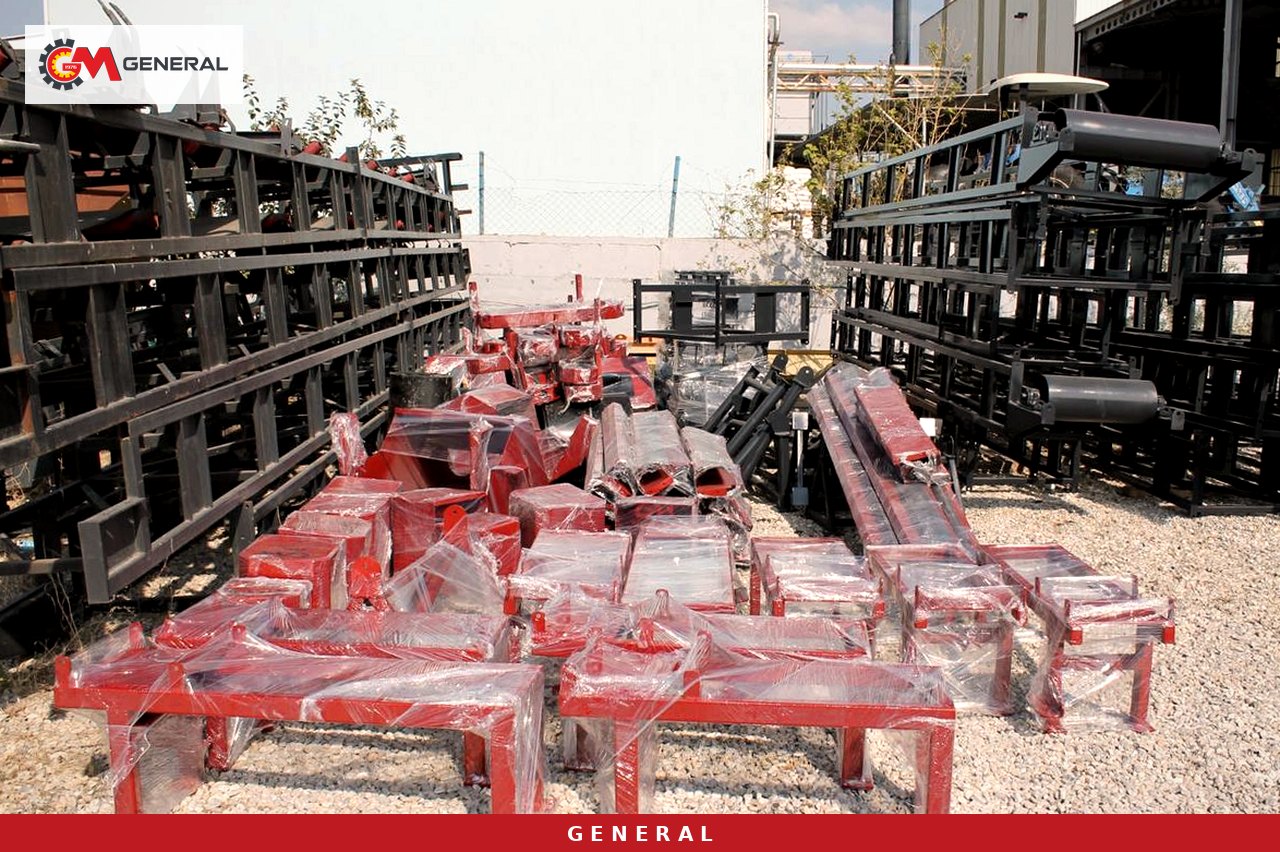
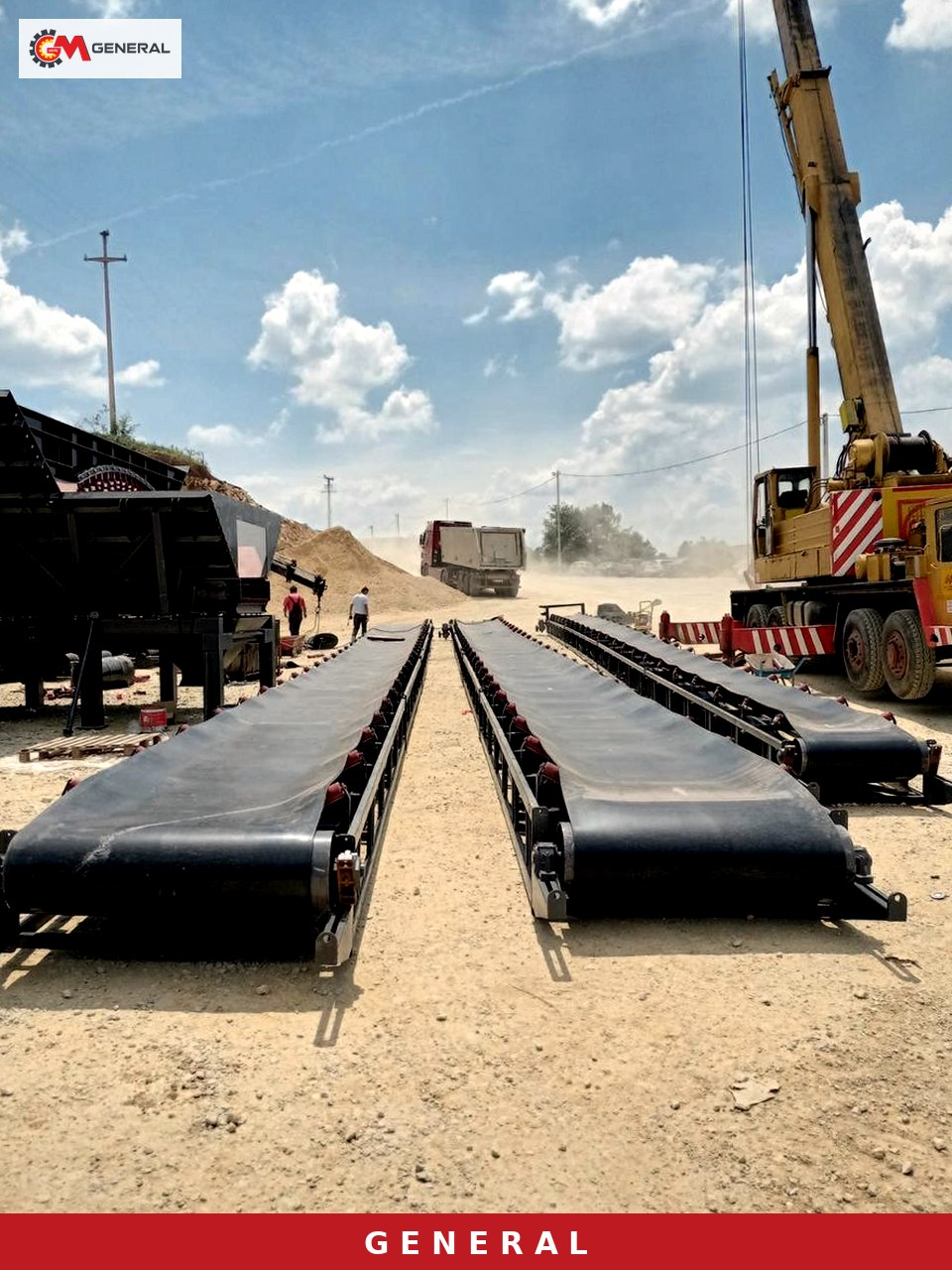
Belts are the circulation system of the plant. Our belt conveyor range is built in seven widths from 500 to 1200 mm with 50-1000 t/h capacity; for a 300-500 t/h main line, width, incline and speed are calculated together. Under impact crushers EP 125 – 4 ply belting replaces standard EP 100, and steep transfers use chevron belts. Carrying idlers are ø76 mm at a maximum spacing of 1 m, return idlers at 3 m. We size the whole belt line from our aggregate conveyor systems in the same project as the crushers and screens.
PLC-based automation is an operating necessity at this tonnage: equipment starts in sequence from the stockpile back to the feeder, when a belt stops every upstream stage stops automatically, and the feeder slows when crusher current approaches its limit. This minimises loaded-belt starts and chute blockages.
Power, dust and shipping plan for a South African site
Power set-up against grid interruptions
Scheduled power cuts (load shedding) have periodically been an issue in South Africa. On a stationary line, the 160 kW of the GNRK 130, the 315 kW of the PDK01 and the screen and belt motors should be assessed together, and grid connection and standby generator capacity calculated separately. The wheeled MC110 and General 03 come with their own 750 kVA generators; on sites with a weak grid, that independence can favour configuration C.
Dust and dry-season measures
In the dry season, transfer points are the largest source of dust. Measures that can be selected per project include water-spray dust suppression at transfer points, covered belts, screen enclosures and heavy-duty air filters on generators. Which ones are needed depends on the distance to settlements and environmental permit conditions; we recommend confirming permit requirements with the relevant authority.
From port to quarry
Equipment shipped from Türkiye is usually landed at Durban, Richards Bay, Gqeberha or Cape Town and trucked to site. The bolted modular frame of our conveyors helps here: long belts are packed in sections and assembled on site. For heavy primary crushers, bridge and road limits on the route should be checked with the haulier in advance.
Quarry data to prepare before requesting a quote
- Rock type and, if possible, laboratory abrasion and compressive strength results
- Largest block size after blasting and an estimate of soil/fines in the feed
- Daily saleable product target and actual operating hours
- Required fractions (for example sand, 5-12, 12-19, 19-40 mm) and the share of each
- Grid connection capacity or a preference for generator operation
- Site layout: level differences between stages, stockpile area and belt lengths
- Permit term: stationary line on foundations or wheeled units
- Local permit conditions for dust and noise
A flow sheet prepared with this data lets you see the differences between configurations in concrete terms. To see how a stationary line of similar tonnage is built, look at our 500 t/h stationary crushing plant in Serbia.
Frequently asked questions
Is a single jaw crusher enough for 500 TPH?
For the primary stage, yes: the GNRK 130 delivers 400-500 t/h and the GNRK 140 500-600 t/h. For saleable product, however, the secondary crusher, screen and belt capacity must carry the same tonnage; a plant is only as strong as its weakest stage.
Can a primary impact crusher be used in a dolerite quarry?
It can, but in hard abrasive rock blow bar life shortens and cost per tonne rises. Jaw + cone is more economical in dolerite, granite and quartzite; primary impact is more economical in limestone and dolomite.
Should I choose a stationary line or wheeled plants?
If the quarry will work in the same place for many years, a stationary line offers a bigger crusher, more screen decks and lower wear cost. If the permit term is short or the site will change, staged growth with two wheeled units is more flexible.
What determines price and delivery schedule?
The chosen configuration, number of crushers and screens, belt lengths, automation scope, power solution and shipping method. Share this information and we will prepare a project-specific quotation and schedule. Our machines carry a 1-year warranty (wear parts excluded).
Conclusion
In a 300-500 TPH quarry plant in South Africa, the right choice starts with the rock and ends with the belt line: GNRK 130/140 jaw primary with cone secondary for hard dolerite and quartzite, GNR PDK01 for limestone, and staged growth with two GNR-MC110 units for quarries with uncertain permits or changing sites. Our ISO 9001 and CE certified team, manufacturing in Izmir since 1976, sizes the line from feeder to stockpile belt in a single project. Send your quarry data through our contact page and we will prepare a flow sheet and quotation for you.
Definitions of technical terms: Glossary