EN — English
 TR — Türkçe
 DE — Deutsch
 RU — Русский
 FR — Français
 ES — Español
 AR — العربية
 SR — Српски

Nigeria Manufactured Sand VSI Crushing and Screening Plant 90-180 TPH
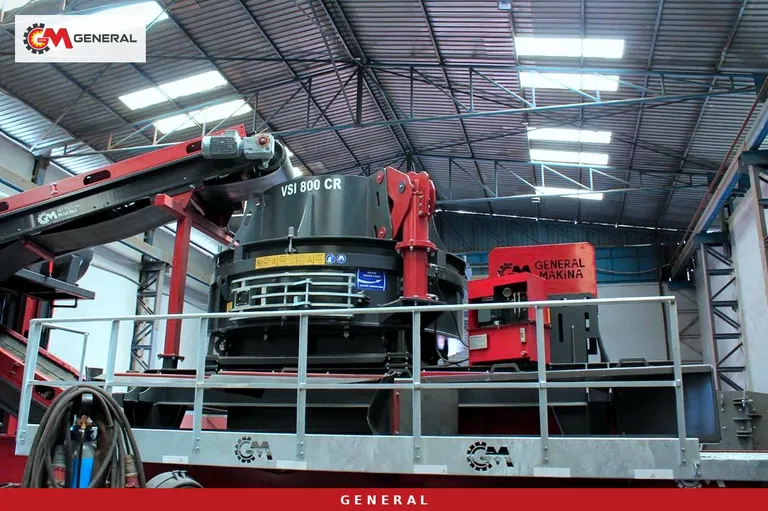
Construction sites in Nigeria mostly get their sand from two sources: "sharp sand" pumped or dug from river beds, and material dredged from coastal lagoons. Both are easy to find near the source, but the grading changes from load to load, and silt, organic matter and clay lumps arrive with it. A granite quarry operator faces a different daily problem: the 0-5 mm dust pile under the cone crusher keeps growing and occupies yard space as unsold stock. A VSI sand maker brings these two issues together at one point. It produces cubical manufactured sand (M-sand) from the quarry's own rock, with the same curve in every batch. This article explains which real models build a line producing 90-180 tonnes of sand per hour under Nigerian conditions, what the wet season and the dusty dry season change in the plant, and which data should be prepared before asking for a quotation.
What sand do Lagos and Abuja sites ask for?
In the Nigerian market sand is not a single product; the end use decides the grading. A sandcrete block maker wants medium-fine sand with little dust so that block edges do not crumble out of the mould. A ready-mix plant expects a continuous 0-4 mm curve and low clay content, because clay raises water demand and cement consumption. Plastering and screed work prefers finer, rounder sand. When designing a manufactured sand line, the first question is not "how many tonnes?" but "which buyer, in what share?".
This is where the VSI pays off. By changing rotor speed and feed rate, the fines share can be raised or lowered, and the three-deck screen splits the product into separate stockpiles. The same line can run mostly block sand in the morning and concrete sand in the afternoon. River sand offers no such adjustment: you sell whatever arrives.
The dust pile in the quarry is really raw material
The basement complex rocks spread from the south-west to the north-central regions of the country, namely granite, gneiss and migmatite, are the raw material of most quarries. They are hard and rich in silica. Granite passing through jaw and cone crushers leaves a considerable fine fraction next to the saleable chippings. That fraction comes out flaky and angular; it reduces workability in concrete, so buyers take it cheaply as "dust" or not at all.
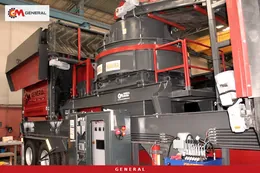
A VSI accelerates the material with a vertical rotor and throws it either against its own rock bed (rock-on-rock) or against a metal anvil. The result is cubical grains with the sharp corners knocked off. In abrasive rock such as granite the rock-on-rock mode is preferred: stone hits stone, so the metal wear parts last longer. Your 0-5 mm stock and slow-selling 5-12 mm chippings thus become feed for the sand line. Because the actual rock in a given quarry can vary, we recommend taking samples and having crushability and abrasiveness tests done; the results firm up the model recommendation.
Matching models to 90-180 TPH
The figures in the table below are taken from the product pages. VSI crushers are shaping machines; they do not break large rock. A primary-secondary stage, either existing or new, must therefore sit in front of the sand line.
| Model | Role | Capacity | Max. feed | Output / products | Power | Weight |
|---|---|---|---|---|---|---|
| GNR-MVSI 900 (wheeled) | Sand + shaping, with screen | 90-180 t/h | 50 mm | 0-20 mm; 0-3 / 3-5 / 5-12 mm | 850 kVA generator | 42,000 kg |
| GNR 900 VSI (stationary) | Sand + shaping | 80-210 t/h | 50-55 mm | — | 2×200 kW | — |
| Mobile tertiary sand unit | Sand from oversize | 60-250 t/h | 0-200 mm | 0-10 mm | — | — |
| General 944 (wheeled) | Pre-crushing: jaw + cone | 120-180 t/h | 800 mm | 0-5 / 5-12 / 12-19 mm | 550 kVA generator | 70,000 kg |
Adding a sand stage to a running granite quarry
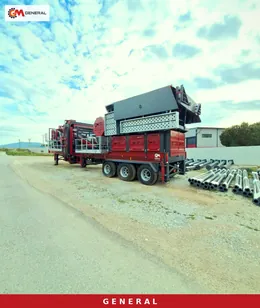
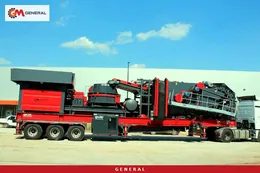
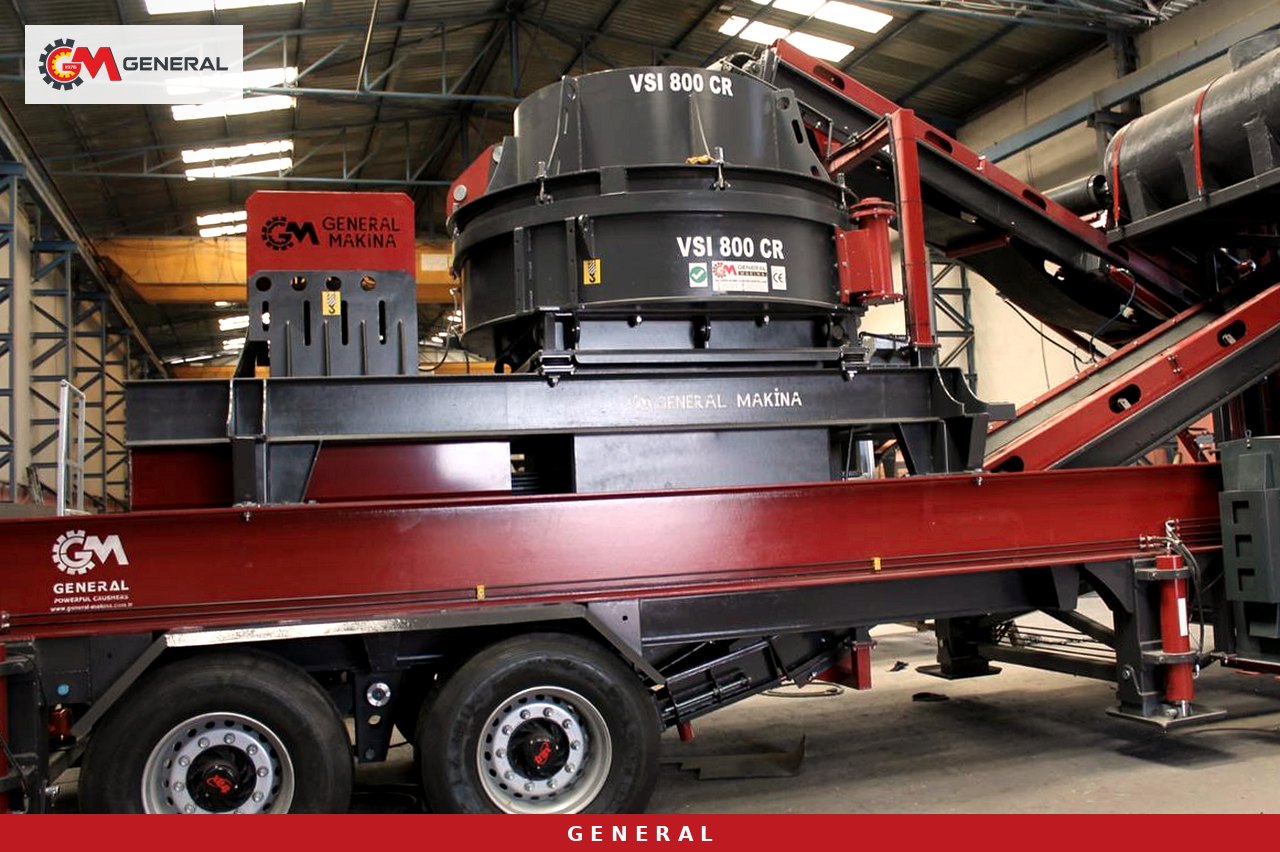
If your quarry already has primary and secondary crushing, the simplest answer is the GNR-MVSI 900. The hopper with vibrating sand feeder, the VSI 900 crusher, a 1600×5000 mm three-deck horizontal screen and the 850 kVA generator all sit on the same wheeled chassis. In a quarry with a weak grid connection, or none, not needing a separate power arrangement is a decisive advantage in Nigeria. Since the feed limit is 50 mm, a 0-50 mm belt line is split off from the secondary crusher discharge.
A sand line built from scratch
For a new quarry, a pre-crushing stage is needed first to bring the large rock below 50 mm. In granite a jaw primary with a cone secondary makes sense for metal life; the General 944 combines both crushers on one wheeled chassis and, at 120-180 t/h, sits inside the VSI's range. If the quarry life is long and the site is fixed, a stationary GNR 900 VSI can be set on a concrete foundation and run with a separate screen. If you only want to turn the oversize of your mobile crusher into sand, the mobile tertiary sand unit is a lighter investment. Compare all wheeled options on the mobile crushing and screening plants page and the stationary machines in the crushers category.
Rainy season and harmattan: tuning the line to the climate
The year in Nigeria has two characters. In the wet months the quarry floor turns to mud, fine material in stockpiles holds water and clay lumps stick to the feed belt. In the dry season the harmattan wind from the north fills the air with dust; engine air filters and electrical panels need more frequent cleaning.
- In the wet season, feeding the VSI by belt directly from the crusher rather than from the top of a stockpile reduces sticking.
- In quarries with high clay content the sand may need washing. Among sand washing equipment the screw washer accepts 0-50 mm feed and works at 50-250 t/h; moisture at the screw discharge is about 15-30%, dropping to 8-20% with dewatering.
- Dust suppression sprays at belt transfer points and belt covers are measures that can be selected per project for the dry season.
- The generator air filter and radiator should be a separate item in the maintenance plan during dusty months.
Building the product curve around the buyer
The screen decks of the GNR-MVSI 900 separate 0-3, 3-5 and 5-12 mm groups. For typical Nigerian buyers the three groups can be used as follows: 0-3 mm as plaster and screed sand, a blend of 0-3 and 3-5 mm as block and concrete sand, and 5-12 mm as cubical fine chippings for concrete and asphalt. The limits can be shifted by changing the screen meshes.
The capacity range must also be read correctly. 90-180 t/h is the amount of material entering the VSI; how much of it comes out as sand and how much as 5-12 mm depends on the rock, rotor speed and feed grading. To raise the sand share, the coarse grains retained on the screen can be returned to the VSI (closed circuit); the circulating load then becomes part of the capacity, and saleable sand stays below the feed figure. If you state your target as "this many tonnes of concrete sand per day", we size the feed and circuit accordingly.
With manufactured sand, the point to watch is the amount of fine dust. The VSI makes cubical grains from granite, but the share below 75 microns also rises. If the concrete specification limits it, either light washing or removing part of the fine fraction with the screen decks is required. Confirm which limit applies from your buyer's specification and the relevant authority; the line is designed to that value.
From port to site: transport, installation and the quotation file
Wheeled chassis are shipped by sea to Nigerian ports and towed by road from there to the site. The GNR-MVSI 900 has a transport size of 4100 × 16200 × 4500 mm and weighs 42,000 kg; the General 944 measures 4130 × 20350 × 4500 mm and weighs 70,000 kg. Bridges, village crossings and the gradient of the quarry road on the route from the port should be checked in advance; in the rainy season, earth quarry roads may struggle to carry a heavy chassis.
Sending the following in one file when asking for a quote lets the right model be fixed in the first meeting:
- The quarry's state and the road route to the nearest port.
- Rock type (granite, gneiss, limestone) and, if possible, laboratory test results.
- Models of the existing crushers and the quantity of 0-50 mm material that can be diverted to the VSI.
- Target products and the daily sales share of each: block sand, concrete sand, fine chippings.
- Is grid power available, or will the line run entirely on a generator?
- If the sand will be washed, the water source on site and room for settling ponds.
Frequently asked questions
Can I feed run-of-quarry rock straight into the VSI?
No. The GNR-MVSI 900 accepts at most 50 mm and the stationary GNR 900 VSI 50-55 mm. Large rock must first pass through a jaw and a secondary crusher.
Can granite manufactured sand replace river sand in concrete?
The cubical grain from a VSI can be used in concrete; the fines share and clay content must be kept within the specification. Confirm suitability with a laboratory test on a sample of the sand you produce.
Rock-on-rock or anvil mode?
In abrasive rock such as granite and gneiss, rock-on-rock mode protects the wear parts. Anvil mode is considered for softer rock and when more fine product is wanted. The decision is made after sample testing.
What are the warranty and certificates?
The machines are built under ISO 9001 and carry CE; the warranty is 1 year, excluding wear parts. Price is set in the quotation according to the chosen configuration, washing needs and shipping method.
Conclusion
In Nigeria, the profitability of a manufactured sand line depends on how much of the quarry's unsold fines and chippings it can turn into saleable sand. With pre-crushing in place, the GNR-MVSI 900 brings sand making, screening and power together on one chassis; at a new quarry, paired with the General 944, it forms a balanced line in the 90-180 TPH range. Send us your rock test and target products and we will work out the right configuration together: contact and quotation request.
Definitions of technical terms: Glossary