EN — English
 TR — Türkçe
 DE — Deutsch
 RU — Русский
 FR — Français
 ES — Español
 AR — العربية
 SR — Српски

Libya Desert Limestone Stone Crushing Plant 100-200 TPH with Dust Control
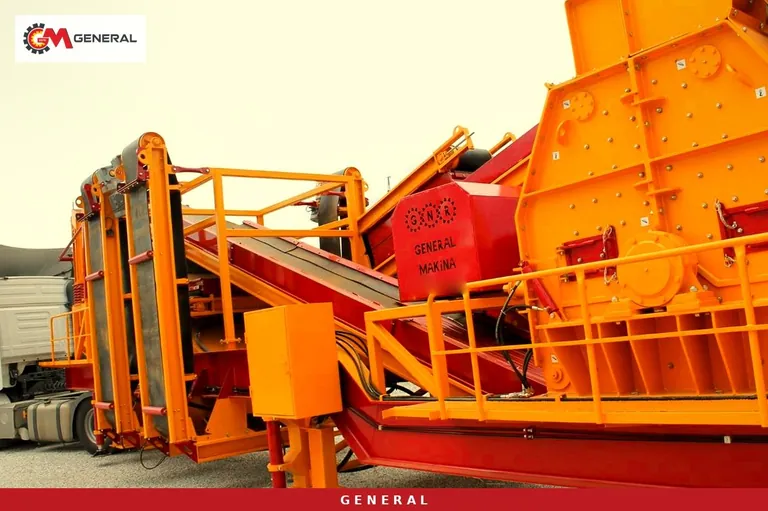
An investor crushing limestone in Libya has to solve two problems at once: getting a steady 100 to 200 tonnes of product per hour, and keeping the dust thrown up by the crusher, the belts and the screen deck from spreading across the site. Limestone suits impact crushing, but impact crushing also makes fines and dust, and desert wind carries them straight into the generator air intake, the electrical cabinet and the stockpiles. This article follows the order of decisions on site: which real model fits this capacity band, where in the plant dust is actually born, and how to suppress it when water is scarce.
What does a Libyan limestone quarry ask of the crusher?
Limestone formations are common along Libya's coastal belt and around the Jebel Akhdar in the north-east, while further inland sandy, gravelly and more mixed surfaces take over. That variety means crusher selection can change from one quarry to the next even within the same country. When the limestone is brittle and low in silica, a horizontal shaft impact (HSI) crusher gives both a high reduction ratio and a cubical grain. If the same bed carries chert bands or quartz veins, blow-bar wear accelerates and the calculation changes. The first step is therefore to have a representative quarry sample tested by an accredited laboratory for abrasiveness and compressive strength, and to tie machine selection to that report.
The second criterion is the product list. Libyan limestone aggregate mostly goes into road sub-base, concrete and block production. Concrete needs 0-5 mm sand plus 5-12, 12-19 and 19-40 mm chippings, while road work may accept a single well-graded sub-base. If one fraction is enough, a screen may not be needed; if four are required, a screened line is essential. This split decides which of the configurations below makes sense.
Real configurations for the 100-200 TPH band
No single model has to cover the whole range in the title; what matters is choosing the setup that meets the target tonnage with the actual behaviour of the rock. The figures below are catalogue values from the product pages, and each one belongs only to the model named.
| Configuration | Capacity (t/h) | Max. feed (mm) | Crusher | Screen | Generator (kVA) | Weight (kg) |
|---|---|---|---|---|---|---|
| General 800 (wheeled, single chassis) | 80-150 | 600 | PDK 1280 primary impact | 1300×4000 mm, 3-deck | 450 | 35,000 |
| General 01 (wheeled, single chassis) | 120-180 | 700 | GPS 1210 impact (primary + secondary) | 1600×5000 mm, 4-deck | 550 | 55,000 |
| M-PDK02 mobile primary HSI | 200-300 | 1200 | Primary impact, 250 kW | — | — | 45,000 |
| M-DMK 02 mobile secondary HSI | 150-250 | 350 | Secondary impact, 200 kW | Feeder with by-pass screen | — | 38,000 |
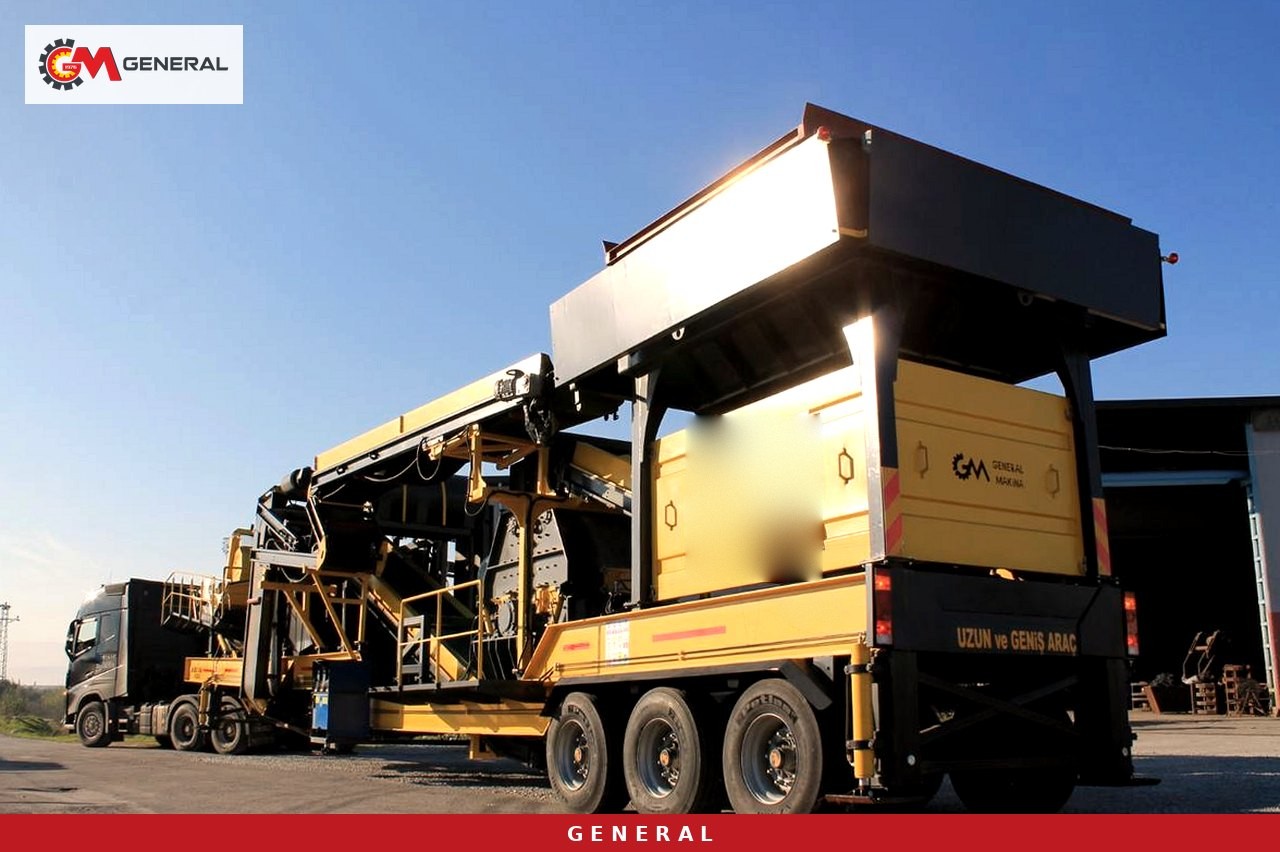
The General 800 covers the lower half of the band: 80-150 t/h, with a PDK 1280 primary impact rotor and a 3-deck screen producing four fractions from limestone. If post-blast boulders exceed 600 mm, the quarry needs secondary breaking or a blast design matched to the crusher inlet.
For the middle of the band the General 01 is better balanced. Its two-chamber GPS 1210 rotor does primary and secondary work in one housing, so 120-180 t/h comes from one chassis with a 4-deck screen. The by-pass grizzly feeder removes soil and fines before the crusher, which is the first point won in dust management.
As the target approaches 200 t/h, a two-unit setup comes in: the M-PDK02 accepts quarry rock up to 1200 mm and reduces it to 0-70 mm, after which the M-DMK 02 turns that product into 0-50 mm cubical aggregate. The bottleneck of this pair is the secondary side, so the practical ceiling is set by the M-DMK 02's 150-250 t/h range. Separating fractions requires a separate mobile screen at the end of the line, and the power demand of both units must be added together when sizing the generator.
Where is dust born in the plant?
Treating dust control as one single "system" is misleading. In a limestone line the dust sources are well defined, and each needs its own measure.
Feeding and pre-screening
When a truck or loader tips into the hopper, the fine portion lifts into the air. Side curtains on the wind-facing faces of the hopper and spray nozzles that run during tipping shrink the first cloud. Because the by-pass grizzly separates soil, it also cuts the dust load entering the crusher; the belt receiving that rejected material must have a covered mouth, otherwise the problem simply moves elsewhere.
Crusher discharge and belt transfers
Rotor speed makes an impact crusher push air out at the discharge, and fine particles rise with it on the belt. Rubber skirting under the crusher, enclosed chutes at transfer points and light sheet covers over the main conveyor limit that movement. The screen deck is another major source: a dust cover can be fitted over the screen box, and the stockpile belt for the finest fraction should be placed with the wind direction in mind.
Generator, motors and electrical cabinet
Without grid power, energy comes from the generator, and this is where dust costs the most. A pre-cleaner (cyclone type) on the generator intake, dust-sealed cabinet doors and, where possible, a pressurised control cabin are worth considering. These are not listed as standard on the models; they are measures selected for the site during the project stage and should be requested as separate line items in the quotation.
A dust suppression plan for a desert site with little water
At a desert quarry water usually arrives by tanker, and every litre is logistics. The aim is therefore not to soak the material but to target the moment dust mixes with air. Fine-mist nozzles cover a wider area with less water than coarse jets; dosing matters too, because over-wetted limestone can blind the screen mesh. Use this checklist when planning:
- Rank spray points: hopper tipping, crusher discharge, screen deck, stockpile belt head.
- Fit simple valve logic so each point opens only while material is passing; a nozzle running empty wastes water.
- Shade the water tank from the sun and feed the line through a filter; sand that blocks a nozzle quietly ends dust control.
- Check skirts and covers at transfer points on a weekly round; torn rubber is the shortest escape route for dust.
- Shorten generator air filter cleaning intervals on windy days and keep spare filter elements on site.
- Locate stockpiles according to the prevailing wind; never put the fine fraction downwind of the plant.
- Dampen haul roads separately; very often the biggest dust source is the road, not the crusher.
Short production stops on days when hot, dusty winds such as the ghibli blow should also be written into the plan. Once the wind drops, filters and belt edges are cleaned first and only then is the line loaded again. This discipline protects bearings and motors even more than it protects wear parts.
Shipping, layout and the data needed for a quote
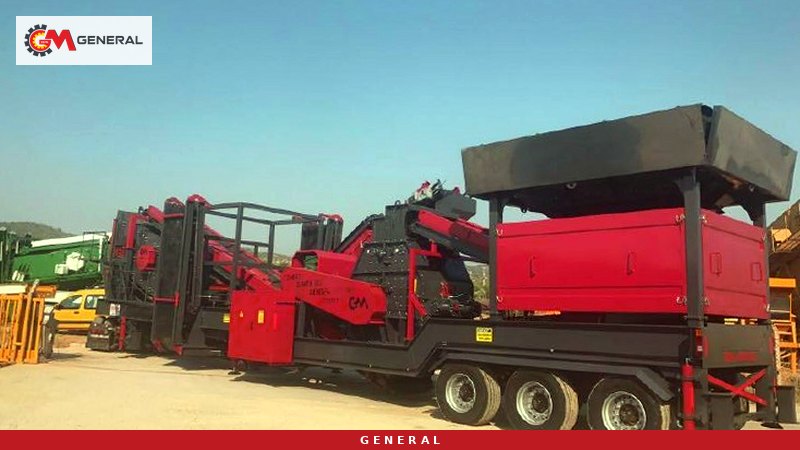
A wheeled unit travelling from Türkiye to Libya usually reaches a port such as Tripoli, Misrata or Benghazi by sea and is then towed by road to the quarry. Port, route and customs requirements can change, so confirm current details with the relevant port authority and your freight forwarder. The transport dimensions are 3600×15500×4500 mm for the General 800 and 4300×18500×4500 mm for the General 01; these figures are needed for tractor selection and for checking bridges and overpasses on the route.
On site a wheeled chassis needs a firm, level platform; support legs will not seat on loose sand. Keeping the crushing point close to the quarry face shortens haul roads and therefore road dust. Our website features the GNR Series mobile crushing plants delivered to Libya which is a useful reference for layout ideas.
For an accurate quotation, send us:
- The laboratory report on the limestone (abrasiveness, compressive strength, moisture) and any chert or clay content.
- The largest block size after blasting.
- Target products and the approximate share of each fraction.
- Daily operating hours and target hourly tonnage.
- Power source: grid or generator.
- Water access on site and the dust conditions required by the local authority.
To compare single-chassis and modular options side by side, browse the wheeled mobile crushing and screening plants and the mobile crusher units categories.
Frequently asked questions
Impact or jaw crusher for Libyan limestone?
If the limestone is brittle and low in silica, an impact crusher gives a more cubical product and higher reduction. If the sample shows high quartz or chert, a jaw primary with a cone or cubicizer secondary is considered; the laboratory report makes the call.
Does dust control come as standard?
The by-pass grizzly and the single-chassis layout are design features that reduce dust. Spray nozzles, belt covers, cyclone pre-filters and cabinet protection are additional measures chosen for the site and itemised in the quotation.
Is one machine enough for 200 t/h?
Among the single-chassis catalogue models, the General 01 reaches a maximum of 180 t/h. Around 200 t/h calls for a two-unit setup of M-PDK02 primary and M-DMK 02 secondary plus a separate screen.
How are price and warranty determined?
Price depends on the model, screen and generator choice, dust measures and shipping scope, so each quotation is prepared for the project. The products carry ISO 9001 and CE certification, with a 1-year warranty excluding wear parts.
Conclusion
For 100-200 TPH of limestone in Libya, the right path is to test the sample first, then choose the General 800, the General 01 or the M-PDK02 and M-DMK 02 pair according to tonnage, and plan dust measures separately for the hopper, crusher discharge, belt transfers and generator. Send your site data through our contact page and our engineers will prepare the configuration and quotation for your crushing and screening plant.
Definitions of technical terms: Glossary