EN — English
 TR — Türkçe
 DE — Deutsch
 RU — Русский
 FR — Français
 ES — Español
 AR — العربية
 SR — Српски

Power and Water Supply for Mobile Plant on Site
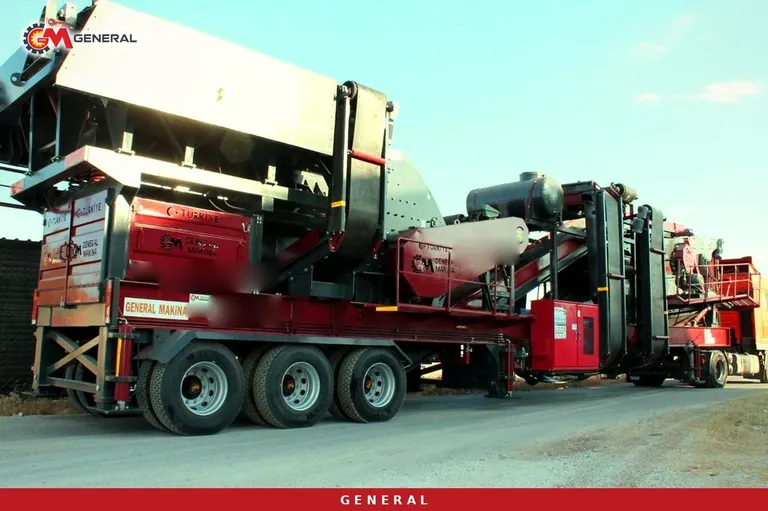
When a plant lands on site the erection crew is ready, but electricity and water usually are not. Power and water supply for mobile plant on site is an item to be planned alongside machine selection rather than after it, because both the generator and the water line are sized to the plant configuration. Load, starting behaviour, distribution and the water side are treated in turn below.
Start from installed load
Planning begins by adding up the rated power of every motor in the plant: crusher, screen, feeder, conveyors, pump and, where fitted, the washer. That sum is the installed load, and it is not the power drawn at any one moment. Conveyors run continuously, the crusher draws a variable load with feed, and the washer may or may not be in circuit depending on the operating mode. Installed load is therefore never used on its own to size a generator.
A generator is rated in kilovolt-amperes while motor power is stated in kilowatts. The link between them is the power factor: active power equals apparent power multiplied by the power factor. Looking at the kilowatt sum and picking a machine of the same number of kilovolt-amperes therefore falls short; on a crushing line where inductive load dominates, the apparent power requirement is higher.
What manufacturer generator figures tell you
Mobile plant manufacturers publish an optional generator rating matched to the plant configuration. Because that figure is set with all consumers of that plant and its starting behaviour in mind, it is a sound starting point on site. The table below places capacity and optional generator rating side by side for mobile plants of different sizes.
| Plant | Capacity | Optional generator |
|---|---|---|
| General 640 Mobile Crusher | 60-100 t/h | 300 kVA |
| Mobile 90 Jaw Crushing Washing Screening Plant | 90-150 t/h | 350 kVA |
| General 800 Mobile Crusher | 80-150 t/h | 450 kVA |
| General 01 Mobile Crusher | 120-180 t/h | 550 kVA |
| General 944 Mobile Cone Crusher | 120-180 t/h | 550 kVA |
| General 950 Mobile Crusher | 120-180 t/h | 600 kVA |
| General 02 Mobile Crusher | 250-300 t/h | 660 kVA |
| GNR-MC110 Mobile Jaw Crusher | 200-300 t/h | 750 kVA |
| General 03 Mobile Crusher | 250-375 t/h | 750 kVA |
| GNR-MVSI 900 Mobile Vertical Shaft Impactor | 90-180 t/h | 850 kVA |
The table makes two things visible. First, the generator rating does not rise linearly with capacity; the crusher type governs it. Second, the highest rating appears not on the highest-tonnage plant but on the vertical shaft impactor, because sand making demands more energy per tonne produced.
Starting current and the distribution side
An induction motor started direct on line draws roughly six to eight times its rated current. That current is short-lived, but the supply source, the cable and the protective devices must be chosen to see the surge. Otherwise voltage dips at the moment of starting, other motors on the same feeder are affected and protection trips without a real fault.
Two approaches are used in practice. The first is to sequence the start: motors are energised one by one, beginning from the product end of the line, rather than all together. The second is a starting method that limits the inrush. Running the start sequence automatically from the control panel also removes the chance of an operator taking them out of order.
On the cable side two criteria are checked together: current carrying capacity and voltage drop. The second is skipped more often on site; when the generator is placed far from the plant, an undersized cable delivers less than rated voltage at the motor terminals and the motor overheats. The position of the panel and the supply distance therefore belong in the layout drawing.
The water side: two different demands
Water performs two separate duties on site and each is sized separately. Dust suppression water binds dust at transfer points and on haul roads; it works on demand rather than continuously and at a comparatively low flow. Washing water is process water: it flows continuously to remove fines and clay from the material, and its flow rate is in an altogether different order.
That distinction drives the storage decision. On a site doing dust suppression only, a bowser and a modest tank may be enough. Once a washing line runs, a settling pond and a recovery circuit become obligatory, otherwise fresh water consumption quickly outgrows the site source. Where concrete production is also in circuit, water is measured and logged separately because aggregate moisture shifts the mix proportion; in mobile concrete plant installations that measurement is planned from the outset.
Frequently asked questions
Is a generator needed where grid supply exists?
Even on sites with a grid connection, whether the transformer capacity absorbs the starting surge is assessed separately. In regions with a high risk of interruption a generator is also positioned as a standby; there the design driver is switchover time rather than continuous running.
Is oversizing the generator harmful?
A heavily oversized generator runs at low load, which is unfavourable for fuel efficiency and engine health. The sound approach is a rating that absorbs the starting surge yet remains reasonably loaded in continuous operation.
At what stage is the water line laid?
At the same stage as ground preparation. Cutting a trench after the platform is laid damages the prepared surface and reduces its stiffness. The pipe route is taken outside the truck manoeuvring area.
Start the power and water calculation in the same week as the plant order; delays in generator and cable supply hold up erection more than machine delivery does. Further reading on site erection is collected under mobile plant.
Definitions of technical terms: Glossary