EN — English
 TR — Türkçe
 DE — Deutsch
 RU — Русский
 FR — Français
 ES — Español
 AR — العربية
 SR — Српски

Mauritius Volcanic Rock Sand: VSI Crushing and Screening Plant 90-180 TPH
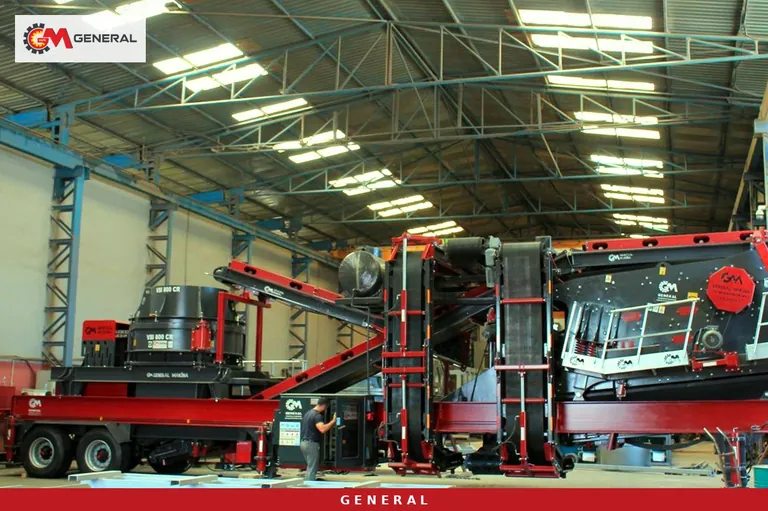
For anyone running a concrete batching plant, a precast block yard or an asphalt plant in Mauritius, crushed stone is not hard to find; the real bottleneck is sand. The island is volcanic in origin and what comes out of its quarries is mostly dark, hard basalt. Rivers are short, and taking beach and lagoon sand is restricted for environmental protection reasons. That situation brings every island-scale aggregate investment back to the same question: how do you make cubical sand fit for concrete from the quarry's own volcanic rock? In this article we build a sand line around a vertical shaft impactor (VSI) for a target of 90-180 TPH using real model data, and work through how basalt behaves inside the rotor, the upstream crushing stage, the washing decision, the tropical climate and shipping through Port Louis. We recommend confirming the current rules on sand extraction and quarry permits with the competent authorities in Mauritius.
Why sand has to come from the quarry in an island economy
In a country with no land border, every tonne of imported sand means freight, port handling and storage; supply is tied to the shipping schedule, and the site's concrete pouring programme slips along with it. Producing sand from the basalt the quarry owner already has reduces that dependence. There is a second advantage: because manufactured sand comes from the same rock in every batch, its grading is a controllable product. By changing screen apertures and the VSI setting, the ratio between 0-3 mm and 3-5 mm can be shifted to suit the concrete mix design.
Another situation is common in existing quarries: the fines produced by the primary and secondary crushers are flaky, angular and dusty, and the concrete producer does not want to buy them as sand. At the same time, some coarse fractions can pile up faster than they sell. A VSI tackles both problems at once. It turns surplus coarse material into sand, corrects the particle shape of the fines and makes the imbalance in the stockyard part of the production plan.
How volcanic basalt behaves in a VSI rotor
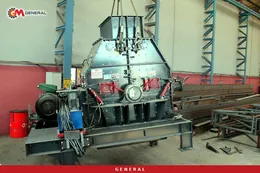
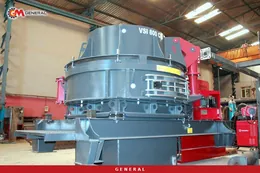
A VSI accelerates material with a vertical rotor and throws it against anvils or against a bed of rock that builds up around the rotor. As stated on the GNR series vertical shaft impactor page, the rotor brings material up to roughly 80 m/s. The job of this machine is shaping rather than size reduction, which is why it is used for sand making and cubical fine aggregate.
Basalt is a hard and abrasive rock. For that reason, rock-on-rock (autogenous) operation comes to the fore with Mauritian basalt. In this mode the rock bed that forms inside the rotor takes over the role of the wear surface, and metal parts such as rotor tips and wear plates last longer. For high-silica material, rotor tips reinforced with ceramic or tungsten carbide can also be chosen. Anvil mode gives more crushing but raises metal consumption; the quarry's rock decides which mode is economical.
Massive basalt and vesicular lava do not make the same sand
On a volcanic island, the same quarry site can contain porous, scoriaceous lava layers alongside massive, dense basalt. Vesicular rock breaks down far more easily in the rotor; the dust content rises and an unwanted amount of very fine material can accumulate in the sand fraction. Massive basalt gives a sounder, more cubical grain but consumes wear parts faster. So even within a single quarry, a separate sample should be taken from each layer. The laboratory result tells you which layer suits sand production; deciding by eye leads to the wrong configuration.
Three real VSI options that fit the 90-180 TPH target
We have three products that cover the capacity range in the title. All figures below come from the respective product pages; unknown cells are left as "—".
| Parameter | GNR-MVSI 900 (wheeled mobile) | GNR 900 (stationary VSI) | Mobile tertiary sand machine |
|---|---|---|---|
| Capacity | 90-180 t/h | 80-210 t/h | 60-250 t/h |
| Maximum feed | 50 mm | 50-55 mm | 0-200 mm |
| Crusher | VSI 900 vertical shaft | 900 mm rotor | VSI principle, rock-on-rock |
| Product | 0-20 mm; 0-3 / 3-5 / 5-12 mm fractions | — | 0-10 mm manufactured sand |
| Screen | 1600×5000 mm, three-deck horizontal | — | — |
| Power | 850 kVA generator | 2×200 kW motors | — |
| Weight | 42,000 kg | — | — |
| Transport dimensions | 4100×16200×4500 mm | — | — |
GNR-MVSI 900: crusher, screen and power on one chassis
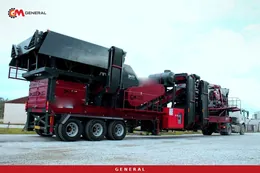
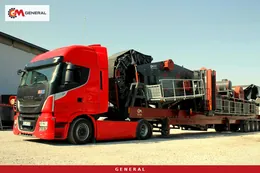
The GNR-MVSI 900 is the model that covers the 90-180 TPH range in the title on its own. A hopper with a vibrating feeder delivers material to the VSI 900 crusher; the crushed product is split on a 1600×5000 mm three-deck horizontal screen into 0-3, 3-5 and 5-12 mm fractions and conveyed to separate stockpiles. Thanks to its 850 kVA generator it can also work in a quarry with no grid connection. One point not to forget: this is a shaping stage, not a primary plant; rock above 50 mm must not be fed to it.
Stationary GNR 900: when the quarry life is long and the site is fixed
The stationary VSI does the same job in the 80-210 t/h range, with 50-55 mm feed and 2×200 kW of motor power. It needs a foundation and a separate screen and conveyor system, so it makes sense for investments where the quarry location will not change for years and grid power is available. On a site with limited reserves or a chance of relocation, the set-up speed of a mobile chassis is worth more.
Mobile tertiary sand machine: for screen oversize surplus
For operators who already own a mobile crushing plant and want to make use of oversize from the screen, this unit accepts 0-200 mm feed and produces 0-10 mm manufactured sand at 60-250 t/h. Because no integrated screen is defined on the product page, the need for fraction separation should be clarified separately at the quotation stage.
The upstream stage that prepares sub-50 mm feed, and the washing decision
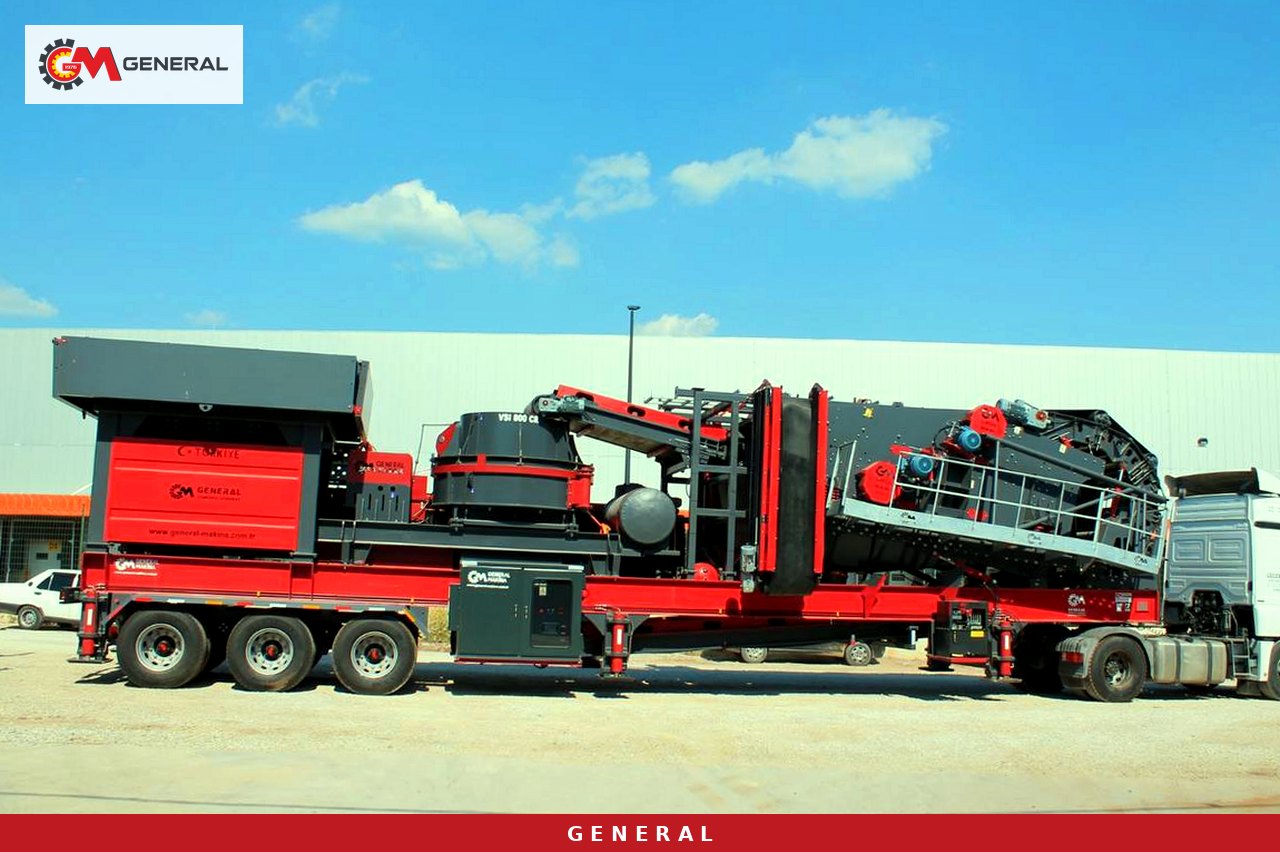
A VSI cannot process quarry rock directly; it needs a crushing chain in front of it that brings the rock below 50 mm. For hard basalt, the model whose capacity matches this line is the General 944: it combines a GPJ 90 jaw primary and a GM430 cone secondary on the same wheeled chassis, runs at 120-180 t/h, accepts 800 mm feed and delivers 0-5, 5-12 and 12-19 mm fractions on a 1600×5000 mm three-deck screen. Because a cone crusher breaks rock by compression, metal life in abrasive basalt is longer than with an impact secondary. The 944 runs on its own 550 kVA generator and the MVSI 900 on its 850 kVA generator, so the power plan is made separately for each unit. You can compare other wheeled options on the mobile crushing and screening plants page.
The flow between the two units is simple to set up: coarse fractions leaving the 944's screen that look surplus in the sales plan are conveyed to the MVSI 900 hopper, and the VSI output is split into sand fractions on its own screen. Which fraction goes to the VSI, and in what proportion, depends on the quarry's rock and on market demand; nobody can state the sand yield before a sample test.
Should manufactured sand be washed?
With sand made from basalt, the problem is usually not clay but excess rock dust. If the concrete specification limits fines, or if overburden gets mixed into the feed, a screw sand washer completes the line: 0-50 mm feed, 50-250 t/h capacity, single and twin models. Moisture at the screw outlet is typically 15-30%; adding a hydrocyclone and a dewatering screen brings it down to the 8-20% band. Clay and fines levels are measured with the methylene blue value or the sand equivalent test. If washing is planned, the water source and the handling of muddy water must be planned from the start.
Tropical climate, sea air and shipping via Port Louis
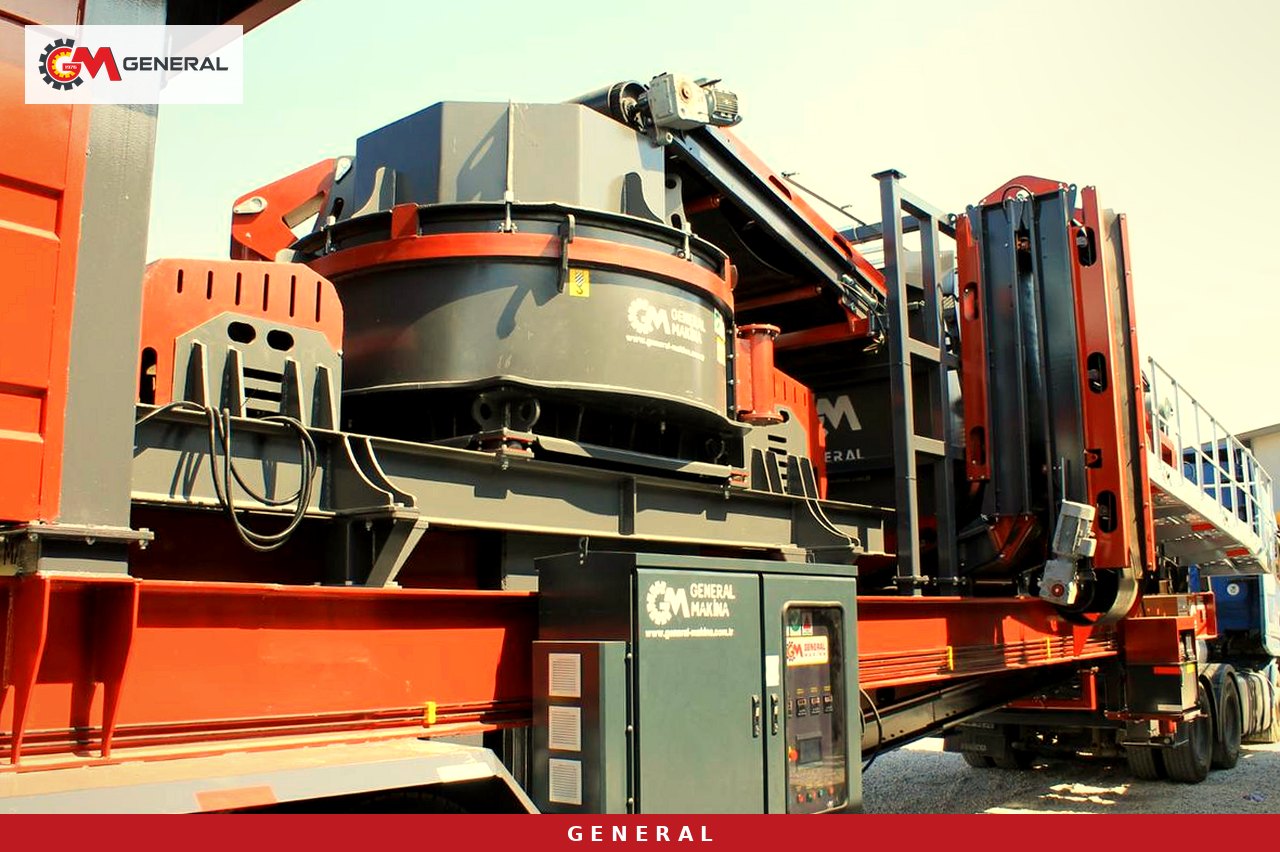
Machines reach the island by sea, and the main point of entry is the port of Port Louis. The GNR-MVSI 900 has transport dimensions of 4100×16200×4500 mm and weighs 42,000 kg; the General 944 measures 4130×20350×4500 mm and weighs 70,000 kg. These values determine the vessel type, handling at the port and the road route from the port to the quarry. Bridges, narrow village roads and bend radii should be checked on site before shipment.
The humid tropical climate has three practical effects on operation:
- Wet fines can blind screen meshes; in the rainy season, screen aperture and mesh type should be chosen accordingly.
- Salt in the sea air accelerates corrosion; the paint system and the sealing of electrical panels are measures that can be selected per project.
- Lowering conveyors and securing the chassis during cyclone warnings should be written into the site procedure.
At quarries close to residential areas, water spraying and enclosed conveyors around the VSI and screen can also be added per project to control dust. Because of island logistics, planning consumables such as rotor tips, wear plates and screen meshes together with the first order shortens downtime; these parts are listed on the spare and wear parts page. Our machines carry a 1-year warranty; wear parts are excluded from warranty cover.
What belongs in the quotation file: a Mauritius checklist
- A separate sample from each layer in the quarry (massive basalt, vesicular lava), with abrasion and crushing resistance tests.
- Target products: concrete sand, plastering sand, block sand; fractions and specification limits for each.
- Hourly and daily target tonnage, shift pattern.
- If there is an existing crushing plant, the fractions it produces and its screen oversize surplus.
- Power: grid connection or generator.
- If washing is planned, the water source and muddy water management.
- Route from the port to the site, dimensions of the installation area and ground conditions.
- Confirmation of quarry and sand production permits with the competent authorities.
If you want to see in advance which machines would be combined with this information, the Design Your Plant is a good starting point.
Frequently asked questions
Can the GNR-MVSI 900 crush rock straight from the quarry face?
No. Its maximum feed size is 50 mm. The rock must first be reduced below that size in a plant with jaw and cone crushers, such as the General 944.
Can sand made from basalt be used in concrete?
A VSI produces cubical grains, and the grading is controlled through the screen settings. Whether the sand is suitable for concrete is decided by laboratory tests on a sample and by the project specification.
Can the line run on a single power source?
According to the product data, both units have their own generator: 550 kVA on the General 944 and 850 kVA on the GNR-MVSI 900. If grid power is available on site, the option of connecting to it is assessed at the quotation stage.
What determines the quotation amount?
The number of units selected, whether a washing line is included, the initial wear parts package, sea freight and installation conditions on site. Once these items are clear, a project-specific quotation is prepared for you.
Conclusion
In Mauritius, the answer to the sand problem lies in the quarry's own basalt. For the 90-180 TPH target the GNR-MVSI 900 is a direct fit; the General 944 is added in front of it for hard basalt, and a screw washer line completes it if the specification requires. The order of decisions is: first layer-by-layer samples, then the fraction targets, and only then the machine list. Send your sample information and target products through our contact page and our team in Izmir, building crushing and screening plants since 1976, will design the line around your rock.
Definitions of technical terms: Glossary