EN — English
 TR — Türkçe
 DE — Deutsch
 RU — Русский
 FR — Français
 ES — Español
 AR — العربية
 SR — Српски

Gulf VSI Sand Crushing and Screening Plant 200 TPH
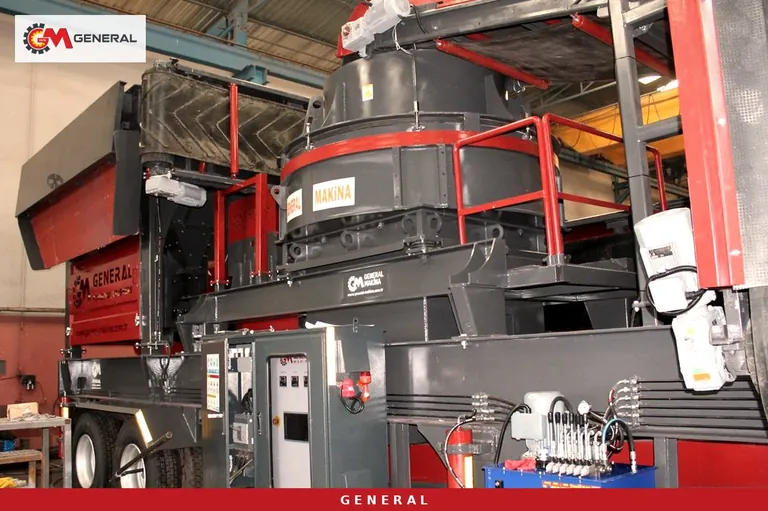
Concrete producers in the Gulf have what looks like an endless sand supply right on their doorstep: the desert. Yet dune sand, carried and rounded by wind over centuries, is both very fine and too smooth in grain shape. Used on its own in concrete it raises water demand and weakens the aggregate skeleton. That is why ready-mix and precast producers from Saudi Arabia to the United Arab Emirates, and from Oman to Qatar, increasingly rely on manufactured sand: cubical sand made from rock with a VSI crusher. This article explains how to build a VSI-equipped crushing and screening plant running at around 200 TPH with real models, and what to watch on hot, dusty Gulf sites.
All models, dimensions and capacities quoted here come from our product catalogue. We give no information about any specific tender, job site or quarry; please confirm your sand specification with the relevant authority, the consulting engineer or the laboratory approving your concrete mix.
Why make sand from rock when the desert is full of it?
Concrete sand must meet three requirements: the right grading, angular but not flaky particles and a low fines content. Dune sand usually sits in a narrow band at the fine end, so the coarse end of the grading curve is empty. Because wind has polished the grain surface, its bond with cement paste is also weaker than that of crushed sand. Many producers do not exclude it completely; they blend it with manufactured sand in a set ratio, and trial mixes in the laboratory decide that ratio.
Manufactured sand fills the gap. Hard rock accelerated in a VSI rotor and thrown against anvils or its own rock bed breaks into cubical particles, gives a broad 0-5 mm grading and lets you adjust the fines by screening. Material taken from sabkha flats along the Gulf coast also carries a chloride and sulphate risk, so producing sand from rock in a controlled quarry is the more predictable route for concrete durability. Limestone quarries are common in the region; gabbro dominates around the Hajar mountains and basalt in the volcanic fields of western Saudi Arabia. Whatever the rock, no model is final until a sample from your own quarry has passed abrasion and crushability tests.
Pinning down "200 TPH": feed rate or saleable sand?
This is the point most often confused in quotation talks. One buyer means the run-of-quarry rock entering the plant, another means 0-5 mm sand landing on the stockpile. The difference can almost double the equipment list.
If total plant feed is 200 TPH, the primary and secondary stages carry that tonnage while the VSI processes only the share destined for sand; the remaining chip fractions go straight to stock. If the target is 200 TPH of saleable sand, the VSI stage must be larger, because part of what leaves the VSI in a single pass stays above 5 mm and returns from the screen to the rotor. The sand yield per pass depends on the rock, the feed grading and the rotor speed; only a test on a sample gives that figure.
To derive the hourly target from daily demand, use: hourly capacity = daily tonnage ÷ (operating hours × availability). Hypothetical example: a concrete group needing 3,960 t of sand per day, with 22 operating hours and 0.90 availability, gets 3,960 ÷ (22 × 0.90) = 200 TPH. If shifts are shortened at midday in the Gulf summer, operating hours drop and the same daily tonnage requires higher hourly capacity.
Three layouts with real models
The table below compares three ways of meeting a 200 TPH sand line with catalogue models. Values that are unknown or set per project are shown as "—".
| Layout | Crushing stage | VSI stage | VSI capacity (t/h) | VSI max. feed (mm) | Power |
|---|---|---|---|---|---|
| A – Wheeled mobile line | GNR-MC110: GPJ 110 jaw + DMK03 impactor, 200-300 t/h, 900 mm feed | 2 × GNR-MVSI 900 | 2 × 90-180 | 50 | MC110: 750 kVA; each MVSI 900: 850 kVA |
| B – Stationary line on foundations | GNRK 110 jaw (200-350 t/h, 1100×850 mm opening) + cone crusher | GNR 900 vertical shaft impactor | 80-210 | 50-55 | GNRK 110: 110/132 kW; GNR 900: 2×200 kW; cone: |
| C – Add-on to an existing plant | Existing primary and secondary | Towed tertiary VSI unit | 60-250 | 200 | — |
Layout A: a wheeled line that is quick to set up
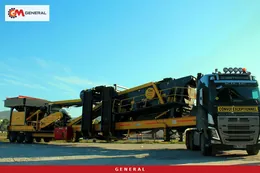
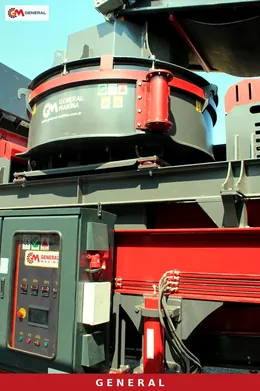
The GNR-MVSI 900 wheeled sand and shaping plant runs at 90-180 t/h, accepts feed up to 50 mm and splits the product into 0-3, 3-5 and 5-12 mm on its 1600×5000 mm three-deck horizontal screen. For a 200 TPH sand target one unit would be over its upper limit, so two units run in parallel; this also keeps one producing while rotor tips are changed on the other. Upstream, the GNR-MC110 carries a jaw primary and an impact secondary on twin chassis and delivers 0-5, 5-12, 12-19 and 19-40 mm fractions. Fractions below 40 mm naturally fit the VSI's 50 mm feed limit. In low-abrasion rock such as limestone this line is economical; in gabbro and basalt the wear cost of the impact secondary must be counted. Other wheeled options are listed under wheeled mobile crushing plants.
Layout B: a stationary line for abrasive rock
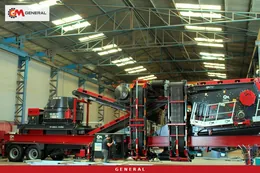
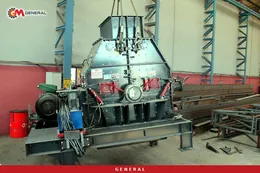
Where quarry life is long and the rock is gabbro or basalt, a jaw and cone pair working by compression keeps metal wear low. The GNRK 110 jaw crusher covers the plant inlet with its 200-350 t/h range; the cone crusher, with hydraulic CSS adjustment, prepares intermediate product sized for the VSI. Cone model data are issued per project, so those cells stay blank. In the final stage the GNR 900 from the GNR series VSI crusher family produces 80-210 t/h with a 900 mm rotor and 2×200 kW. Since 200 TPH sits near the top of that range, projects targeting net sand should consider a second VSI or a split arrangement with a GNR 800 (55-160 t/h). For layouts on foundations see fixed crushing plants.
Layout C: turning oversize into sand
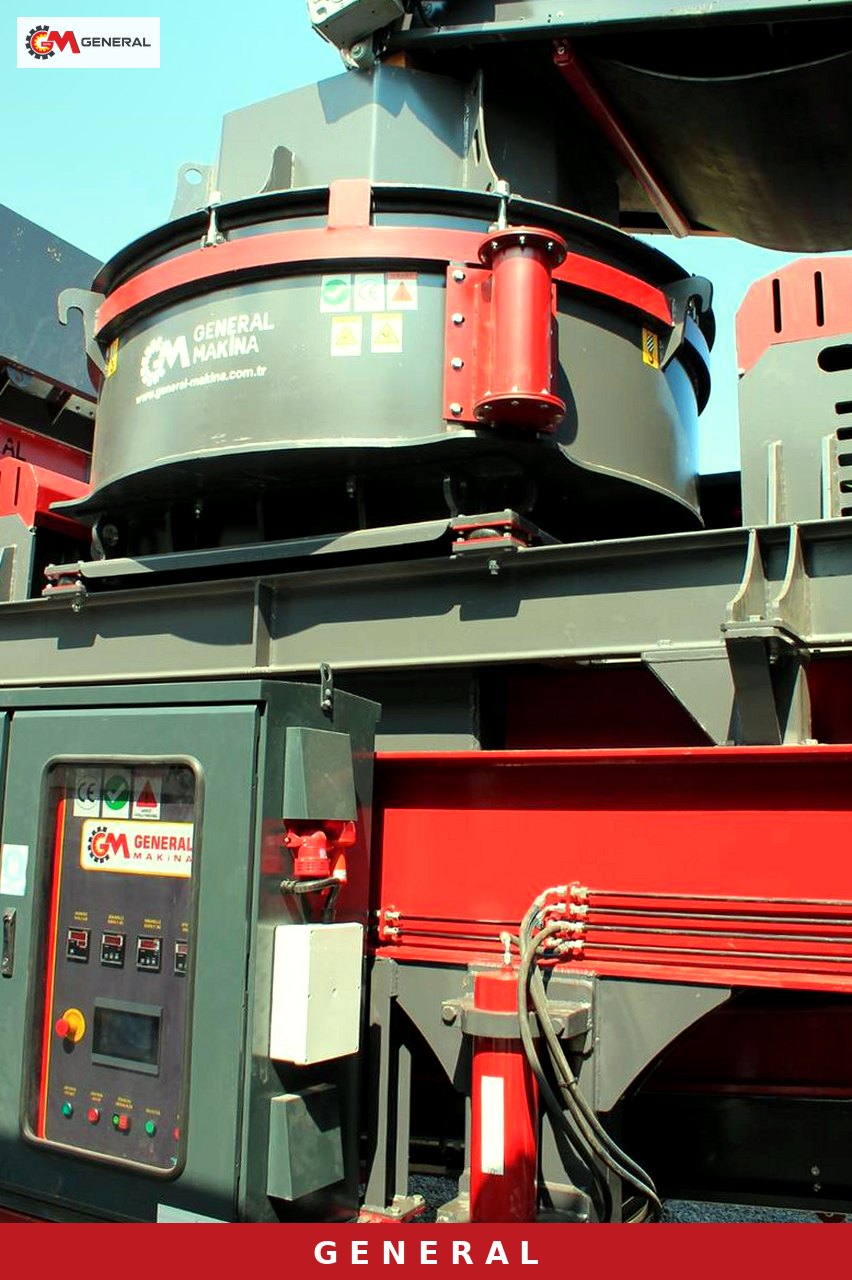
At many Gulf quarries part of the 12-19 and 19-40 mm chip stock sits unsold. A towed tertiary VSI unit placed beside the existing line accepts 0-200 mm feed, produces 0-10 mm crushed sand at 60-250 t/h and turns those stockpiles into revenue. As it needs no new primary investment, it is a sensible start for operators who want to test sand demand on a small scale before expanding.
VSI mode by rock type: rock-on-rock or anvil?
A VSI works in two ways, and the variety of Gulf rock makes the choice important. In rock-on-rock (autogenous) mode, stone leaving the rotor hits its own material built up in the chamber, so metal wear is minimal. This is the preferred mode for high-silica gabbro, basalt and quartz-rich gravel. In anvil mode the stone hits metal anvils; the crushing action is stronger and the fines share rises, but in abrasive rock the anvils and rotor tips are replaced more often. In limestone, anvil mode can yield more sand.
In abrasive material, rotor tips reinforced with ceramic or tungsten carbide are used. Running the same sample in both modes shows which gives the lower cost per tonne. Testing a representative quarry sample for abrasion and crushability before building a sand plant is the cheapest insurance in model selection.
Operating on hot, dusty, water-scarce sites
Gulf sites share high summer temperatures, airborne dust and costly fresh water. These three conditions shape auxiliary equipment as much as the machine choice.
Power: Quarries far from the grid run on generators. The power unit of the GNR-MVSI 900 is 850 kVA, that of the GNR-MC110 750 kVA. For a generator to deliver its rated output efficiently in hot weather, enclosure ventilation and radiator capacity should be specified per project.
Dust: A VSI produces fine material, and on a windy site its discharge points become dust sources. Covered belt guards, spray dust suppression at transfer points and dust filters on electrical cabinets are measures that can be added per project.
Water and washing: If the fines content of manufactured sand exceeds the specification, the first step is screen adjustment; if that is not enough, washing is needed. The GNR YM1650 mobile washing and screening plant, rated at 120-180 t/h, cleans sand with its screw washer, but in the Gulf washing without water recovery is expensive to run. A chain built with a hydrocyclone and a dewatering screen recovers both water and fine sand. See the options under sand washing and dry screening plants.
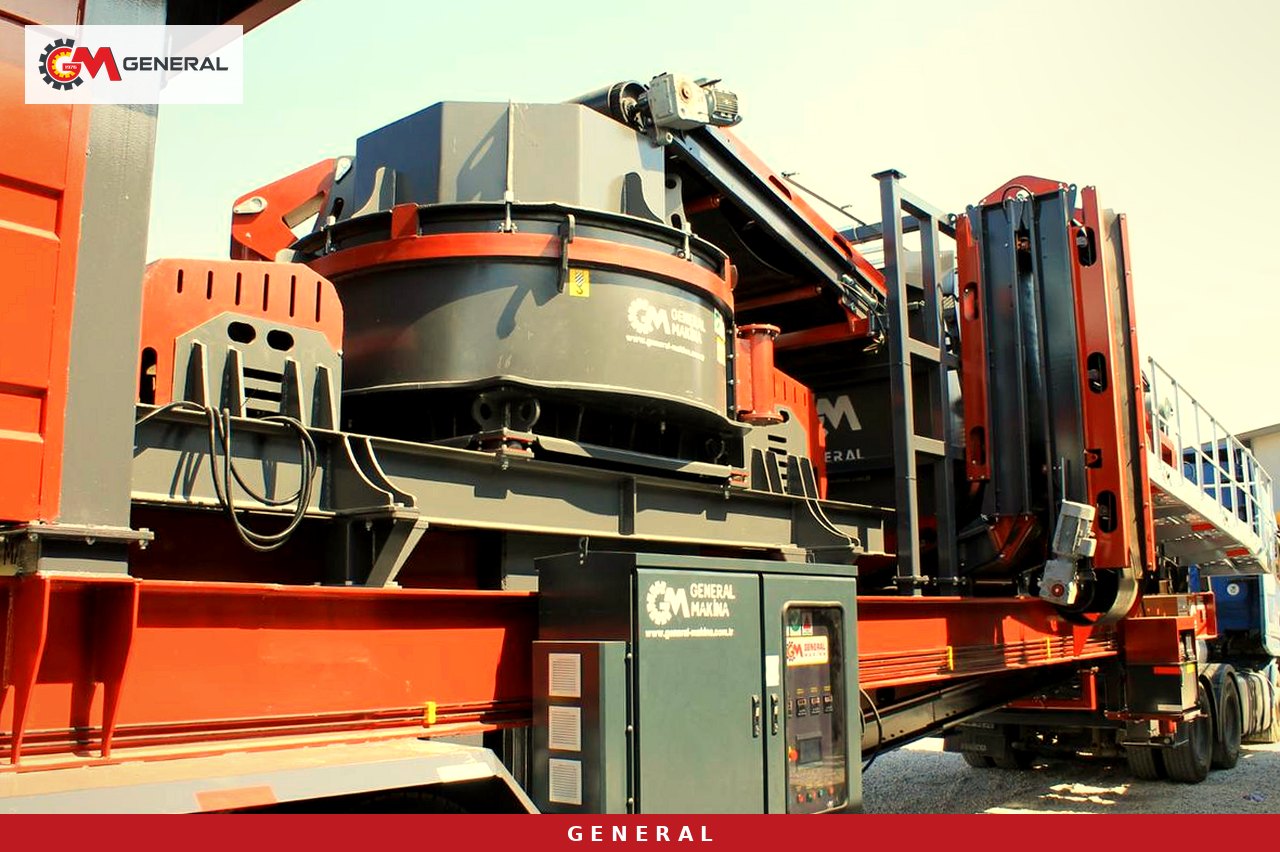
We also have a delivered reference in the Gulf: GNR PDK 02 stationary crusher in Saudi Arabia, 250 t/h in desert conditions. It is a crushing and screening line, not a sand line, but it is worth reviewing for operating experience in desert conditions.
Checklist before requesting a quotation
- Rock type and, if possible, a lab report: abrasion, compressive strength, silica content.
- Largest run-of-quarry lump size and typical post-blast grading.
- What 200 TPH means: total feed or net 0-5 mm sand?
- Required sand fractions (for example 0-3 and 3-5 mm) and the fines limit.
- Chip fractions to be sold besides sand, and stockpile area.
- Power source: grid or generator; water source and recovery options.
- Whether the site is permanent or project-based; mobile or foundation-mounted preference.
- Port of discharge and road route to site.
Frequently asked questions
Can a single GNR-MVSI 900 produce 200 TPH of sand?
No. The GNR-MVSI 900 is rated at 90-180 t/h. For 200 TPH of net sand two units run in parallel, or the VSI stage is split in a stationary layout.
What feed size should go to the VSI?
The GNR-MVSI 900 accepts up to 50 mm, the stationary GNR 900 VSI 50-55 mm. A secondary crusher upstream must therefore prepare the feed. The towed tertiary VSI unit, by contrast, can take 0-200 mm oversize directly.
What warranty and certificates apply?
Our machines are built under ISO 9001 and carry CE marking; a 1-year warranty applies, excluding wear parts. The company has been manufacturing in Izmir since 1976.
What determines the price?
The layout (mobile or stationary), number of VSI units, generator needs, dust and washing equipment and shipping method set the price. We prepare a project-specific quotation from your rock and capacity data.
Conclusion
Read correctly, a 200 TPH sand target in the Gulf can be met with real models: GNR-MC110 plus two GNR-MVSI 900 units for fast setup; GNRK 110, a cone crusher and GNR 900 for a long-life stationary line in abrasive rock; or a towed tertiary VSI unit as an add-on to an existing plant. The rock sample, net sand target, power and water conditions decide the choice. Send us your quarry data and we will work out the right layout together: request a quotation via our contact page.
Definitions of technical terms: Glossary