EN — English
 TR — Türkçe
 DE — Deutsch
 RU — Русский
 FR — Français
 ES — Español
 AR — العربية
 SR — Српски

Namibia Walvis Bay Port Granite Stone Crusher Plant 200-300 TPH
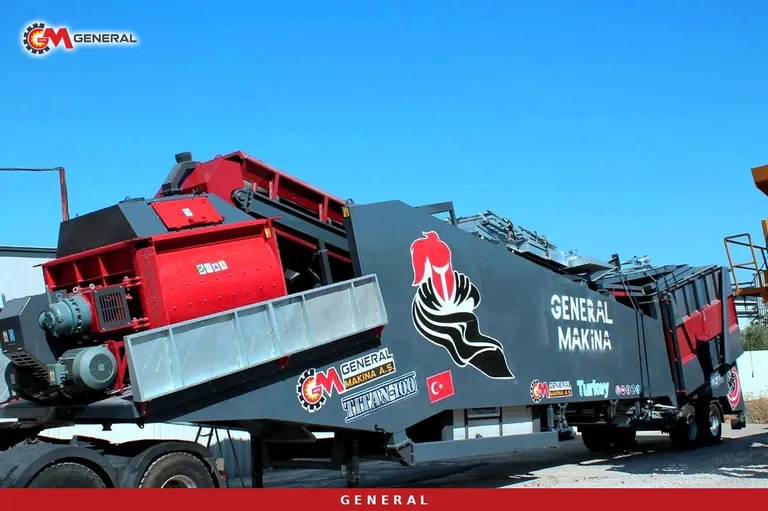
Walvis Bay is Namibia's main port on the Atlantic coast and the starting point of road and rail links into the interior and to neighbouring countries. When quay, reclamation and back-of-port works grow at a harbour like this, the material consumed in the largest volume is crushed rock: concrete aggregate, manufactured sand, road base and coarse fill. This article explains, with catalogue figures, which machines and in what order a 200-300 tph granite line should use to produce what a port construction site asks for.
We give no information about the scope, schedule or contractors of any expansion work at Walvis Bay port. Confirm specification items such as aggregate grading, Los Angeles abrasion limit and particle shape in the current documents of the port authority and the project engineer; plant design starts from those values.
The stone list of a port construction site
A port expansion expects four separate products from the same quarry. Quay walls, pile caps and precast blocks need dedusted 5-12 and 12-19 mm aggregate. The fine part of the concrete mix needs 0-5 mm manufactured sand. Container yards and service roads consume graded base material. Backfill can be built with coarse, unscreened rock straight from the crusher. The ratio between these products differs on every project and directly sets the number of screen decks in the plant.
Find the capacity by calculation, not by guesswork: multiply daily concrete volume by the aggregate content of the mix design, add road and fill tonnage, and divide the total by net daily operating hours. If the result stays under 200 tph, a large line is an unnecessary investment; if it exceeds 300 tph, two parallel primaries should be considered. In this hypothetical calculation keep net hours realistic by deducting maintenance stops and shift changes.
What Erongo granite demands from the machines
Hard crystalline rocks such as granite and gneiss are common in the Erongo region inland from Walvis Bay. Granite is high in silica and abrasive. Our cone crusher product page gives an abrasion index of about 0.55 for granite and about 0.20 for basalt. That gap changes crusher selection. Impact crushers give good shape in granite, but blow bar change intervals become short. In jaw and cone crushers, which break rock by compression, manganese steel liners last longer and the parts cost per tonne falls.
Before opening the quarry, take core or blast samples from at least two different points and have compressive strength, abrasion index and Los Angeles value measured by an independent laboratory. Even inside one quarry the weathered upper zone and fresh granite can differ clearly. The upper zone brings soil and has to be removed ahead of the primary; otherwise the crusher works for nothing and the screens blind.
Two line layouts for 200-300 TPH
In granite the stage order does not change: grizzly feeder, jaw primary, secondary crusher, screens and, where needed, a VSI for manufactured sand. What changes is whether these machines sit on concrete foundations or on mobile chassis.
Fixed line: GNRK 110 with a cone secondary
If quarry life is longer than the port job, meaning the plant will keep supplying city and road work after the port is finished, a fixed line makes sense. At the inlet the GNR 110 vibrating grizzly feeder runs at 200-300 tph with a 2x7.5 kW motor; its grizzly section removes soil from the weathered zone before it reaches the crusher. Behind it the GNRK 110 jaw crusher has a 1100×850 mm opening, a 110/132 kW motor and 200-350 tph capacity, with a discharge setting of 150-225 mm. That output fits the 50-250 mm feed range of the cone crusher. The cone secondary reduces at 6:1 to 8:1; model, power and CSS values are issued per project, so we left them blank in the table. On the screening side the GNR 2060 (2000×6000 mm, 18.5 kW), from a series available with 1 to 4 decks, is sized to split the port product list. Foundation-based layouts are on our fixed crushing plants page.
Line built from mobile units: GNR 110, M-DMK 03 and mobile VSI
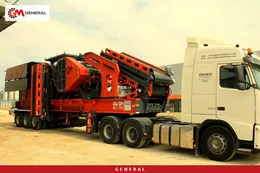
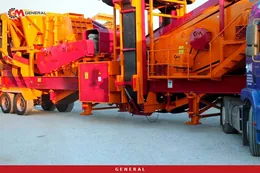
If the port job runs for a few years and the plant then moves to another site, mobile units remove the cost of concrete foundations. The GNR 110 mobile primary jaw crusher, with its 1100×4750 mm feeder and GNRK 110 jaw, delivers 180-300 tph; it weighs 55,000 kg and sets up on hydraulic legs without foundations. It is followed by the M-DMK 03 mobile secondary impact crusher: 1500×4000 mm feeder with by-pass screen, 250 kW motor, 175-300 tph and 45,000 kg. The by-pass screen lets material that is already at product size from the primary skip the crusher. In granite the price of an impact secondary is more frequent blow bar changes; in return, cubical particles for concrete aggregate are easier to achieve. All these units sit in our portable crushers category.
| Machine | Role in the line | Capacity (tph) | Motor (kW) | Weight (kg) |
|---|---|---|---|---|
| GNR 110 grizzly feeder | Feeding and scalping | 200-300 | 2x7.5 | — |
| GNRK 110 jaw crusher | Fixed primary | 200-350 | 110/132 | 33,000 |
| General cone crusher | Fixed secondary | — | — | — |
| GNR 110 mobile primary jaw | Mobile primary | 180-300 | — | 55,000 |
| M-DMK 03 | Mobile secondary | 175-300 | 250 | 45,000 |
| Mobile tertiary crusher (VSI) | 0-10 mm manufactured sand | 60-250 | — | — |
| GNR 2060 vibrating screen | Fraction separation | — | 18.5 | 12,700-13,000 |
The capacities in the table are per machine. Real line capacity equals the narrowest stage; if 300 tph is the target, the secondary and the screen area must also carry that tonnage.
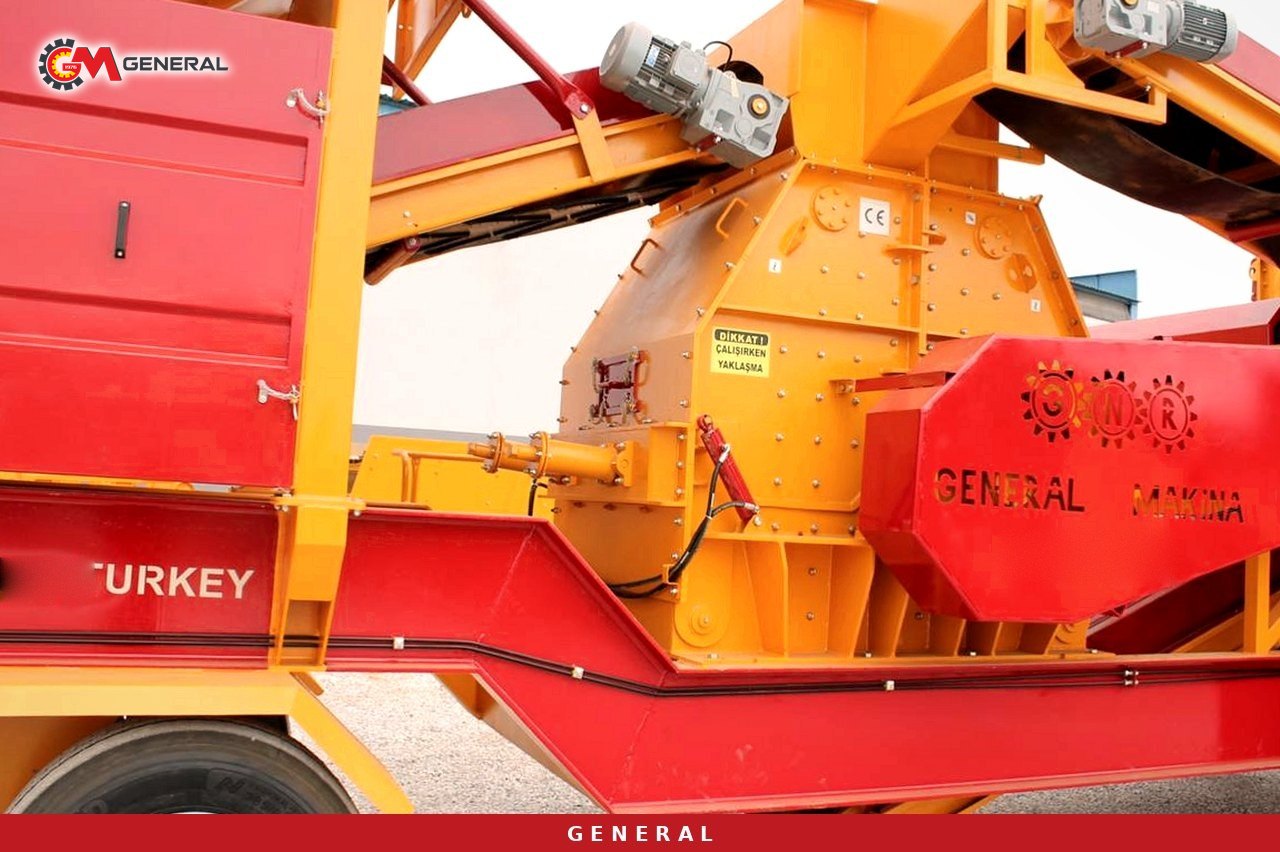
Concrete aggregate and manufactured sand circuit
Port concrete is in contact with seawater; particle shape and the cleanliness of the fines directly affect durability. Beach sand and desert sand are often unsuitable for concrete: they can carry salt and their grains are very fine and rounded. Producing manufactured sand from granite gives the batching plant a controllable fine aggregate. For this job the mobile tertiary crusher (VSI) turns 0-200 mm screen oversize into 0-10 mm manufactured sand on the rock-on-rock principle, at 60-250 tph. The whole main flow does not need to pass through the VSI; only the tonnage required to cover the sand deficit is diverted to it.
In granite manufactured sand, the share of dust below 0.063 mm can exceed the specification limit. In that case washing or air classification is added to the sand circuit; the laboratory result on the sample shows which is needed. If the aggregate will be turned into ready-mix concrete on the same site, choose the mobile concrete batching plant together with the number of fractions; a four-compartment aggregate bin weighs four fractions separately.
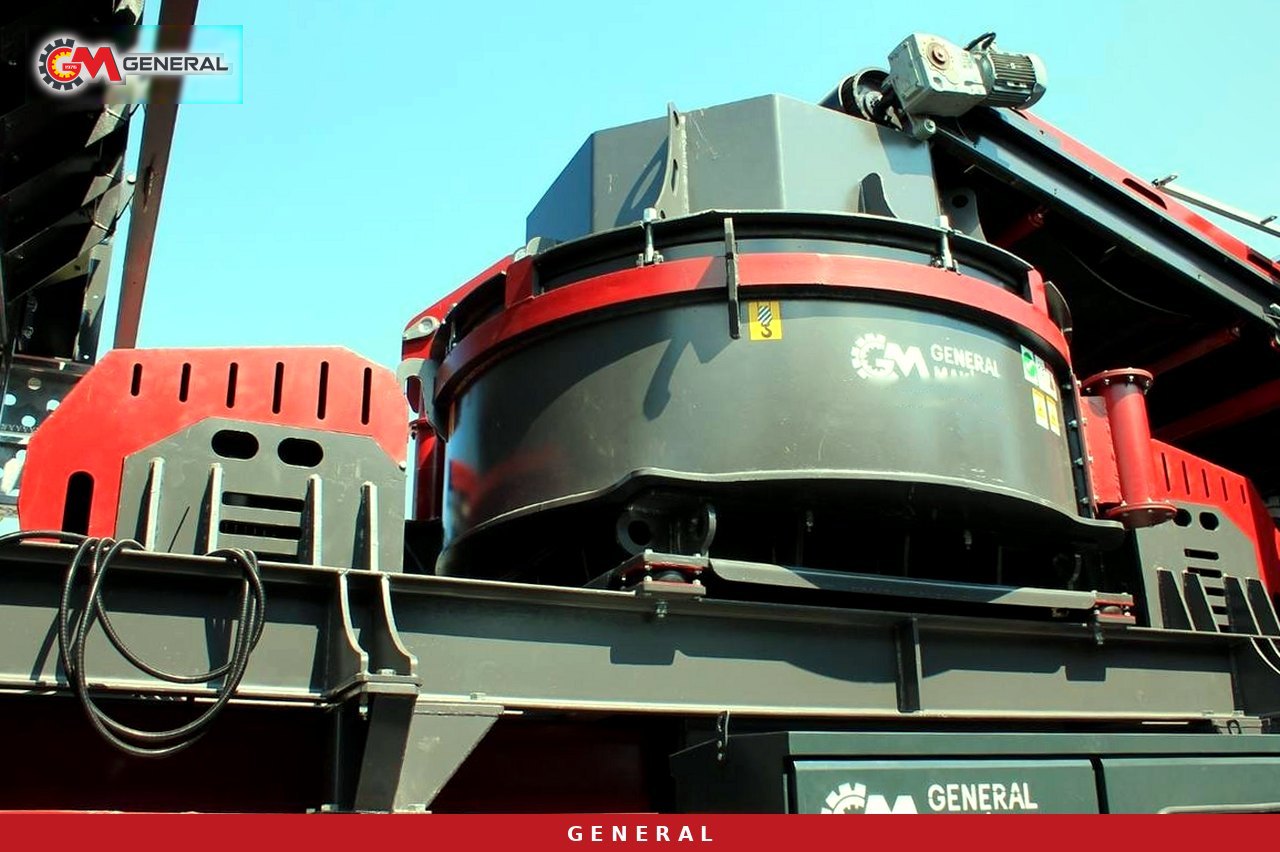
Dust, fog and salt on the Namib coast
The Walvis Bay area is a coast where desert meets ocean. The coastal fog that is frequent in the mornings leaves salt on metal surfaces, and later in the day wind carries fine sand. These two effects damage different parts of a machine. Salt attacks paint, electrical panels and fasteners; sand attacks air filters, bearings and conveyor pulleys.
Measures that can be selected per project include a paint system suitable for marine atmosphere, enclosed electrical panels with a high protection class, belt covers and dust suppression nozzles at transfer points, and pre-filtered air intakes on generators and motors. These are not standard on every model; request each of them in writing at quotation stage. On a site where water is scarce, limiting dust suppression to crusher discharges and belt drop points keeps water use low.
Shipment through Walvis Bay port and site installation
In this project the port where the machines enter the country and the port that receives the stone are the same. Units shipped by sea from Izmir are discharged at Walvis Bay and towed to the quarry by road. The weights of the mobile units (GNR 110 mobile primary 55,000 kg, M-DMK 03 45,000 kg) drive heavy-haul and abnormal-load permit planning; confirm permit rules with Namibia's road authority.
Where a remote quarry has no grid, power comes from a generator. Do not guess generator size: add up the kW ratings of all motors, include starting current of the large motors and power derating in hot weather, and have your electrical engineer convert the result to kVA. In a mobile line the 250 kW motor of the M-DMK 03, the feeder and conveyor motors, the VSI and the screen motors will all run at once.
Prepare this information before asking for a quote:
- Compressive strength, abrasion index and Los Angeles results of quarry samples
- The fraction list in the port specification and the daily tonnage of each fraction
- Distance and road condition between quarry and port
- Whether grid power exists, and if not, the generator preference
- The amount of water available for dust suppression
- Whether the plant will stay in place after the port job
Frequently asked questions
Does using the M-DMK 03 instead of a cone in the mobile line cause problems in granite?
It works, but the wear parts budget grows. An impact secondary consumes blow bars faster in granite; in return it gives cubical particles and high reduction. If particle shape is the leading item in the concrete aggregate specification, the M-DMK 03 makes sense; if cost per tonne comes first, a cone secondary on a fixed line is preferred.
Can a single machine crush 300 tph of granite?
At the primary stage, yes: the GNRK 110 jaw crusher is rated at 200-350 tph. But line capacity is set by the narrowest stage, not the primary. If the secondary, screens and conveyors are not sized for the same tonnage, 300 tph stays on paper.
Can sand from around Walvis Bay be used in concrete?
The laboratory decides. Coastal and desert sands often fail the specification because of salt, excessive fines or rounded grains. In that case making manufactured sand from granite with a VSI brings the fine aggregate under control.
How are warranty and price determined?
Our machines are built under ISO 9001 and CE and carry a 1-year warranty excluding wear parts. Price is calculated per project from the chosen layout (fixed or mobile), the number of screen decks, the sand unit, extra equipment for coastal conditions and the scope of shipment.
A last note for the decision
For a quarry supplying granite to Walvis Bay port works, the route that keeps wear cost lowest is a line built around a jaw primary and a compression secondary. Where particle shape in concrete aggregate takes priority, the M-DMK 03 and the mobile VSI come in. Quarry life answers the fixed or mobile question. Write to us with your sample results and fraction list, and we will size the crushing and screening plant with you.
Definitions of technical terms: Glossary