EN — English
 TR — Türkçe
 DE — Deutsch
 RU — Русский
 FR — Français
 ES — Español
 AR — العربية
 SR — Српски

Automation and Remote Monitoring Systems for Mobile Crushing Plants
When buyers ask about automation on a mobile crushing and screening plant, the question is usually "is the panel a touchscreen?" On site, what decides the result is the logic behind the screen: the order in which equipment starts, what upstream machines do when a belt stops, who intervenes at the feeder when the crusher is overloaded, and where all of that is recorded. This article splits automation on mobile plants into three layers, shows which equipment is standard and which is optional on the mobile models in the General Makina catalogue, and lists the questions you should ask at quotation stage. The goal is to turn "does it have remote monitoring?" into a clearly defined scope request.
Automation, remote control and remote monitoring are not the same thing
In quotation correspondence these three terms are often mixed up, and later turn into a "we expected that too" dispute. Draw the boundaries from the start.
- Automation: the line managing itself. Start-up sequence, interlocks, shutdown scenarios and adjusting feeder speed to crusher load are defined in a programmable logic controller (PLC). The logic runs whether an operator is present or not.
- Remote control: the operator issuing commands from a distance without climbing onto the machine, starting, stopping or changing the speed of the feeder. On mobile screening plants it lets the truck or loader driver manage the flow while charging the hopper.
- Remote monitoring: once the automation panel is connected to a network, plant data can be viewed away from site and recorded. Shift reports, produced tonnage, downtime and alarm history belong to this layer.
A plant can have the first layer without the third. Instead of writing "with automation" in your enquiry, have each layer listed as a separate line item; comparison becomes much clearer.
What sits inside the panel: four hardware groups
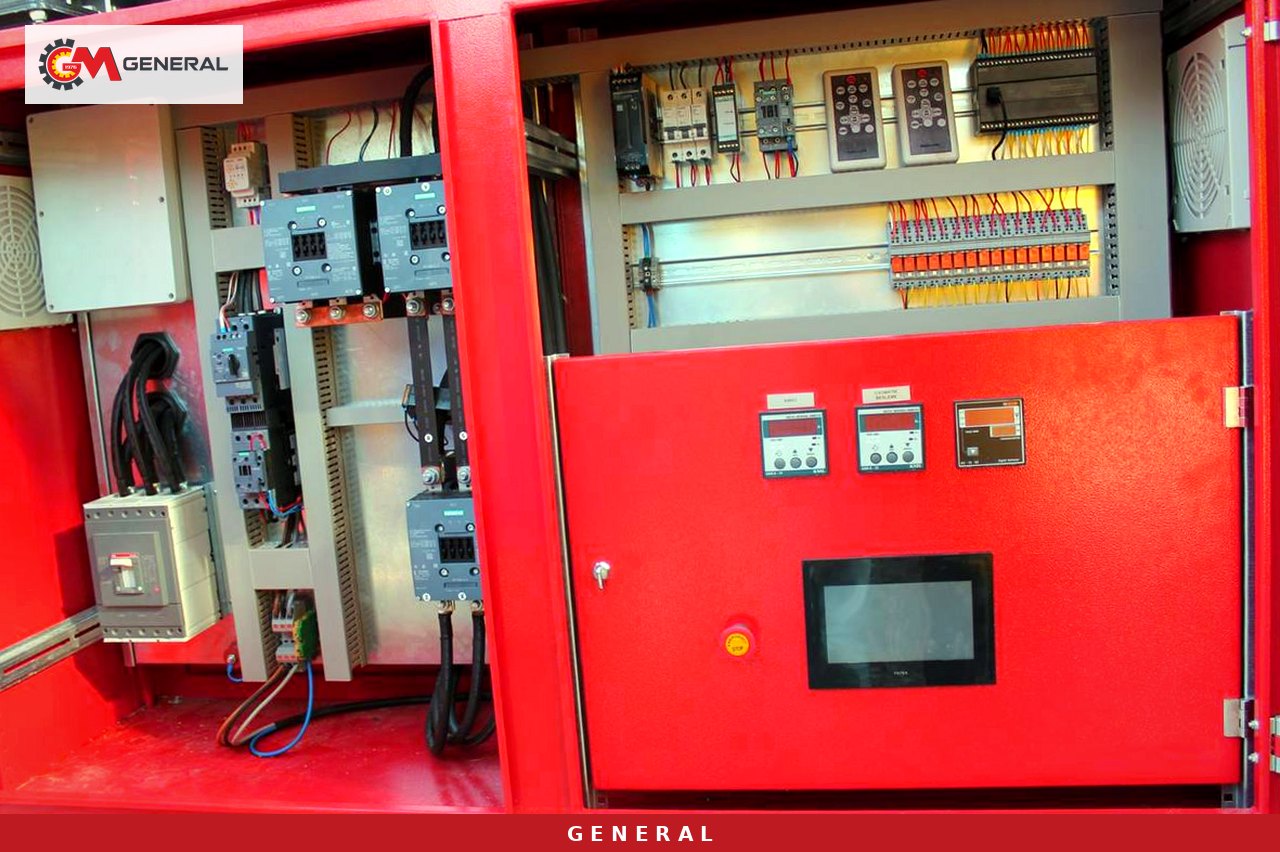
General Makina's automation and control system page describes the system through four components. On a mobile plant each of them faces a different challenge than on a stationary one.
PLC
The logic of the line runs here. Equipment start-up order, interlocks and shutdown scenarios are written into the PLC program. On a mobile plant the machine layout stays the same at every new set-up, but the direction of the stockpile conveyors or an extra screen unit added to the line may change; ask whether the program can be updated for these variations.
SCADA / operator panel
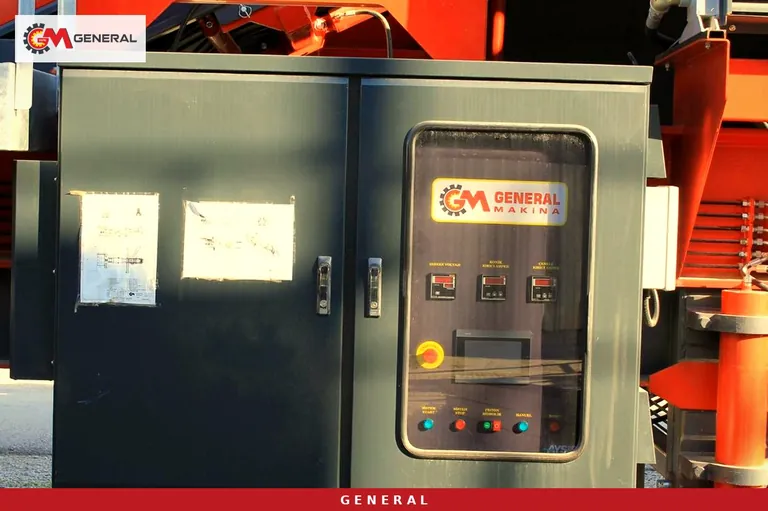
The plant diagram is displayed live on the touchscreen in the cabin; the running state, current draw and alarms of every machine are monitored from a single screen. For the operator the most valuable figure is current draw: he sees how heavily the crusher is loaded as a number, not by eye.
Field instrumentation
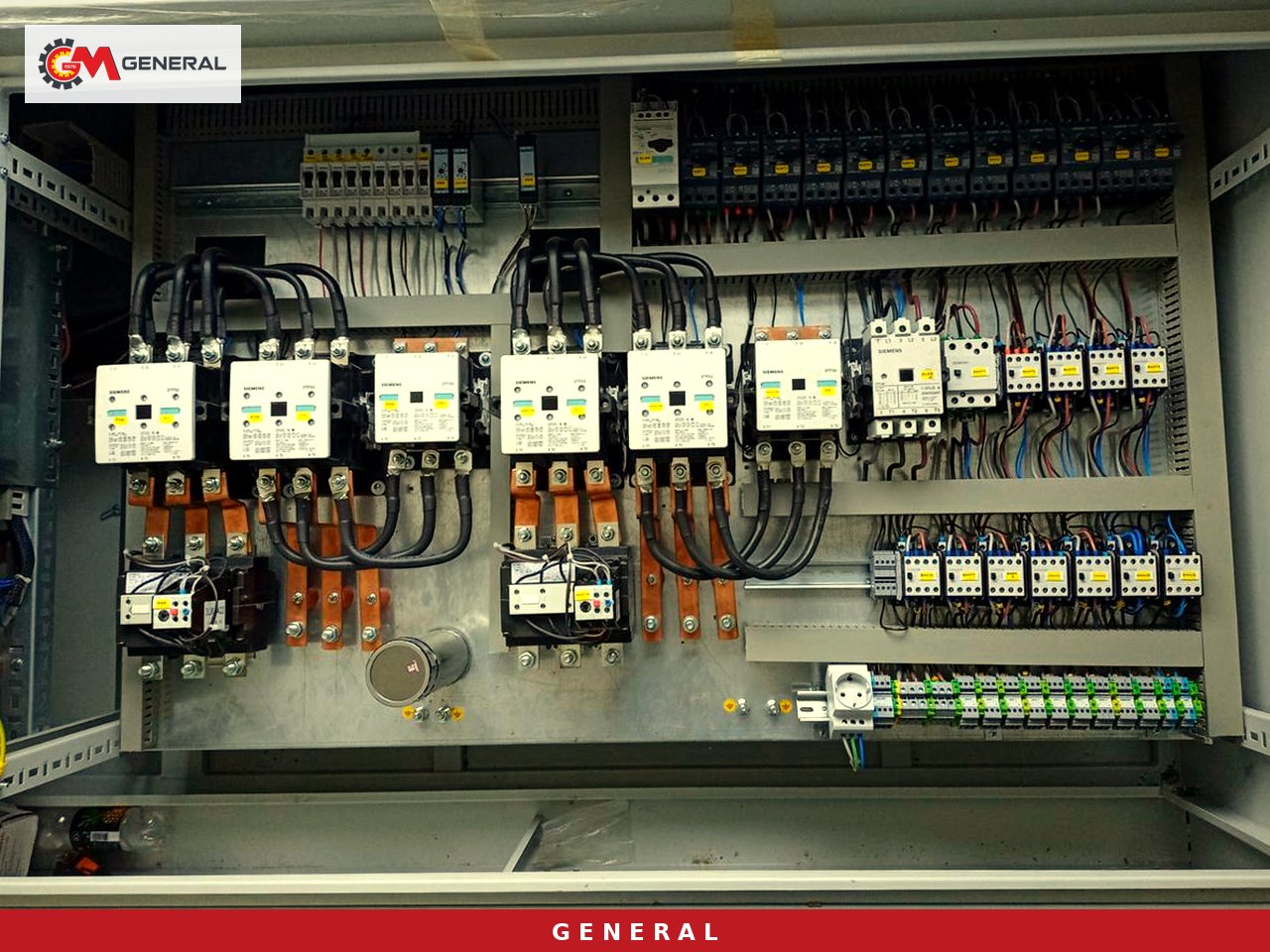
Level sensors, belt misalignment and speed switches, temperature and vibration sensors and load cells form this group. On a mobile plant these sensors are shaken at every move and their cables and connectors fatigue at every dismantling. Plug-in, labelled cable harnesses shorten set-up time and reduce the risk of wrong connections.
Motor control centre (MCC)
Starters, variable frequency drives (VFD) and protection relays sit here. This is the group that physically balances feeder speed against crusher load.
What sequential start-up, interlocks and load balancing deliver on site
In crushing lines the equipment is started against the material flow, from the stockpile conveyor back towards the feeder. The belts and the screen that will carry material run first, the crusher gets up to speed, and the feeder starts last. When one machine stops, every stage upstream of it stops automatically. This rule prevents two concrete failures: starting under a loaded belt and conveyor blockages. On a manually operated line the same discipline depends on the operator's attention; one wrong sequence by a tired operator at the end of a shift can mean hours of belt cleaning.
Load balancing depends on crusher current. When the current approaches its threshold the feeder speed is reduced automatically and increased again once the current returns to normal. The benefit is clearest in quarries where feed varies: when large blocks and fines arrive mixed, the operator cannot follow the fluctuation by eye, but the PLC follows it continuously.
On a mobile plant sequential start-up also has an energy side. On sites far from the grid all motors are fed from a single generator. The catalogue generator rating of the General 01, for example, is 550 kVA, and this model's touchscreen panel includes a soft-starter and frequency control. Starting large motors one after another with soft starting, rather than all at once, spreads the inrush load on the generator. We covered the effect of generator sizing on consumption separately in our article on energy saving in mobile plants.
The safety circuit must be independent of automation
Emergency stop buttons, pull-cord switches and guard sensors are wired directly into the safety circuit. When the safety circuit opens, the equipment concerned stops independently of any automation command. The distinction matters: a software error or a lost network connection must not affect the stop function. Lock-out/tag-out during maintenance is supported through this circuit too. When remote access is discussed, the rule should be clear: remote monitoring reads data; it cannot bypass the safety circuit.
Automation scope on the mobile models in the catalogue
The table below summarises the automation-related equipment explicitly stated on General Makina's mobile crushing plants and mobile screening plants pages. Cells not stated on the product page are marked "—". That does not mean the equipment cannot be supplied, only that it is not defined in the catalogue, so ask for it separately in the quotation.
| Model | Capacity | Power | Automation equipment in the catalogue | Remote monitoring / control |
|---|---|---|---|---|
| General 01 | 120-180 t/h | 550 kVA generator | Touchscreen control panel, soft-starter, frequency control | Internet-linked remote monitoring as an option |
| General 02 | 250-300 t/h | 660 kVA power unit | Control panel as standard | — |
| Mobil 90 | 90-150 t/h | 350 kVA generator | Complete hydraulics and automation panel | — |
| GNR ME1650 | 120-180 t/h | Generator or mains | Standard automation | — |
| GNR ME2060 | 200-350 t/h | Generator or mains | Full automation, fan-cooled electrical panel | Remote control as standard |
The practical conclusion: on the General 01 page, remote monitoring over the internet is explicitly listed as an option. On the GNR ME2060 what is standard is remote control, which is not the same as a monitoring system that records data. If you want remote monitoring on the other models, have it written into the order scope as a separate line.
The fan-cooled panel on the ME2060 is a small-looking but important detail for a mobile plant. Dust and hot air are the two main factors shortening the life of an electrical panel; drives and PLCs start throwing faults when they overheat. For plants working in open quarries through the summer, the panel's cooling and dust protection matter more than the size of the screen.
Remote monitoring: what data is recorded and who uses it?
Once the automation panel is connected to the network, shift reports, produced tonnage, downtime and alarm history are recorded. These four data sets serve three different people.
For the quarry owner or operations managerthe key output is tonnage and downtime per shift. Without being on site, he sees how many hours the shift actually produced and how many it stood still. He can express the cost of downtime with his own figures: Downtime loss = Downtime (h) × Hourly output (t/h) × Contribution per tonne. An operator who plugs his own values into this formula sees which fault deserves priority without further debate.
For the maintenance supervisorthe alarm history is what counts. The same belt misalignment switch tripping at the same time every week says something about belt alignment or the loading pattern. Crusher current repeatedly hitting the threshold can point to the feed gradation or the wear parts needing a check. The record-keeping method in our maintenance and spare parts article can be fed directly with this data to link wear part changes to tonnage.
For the service teamremote monitoring is a diagnostic tool. In the event of a fault, the service team can review the alarm log over the connection and make a preliminary diagnosis without travelling to site. The right part and the right person set off the first time, which shortens repair time. On remote sites in export regions this difference grows even larger.
Plan the connection infrastructure for the site
Remote monitoring works only as well as the site's internet connection. Mobile coverage is not always adequate in the quarries a mobile plant moves between. At quotation stage, ask how the connection will be set up, whether data is buffered in the panel when the link drops, and whether it is transferred once the link returns. Who gets access to the data should also be agreed early: operations, maintenance and the manufacturer's service need different permission levels.
Pre-quotation automation checklist
Add the following points to your enquiry; written answers to each make different quotations far easier to compare.
- Which equipment is connected to the PLC and which runs from a separate panel? Do sequential start-up and interlocks cover the whole line?
- Is feeder speed adjusted automatically to crusher current? Which motors have frequency drives and which have soft-starters?
- Does the operator panel show current draw and alarms for every machine?
- Are remote control and remote monitoring defined separately? Which is standard and which is optional?
- Which data is recorded: shift report, tonnage, downtime, alarm history? How long are records kept, and can they be exported?
- Is data retained in the panel when the connection drops? Can the connection method be chosen to suit the site?
- Are emergency stops and pull-cord switches wired to a safety circuit independent of automation? Is lock-out/tag-out supported?
- What are the panel's cooling and dust protection arrangements? Are the cable harnesses plug-in and labelled?
- When running on a generator, is the start-up order of large motors programmed to suit the power unit's capacity?
Frequently asked questions
Does an automated plant work without remote monitoring?
Yes. Sequential start-up, interlocks and load balancing run in the PLC and need no network connection. Remote monitoring adds a data-recording and remote-access layer on top of that logic. If the connection drops, the plant should keep producing.
Can remote monitoring be retrofitted to my existing mobile plant?
That depends on the PLC, drives and sensors in the panel. If you send the panel details of your plant and the data you want to monitor, feasibility and scope are assessed project by project.
Can a remote monitoring system stop the plant remotely?
Monitoring and control are separate functions, and their scope is defined in the order. Whatever the configuration, emergency stops and guard sensors remain in a safety circuit independent of automation; software cannot bypass that circuit.
How does automation scope affect the quotation price?
The price is driven by the number of machines connected to the PLC, the number of motors with frequency drives, sensor coverage, the operator panel and the remote monitoring infrastructure. Rather than a fixed figure, the right route is a quotation prepared for your line configuration.
Conclusion
On a mobile plant the value of automation comes not from how the screen looks but from how completely the start-up sequence, interlocks and load balancing are programmed. Remote monitoring keeps a record of that logic and lets service make a preliminary diagnosis without travelling to site. When requesting a quotation, have automation, remote control and remote monitoring listed as separate lines, and settle the connection and safety-circuit questions from the outset. Share your material, target tonnage and site power conditions via our contact page and we will prepare a quotation with the automation scope that fits your line.
Definitions of technical terms: Glossary