EN — English
 TR — Türkçe
 DE — Deutsch
 RU — Русский
 FR — Français
 ES — Español
 AR — العربية
 SR — Српски

Mobile Crusher Selection Guide for Aggregate Producers
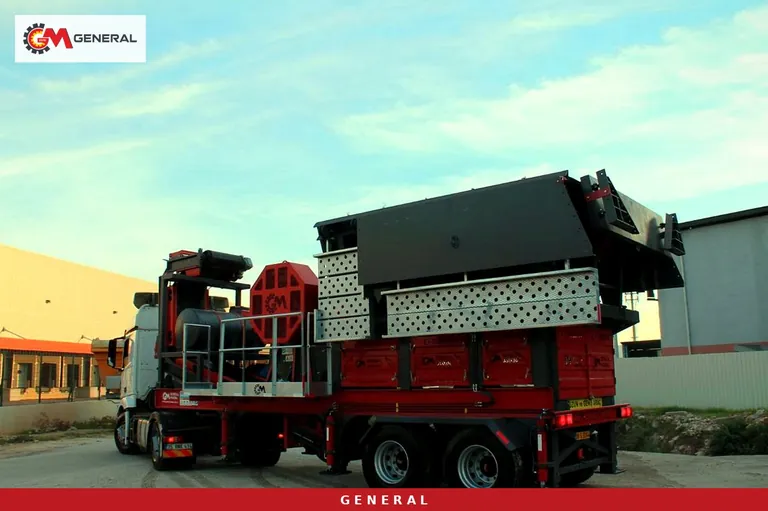
A contractor crushing rock for his own site and a quarry operator who earns money by selling aggregate look at the same mobile crusher through different eyes. The contractor asks: "Will it finish my job?" The aggregate producer asks: "Can I sell every tonne I make, which fraction will sit in the stockpile, and which crusher meets my buyer's specification?" This guide is written for the second group. We start the selection from the sales list, not from capacity, and compare General Makina's wheeled models by fractions, particle shape and sand balance, using the technical tables on the product pages.
Selection starts with the sales list, not the capacity column
An aggregate business earns from tonnes sold, not tonnes produced. A plant that piles a high hourly output of an unwanted fraction in the stockyard looks efficient on paper and loses money in the accounts. So before looking at machines, write down three lists: who you sell what to today, which buyers you want to win next, and the size classes each buyer asks for.
In a typical regional market, ready-mix plants want sand plus two separate coarse aggregates. Asphalt plants look for clean, cubical chippings. Road contractors accept a wider grading for sub-base. Each of these orders calls for different screen decks, a different crusher layout and different sand management. The first question in choosing a mobile crusher is therefore not "how many tonnes" but "which fractions, in what proportions".
The second question is the run-of-mine feed. The largest block coming from the face sets the feed opening the plant needs. Feed mixed with soil and overburden needs pre-screening. Clay turns into a quality problem on a dry screen. Once you answer these two questions, the model list narrows by itself.
Fraction portfolio: which model separates which products?
On wheeled plants the number of products is set by the screen decks. A triple-deck screen gives the 0-5 / 5-12 / 12-19 mm trio in the tables. A four-deck screen adds the 19-40 mm class. If you sell coarse aggregate, for example 19-40 mm to a concrete plant or a coarse class into sub-base blends, a model with a four-deck screen removes the need for a second screening unit. For the screen options, see the vibrating screen range.
| Model | Crusher layout | Capacity | Max. feed | Product fractions | Screen | Generator |
|---|---|---|---|---|---|---|
| General 640 | GPJ 60 jaw + GNR 50 impact | 60-100 t/h | 500 mm | 0-5 / 5-12 / 12-19 mm | 1200×4000 mm, 3-deck | 300 kVA (optional) |
| General 800 | PDK 1280 primary impact | 80-150 t/h | 600 mm | 0-5 / 5-12 / 12-19 / 19-40 mm | 1300×4000 mm, 3-deck | 450 kVA |
| General 944 | GPJ 90 jaw + GM430 cone | 120-180 t/h | 800 mm | 0-5 / 5-12 / 12-19 mm | 1600×5000 mm, 3-deck | 550 kVA |
| General 950 | GPJ 90 jaw + DMK01 impact | 120-180 t/h | 800 mm | 0-5 / 5-12 / 12-19 mm | 1600×5000 mm, 3-deck | 600 kVA |
| General 01 | GPS 1210 impact (primary+secondary) | 120-180 t/h | 700 mm | 0-5 / 5-12 / 12-19 / 19-40 mm | 1600×5000 mm, 4-deck | 550 kVA |
| General 02 | GPS 1413 impact | 250-300 t/h | 1000 mm | 0-5 / 5-12 / 12-19 / 19-40 mm | 2000×5000 mm, 4-deck | 660 kVA |
| GNR-MC110 | GPJ 110 jaw + GS1215 / DMK03 impact | 200-300 t/h | 900 mm | 0-5 / 5-12 / 12-19 / 19-40 mm | 2000×6000 mm, 4-deck | 750 kVA |
| GNR-MVSI 900 | VSI 900 vertical shaft (tertiary) | 90-180 t/h | 50 mm | 0-3 / 3-5 / 5-12 mm | 1600×5000 mm, 3-deck | 850 kVA |
One detail stands out: the General 800 has a triple-deck screen, yet its product table lists four fractions. The screen underflow may be counted as a separate class. At quotation stage, get written confirmation from the manufacturer of which fractions go to separate stockpiles. For an aggregate seller, this detail decides how long a product waits in the yard.
Particle shape and the buyer's specification: cone or impact?
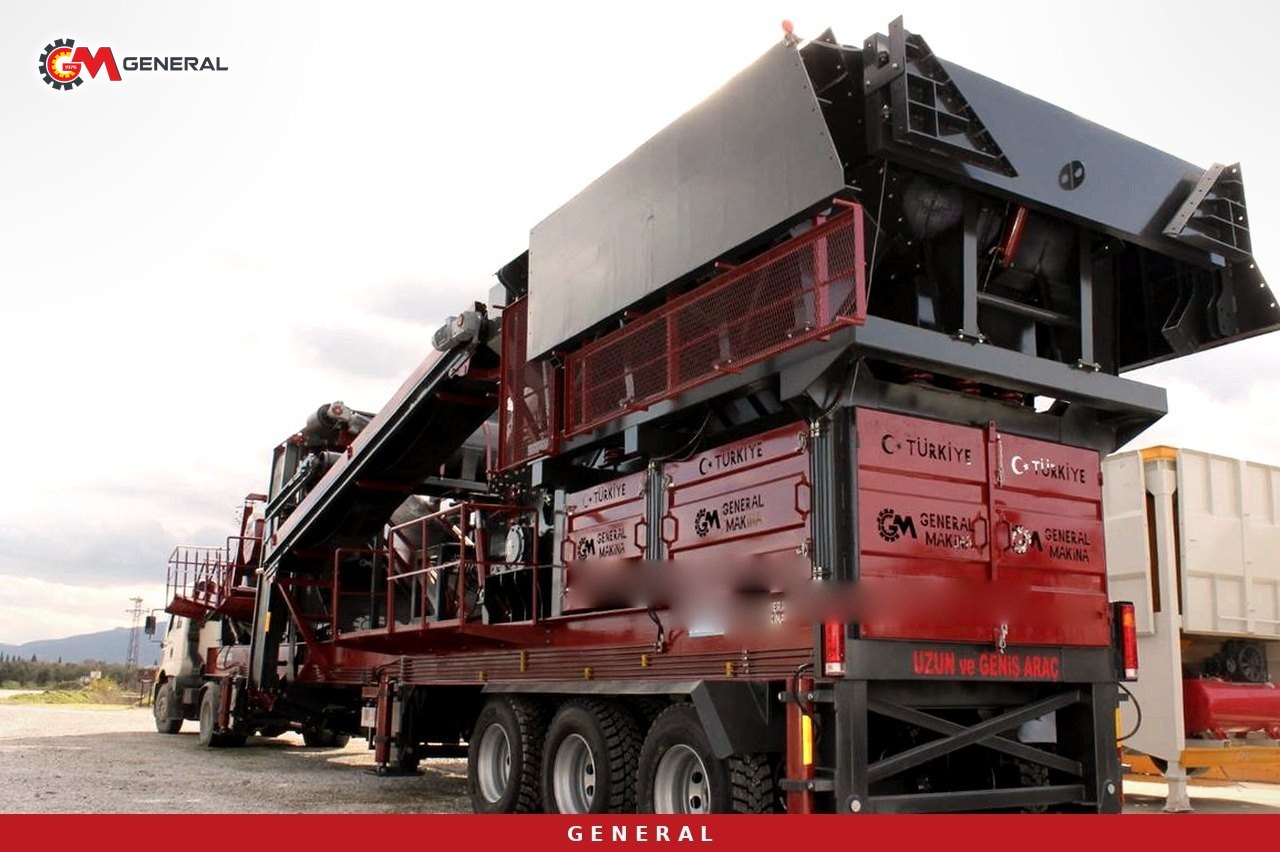
Two chippings of the same size class are not the same product to a buyer. Concrete and asphalt producers dislike flaky, elongated particles; cubical grains help both mix workability and specification tests. On a mobile plant, particle shape depends mostly on the working principle of the secondary crusher.
Putting the General 944 and General 950 side by side shows this clearly. Both run a GPJ 90 jaw primary, deliver 120-180 t/h with 800 mm feed and carry the same 1600×5000 mm triple-deck screen. The only difference is the secondary: a GM430 cone on the 944, a DMK01 impact crusher on the 950.
- General 944 (cone secondary): crushes by compression. Long metal life in hard, abrasive rock such as basalt, granite and quartz. It comes first when buyers expect hard-rock aggregate and wear cost drives your margin per tonne.
- General 950 (impact secondary): crushes by impact. High reduction ratio and cubical product. It makes sense in medium-hard rock where cubical chippings sell at a premium. In very abrasive rock, factor in how often impact parts must be changed.
- General 01 and 800 (all-impact): high reduction with a single crusher in limestone and low-abrasion rock. Four separated fractions give flexibility to a business that also sells coarse aggregate.
If you run a hard-rock quarry and also want to sell cubical product, consider a staged layout instead of forcing one model. Adding a shaping stage behind a jaw-and-cone line raises product quality without replacing the main plant. The first step of that layout is usually the General 944 mobile jaw + cone plant.
Sand balance: turning surplus fines into revenue
The stockyard problem in aggregate businesses is often a single fraction. Depending on demand, either sand runs short or a mid-size fraction builds up. Crusher type and output setting decide the grading of crushed rock; the market decides what sells. The two distributions rarely match.
If sand is short or 5-12 mm is piling up, the answer is to turn the mid fraction into manufactured sand. The GNR-MVSI 900 mobile VSI crusher is built for exactly this. It takes feed up to 50 mm, works with a 0-20 mm output setting, separates 0-3 / 3-5 / 5-12 mm and has a capacity of 90-180 t/h. Added behind the main plant, it converts stockpiled material into the sand a ready-mix plant wants. Its own power unit is 850 kVA, the highest in the group, so plan energy accordingly.
If the feed carries clay and silt, sand from a dry screen may fail the buyer's cleanliness test. Then the Mobil 90, which combines crushing and washing on one chassis, is an option: GPJ 90 jaw crusher, 800 mm feed, 90-150 t/h, a 600×6000 mm twin screw washer and 0-5 / 5-20 / 20-60 mm fractions. How much product dirty feed costs you on dry screening varies from quarry to quarry. Have a washing test run on a sample before deciding.
Saleable tonnage and stockyard planning
The figure an aggregate producer should compare is not catalogue capacity but saleable output per hour. Build the calculation with variables, not invented numbers:
Saleable output (t/h) = Q × K × S
- Q: average capacity measured with your own rock at your own output setting. Not the range in the product table, but the value measured in a test crush.
- K: availability. The share of working time left after planned maintenance, wear-part changes, relocation and waiting.
- S: the share of the product split that already has a buyer. Every tonne sitting in the stockpile lowers S.
The S term directly affects model choice. A higher-capacity plant that cannot sell its extra tonnes lowers S, and saleable output does not rise. A four-deck screen or a VSI stage, on the other hand, can raise S without changing Q. In most cases it is smarter to spend the capacity budget on reducing what goes to the stockpile.
The stockyard enters the calculation too. Each fraction needs its own pile, its own conveyor discharge and a truck loading area. A plant producing four fractions needs a wider, better-drained yard than one producing three. In a quarry with tight permit boundaries, this can decide the model more than capacity does.
The aggregate producer's checklist before requesting a quote
The clearer the information you send the manufacturer, the more comparable the quotes you get back. Do not request a quote before completing this list:
- The fractions you sell and plan to sell, with each one's monthly share of demand.
- Particle shape and cleanliness requirements in your buyers' specifications (concrete, asphalt, sub-base).
- Rock type and abrasiveness; if possible, a lab report and a representative sample.
- Largest block size from the face and the soil, clay and moisture content of the feed.
- Stockyard dimensions, loading layout and truck traffic.
- Power source: grid connection or generator? The required kVA differs by model in the table.
- How many times a year the plant will move, and any limits on the transport route.
- Stages you may add later: VSI, washing or a second screen.
With this information you can use the Design Your Plant for a first shortlist and compare all wheeled options side by side in the mobile crushing and screening plant category.
Frequently asked questions
Is a triple-deck screen enough for selling aggregate?
If you only sell sand and chippings up to 19 mm, a triple-deck screen covers your needs. If you will also sell a coarse class such as 19-40 mm separately, four-deck models that list this fraction in their product tables, such as the General 01, General 02 or GNR-MC110, need no second screening unit.
How do I choose between the 944 and 950 at the same capacity?
Look at the abrasiveness of your rock and the value of cubical product in your market. In hard, abrasive rock the cone-secondary 944 gives a metal-life advantage. In medium-hard rock, if you can sell cubical chippings at a better price, the impact-secondary 950 may fit better. Capacity, feed size and screen are the same on both.
How do I find out price and delivery time?
Price depends on the model, screen decks, generator or grid choice, automation options and any added stage. Delivery depends on the production schedule at the time of order. That is why we confirm both only in a written quotation.
What about warranty and certification?
General Makina plants carry ISO 9001 and CE certification and a 1-year warranty, excluding wear parts. The company has been manufacturing in İzmir since 1976.
Conclusion
For an aggregate producer, the right mobile crusher is not the one with the highest tonnage but the one that produces the fractions on your sales list, with the required particle shape and the least stockpile build-up. Define the fractions and buyer specifications first, then the rock and feed, and capacity last. Send your sales list and sample details through our contact page and we will prepare a quotation for the configuration you need.
Definitions of technical terms: Glossary