EN — English
 TR — Türkçe
 DE — Deutsch
 RU — Русский
 FR — Français
 ES — Español
 AR — العربية
 SR — Српски

Kenya Nairobi Expressway Stone Crushing Plant 250 Ton Per Hour
For a contractor taking on an expressway package around Nairobi, the crusher question starts with "how many tonnes?" but does not end there. Two hundred and fifty tonnes per hour is not a single line item: 0-40 mm crushed stone for sub-base and base, separately screened fine and coarse aggregate for the asphalt plant, and concrete aggregate for bridge piers and viaducts are all requested from the same quarry, often in the same week. This article matches the 250 TPH target with real models from General Makina's product pages, explains which layout makes sense in Kenya's central highlands and lists what belongs in your quotation file. The Nairobi Expressway or any other corridor name serves here only as a geographic frame; always confirm cross-sections, layer thicknesses and the aggregate specification against the current documents of the responsible roads authority.
What 250 TPH means on an expressway: a product list, not a tonnage
On an expressway job the material leaving the crusher goes to three different customers. The earthworks crew wants a continuous supply of wide-tolerance crushed stone for sub-base and base; the asphalt crew wants cubical, dust-controlled aggregate within tight limits for wearing and binder courses; the structures crew wants clean sand and chippings for kerbs, culverts and bridge concrete. That is why, before choosing a 250 TPH line, you write the product list first: which fraction, how many tonnes a day, and in which phase.
The planning formula is simple: daily saleable product = nominal capacity × actual operating hours × availability × product share. A hypothetical example: a nominal 250 TPH line runs 10 hours, availability after maintenance and waiting is taken as 0.85, and 0.60 of the output falls into the base-course fraction; that leaves about 1275 tonnes of base material per day. The numbers will differ on your site; what matters is reading capacity together with the gap between "tonnes fed" and "tonnes delivered in the required fraction".
Rock around Nairobi and the choice of crusher
Volcanic rocks are common in the parts of Kenya close to the Rift Valley: basalt, phonolite, trachyte and softer tuff layers can occur in the same area. That variety drives crusher selection directly. In a hard, abrasive basalt quarry a jaw as primary keeps wear-part cost under control; in less abrasive, uniform stone a primary impactor gives a high reduction ratio and cubical grains, which pays off in asphalt aggregate.
Do not decide on the rock of a specific quarry by guesswork. Take representative samples and have Los Angeles abrasion, compressive strength and silica content tested; if you share the results at quotation stage, the primary and secondary crusher types are proposed on that basis. If tuff or clay interlayers are present, the pre-screening capacity needs a separate discussion.
Real configurations that reach 250 TPH
The table below contains only values published on our product pages. Unknown values are shown as "—".
| Option | Primary / secondary | Capacity | Feed | Screen | Generator | Weight |
|---|---|---|---|---|---|---|
| General 03 | GPS 1415 impactor / | 250-375 t/h | 900 mm | 2400×5000 mm, 4 decks | 750 kVA | — |
| General 02 | GPS 1413 impactor / | 250-300 t/h | 1000 mm | 2000×5000 mm, 4 decks | 660 kVA | 76,000 kg |
| GNR-MC110 (two chassis) | GPJ 110 jaw / DMK03 impactor | 200-300 t/h | 900 mm | 2000×6000 mm, 4 decks | 750 kVA | 2 × 55,000 kg |
| 2 × General 950 | GPJ 90 jaw / DMK01 impactor | 2 × 120-180 t/h | 800 mm | 1600×5000 mm, 3 decks (each) | 600 kVA (each) | 2 × 70,000 kg |
Impactor primary: General 03 and General 02
The General 03 leaves headroom above the target at 250-375 t/h; its four-deck 2400×5000 mm screen separates 0-5, 5-12, 12-19 and 19-40 mm fractions in a single pass, which suits a contractor who wants asphalt and base material at the same time. The General 02 runs 250-300 t/h and, with 1000 mm, has the widest inlet in the family, so it takes coarse blasted blocks more easily. Both use an impactor as primary and are strong in low- to medium-abrasion stone; if tests show high silica, the wear cost of these two models must be calculated separately.
Jaw in front: GNR-MC110 or two General 950 units
If the quarry yields hard basalt, a jaw primary comes first. The GNR-MC110 splits a GPJ 110 jaw group and a DMK03 impactor group over two chassis; the upper part of its 200-300 t/h band covers the 250 TPH target, and the primary group can also run on its own. The alternative is to install two General 950 plants: each gives 120-180 t/h, so together they reach a 240-360 t/h band. The practical benefit is that one unit keeps producing while the other is in maintenance, and the two can be split between different sections when needed.
Mobile line or a stationary plant at the quarry?
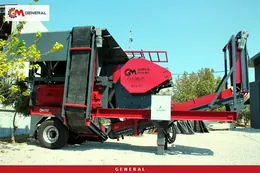
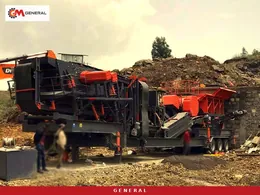
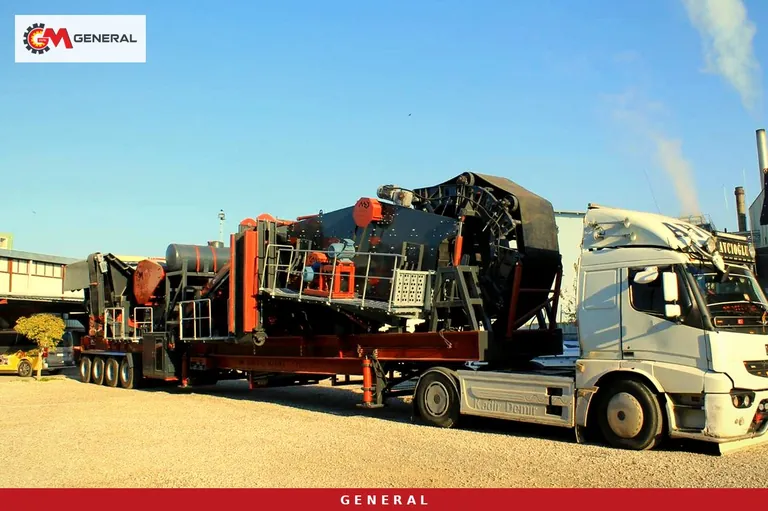
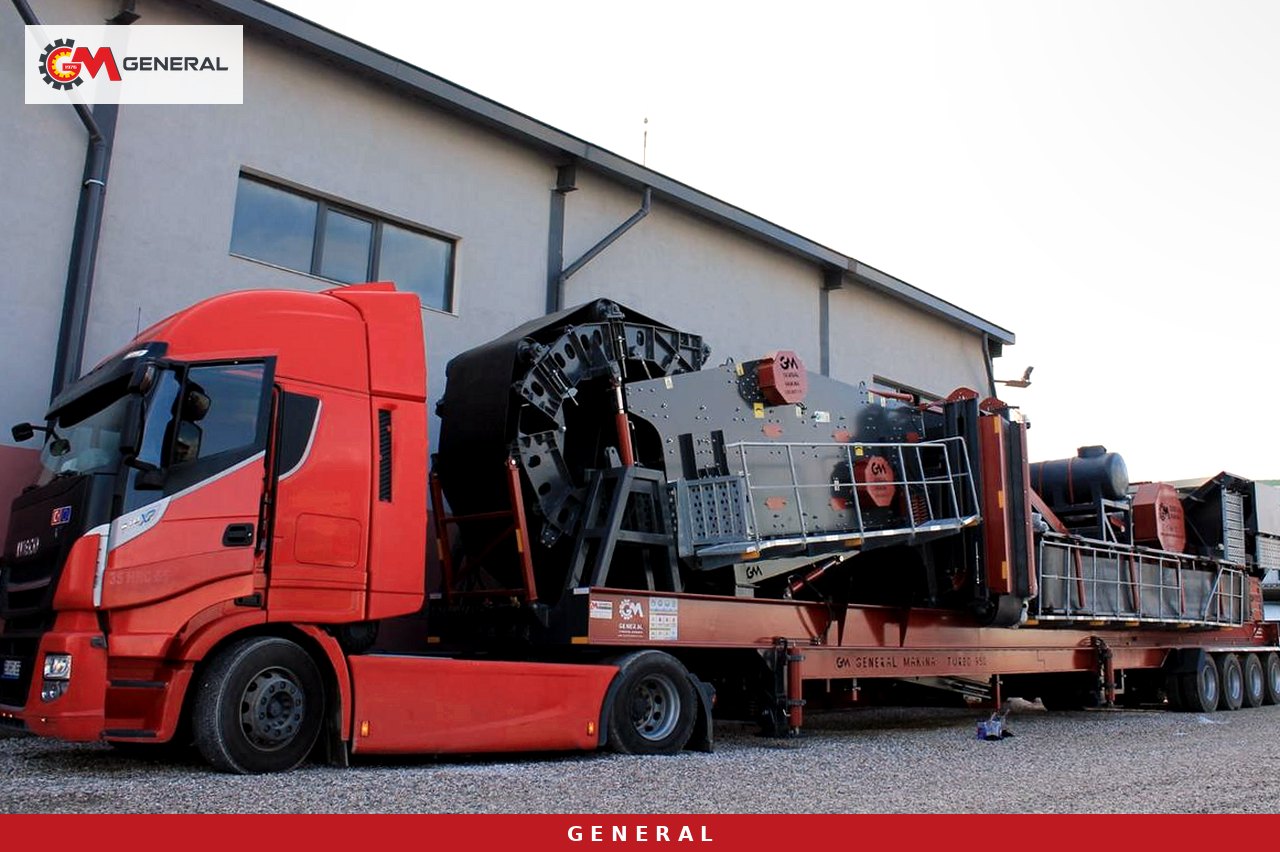
Expressway work advances in a line. If the crusher stays 30-40 km behind, every tonne of crushed stone travels a long way by truck and adds to city traffic. Wheeled plants therefore suit work that follows the alignment: the General 950 moves on one truck and, according to its product page, is working within 30 minutes; the General 03 sets up on folding hydraulic conveyors and hydraulic legs with no foundation excavation.
On the other hand, when the contract spans several years and the quarry is fixed, a stationary crushing plant offers higher capacity, more fractions and a long service life. A mixed solution is common in practice: a stationary line at the main quarry and a wheeled unit for distant sections. You can compare mobile options on the wheeled mobile crushing plants page and fixed ones on the fixed crushing plants page. If the base course is to be stabilized, the mobile pugmill plant which mixes crushed aggregate with cement and water, can be planned with the same alignment logic.
Working close to the city: dust, traffic and highland climate
On a site near Nairobi a crusher's neighbours are housing, main roads and farmland. Dust is the most visible issue in the dry season. Measures that can be chosen per project include water-spray dust suppression at the crusher inlet and conveyor transfer points, enclosed or covered conveyors, stockpiles positioned with the wind direction in mind, and watering of haul roads. These should be fixed in the contract according to the requirements of the local environmental permit.
Rainy seasons and clayey feed
During Kenya's rainy seasons soil and clay from the quarry face can blind the feeder and the screen. Grizzly pre-screening removes fines before they reach the crusher; a scalping unit ahead of the primary protects the crusher and keeps the capacity steady. Mesh apertures and screen inclination should be reviewed again for this period.
Altitude, power and cooling
Highland altitude and midday heat affect the output of diesel generators and engines. The generator figures in the table (e.g. 660 kVA for the General 02, 750 kVA for the General 03) are the standard values from the product pages; if you state your site altitude and ambient temperature in the enquiry, generator and radiator selection is assessed accordingly. Air filters chosen for dusty duty and shorter replacement intervals should also be written into the operating plan.
From the port to the site
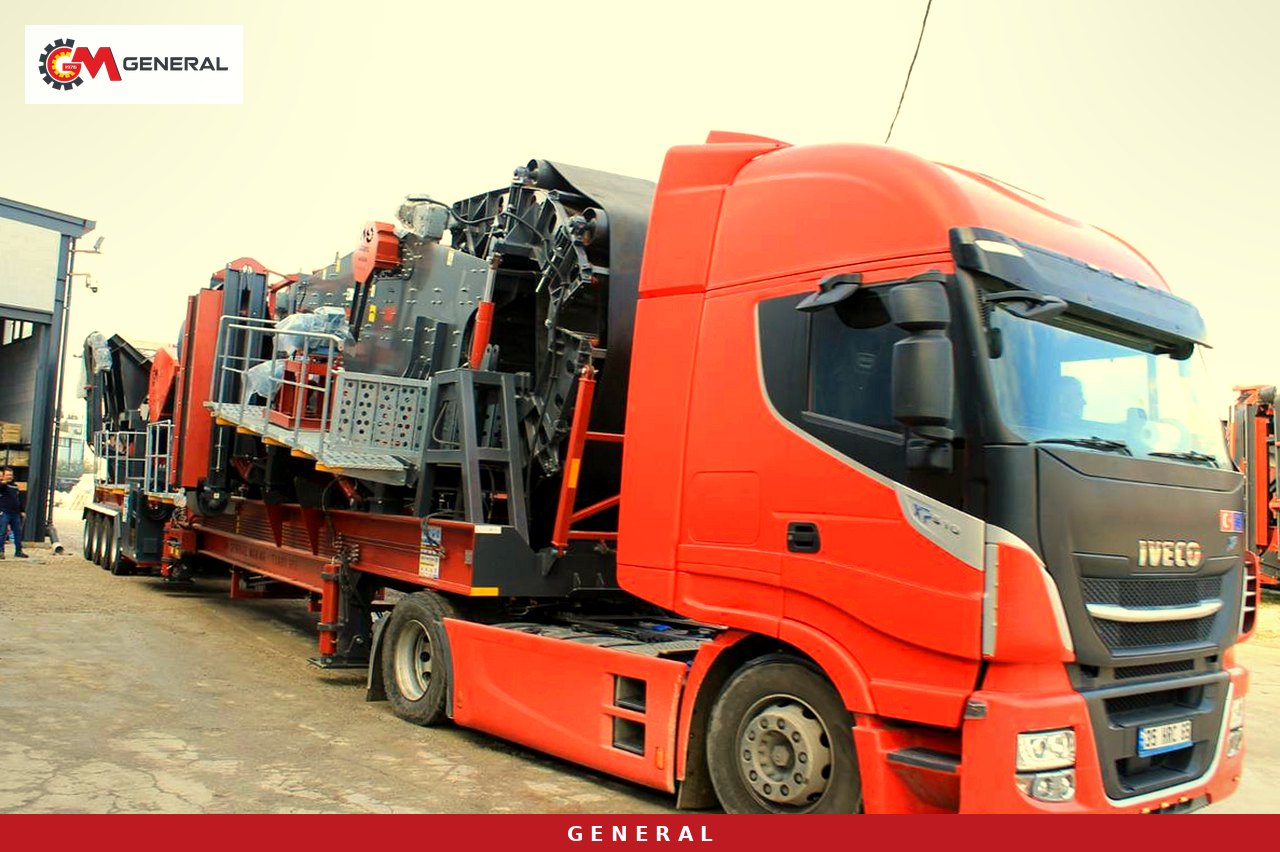
A wheeled plant coming from Türkiye normally travels by sea to an East African port and then by road inland. For road transport the dimensions on the product pages matter: 4130 × 20350 × 4500 mm and 70,000 kg for the General 950, 4340 × 20600 × 4500 mm and 76,000 kg for the General 02. The two chassis of the GNR-MC110 travel separately; the primary chassis measures 3000 × 13500 mm and the secondary chassis 4200 × 18300 mm. Abnormal-load permits, bridge and viaduct crossings and night-transport restrictions should be agreed with the haulier in advance.
Checklist for your quotation file
- Product list: fractions (e.g. 0-5, 5-12, 12-19, 19-40 mm, 0-40 mm base) and a daily tonnage target for each.
- Rock test results: Los Angeles abrasion, compressive strength, silica content; sample photos.
- Largest block size from blasting and whether tuff or clay interlayers occur.
- Site altitude, access to grid power or preference for generator operation.
- How many times the plant will move along the alignment and the expected run time at each location.
- Environmental permit conditions for dust and noise, distance to nearby housing.
- Port of delivery and road restrictions for inland haulage.
- Expected warranty and a list of spare wear parts.
Frequently asked questions
Is one machine or two the better choice for 250 TPH?
A single General 03 or General 02 simplifies setup and the operating crew. Two General 950 units give redundancy and the option of producing on two sections at once. The decision follows the number of sections in the contract and the abrasiveness of the rock.
Which layout suits asphalt aggregate best?
Where cubical grains and narrow fractions are required, layouts with an impact crusher have the edge. If the stone is hard, a jaw primary with an impact secondary (GNR-MC110 or General 950) balances both wear and particle shape.
Which warranty and certificates apply?
General Makina has been manufacturing in Izmir since 1976; the machines carry ISO 9001 and CE certification and are covered by a 1-year warranty, wear parts excluded.
What determines the price?
The model, secondary crusher type, number of screen decks, generator, options such as dust suppression and pre-screening, and the transport scope set the price. A firm figure can only be given in a quotation prepared from your product list and site data.
Final word
When choosing a 250 TPH stone crushing plant for Nairobi expressway work, the starting point is rock testing and the product list; the model comes after those two inputs. In soft to medium-hard stone the General 03 or General 02 are realistic choices, in hard basalt the GNR-MC110 or two General 950 units. Once your site data is ready, reach us through our contact page and we will finalise the configuration and quotation together.
Definitions of technical terms: Glossary