EN — English
 TR — Türkçe
 DE — Deutsch
 RU — Русский
 FR — Français
 ES — Español
 AR — العربية
 SR — Српски

Cape Verde Basalt Mobile Stone Crusher Plant 60-100 TPH
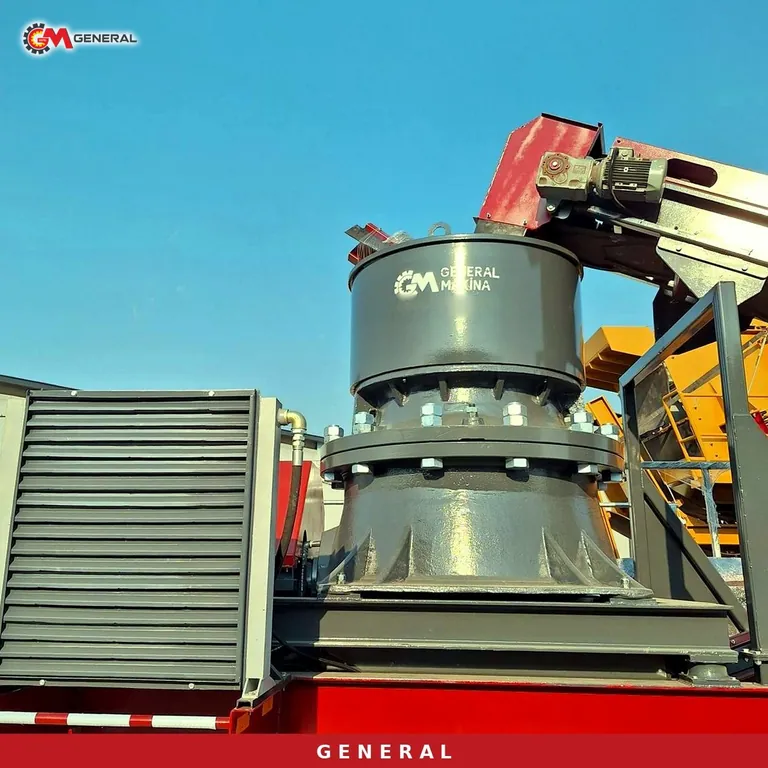
A contractor planning a quarry in Cape Verde (Cabo Verde) starts from two fixed facts: the rock to be crushed is almost certainly volcanic basalt, and before the machine ever reaches the face it has to fit on a ship and then on a narrow island road. The archipelago consists of ten volcanic islands in the middle of the Atlantic, so on most of them the raw material for aggregate is dark, dense, hard basalt together with the pyroclastic layers that accompany it. This article explains how to choose a mobile stone crusher plant for basalt aggregate in the 60-100 TPH band, which models genuinely fit that band, and how island conditions change the machine choice. Every technical value quoted comes from our product pages. We give no information about any specific quarry, tender or infrastructure job in Cape Verde; the project specification should be confirmed with the relevant authority and the rock properties with a sample analysis.
What volcanic basalt demands from a crusher
Basalt is difficult less because of hardness than because of density and toughness. A block from a fine-grained, tightly packed lava flow resists impact for a long time, and when it does break it tends to produce flat, elongated particles. Our cone crusher page gives an abrasion order of Ai≈0.20 for basalt. That is below granite, so basalt does not eat steel as fast as granite does; yet in the same quarry it is common to find vesicular, scoriaceous layers next to massive ones. The massive layer loads the crusher, while the vesicular layer generates dust and fines.
The machine is chosen with both extremes in mind. In the first stage a jaw crusher, which breaks by compression, is the right start in hard, abrasive stone such as basalt; its jaw plates are Mn13/Mn18 austenitic manganese steel that work-hardens under impact. In the second stage particle shape counts as much as size reduction. Concrete and asphalt specifications require cubical aggregate; chippings with a high share of flaky grains will not sell even when crushing cost is low. So in a 60-100 TPH basalt line, how the second stage delivers cubical product matters as much as capacity.
Real model configurations for 60-100 TPH
The range in the title is a target band. Below we compare three approaches with catalogue data that cover it. We add no capacity to any of them and leave cells without data blank.
Single-chassis answer: General 640
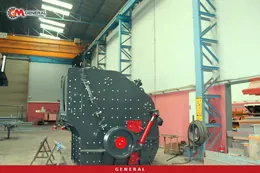
The General 640 is a closed-circuit crushing and screening plant that combines a GPJ 60 jaw and a GNR 50 impactor on one wheeled chassis. It works at 60-100 tph, accepts feed up to 500 mm and delivers 0-5 / 5-12 / 12-19 mm fractions through a 1200×4000 mm triple-deck screen. It weighs 38,000 kg with transport dimensions of 3500×17000×4500 mm; a 300 kVA generator is optional for off-grid sites. A return conveyor sends oversize back to the crusher until the target size is reached. In basalt the wear parts of the impact secondary need closer monitoring; the plant's moderate pace limits that wear.
Staged line from separate units: primary jaw + cubicizer + screen
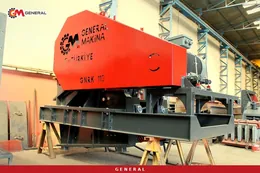
The second route is to set up each stage as a separate mobile unit. The GNR 90 model of the mobile primary jaw crusher with feeder hopper series works at 70-180 t/h with a 1000×3800 mm feeder and a GNRK 90 jaw, and weighs 25,000 kg. Behind it, the GNR MK100 mobile cubicizer takes feed up to 250 mm with a 1550×1200 mm rotor and a 132 kW motor and runs at 90-130 t/h; its liners are Hardox 500 wear steel. The cubicizer's job is shaping rather than reduction, and its product page recommends it specifically for basalt lines. For sizing, the 120-180 tph GNR ME1650 dry screening plant, weighing 18,000 kg, can be added.
Tracked primary: GM 90JP
If the unit must move around the quarry often, the self-driving GM 90JP is an option: GNR 90 jaw (95 kW), 10 m³ hopper, 700 mm feed, 70-180 tph, 250 kVA power unit and 35,000 kg weight. On its own it is a primary crusher; cubical chippings still need a second stage.
| Configuration | Capacity | Max. feed | Crushing stages | Weight | Power |
|---|---|---|---|---|---|
| General 640 | 60-100 tph | 500 mm | GPJ 60 jaw + GNR 50 impactor | 38,000 kg | 300 kVA generator (optional) |
| GNR 90 primary jaw unit | 70-180 t/h | — | GNRK 90 jaw | 25,000 kg | — |
| GNR MK100 cubicizer | 90-130 t/h | 250 mm | Rotor shaping | — | 132 kW motor |
| GNR ME1650 dry screen | 120-180 tph | 0-100 mm | Screening only | 18,000 kg | Generator or mains |
| GM 90JP tracked jaw | 70-180 tph | 700 mm | GNR 90 jaw, 95 kW | 35,000 kg | 250 kVA |
By the table, at 60-100 TPH the route with the fewest pieces is the General 640. The units of the staged line can go beyond this band; a quarry that plans to grow can size the primary and screen generously from day one and upgrade the cubicizer later. Further options are listed under wheeled mobile crushing and screening plants and single-chassis mobile crusher units.
When does a cone crusher make sense in this band?
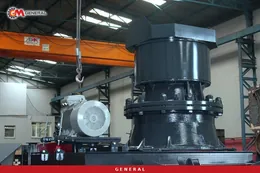
Because a cone crusher breaks stone by compression, it consumes less metal than an impactor in hard, abrasive material. Its product page gives a 6:1–8:1 reduction ratio for the secondary stage; mantle and concave are manganese steel. A cone, however, wants to be choke-fed and needs an evenly sized feed. The cone-secondary mobile plant on our site, the General 944, runs at 120-180 tph, which is more than a 60-100 TPH target requires. If the basalt has high silica, massive layers dominate and output is expected to rise, that model is worth a separate discussion. If today's target stays under 100 TPH, a jaw + cubicizer line or the General 640 is the more balanced investment.
From ship to quarry: dimensions, weight and inter-island transport
A mobile crusher bound for Cape Verde travels as ro-ro or open-deck cargo, not in a container. The main ports are Praia on Santiago and Mindelo on São Vicente; the machine lands at one of them, and if the quarry is on another island a second sea leg may be needed. Every link in this chain is sensitive to size and weight. Before planning the shipment, answer these questions: what length and weight of wheeled cargo does the vessel serving the target island accept? Are there narrow bridges, tight bends or steep grades between port and quarry? Is there a crane or tractor unit on site to unload the machine?
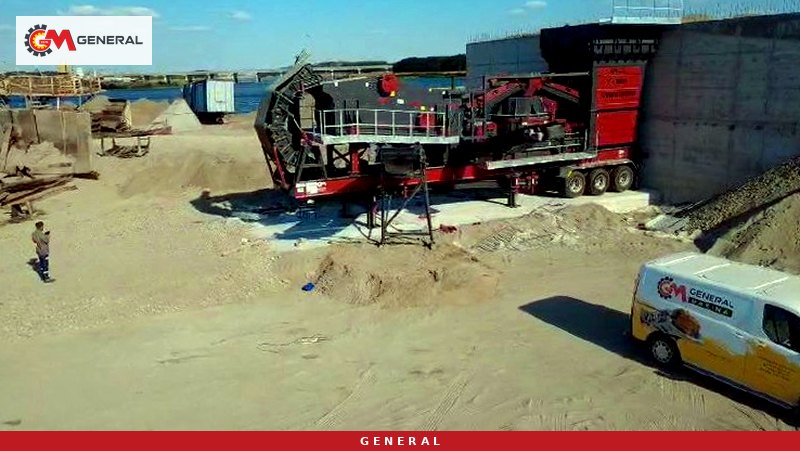
The General 640 is designed to travel on one truck and is commissioned on hydraulic legs without a concrete foundation; its 17-metre transport length and 38-tonne weight are the figures to check against the questions above. In the staged line the heaviest piece is the GNR 90 primary unit (25,000 kg); because the weight is split across several pieces, this can help with a small vessel or a narrow road. The trade-off is that three units must be aligned on site, conveyors linked and each one supplied with power.
Salt air, wind and scarce water: measures on site
Island quarries are usually close to the coast, and the machine is exposed to salt air all year. Paint system thickness, sealing of electrical panels and exposed bolted joints should be discussed at the order stage. The islands lie under the north-east trade winds, and in the winter months fine dust from the Sahara can turn the air hazy. That dust fills engine and generator air filters quickly; inspection intervals should be shorter than at a mainland quarry and spare filters kept on site.
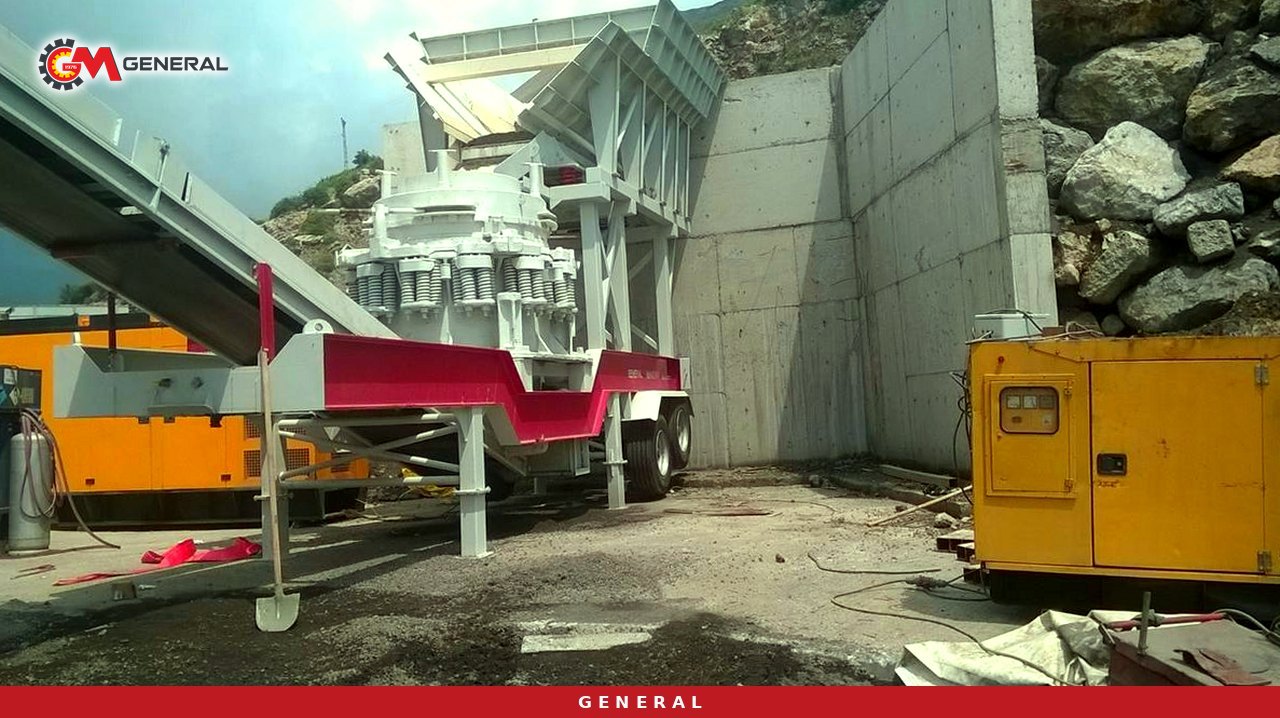
Fresh water is precious on the islands. Dry screening with targeted dust suppression is therefore usually more realistic than a wash line: fine spray nozzles at transfer points, covers over conveyors and stockpiles placed according to the prevailing wind. Vesicular basalt layers give off more dust; if they are excavated separately and pre-screened, both dust and crusher load fall. Where the island grid does not reach the quarry, the optional 300 kVA generator of the General 640 or the 250 kVA power unit of the GM 90JP is taken into account, and how often fuel reaches the site becomes part of the operating plan.
On the wear side, jaw plates and cubicizer liners are the items that change most often in basalt. Every order to an island means a shipment, so sending at least one set of jaw plates and secondary wear parts with the first delivery is the simplest way to cut downtime risk.
Information to prepare before requesting a quote
- Rock sample or lab report: whether the basalt is massive or vesicular, and an abrasion value if possible.
- Target products: required fractions for concrete chippings, asphalt aggregate or sub-base, and the particle-shape limit in the specification.
- Hourly and daily output target; number of shifts.
- Largest block size after blasting (sets the primary feed opening).
- Island of the quarry, port of arrival and restrictions on the road from port to quarry.
- Power source: island grid or generator?
- Water access and the amount available for dust suppression.
- Whether a capacity increase is planned later.
Frequently asked questions
Can a Cape Verde basalt quarry start with a single machine?
Yes. The General 640 carries a jaw, an impactor and a screen; it produces three fractions at 60-100 tph and moves on one truck. If the particle-shape requirement is strict or output will grow, a staged line with a separate primary jaw and cubicizer is more flexible.
Won't an impactor wear out too fast in basalt?
An impactor consumes more metal in basalt than a cone, so its wear parts are checked often and spares are kept on site. A jaw primary and an evenly sized feed to the secondary limit that wear. In a high-silica quarry the cone-secondary option is assessed separately.
How is the machine moved to another island?
Wheeled chassis ship as ro-ro or deck cargo. Which vessel accepts which dimensions, and whether the road from port to quarry is suitable, should be confirmed with a local carrier; machine dimensions and weights are given in the quotation file.
What determines price and delivery date?
The chosen configuration, number of units, generator need, screen fractions, spare parts package and shipping method set the price. A firm figure is given in a project-specific quotation once the points above are clear.
Conclusion
The right mobile crusher for 60-100 TPH of basalt in Cape Verde is the one that handles the rock's toughness, the cubical-shape requirement and island logistics at the same time. The route with the fewest pieces is the General 640; the route open to growth is a staged line of GNR 90 primary jaw, GNR MK100 cubicizer and GNR ME1650 screen. General Makina has manufactured in Izmir since 1976; the machines carry ISO 9001 and CE certification and a 1-year warranty excluding wear parts. Send your rock data and target products through our contact page and we will work out the configuration that suits your site.
Definitions of technical terms: Glossary