EN — English
 TR — Türkçe
 DE — Deutsch
 RU — Русский
 FR — Français
 ES — Español
 AR — العربية
 SR — Српски

Jordan Amman Housing Aggregate Crushing Plant 150-250 TPH
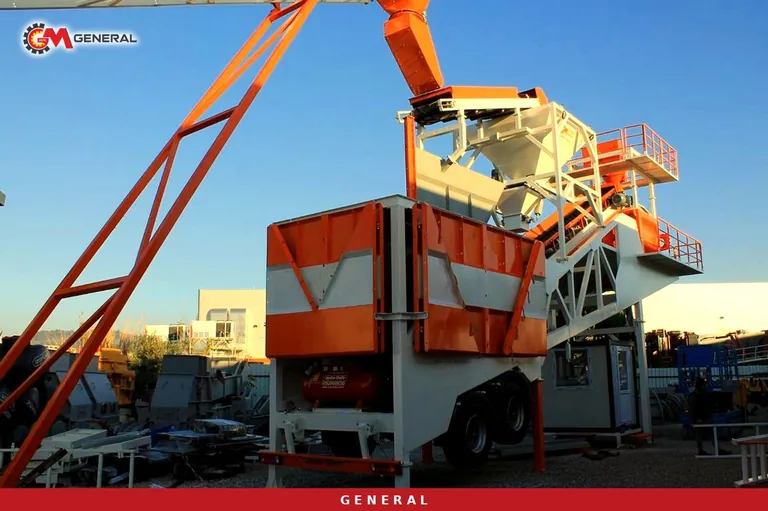
For a contractor building housing in Amman, the aggregate question is not the road-builder's "how many tonnes of base course do I need". Residential concrete asks for the same grading on every pour day, low dust content and cubical rather than flaky coarse particles; when those three conditions slip, the ready-mix plant has to raise the cement dosage and the cost climbs from there. The main raw material in the quarries around the capital is limestone. It shapes well in an impact crusher, but the chert nodules and marly interbeds it often contains can change the plant you should buy. This article builds a 150-250 TPH crushing and screening plant for housing concrete around Amman's rock, water, terrain and the link to the batching plant. Every model and figure comes from the technical tables on our product pages; confirm the aggregate specification and project requirements with the employer and the relevant authority.
What housing concrete expects from aggregate: the Amman product list
On a residential development, concrete demand swings between footing, wall, slab and column pours, yet the aggregate sent to the batching plant has to fit the same mix design every time. That is why plant planning starts with the product list rather than with capacity. A typical housing concrete mix uses at least three fractions: crushed sand, fine chippings and coarse chippings. On our wheeled crushing and screening plants the standard product sizes are 0-5, 5-12, 12-19 and 19-40 mm, and screen meshes are specified separately on each order to suit the specification.
Three quality criteria decide the outcome in residential concrete:
- Particle shape: flaky and elongated particles reduce workability and make pumping harder. In limestone, impact crushing largely solves this.
- Fines and clay: dust and marl-derived clay in crushed sand raise water demand and shrinkage. Overburden and marly bands must be removed before they reach the crusher.
- Consistency: the batching recipe is fixed; if the plant over-produces 0-5 mm one day and under-produces it the next, the stockpile balance breaks. A multi-deck screen and a return conveyor keep that balance.
The limits for these criteria depend on the concrete and aggregate standards applied in Jordan and on the project's technical specification. Get the limit values from the employer's laboratory; designing the plant around them is far cheaper than changing screens or crushers later.
Limestone around Amman and the chert question
The sedimentary limestones common on Jordan's central plateau, along the Amman–Zarqa belt, are generally of medium hardness and low abrasiveness. In this kind of rock an impact crusher works at a high reduction ratio and delivers cubical chippings in a single stage. The same quarry, however, may contain hard chert nodules, silicified bands or soft marl layers. These differences vary from quarry to quarry, and even between benches of one quarry.
When the chert content rises, the crusher choice changes
Chert is a silica-rich, very hard component inside limestone. At low proportions the blow bars of an impact crusher tolerate it; as the proportion rises, rotor parts wear quickly and wear cost per tonne climbs. In that case a layout with a jaw crusher at the primary stage and an impact crusher at the secondary stage gives a more balanced result: the jaw meets the hard pieces first with compression, and the impactor concentrates on shaping and reduction. To decide, take representative samples from the quarry and have Bond abrasion index (Ai), Los Angeles abrasion and compressive strength tests carried out; sample every bench you plan to work, not a single spot.
Marl and overburden contaminate crushed sand
If the overburden stripped while opening the quarry and the marly interbeds get mixed into the feed, the clay content of the crushed sand rises. The fix starts before the crusher: a grizzly feeder or a feeder table with a by-pass screen diverts the fine, soil-laden part to a separate stockpile without sending it through the crusher. That material does not go into housing concrete, but it can be used for fill and grading work.
Three real plant layouts for 150-250 TPH
The target range can be met not with one model but with three layouts, depending on the quarry. The table below contains only values from our product pages.
| Layout | Crushers | Capacity (t/h) | Max. feed | Screen | Power unit | Weight |
|---|---|---|---|---|---|---|
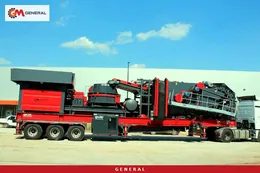
| General 02 (single chassis) | GPS 1413 primary impactor | 250-300 | 1000 mm | 2000×5000 mm, 4 decks | 660 kVA | 76,000 kg |
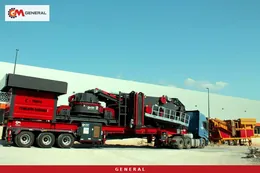
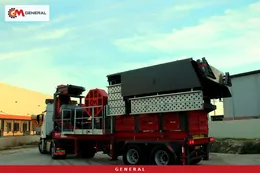
| GNR-MC110 (twin chassis) | GPJ 110 jaw + DMK03 impactor | 200-300 | 900 mm | 2000×6000 mm, 4 decks | 750 kVA | 2 × 55,000 kg |
| GNR 110 + M-DMK 02 (separate units) | GNRK 110 jaw + secondary impactor | 180-300 / 150-250 | 1100 mm / 350 mm | Separate screen (e.g. GNR 2060, 2000×6000 mm) | — | 55,000 + 38,000 kg |
| GNR-MVSI 900 (optional sand stage) | VSI 900 vertical shaft | 90-180 | 50 mm | 1600×5000 mm, 3 decks | 850 kVA | 42,000 kg |
Clean limestone quarry: General 02
In a homogeneous limestone quarry with little chert, General 02 is the simplest answer. The GPS 1413 primary impactor accepts blocks up to 1000 mm; the 2000×5000 mm four-deck screen separates the four fractions housing concrete needs in one pass and sends oversize back to the rotor. Because the nominal 250-300 TPH range sits above the 150-250 TPH target, the plant runs without straining at full load; that margin absorbs feed fluctuations and screen blinding.
Cherty or variable quarry: GNR-MC110
If sample tests show higher abrasiveness, GNR-MC110 comes forward. The GPJ 110 jaw primary handles the hard pieces and the DMK03 secondary impactor produces cubical particles. Since the two chassis can run independently, only the primary group can be installed in the first phase to produce coarse fill, with the secondary chassis brought online once the housing concrete pours begin.
Phased growth with separate units: GNR 110 and M-DMK 02
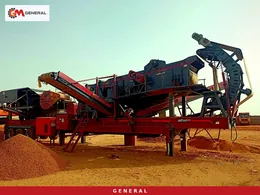
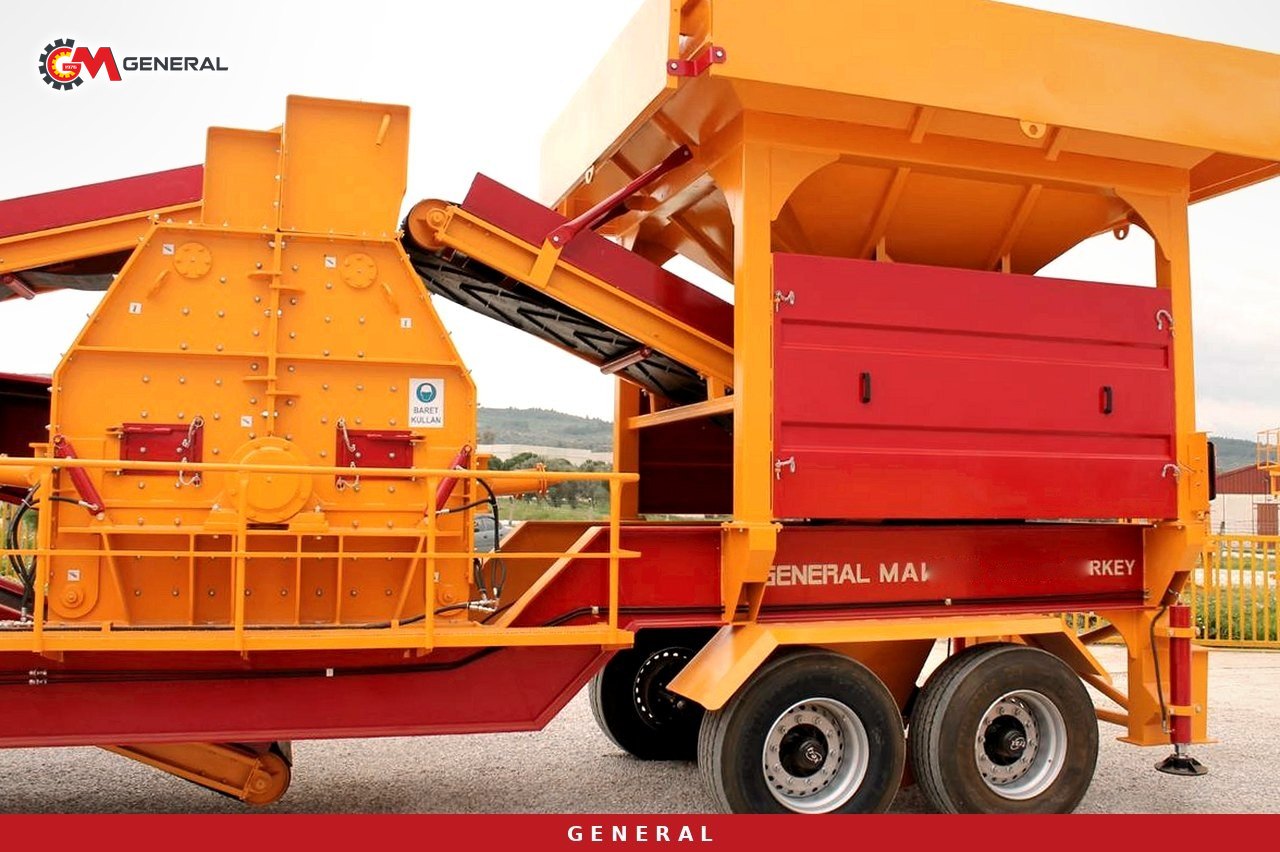
For an investor who already owns screening equipment or wants to build the line step by step, single-chassis crusher units offer flexibility. The GNR 110 jaw primary unit works at 180-300 TPH and the M-DMK 02 secondary impact unit at 150-250 TPH. The narrowest link sets the real capacity of the line; here that link is the M-DMK 02, and its range matches the target in the title. The by-pass screen on the feeder table of the M-DMK series removes marly fines before they enter the crusher.
Crushed sand: dry line without washing, or a shaping stage?
Jordan is counted among the most water-scarce countries, and around Amman setting aside wash water for a crushing plant is often costly and subject to permits. So the first choice is a dry line: remove overburden and marl at pre-screening and take the crushed sand straight from the four-deck screen. If laboratory results show the fines content of the crushed sand exceeds the specification, there are two routes.
- Shaping stage: among our wheeled mobile crushing plants the GNR-MVSI 900 turns material up to 50 mm into cubical sand with a vertical-shaft rotor and delivers 0-3, 3-5 and 5-12 mm fractions. It uses no water; it improves particle shape but does not remove clay.
- Sand washing: if pre-screening cannot solve the clay problem, a screw washer (0-50 mm feed, 50-250 TPH) is added to the line. Water recovery and sludge handling then become a separate project item, sized to the site's water permit.
Installing the dry line first, testing the sand it produces and adding a VSI or washing only if needed is the sensible way to phase the investment under Amman conditions.
From aggregate to concrete: planning the crushing line and batching plant together
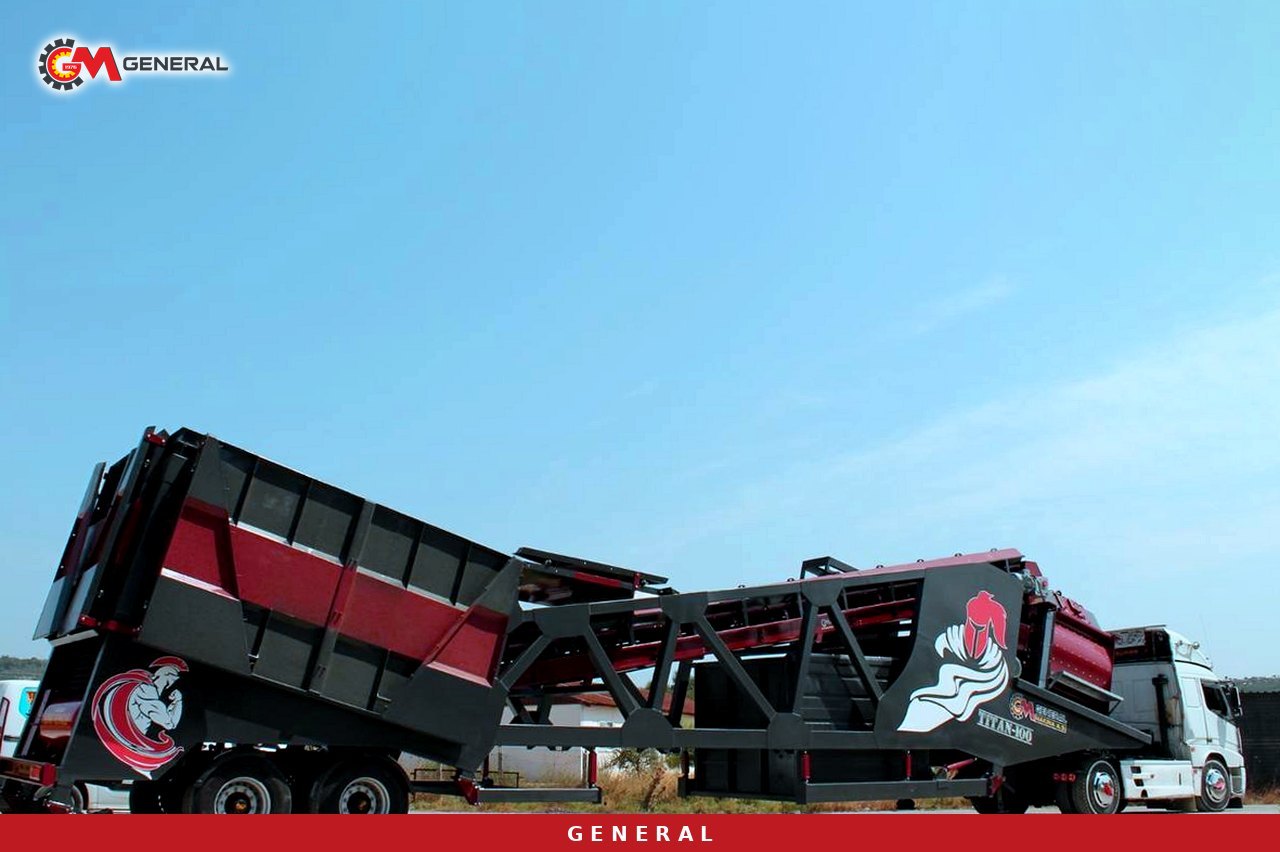
On housing projects the crushing plant's customer is usually a concrete batching plant on the same site or nearby. Planning the two separately leads to unnecessary piles in the stockyard or to the batching plant waiting for one fraction. For example, the M-Titan 100 mobile concrete batching plant runs at 100 m³/h with a twin-shaft mixer driven by 2×45 kW motors, has a four-compartment 4×15 m³ aggregate bin and 4800 kg aggregate weighing. The crushing plant's hourly output of each fraction should be set to feed these bin compartments.
A simple formula is enough for the required aggregate: hourly concrete output (m³/h) × quantity of each fraction per m³ in the mix (kg) = hourly demand for that fraction. Compare this with the screen output of the crushing plant; for a fraction that falls short, changing a screen mesh or raising the return rate is usually enough. The practical benefit of buying crushing, screening and batching from one manufacturer is that this balancing is done by one engineering team and spare parts come from one source.
Site set-up in Amman: proximity to housing, sloping ground and transport
Amman is built on hilly ground and housing projects spread quickly into the outer ring of the city. The closer the aggregate plant is to settlements, the shorter the haul, but the more sensitive dust and noise become. Measures that can be chosen per project include water-spray dust suppression at the crusher inlet and conveyor transfer points, wind screens or covered belts on stockpile conveyors, and night working hours arranged to local rules. Which of these are mandatory is set by the environmental permit; clarify the permit conditions before ordering the plant.
Wheeled chassis do not need concrete foundations, but they need a level, compacted platform. For a plant on a slope, the crusher chassis, screen and stockpile conveyors can be laid out to use the level difference, with the truck tipping ramp built to the hopper height. On the power side a 660 kVA power unit is standard on General 02 and 750 kVA on GNR-MC110; if a grid connection is possible, the generator can be kept as backup. Hot, dusty summer weather calls for more frequent cleaning of radiators and air filters; build the maintenance plan around that.
Equipment shipped from Izmir reaches the port of Aqaba by sea and travels north to Amman by road. Because each chassis of the twin-chassis GNR-MC110 is carried separately, heavy haulage permits are easier to plan than for a single-piece load. Information we ask you to share before quoting:
- Ai, Los Angeles and compressive strength results of the quarry samples
- Largest block size after blasting
- Fractions in the housing concrete mix and the specification limits
- Hourly and daily target output, number of shifts
- Grid power status and access to water
- Dimensions and level difference of the installation area
- Any existing screen, feeder or batching plant
Frequently asked questions
Is an impact crusher alone enough for Amman limestone?
Yes, if the share of chert and silicified bands is low; a primary impact plant such as General 02 gives cubical chippings and crushed sand for housing concrete. If tests show high abrasiveness, a jaw primary plus impact secondary layout, either GNR-MC110 or GNR 110 + M-DMK 02, should be preferred.
Can concrete sand be produced without washing?
If overburden and marl are removed at pre-screening, a dry line yields specification-compliant crushed sand in most limestone quarries. The result must be confirmed in the laboratory; if the fines limit is exceeded, a VSI shaping stage or a screw washer is added.
Which certificates and warranty come with the machines?
General Makina has been manufacturing in Izmir since 1976. Our machines carry ISO 9001 and CE certification and come with a 1-year warranty, excluding wear parts.
How do I get price and delivery information?
Price depends on the chosen layout, the number of screens and crushers, the power unit, extra equipment such as dust suppression, and transport conditions. When you contact us with the information in the list above, a project-specific quotation is prepared.
Conclusion
The right choice for a 150-250 TPH plant producing aggregate for housing concrete in Amman depends on the chert and marl content of the rock, the fines limit for crushed sand and the fraction demand of the batching plant. General 02 for clean limestone, GNR-MC110 for hard or variable quarries, and the GNR 110 plus M-DMK 02 pairing for phased investment are realistic options. If your quarry tests and mix design are ready, reach us through our contact page and we will settle the right configuration and quotation together.
Definitions of technical terms: Glossary