EN — English
 TR — Türkçe
 DE — Deutsch
 RU — Русский
 FR — Français
 ES — Español
 AR — العربية
 SR — Српски

Gulf Region Crusher and Screener Plant Permits & Site Prep 150-300 TPH
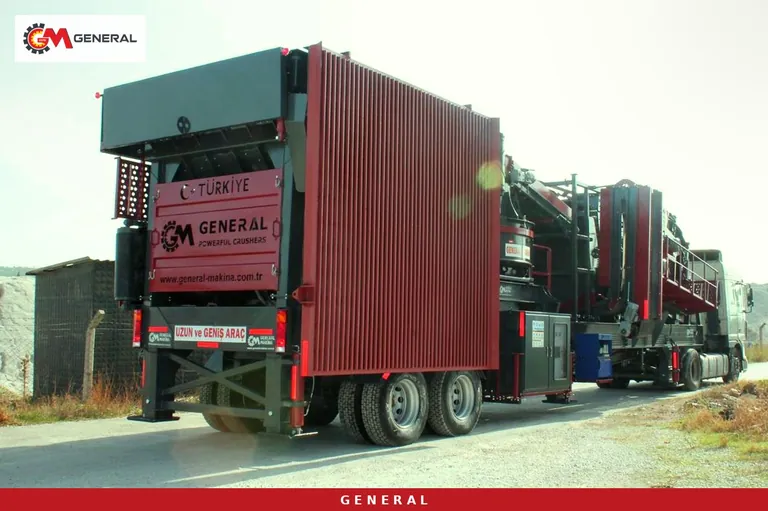
On a Gulf crushing and screening plant designed for 150-300 TPH, the first serious delay rarely comes from the machine. It comes from a permit file that turns out to be incomplete, or from a site that is not ready when the trailers arrive. In Saudi Arabia, the United Arab Emirates, Qatar, Kuwait, Bahrain and Oman, the licensing authorities, document lists and environmental rules differ from country to country, and in the UAE even from emirate to emirate. The one common thread is that the authority wants to understand the plant on paper first. This article answers three questions from a site engineer's point of view: which technical data go into the application, how much space and power the real models in the 150-300 TPH band need, and how ground, access roads, water and drainage should be prepared before the plant lands.
Let us draw the line first: this is not legal advice. Which body issues which approval, in what order and for what fee is decided by the country and municipality where the site lies. Confirm the current requirements with the relevant authority and a local environmental consultant; our part is the machine-related technical section of the file.
The permit file starts with machine selection
Many investors assume the natural order is to secure the licence and then shop for equipment. In practice it works the other way round. Environmental assessment, noise and dust estimates, fuel storage and fire-safety reviews all look at installed power, site layout and the number of dust-generating points. None of that can be written before the model is fixed. Our advice is to settle the configuration at the preliminary quotation stage and build the file around it; if the model changes later, a large part of the file has to be redone.
Machine documents the file is likely to need
- General arrangement drawing: feed hopper, crushers, screen, conveyor discharge points and stockpiles, with dimensions.
- Transport dimensions and weight of each unit, required both for the route permit and for the ground calculation.
- Generator rating (kVA) and, if a grid connection is planned, the motor list.
- A list of dust sources: feed point, crusher discharge, screen, belt transfers and stockpile drop points.
- CE declaration of conformity, ISO 9001 certificate, operating and maintenance manual.
- Safety information showing emergency stops, guards and service platforms.
Questions to put to the authority and consultant early
Will the site operate under a quarry licence, or will it be permitted as a temporary site plant serving an infrastructure project? In most countries that distinction changes which agency you apply to. You should also clarify before applying whether the generator and diesel tank need a separate approval, whether groundwater abstraction is allowed, whether there is a minimum distance to housing or highways, and whether night shifts are permitted. These answers shape the site layout described below.
Real configurations and footprints for 150-300 TPH
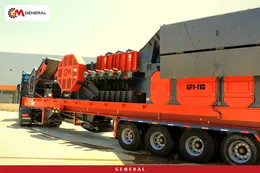
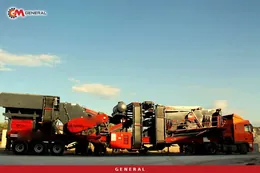
The target range corresponds to two different investment shapes. At the lower end, around 150 TPH, a single-chassis plant with a jaw primary may be enough. At the upper end, 250-300 TPH calls either for a high-tonnage plant or for a modular line in which two units work together. The full family is on our wheeled mobile crushing and screening plants page. The figures below come from our product pages; values that are not published are shown as "—".
| Configuration | Capacity (t/h) | Max. feed (mm) | Generator | Weight | Transport size |
|---|---|---|---|---|---|
| General 950 (GPJ 90 jaw + DMK01 impact) | 120-180 | 800 | 600 kVA | 70,000 kg | 4130 × 20350 × 4500 mm |
| GNR-MC110 (twin chassis: GPJ 110 jaw + DMK03 impact) | 200-300 | 900 | 750 kVA | 2 × 55,000 kg | 3000 × 13500 mm and 4200 × 18300 mm |
| General 02 (GPS 1413 primary impact) | 250-300 | 1000 | 660 kVA | 76,000 kg | 4340 × 20600 × 4500 mm |
| General 03 (GPS 1415 primary impact, 4 axles) | 250-375 | 900 | 750 kVA | — | — |
| Mobile primary jaw GNR 110 + M-DMK 03 | 180-300 / 175-300 | 0-1100 (primary) | — | 55,000 kg + 45,000 kg | — |
| GNR ME2060 mobile screen (pre-screening or dry screening) | 200-350 | 0-100 | (screen motor 22 kW) | — | 15 × 4.10 × 4.50 m |
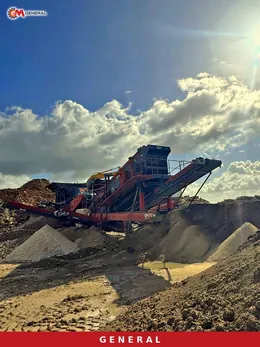
Rock type decides. In the limestone and dolomite quarries of the Gulf coastal belt, the primary impact General 02 and 03 achieve high reduction in one stage. In ophiolitic rocks such as the gabbro of the Hajar Mountains in Oman and the UAE, or in the granite and basalt of western Saudi Arabia, a jaw-led line such as the GNR-MC110 twin-chassis plant or the General 950 is the sounder choice, because blow bars wear fast in abrasive rock. Decide which group your deposit belongs to with laboratory tests on a sample taken from the quarry.
If production is planned at one site for many years, a stationary line on concrete foundations also comes into play. Our GNR PDK 02 stationary crusher in Saudi Arabia (250 t/h) working in desert conditions, is an example of that approach. Because a fixed plant needs a foundation design and a building approval, its permit path differs from that of a mobile plant.
A modular line can phase the permit too
Since the primary chassis of the GNR-MC110 can run on its own, some investors commission only the primary group in phase one and bring the secondary chassis later. A primary jaw unit chosen from our mobile crusher units combined with the M-DMK mobile secondary impact crusher gives the same flexibility; the screen on the M-DMK feeder deck and its by-pass conveyor divert soil-laden fines before they enter the crusher. Showing the final layout in the file from day one reduces the risk of a fresh application for phase two; plan this together with the authority.
Ground: what foundation-free set-up does and does not mean
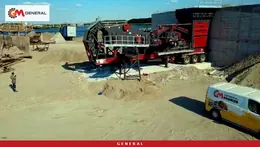
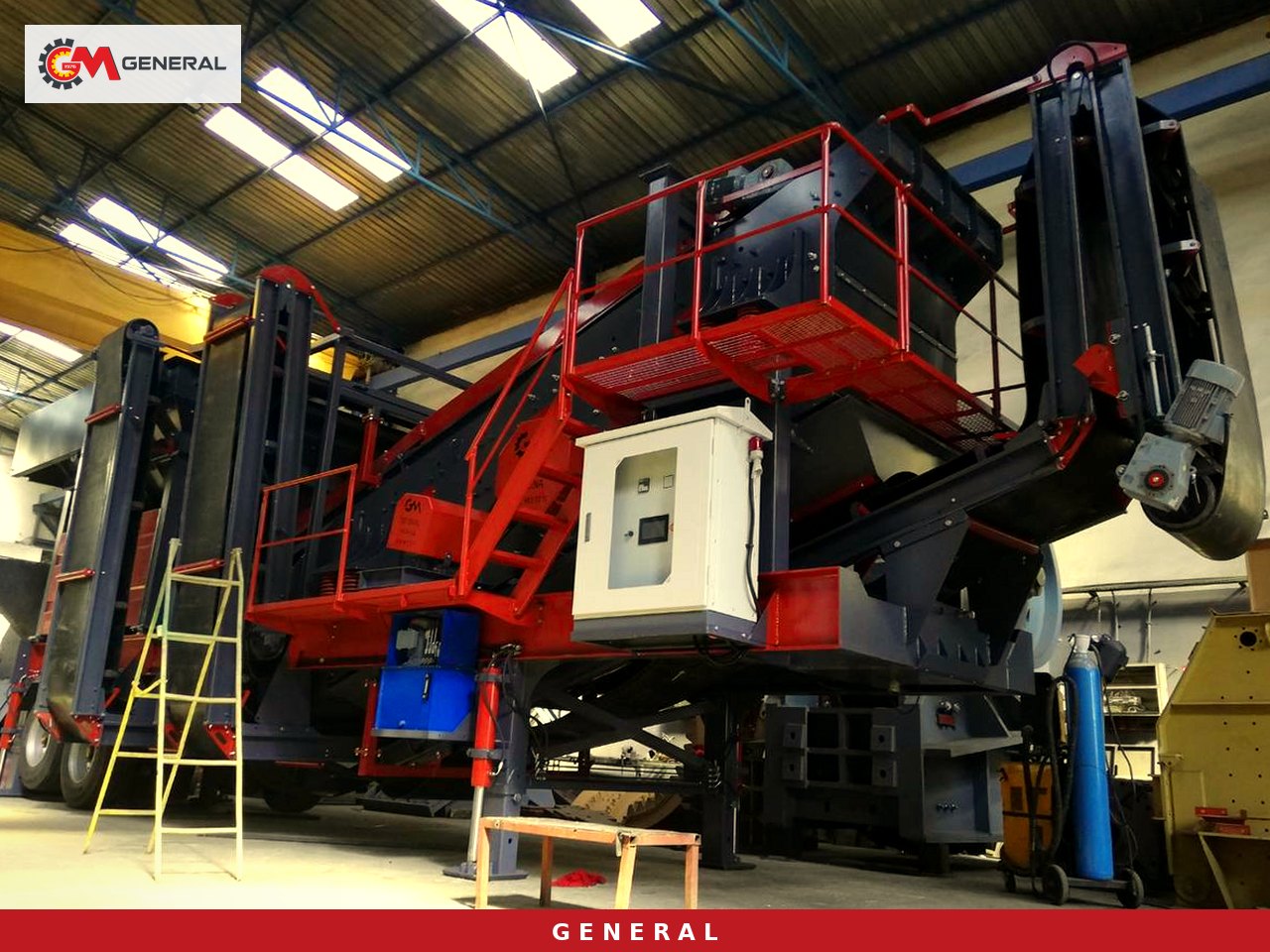
Our wheeled mobile plants are set up on hydraulic support legs; no excavation or concrete foundation is needed. That does not mean the ground needs no work. A 70-76 tonne chassis transfers its load through a handful of leg pads. If one leg sinks into loose sand or soft fill, the screen angle drifts, belt alignment shifts and vibration spreads through the frame.
Levelling and bearing capacity
The pad where the plant stands should be compacted, levelled granular fill, with steel or concrete load plates under the legs where needed. A geotechnical engineer who surveys the site determines the bearing capacity; we provide the leg layout and unit weights. The ramp where trucks or loaders approach the hopper is a separate load zone and is usually the part of the site that deteriorates fastest in operation.
Sabkha, dunes and wadi beds
The salt flats (sabkha) of the Gulf coast can look firm on dry days yet soften quickly after rain and lose bearing capacity, while the salt accelerates corrosion on steelwork. Mobile dune edges bury the pad with wind-blown sand. Dry wadi beds are the paths of rare but sudden flash floods. Setting the plant away from all three, on a sound pad even at the cost of a longer conveyor or haul road, works out cheaper over the life of the operation.
Route from port to site
Plants bound for the Gulf usually land at ports such as Jebel Ali, Dammam, Hamad or Sohar and are towed to site by road. The 4-axle chassis of the General 03 is designed with international transport in mind. The 4340 mm width of the General 02, and the 4200 mm width and 18.3 m length of the GNR-MC110 secondary chassis, fall into the oversize load category. Route permits, escort vehicle requirements and clearances under bridges and underpasses should be worked out with the haulage contractor in advance.
The last kilometres need a stabilised access road, with turning radii sized to the combined length of tractor and trailer. Once the chassis is on site, the area where the legs deploy and where the folding conveyors swing out must stay clear; do not park containers or stack materials there.
Power, water and drainage
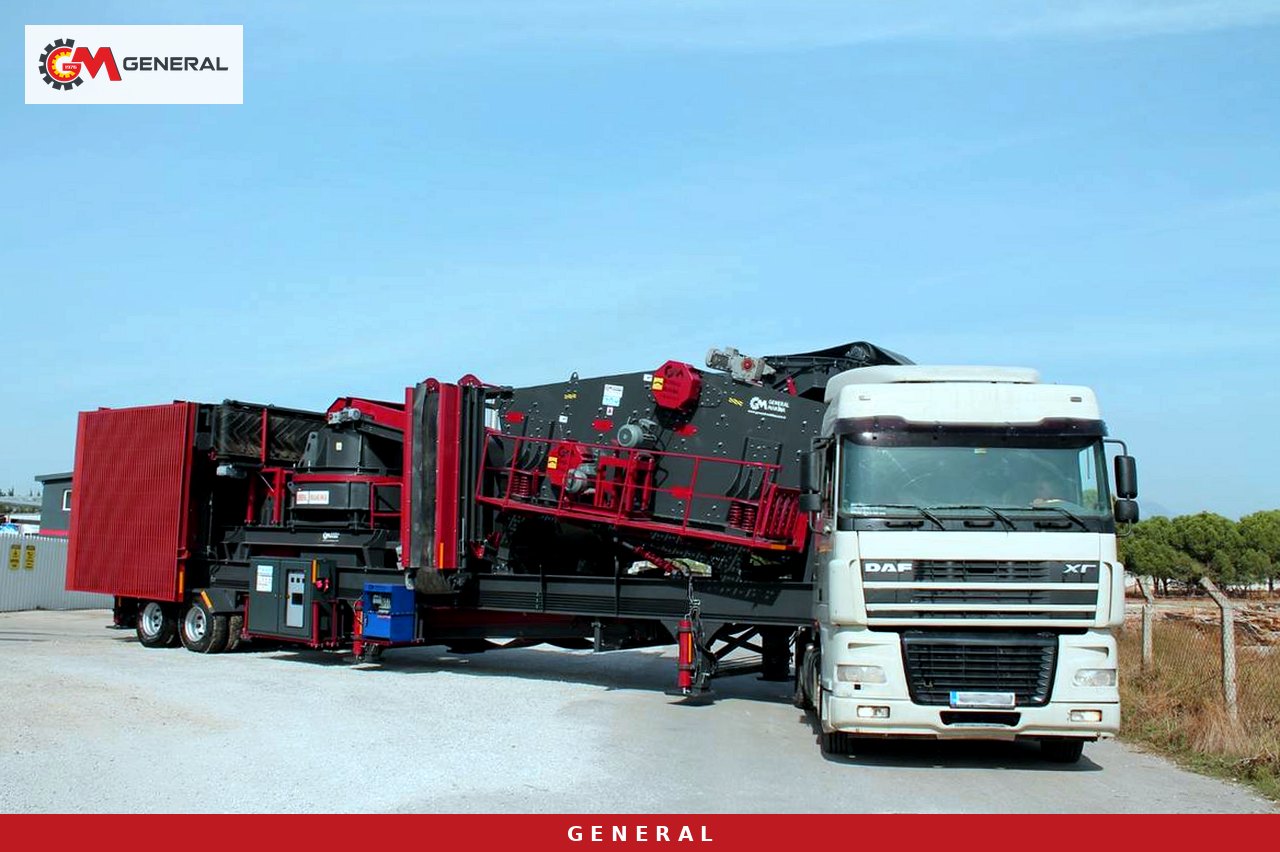
Power: On remote sites the plant runs on a generator. Rating depends on the model: 600 kVA for the General 950, 660 kVA for the General 02, 750 kVA for the General 03 and the GNR-MC110. The generator and fuel tank should stand away from crusher vibration, at a point the prevailing wind keeps free of dust, and over a spill tray. Fuel storage is inspected separately in most countries, so state tank volume and location in the file. If a grid connection is possible, mark the transformer position and cable route on the layout as well.
Water: The source for dust suppression sprays, road watering and staff needs should be fixed at permit stage: tanker, well or treated water. Even a dry-screening site needs water for roads and stockpiles. What matters here is that the water tank, pump and pipe route appear on the layout drawing; authorities often want to see them.
Drainage: The pad should fall gently away from the wadi side, and concrete trays should catch oil and fuel leaks under the crushers and around the generator. Electrical panels should be raised off the ground. Solutions such as the fan-cooled panel that is standard on the GNR ME2060 protect electronics in the midday heat; keep the ventilation clearance in front of the panel open.
Site checklist before the plant arrives
Every item below should be ticked before the first tractor enters the site:
- Permit scope and written agency approvals on file; final layout drawing approved.
- Pad compacted and level surveyed; load plates ready at leg positions.
- Hopper ramp, truck turning area and one-way traffic loop marked out.
- A separate stockpile area for each fraction, with loader manoeuvring room between belt end and pile.
- Generator, fuel tank and spill tray positioned according to wind direction.
- Water tank, pump and spray line route ready.
- Site fence, gate control, shaded rest area and first-aid point in place.
- Operators and maintenance crew named; on-site training scheduled for commissioning days.
The process from engineering through shipment to after-sales is described in our four-step way of working. The layout drawing and technical file are prepared in its first step.
Frequently asked questions
Does a mobile plant also need an environmental permit?
In most Gulf countries rock crushing falls under the environmental authority's review even when the plant is mobile. The scope depends on the country and the status of the site; get the definitive answer from the competent body. We prepare the machine data that go into the file.
Do I have to pour a concrete foundation?
Our wheeled mobile plants are installed on hydraulic legs without foundations; a compacted, level pad and leg plates where needed are sufficient. Stationary lines do require a foundation design.
Can I order the machine while the permit is in progress?
Yes, many investors run manufacturing and shipment in parallel with the permit process. The configuration must, however, stay the same as in the file; a later change may trigger a new review.
What determines price and delivery?
Configuration, rock type, required product fractions, generator and options, and the port of arrival. Share these details and a tailored quotation is prepared for you.
Conclusion
Getting a 150-300 TPH line into production on time in the Gulf depends on planning the permit file and site preparation at the same table as machine selection. Choose the configuration by rock type, state footprint and power demand correctly in the file, and keep the pad clear of sabkha and wadi risk. As a manufacturer producing in Izmir since 1976, certified to ISO 9001 and CE, we supply our plants with a 1-year warranty (wear parts excluded). Send your quarry details, target capacity and port of arrival through our contact page and let us prepare the layout drawing and quotation together.
Definitions of technical terms: Glossary