EN — English
 TR — Türkçe
 DE — Deutsch
 RU — Русский
 FR — Français
 ES — Español
 AR — العربية
 SR — Српски

Guinea-Bissau Road Mobile Crushing & Screening Plant 80-150 TPH
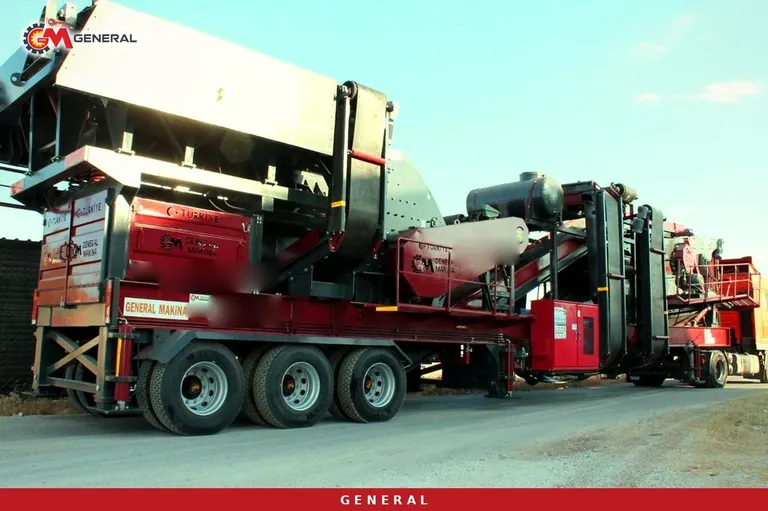
For a contractor winning road work in Guinea-Bissau, choosing a crushing and screening plant starts with one question: where will the stone come from? The area around Bissau and the coastal belt is low, flat ground cut by estuaries and mangrove shores and covered with thick laterite. Sound rock tends to appear further inland, towards Bafatá and Gabú, as scattered outcrops. Two consequences follow: the quarry is often far from the job, and the crushing point has to move as the road advances. A target of 80-150 TPH is large enough to feed a mid-sized road section and compact enough to travel behind a single tractor unit. This article compares the real models that cover that band using their published data, and links road-layer gradings, the rainy season, dry-season dust and the shipment from the port of Bissau to the purchasing decision.
The crusher follows the road: why a wheeled plant?
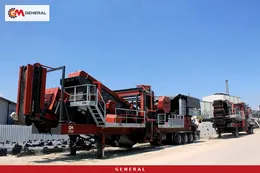
Road construction and rehabilitation in Guinea-Bissau usually progress in a line; once one section is finished, demand for material shifts tens of kilometres away. A stationary plant needs foundation concrete, steelwork and a long erection period. As the distance between quarry and job grows, trucking crushed stone adds to the cost per tonne. A wheeled mobile plant changes that equation: feed hopper, crusher, screen and conveyors arrive on one chassis, settle on hydraulic legs in a short time and, when the job ends, leave for the next quarry behind the same tractor.
Capacity should be sized from the daily consumption of the road layers. The required hourly rate follows from a simple relation: hourly capacity = daily demand (t) ÷ (shift hours × availability). Availability covers feed interruptions, wear-part changes and rain stoppages. With a long rainy season in Guinea-Bissau, this factor should not be taken optimistically. If the result lands in the middle of the 80-150 TPH band, a model close to the upper limit leaves room to recover lost output on dry days.
Laterite plains and scattered rock outcrops: know the material
As across much of the West African coastal belt, red-brown laterite covers the surface in Guinea-Bissau. Compacted laterite gravel can serve as fill and lower sub-base; with a high clay content, however, it is unsuitable for the base course and surface dressing that call for crushed stone. Crushed stone comes from rock outcrops. The bedrock of the region may include hard rocks such as granite, gneiss and dolerite, with sandstone beds in places, but the hardness and abrasiveness of a specific quarry cannot be read from a geological map.
The first step is to take samples from the candidate quarry and have them tested for compressive strength, Los Angeles abrasion and silica content. The result decides the crusher type. An impact crusher gives a high reduction ratio and cubical particles in limestone and low-abrasive stone. In hard, abrasive granite or dolerite, a line that starts with a jaw primary keeps wear-part consumption reasonable. If the laterite cap is sent to the crusher without stripping, the screen blinds and the product is contaminated; the grizzly by-pass on the feeder exists to remove that soil before it reaches the crusher.
Real models for the 80-150 TPH band
The table below places three wheeled plants worth considering in this band side by side, using the data on their product pages. All three belong to the wheeled mobile crushing plants range.
| Feature | General 640 | General 800 | General 01 |
|---|---|---|---|
| Capacity | 60-100 t/h | 80-150 t/h | 120-180 t/h |
| Crusher | GPJ 60 jaw + GNR 50 impact | PDK 1280 primary impact | GPS 1210 impact (primary + secondary) |
| Max. feed | 500 mm | 600 mm | 700 mm |
| Screen | 1200×4000 mm, 3 decks | 1300×4000 mm, 3 decks | 1600×5000 mm, 4 decks |
| Product fractions | 0-5 / 5-12 / 12-19 mm | 0-5 / 5-12 / 12-19 / 19-40 mm | 0-5 / 5-12 / 12-19 / 19-40 mm |
| Generator | 300 kVA (optional) | 450 kVA | 550 kVA |
| Weight | 38,000 kg | 35,000 kg | 55,000 kg |
| Transport dimensions | 3500×17000×4500 mm | 3600×15500×4500 mm | 4300×18500×4500 mm |
General 800: a direct match for the target band
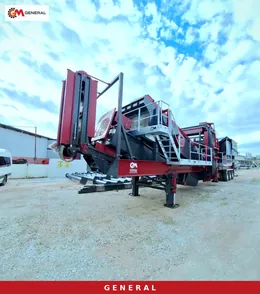
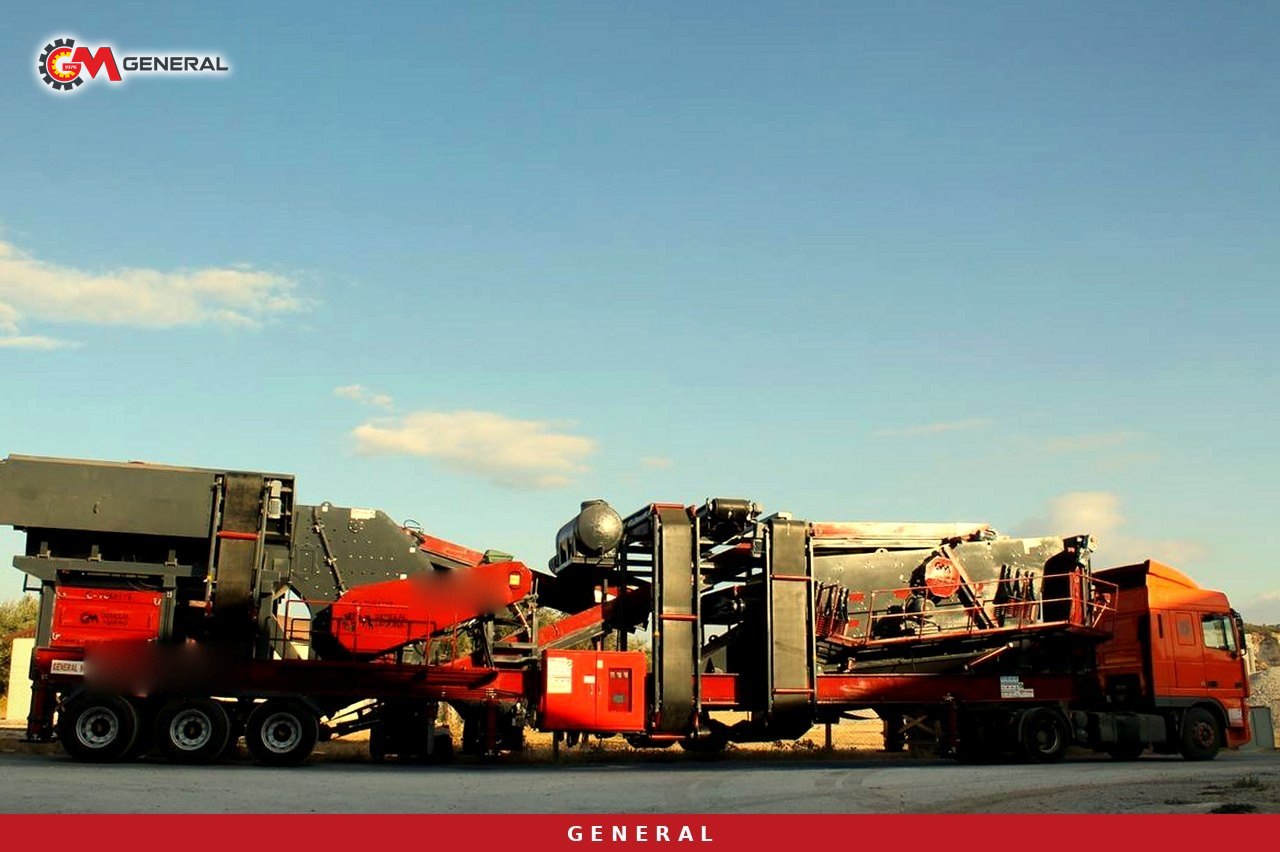
The General 800 is the model that covers the 80-150 TPH target on its own. Its PDK 1280 primary impactor takes stone up to 600 mm, and the 1300×4000 mm three-deck screen, working in closed circuit, returns oversize to the crusher. The 19-40 mm fraction in its standard list is useful where specifications ask for coarse material in the base course. The impact principle performs best in limestone and low-abrasive stone; if quarry tests show hard granite, blow-bar life shortens and the operating budget feels it.
General 640: for hard stone and short sections
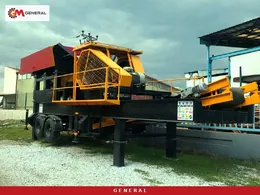
The General 640 places a GPJ 60 jaw crusher ahead of a GNR 50 impactor. At 60-100 t/h it sits in the lower half of the target band; in return, the jaw primary keeps metal consumption calmer in abrasive stone. It can be enough for bridge approaches, short sections or feeder roads inland. Its standard fraction list does not include 19-40 mm; since screen openings are fixed per order for the material, any need for coarse base material should be settled at the quotation stage.
General 01: headroom at the upper end
The General 01 rises above the target band at 120-180 t/h. Its GPS 1210 impactor performs primary and secondary crushing in one body, and the 1600×5000 mm four-deck screen separates four fractions in a single pass. For a contractor who must make up rain stoppages on dry days, that extra capacity makes sense. The price is a heavier chassis (55,000 kg) and longer transport dimensions, which call for advance checks at the port and on bridges.
If quarry tests show hard, abrasive rock and demand exceeds 120 t/h, the General 950 (GPJ 90 jaw + DMK01 impact, 120-180 t/h, 800 mm feed) deserves a separate look.
The gradings road layers ask for
On a road project every fraction leaving the crusher needs a destination; otherwise the stockyard fills with material the job will not take. A typical match is shown below; the exact grading must always come from the project's technical specification and be confirmed with the relevant authority:
- 0-5 mm: fines for bituminous mixes and concrete, void filler in blended base mixes.
- 5-12 and 12-19 mm: surface-dressing chippings, asphalt and concrete aggregate.
- 19-40 mm: the coarse component of the base course and drainage fill.
- Blended 0-40 mm: sub-base and base course produced by recombining separate fractions in set proportions.
If the specification calls for cement-stabilised base, a pugmill is added behind the crushing plant. Within the pugmill plants for road base range, the mobile pugmill plant mixes aggregate dosed from 3-5 cold silos with cement and water in a twin-shaft mixer. At 200-600 t/h it works through the stockpile built by an 80-150 TPH crushing line quickly, so crushing and mixing can be scheduled in separate shifts and the pugmill is not tied to the crusher's pace.
Rain, harmattan dust and power: keeping the plant running on site
Guinea-Bissau's climate has two distinct seasons. In the rainy season laterite roads turn to mud, quarry ramps become slippery and wet, clayey material blinds screen meshes. For this period, plan stone-reinforced haul roads inside the quarry, removal of fines and soil at the feeder before the crusher, and screen media chosen for wet material. In the dry season the harmattan wind from the north-east carries fine dust; generator air filters, the electrical panel and bearings suffer from it. Dust-suppression sprays, covers at conveyor transfer points and frequent filter checks are measures that can be selected per project.
Because most quarries will be far from the grid, power comes from a generator. The technical tables list a 450 kVA generator for the General 800 and 550 kVA for the General 01; on the General 640 a 300 kVA generator is optional. How fuel reaches the site, where it is stored and whether the supply road stays open in the rainy season are items to address together with the choice of machine.
From the port of Bissau to the quarry: shipping, set-up and quotation
A plant built in Izmir reaches the port of Bissau by sea; the choice between ro-ro and flat rack depends on the machine's dimensions and the service the line offers. The transport dimensions in the table feed straight into that plan: the General 800, at 3600×15500×4500 mm and 35,000 kg, is the most compact option; the General 01, at 4300×18500×4500 mm and 55,000 kg, is longer and heavier. Bridge load limits, ferries and narrow passages on the route inland should be checked in advance, with written confirmation from the roads authority and the haulier. Customs and temporary-import rules should likewise be confirmed against the current practice of the relevant authority.
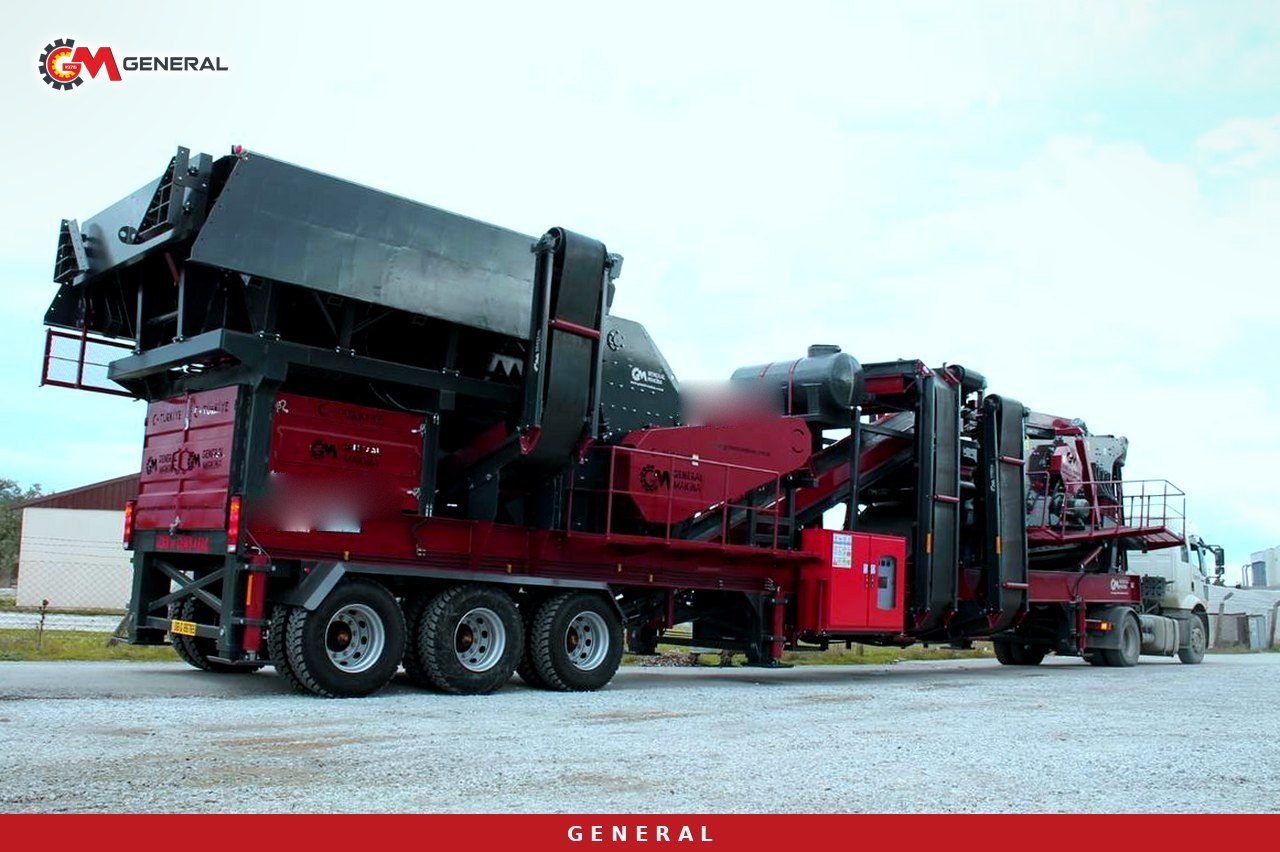
No foundation concrete is needed on site; the plant lowers onto its hydraulic legs and the folding conveyors swing out. What is needed is a compacted level pad, turning room for trucks and the loader, and free-draining ground for the stockpiles. If set-up falls in the rainy season, reinforcing the pad with stone stops the legs and chassis from sinking.
Information to gather before asking for a quotation
- Test results for the quarry sample: compressive strength, abrasion value, silica content.
- The largest block size coming from the quarry; it decides the feed opening (500, 600 or 700 mm).
- The fractions in the specification and the daily demand for each.
- Shift pattern and rainy-season working plan.
- Power source: generator or grid connection?
- Route: port, bridges and the ground on the last kilometres to the quarry.
- Whether cement-stabilised base is required.
The main factors behind price are the model and crusher type, generator and automation options, extra conveyors and screens, the spare wear-part package and freight. General Makina has been manufacturing in Izmir since 1976; the plants carry ISO 9001 and CE certification and are delivered with a 1-year warranty excluding wear parts.
Frequently asked questions
Can laterite gravel be processed in these plants?
Laterite gravel usually needs screening and stabilisation more than crushing. The larger rock pieces in it can be crushed, but a high clay content leads to screen blinding and dirty product. The main source of crushed stone is a sound-rock quarry; determine suitability by sample testing.
Is a single plant enough for 80-150 TPH?
In low-abrasive stone the General 800 covers this band on its own. If the quarry yields hard, abrasive rock, the jaw-primary General 640 serves the lower half of the band; once demand passes 120 t/h, the General 01 or General 950 comes into consideration.
What determines price and delivery time?
Both depend on the chosen model, options, spare-parts package and shipping method. For that reason a written quotation is prepared for your project instead of a fixed figure.
What warranty and certificates apply?
The plants are certified to ISO 9001 and CE and covered by a 1-year warranty excluding wear parts.
Conclusion
In Guinea-Bissau the quarry's stone and the road's rate of advance decide the right plant. In low-abrasive stone the General 800 is a direct match for the target band; in hard stone a jaw-primary line, and where headroom is needed the General 01, come to the table. Send your sample results, fraction list and route details through our contact page and we will prepare the model recommendation and quotation accordingly.
Definitions of technical terms: Glossary